Thailand Switchboards Market Summary
The thailand switchboards market was estimated at USD 246 Million in 2025 and is projected to reach USD 281 Million by 2032, growing at a CAGR of 3.0% from 2026 to 2032.
Thailand Switchboards Market Year-wise Growth Rate and Key Drivers
This graph highlights how the Thailand Switchboards Market has steadily grown over the past five years, supported by major growth factors.
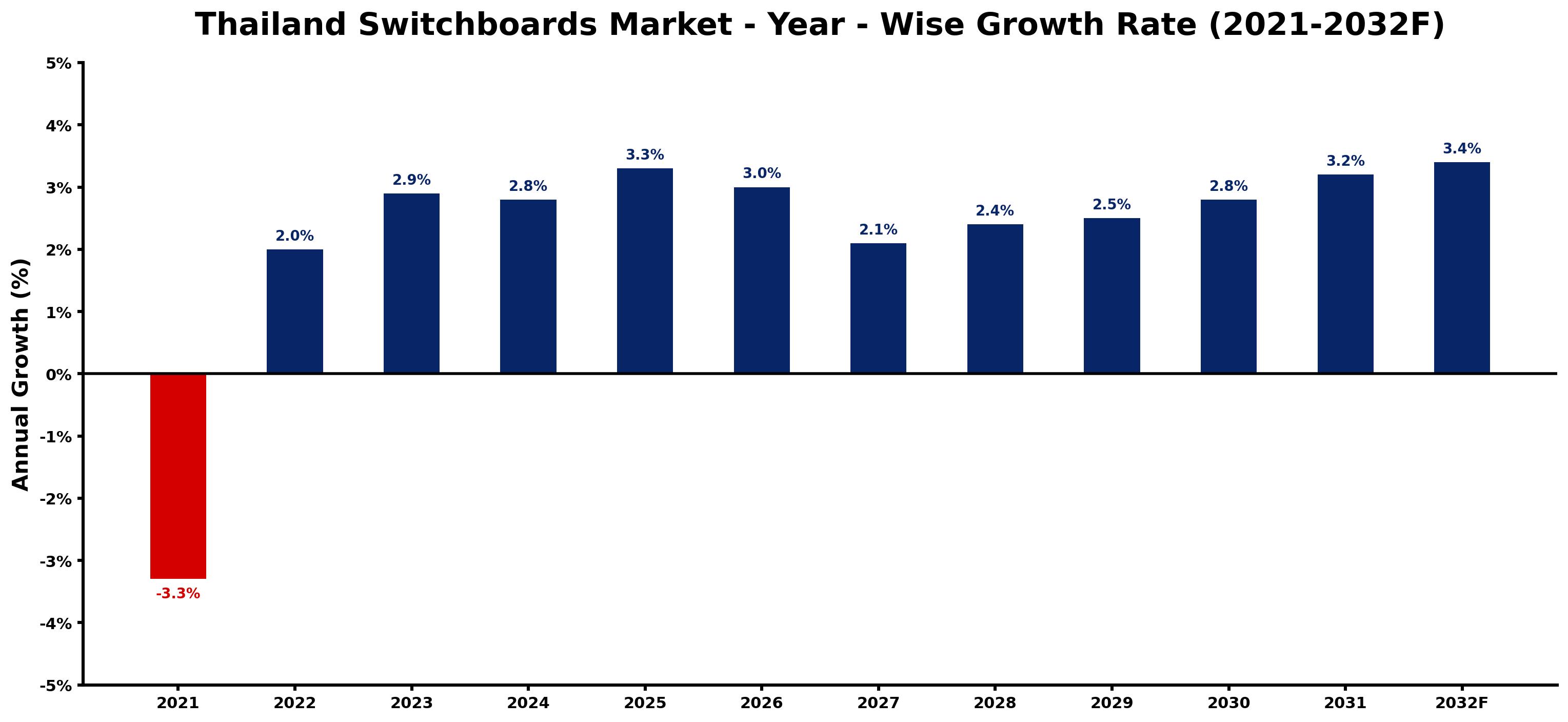
The table below presents the year wise growth rates along with the key drivers influencing the market
| Year | Growth Rate | Major Drivers |
| 2021 | -3.3% | Intensified competition from alternative energy solutions diminished demand for traditional switchboard systems. |
| 2022 | 2.0% | Increased residential developments require higher switchboard integration within new infrastructures. |
| 2023 | 2.9% | Legacy electrical systems prompt urgent upgrades to maintain safety compliance and performance. |
| 2024 | 2.8% | Urban migration trends lead to expanded residential and commercial electrical needs. |
| 2025 | 3.3% | Corporate investments in renewable energy drive demand for modern switchboard solutions. |
| 2026 | 3.0% | Technological evolution favors smart switchboards, enhancing energy management capabilities significantly. |
| 2027 | 2.1% | Competitive pricing from local manufacturers boosts accessibility and innovation in the market. |
| 2028 | 2.4% | Sustainability initiatives encourage businesses to adopt more efficient electrical infrastructure. |
| 2029 | 2.5% | Data center expansions necessitate advanced switchboard solutions to manage increased loads. |
| 2030 | 2.8% | Regulatory updates promote stricter safety standards, increasing switchboard replacement opportunities. |
| 2031 | 3.2% | Collaboration with tech firms enhances product offerings, meeting evolving customer preferences. |
| 2032 | 3.4% | Consumer awareness of energy efficiency positions switchboards as essential investment items. |
Note - Market size estimations and growth projections presented in this report are based on 6Wresearch's advanced forecasting approach, validated with industry datasets as of June 2026.
Thailand Switchboards Market Synopsis
The Thailand Switchboards Market is projected to reach 3.0% and witness significant growth during the forecast period (2026-2032). The market is poised to expand at a CAGR of 6.3%, driven largely by the increasing demand for electricity as a result of rapid urbanization and industrial development in the country. This surge in power consumption has amplified the requirement for reliable and efficient switchboards across various sectors in Thailand.
Thailand Switchboards Market Growth Drivers
The growth of the Thailand switchboards market can be attributed to several key drivers:
- The escalating population growth rate in major urban centers such as Bangkok and Chiang Mai has led to a heightened demand for electricity, necessitating the use of efficient switchboards that are capable of managing increased load demands.
- Ongoing economic development across Thailand has reinforced the need for robust electrical infrastructure, further driving the adoption of advanced switchboard solutions in both residential and commercial sectors.
- Government initiatives centered around economic modernization, like Thailand 4.0 and Smart Cities, aim to elevate the nation's digital infrastructure, enhancing the demand for cutting-edge switchboard technologies.
- The growing focus on energy efficiency and sustainability has led businesses to invest in modern electrical systems, thereby propelling the demand for high-quality switchboards that offer superior reliability and safety.
- Increased industrial activities, particularly in manufacturing and construction, have further bolstered the requirement for sophisticated switchboard solutions designed for high performance under demanding conditions.
Thailand Switchboards Market Challenges and Restraints
Despite the optimistic growth outlook, the Thailand switchboards market faces several challenges:
- A significant constraint is the lack of adequate technical expertise among local manufacturers, which limits their ability to innovate and implement advanced automation solutions in their production processes.
- High import costs for advanced technology and materials may hinder local manufacturers' competitiveness against imported switchboards, impacting market dynamics adversely.
- The limited availability of qualified personnel in electrical engineering and related fields restricts the implementation of cutting-edge technology within manufacturing facilities.
- Regulatory compliance and the need for adherence to safety standards can present challenges for manufacturers, particularly smaller entities with limited resources to invest in compliance activities.
- Economic fluctuations and the potential for global supply chain disruptions could affect the procurement of essential components, impacting production timelines and overall market stability.
Thailand Switchboards Market Government Investment and Initiatives
Government policy plays a crucial role in shaping the Thailand switchboards market. Initiatives such as Thailand 4.0 and the Smart City project showcase the government's commitment to enhancing digital infrastructure. These programs promote investment in innovative technologies, creating a welcoming environment for private sector participation in the switchboard market.
Development plans aimed at upgrading the country's electrical grid are pivotal, as they augment the demand for modern switchboard solutions. By fostering an ecosystem conducive to innovation and infrastructure development, the government aims to not only increase the reliability of electrical systems but also enhance energy efficiency across various sectors.
Thailand Switchboards Market Latest Developments (May 2025 - June 2026)
The Thailand switchboards market has witnessed several notable developments in the past year leading up to mid-2026. As economies began to reopen post-COVID-19, there was a rapid recovery in the demand for switchboards, with manufacturers adapting strategies to mitigate disruptions experienced during the pandemic.
Innovations focusing on higher energy efficiency and automation have emerged as key trends, as market players strive to align with government initiatives aimed at sustainability. Additionally, significant investment in infrastructure projects has spurred the demand for advanced switchboard systems across various industries, setting the stage for a robust growth trajectory going forward.
Thailand Switchboards Market - Key Attractiveness of the Report
- 10 Years of Market Numbers
- Historical Data Starting from 2022 to 2025
- Base Year: 2025
- Forecast Data until 2032
- Key Performance Indicators Impacting the Market
- Major Upcoming Developments and Projects
Key Highlights of the Report:
- Thailand Switchboards Market Outlook
- Market Size of Thailand Switchboards Market, 2025
- Forecast of Thailand Switchboards Market, 2032
- Historical Data and Forecast of Thailand Switchboards Revenues & Volume for the Period 2022-2032F
- Thailand Switchboards Market Trend Evolution
- Thailand Switchboards Market Drivers and Challenges
- Thailand Switchboards Price Trends
- Thailand Switchboards Porter's Five Forces
- Thailand Switchboards Industry Life Cycle
- Historical Data and Forecast of Thailand Switchboards Market Revenues & Volume By Type for the Period 2022-2032F
- Historical Data and Forecast of Thailand Switchboards Market Revenues & Volume By Low-Voltage for the Period 2022-2032F
- Historical Data and Forecast of Thailand Switchboards Market Revenues & Volume By Middle-Voltage for the Period 2022-2032F
- Historical Data and Forecast of Thailand Switchboards Market Revenues & Volume By High-Voltage for the Period 2022-2032F
- Historical Data and Forecast of Thailand Switchboards Market Revenues & Volume By End-users for the Period 2022-2032F
- Historical Data and Forecast of Thailand Switchboards Market Revenues & Volume By Industrial for the Period 2022-2032F
- Historical Data and Forecast of Thailand Switchboards Market Revenues & Volume By Residential for the Period 2022-2032F
- Historical Data and Forecast of Thailand Switchboards Market Revenues & Volume By Commercial for the Period 2022-2032F
- Historical Data and Forecast of Thailand Switchboards Market Revenues & Volume By Other for the Period 2022-2032F
- Thailand Switchboards Import Export Trade Statistics
- Market Opportunity Assessment By Type
- Market Opportunity Assessment By End-users
- Thailand Switchboards Top Companies Market Share
- Thailand Switchboards Competitive Benchmarking By Technical and Operational Parameters
- Thailand Switchboards Company Profiles
- Thailand Switchboards Key Strategic Recommendations






































