Thailand Telecom Services Market Size, Share & Growth Rate
The Thailand Telecom Services Market was estimated at USD 141 Million in 2025 and is projected to reach USD 162 Million by 2032, growing at a CAGR of 2.0% from 2026 to 2032. This growth trajectory is primarily driven by the surging smartphone penetration and increasing demand for high-speed internet among consumers. The rise of remote work and the digitalization of various sectors further catalyze the need for robust telecom services, fostering innovation and significant investments within the market.
Thailand Telecom Services Market Year-wise Growth Rate and Key Drivers
This graph highlights how the Thailand Telecom Services Market has steadily grown over the years, supported by major growth factors.
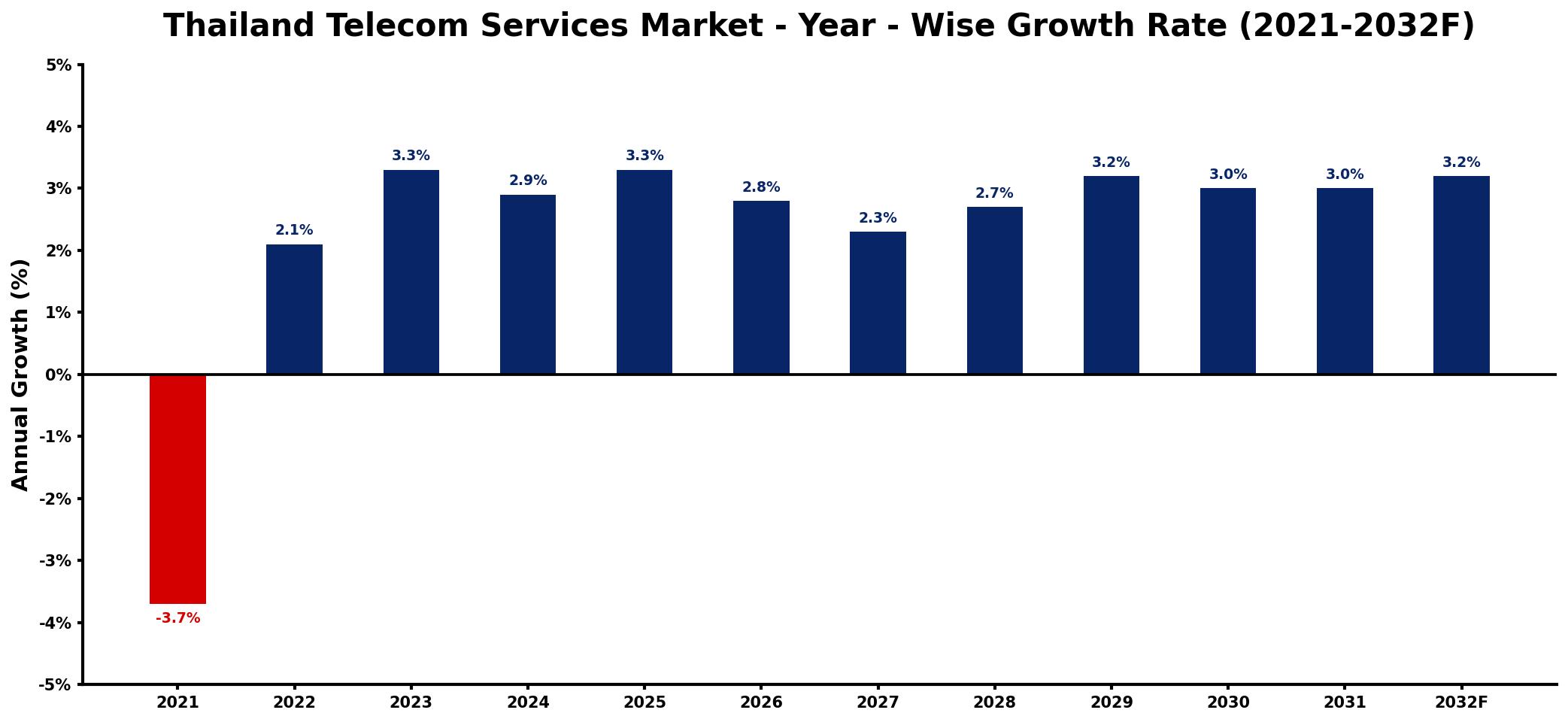
The table below presents the year‑wise growth rates along with the key drivers influencing the market
| Year | Growth Rate | Major Drivers |
| 2021 | -3.7% | decrease in consumer spending power |
| 2022 | 2.1% | rise in mobile internet adoption |
| 2023 | 3.3% | expansion of digital payment solutions |
| 2024 | 2.9% | growth in smartphone penetration rates |
| 2025 | 3.3% | increase in foreign investments influx |
| 2026 | 2.8% | enhancement of network infrastructure development |
| 2027 | 2.3% | broadband access in rural areas |
| 2028 | 2.7% | adoption of 5G technology rollout |
| 2029 | 3.2% | growing demand for smart devices |
| 2030 | 3.0% | increased focus on digital transformation |
| 2031 | 3.0% | rising demand from electronics |
| 2032 | 3.2% | increased pharmaceutical industry usage |
Note: Market size estimations and growth projections presented in this report are based on 6Wresearch's proprietary forecasting methodology, utilizing the latest available industry data, government publications, and primary research inputs.
Thailand Telecom Services Market Synopsis
The Thailand Telecom Services Market has recently demonstrated remarkable momentum, fueled by technological advancements and a competitive landscape that encourages continuous improvement. As more Thais rely on mobile connectivity and high-speed internet, the industry is on the verge of an exciting evolution.
Looking forward, the market is expected to remain dynamic, with substantial investments aimed at upgrading infrastructure and expanding service coverage. Government initiatives aimed at bridging the digital divide further enhance market potential, particularly in rural and underserved regions.
Thailand Telecom Services Market Key Takeaways
- High smartphone penetration and increasing internet usage are pivotal in driving market growth.
- Remote work trends and digitalization across industries are catalyzing demand for enhanced connectivity.
- Government policies focus on expanding telecom infrastructure in less accessible areas.
- Intense competition necessitates continuous upgrades to network capabilities among service providers.
- Challenges in pricing strategies and regulatory compliance are prevalent in the evolving market landscape.
Evaluation of Restraints in Thailand Telecom Services Market
Despite its growth, the Thailand Telecom Services Market faces notable constraints. The intensity of competition among service providers often leads to pricing pressures, making it challenging to balance profitability with consumer affordability. Additionally, the rapid pace of technological advancement, particularly with the advent of 5G, requires operators to make significant investments in upgrading infrastructure while managing existing customer expectations. Regulatory compliance adds another layer of complexity, as companies must navigate the intricate landscape of data privacy laws and consumer protection regulations, further straining resources and strategic focus.
Thailand Telecom Services Market Trends
Several key trends are shaping the Thailand Telecom Services Market. The demand for 5G technology is rapidly increasing, promising faster speeds and lower latency, which are crucial for supporting a range of applications from smart cities to IoT. Furthermore, the growing interest in converged services that bundle mobile, broadband, and content are appealing to consumers seeking streamlined solutions. The implementation of innovative technologies such as Artificial Intelligence (AI) in customer service and network management is also becoming more prevalent, optimizing operational efficiencies and enhancing customer experiences.
Thailand Telecom Services Market Opportunities
The landscape for growth in the Thailand Telecom Services Market is vibrant, particularly with the expansion of digital services. Opportunities lie in the enhancement of broadband access in rural areas, driven by government incentives and public-private partnerships. The increasing adoption of mobile payment solutions and e-commerce platforms also presents avenues for telecom operators to diversify their offerings and tap into the expanding digital economy. Moreover, investments in cybersecurity services are becoming essential as digital transformation accelerates, creating a fertile ground for growth in this area.
Government Initiatives in the Thailand Telecom Services Market
The Thai government has implemented various initiatives to strengthen the telecom infrastructure across the country. These initiatives include policies aimed at expanding coverage in rural and underserved areas to ensure equitable access to telecommunication services. Investments in broadband infrastructure are prioritized, as are programs that encourage public-private partnerships to boost innovation and service delivery. Furthermore, regulations are being reviewed to facilitate the seamless rollout of new technologies, such as 5G, enhancing Thailands competitive position in the regional telecom landscape.
Future Insights of the Thailand Telecom Services Market
Looking ahead to the period between 2026 and 2032, the Thailand Telecom Services Market is poised for significant transformations. The ongoing demand for advanced connectivity solutions will likely drive substantial investments in infrastructure, especially as 5G technology becomes more widely available. Moreover, the continuous evolution of consumer expectations will encourage telecom operators to innovate in service offerings, including personalized data plans and enhanced customer support. As the market adapts to these trends, it is expected to foster a competitive yet collaborative environment that propels industry growth.
Thailand Telecom Services Market Latest Developments (2025 - 2026)
In recent months, the Thailand Telecom Services Market has seen a surge in investments focused on 5G infrastructure, with various initiatives launched to enhance network capabilities. Collaborations between telecom operators and technology companies have become increasingly common, aiming to develop smart solutions tailored to consumer needs. Additionally, there has been a noticeable push towards enhancing customer service experience through digital channels, reflecting the industry's adaptation to evolving consumer behavior and expectations.
Thailand Telecom Services Market - Key Attractiveness of the Report
- 10 Years of Market Numbers
- Historical Data Starting from 2022 to 2025
- Base Year: 2025
- Forecast Data until 2032
- Key Performance Indicators Impacting the Market
- Major Upcoming Developments and Projects
Key Highlights of the Report:
- Thailand Telecom Services Market Outlook
- Market Size of Thailand Telecom Services Market, 2025
- Forecast of Thailand Telecom Services Market, 2032
- Historical Data and Forecast of Thailand Telecom Services Revenues & Volume for the Period 2022-2032F
- Thailand Telecom Services Market Trend Evolution
- Thailand Telecom Services Market Drivers and Challenges
- Thailand Telecom Services Price Trends
- Thailand Telecom Services Porter's Five Forces
- Thailand Telecom Services Industry Life Cycle
- Historical Data and Forecast of Thailand Telecom Services Market Revenues & Volume By Service Type for the Period 2022-2032F
- Historical Data and Forecast of Thailand Telecom Services Market Revenues & Volume By Fixed Voice Services for the Period 2022-2032F
- Historical Data and Forecast of Thailand Telecom Services Market Revenues & Volume By Fixed Internet Access Services for the Period 2022-2032F
- Historical Data and Forecast of Thailand Telecom Services Market Revenues & Volume By Mobile Voice Services for the Period 2022-2032F
- Historical Data and Forecast of Thailand Telecom Services Market Revenues & Volume By Mobile Data Services for the Period 2022-2032F
- Historical Data and Forecast of Thailand Telecom Services Market Revenues & Volume By Pay-TV Services for the Period 2022-2032F
- Historical Data and Forecast of Thailand Telecom Services Market Revenues & Volume By Machine-to-Machine (Mobile IoT) Services for the Period 2022-2032F
- Historical Data and Forecast of Thailand Telecom Services Market Revenues & Volume By Transmission for the Period 2022-2032F
- Historical Data and Forecast of Thailand Telecom Services Market Revenues & Volume By Wireline for the Period 2022-2032F
- Historical Data and Forecast of Thailand Telecom Services Market Revenues & Volume By Wireless for the Period 2022-2032F
- Historical Data and Forecast of Thailand Telecom Services Market Revenues & Volume By End-use for the Period 2022-2032F
- Historical Data and Forecast of Thailand Telecom Services Market Revenues & Volume By Consumer/Residential for the Period 2022-2032F
- Historical Data and Forecast of Thailand Telecom Services Market Revenues & Volume By Business for the Period 2022-2032F
- Thailand Telecom Services Import Export Trade Statistics
- Market Opportunity Assessment By Service Type
- Market Opportunity Assessment By Transmission
- Market Opportunity Assessment By End-use
- Thailand Telecom Services Top Companies Market Share
- Thailand Telecom Services Competitive Benchmarking By Technical and Operational Parameters
- Thailand Telecom Services Company Profiles
- Thailand Telecom Services Key Strategic Recommendations






































