Thailand Tourism Market Growth Rate
According to 6Wresearch internal database and industry insights, the Thailand Tourism Market is projected to grow at a compound annual growth rate (CAGR) of 8.9% during the forecast period (2026–2032).
Thailand Tourism Market Year-wise Growth Rate and Key Drivers
This graph highlights how the Thailand Tourism Market has steadily grown over the past five years, supported by major growth factors.
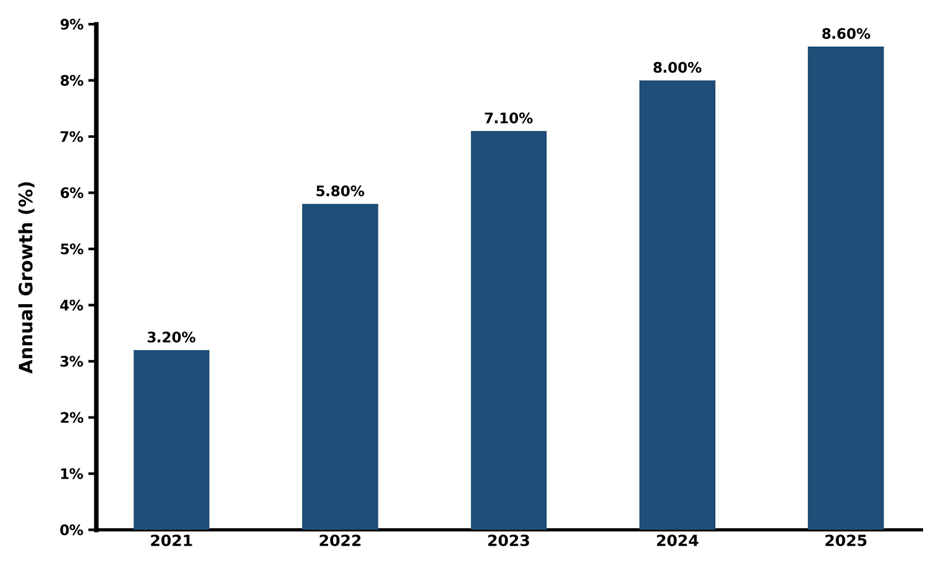
The table below presents the year‑wise growth rates along with the key drivers influencing the market
| Year | Est. Annual Growth (%) | Growth Drivers |
| 2021 | 3.2% | Step-by-step reopening of local travel networks pushing recovery in domestic tourism demand. |
| 2022 | 5.8% | Resumption of international flights as well as return of foreign tourists, especially from China, Europe and Southeast Asia nations. |
| 2023 | 7.1% | A surge in inbound tourism, increasing demand for healthcare travel, and gradual recovery of hotels and resorts sector. |
| 2024 | 8% | Rising adventure and experiential tourism, expansion of MICE sector, and increased tourist spending per visit. |
| 2025 | 8.6% | Growing digital travel booking adoption, government tourism promotion campaigns, and rising domestic travel frequency. |
Topics Covered in the Thailand Tourism Market Report
The Thailand Tourism Market report comprehensively covers the market by type and purpose. This report provides an in-depth analysis of ongoing market trends, opportunities, and market drivers that will be vital for decision makers to align their strategies based on current and future market trends.
Thailand Tourism Market Highlights
| Report Name |
Thailand Tourism Market |
| Forecast period | 2026-2032 |
| CAGR | 8.9% |
| Market Size |
Travel, Hospitality & Tourism Services |
Thailand Tourism Market Synopsis
The Thailand Tourism Market is expected to register high growth rates during the forecast period owing to the established global reputation of the country as being one of the favorite tourist destinations of the world. The diverse aspects of the tourism sector in Thailand that include beautiful beaches, its cultural heritage, street food, medical tourism centers, and adventure tourism are some of the major draws for tourists all around the world.
Evaluation of Growth Drivers in Thailand Tourism Market (2026–2032)
Below is the table listing major drivers responsible for Thailand Tourism Market Growth and their influence on market dynamics:
| Drivers | Primary Segment Affected | Why It Matters (Evidence) |
| Strong International Tourist Arrivals | International, Adventure, Medical | Thailand consistently ranks among the top global tourist destinations, driving sustained inbound travel demand. |
| Rising Domestic Travel Frequency | Local/Domestic | Growing middle-class income and affordable domestic travel options are encouraging more Thai citizens to travel within the country. |
| Growth in Medical Tourism | Medical, International | Thailand's affordable, high-quality healthcare services attract a large and growing number of international medical tourists each year. |
| Government Tourism Promotion | All Segments | TAT campaigns, visa-free policies, and tourism investment incentives actively support both domestic and international visitor growth. |
| Adventure and Experiential Travel Demand | Adventure, International | Younger travellers are increasingly seeking unique, active, and immersive experiences beyond conventional sightseeing. |
The Thailand Tourism Market is projected to exhibit a CAGR of 8.9% during the forecast period (2026–2032) on account of the country’s global reputation for travel, increasing expenditure on international and domestic travels, and government support for tourism are expected to push the market ahead. In addition, the advent of specialized types of tourism such as adventure tourism, medical tourism, and sea tourism has added further growth prospects for the highly-developed tourism sector of Thailand.
Evaluation of Restraints in Thailand Tourism Market
Below is the tabular representation of some major restraints and their influence on market dynamics:
| Restraints | Primary Segment Affected | What This Means (Evidence) |
| Overdependence on Specific Source Markets | International | Heavy reliance on Chinese tourists makes the market vulnerable to geopolitical or economic disruptions in China. |
| Environmental Degradation of Tourist Sites | Adventure, Sea Farming | Overcrowding and environmental damage at popular destinations can reduce their long-term appeal and sustainability. |
| Seasonal Demand Fluctuations | Local/Domestic, International | Country's monsoon season results in significant off-peak periods, creating uneven revenue distribution. |
| Rising Cost of Travel and Accommodation | All Segments | Due to high hotel rates, and travel costs, budget-conscious tourists may not choose Thailand over competing destinations. |
| Natural Disasters and Health Crises | All Segments | Events such as floods, pandemics or political instability can quickly disrupt tourist arrivals and industry confidence. |
Thailand Tourism Market Challenges
While the Thailand Tourism Market has strong growth prospects, it is also facing a number of obstacles. Such as the country’s tourism sector is heavily reliant on a small number of key source markets, particularly China, which creates a vulnerability when those markets go through economic downturns or travel restrictions. Popular tourist destinations such as Maya Bay, Phuket, and Koh Samui are facing a high pressure from overtourism, threatening the natural environments that make them attractive in the first place.
Trends in the Thailand Tourism Market
Some of the major trends in the Thailand Tourism Market include:
- Rise of Experiential & Adventure Travel: Tourists have started looking forward to an adventurous holiday involving trekking in northern Thailand, diving in the Andaman Sea, and visiting communities.
- Digital & Mobile-First Booking: More travelers are opting for complete online bookings from their home, thereby pushing the tourism industry to invest in digitization.
- Growth of MICE & Business Tourism: The cities of Bangkok and Pattaya have emerged as popular meeting places for business-related trips and other activities.
Opportunities for Investment in Thailand Tourism Market
The below list mentions the different kinds of investment opportunities available in the Thailand Tourism Market:
- Boutique & Luxury Hospitality Services: With the rising trend of personalized tourism, opportunities exist for investments in boutique hotels and luxury resorts.
- Infrastructure for Medical Tourism: With the growing demand for health care, investment in accredited hospitals, recovery centers, and wellness clinics has risen.
- Adventure & Eco-Tourism Ventures: Investment opportunities in adventure parks and eco-tourism destinations have grown in the past couple of years.
Top 5 Leading Players in Thailand Tourism Market
Below are some of the leading companies holding majority of Thailand Tourism Market Shares:
1. Tourism Authority of Thailand (TAT)
| Company Name | Tourism Authority of Thailand (TAT) |
|---|---|
| Established Year | 1960 |
| Headquarters | Bangkok, Thailand |
| Official Website | Click Here |
The Tourism Authority of Thailand is the government body responsible for promoting Thailand as a travel destination both domestically and internationally. TAT plays a central role in shaping the country's tourism brand and coordinating with private sector partners to attract visitors.
2. Thai Airways International
| Company Name | Thai Airways International |
|---|---|
| Established Year | 1960 |
| Headquarters | Bangkok, Thailand |
| Official Website | Click Here |
Thai Airways is Thailand's national carrier and one of the most important enablers of international tourism to the country. As a full-service airline connecting Thailand with major cities across Asia, Europe, and beyond, it plays a vital role in bringing international tourists into the country.
3. Agoda (Booking Holdings)
| Company Name | Agoda (Booking Holdings) |
|---|---|
| Established Year | 2005 |
| Headquarters | Singapore (Thailand Operations: Bangkok) |
| Official Website | Click Here |
Agoda is one of Asia's leading online travel and accommodation booking platforms, with Thailand being one of its strongest and most important markets.
4. Minor Hotels (Minor International)
| Company Name | Minor Hotels (Minor International) |
|---|---|
| Established Year | 1978 |
| Headquarters | Bangkok, Thailand |
| Official Website | Click Here |
Minor Hotels is one of Thailand's largest and most globally recognised hospitality companies, operating a portfolio of luxury, upscale, and mid-market hotel brands across Thailand and internationally.
5. Bumrungrad International Hospital
| Company Name | Bumrungrad International Hospital |
|---|---|
| Established Year | 1980 |
| Headquarters | Bangkok, Thailand |
| Official Website | Click Here |
Bumrungrad International Hospital is Thailand's most prominent medical tourism institution and one of the most internationally recognised hospitals in Asia. It serves over one million patients annually, with a significant proportion coming from overseas specifically for medical treatment.
Government Initiatives Implemented in the Thailand Tourism Market
According to Thai government data, some significant measures have been undertaken to develop the tourism industry in Thailand. The Tourism Authority of Thailand conducts international marketing activities aimed at drawing tourists from various parts of the world, including Asia, Europe, and the Middle East. In addition, the Thai government offers visa-free and visa-on-arrival policies to tourists from many countries, thus simplifying the entry process into Thailand. The MICE Thailand program, run by the Thai government, promotes Bangkok and other major cities as top locations for hosting business meetings, incentive trips, conferences, exhibitions, and other corporate events.
Future Insights of the Thailand Tourism Market
The Thailand Tourism Market will experience a tremendous growth and success in the years ahead. International arrivals in the country are anticipated to recover and increase due to Thailand's continued popularity worldwide, increasing air links, and sustained investment by the government in tourism destination development. Domestic tourism is likely to remain an essential and reliable component of the market, as it benefits from growing disposable incomes among Thais and an increasing propensity for travel among the youth generation.
Market Segmentation Analysis
The report offers a detailed study of the following market segments and their leading categories in the Thailand Tourism Market:
By Type – International Tourism to Lead the Market
According to Priya, Senior Research Analyst, 6Wresearch, International tourism holds the largest share of Thailand's tourism market in terms of revenue and spending per visitor. Thailand welcomed tens of millions of international tourists annually before the pandemic and has been steadily recovering those numbers, with visitors from China, Malaysia, India, South Korea, and Europe representing the largest source markets.
By Purpose – Adventure Tourism to Lead the Market
Adventure tourism is the leading purpose-based segment, driven by Thailand's exceptional natural landscape which includes tropical islands, mountain trekking routes, national parks, and world-class diving sites. A growing number of both domestic and international visitors are choosing Thailand specifically for active and experiential travel.
Key Attractiveness of the Report:
- 10 Years of Market Numbers
- Historical Data Starting from 2022 to 2025
- Base Year: 2025
- Forecast Data until 2032
- Key Performance Indicators Impacting the Market
- Major Upcoming Developments and Projects
Key Highlights of the Report:
- Thailand Tourism Market Outlook
- Market Size of Thailand Tourism Market, 2025
- Forecast of Thailand Tourism Market, 2032
- Historical Data and Forecast of Thailand Tourism Revenues & Volume for the Period 2022- 2032
- Thailand Tourism Market Trend Evolution
- Thailand Tourism Market Drivers and Challenges
- Thailand Tourism Price Trends
- Thailand Tourism Porter's Five Forces
- Thailand Tourism Industry Life Cycle
- Historical Data and Forecast of Thailand Tourism Market Revenues & Volume By Type for the Period 2022- 2032
- Historical Data and Forecast of Thailand Tourism Market Revenues & Volume By Local/domestic for the Period 2022- 2032
- Historical Data and Forecast of Thailand Tourism Market Revenues & Volume By International for the Period 2022- 2032
- Historical Data and Forecast of Thailand Tourism Market Revenues & Volume By Purpose for the Period 2022- 2032
- Historical Data and Forecast of Thailand Tourism Market Revenues & Volume By Adventure for the Period 2022- 2032
- Historical Data and Forecast of Thailand Tourism Market Revenues & Volume By Business for the Period 2022- 2032
- Historical Data and Forecast of Thailand Tourism Market Revenues & Volume By Medical for the Period 2022- 2032
- Historical Data and Forecast of Thailand Tourism Market Revenues & Volume By Sea Farming for the Period 2022- 2032
- Historical Data and Forecast of Thailand Tourism Market Revenues & Volume By Others for the Period 2022- 2032
- Thailand Tourism Import Export Trade Statistics
- Market Opportunity Assessment By Type
- Market Opportunity Assessment By Purpose
- Thailand Tourism Top Companies Market Share
- Thailand Tourism Competitive Benchmarking By Technical and Operational Parameters
- Thailand Tourism Company Profiles
- Thailand Tourism Key Strategic Recommendations
Market Covered
The report offers an extensive study of the following market segments:
By Type
- Local/Domestic
- International
By Purpose
- Adventure
- Business
- Medical
- Sea Farming
- Others






































