Thailand Wooden Furniture Market Size, Share & Growth Rate
The Thailand Wooden Furniture Market was estimated at USD 185 Million in 2025 and is projected to reach USD 212 Million by 2032, growing at a CAGR of 2.0% from 2026 to 2032. This growth trajectory is primarily driven by the enduring appeal of wooden furniture, rooted in Thailand's cultural heritage and craftsmanship. The increasing demand for sustainable and eco-friendly products further bolsters this market, as consumers increasingly prioritize responsible sourcing in their purchasing decisions.
Thailand Wooden Furniture Market Year-wise Growth Rate and Key Drivers
This graph highlights how the Thailand Wooden Furniture Market has steadily grown over the years, supported by major growth factors.
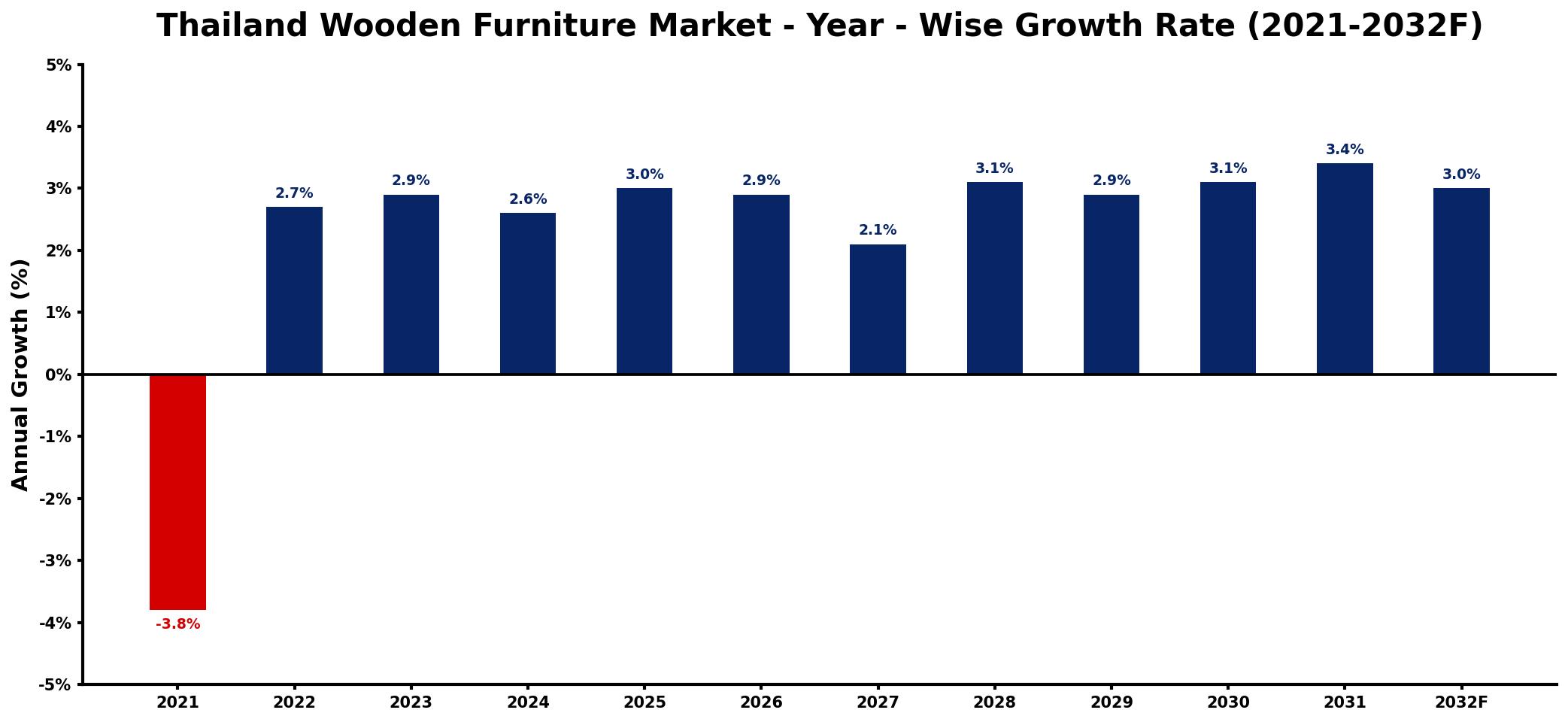
The table below presents the year‑wise growth rates along with the key drivers influencing the market
| Year | Growth Rate | Major Drivers |
| 2021 | -3.8% | decreased consumer spending on home |
| 2022 | 2.7% | rising demand for sustainable materials |
| 2023 | 2.9% | increased investment in local manufacturing |
| 2024 | 2.6% | growing popularity of minimalistic designs |
| 2025 | 3.0% | expansion of online retail channels |
| 2026 | 2.9% | surge in interior design projects |
| 2027 | 2.1% | heightened focus on eco-friendly products |
| 2028 | 3.1% | growth in tourism boosting hospitality |
| 2029 | 2.9% | increased exports to neighboring countries |
| 2030 | 3.1% | innovation in design and technology |
| 2031 | 3.4% | greater emphasis on customization options |
| 2032 | 3.0% | rising disposable income among consumers |
Note: Market size estimations and growth projections presented in this report are based on 6Wresearch's proprietary forecasting methodology, utilizing the latest available industry data, government publications, and primary research inputs.
Thailand Wooden Furniture Market Synopsis
Sustainability is the strongest force shaping the Thailand Wooden Furniture Market today. As global awareness around environmental issues grows, the demand for responsibly sourced wooden furniture is surging, reflecting a shift in consumer preferences towards eco-friendly products. This trend is complemented by the resurgence of interest in traditional craftsmanship, which continues to attract buyers looking for authenticity in their home furnishings.
Additionally, the diversification of design offerings in the market caters to both modern and traditional aesthetics, making wooden furniture a versatile choice for various consumer segments. As real estate and the hospitality sector expand, the need for high-quality wooden furniture solutions in both residential and commercial settings is likely to amplify, reinforcing the market's significance.
Thailand Wooden Furniture Market Key Takeaways
- The market is driven by a blend of cultural heritage and modern design preferences.
- There is a growing consumer focus on sustainability and eco-friendly products.
- Wooden furniture continues to hold its ground despite competition from alternative materials.
- The hospitality and real estate industries are significant growth catalysts for the market.
- Consumer demand for affordability is shaping product offerings and design innovations.
Evaluation of Restraints in Thailand Wooden Furniture Market
While the market demonstrates a positive growth trajectory, it faces several restraints that could limit its potential. One of the most pressing challenges is the sustainable sourcing of wood and adherence to responsible forestry practices. Ensuring compliance with environmental regulations remains critical, as consumers increasingly demand transparency regarding product origins. Furthermore, competition from alternative materials, such as engineered wood and metal, introduces pressure on traditional wooden furniture makers to innovate and maintain product appeal, quality, and durability.
Thailand Wooden Furniture Market Trends
The Thailand Wooden Furniture Market is currently experiencing a wave of innovation. Designs are becoming more adaptive, blending traditional aesthetics with contemporary needs, thereby appealing to a broader audience. Additionally, technological advancements in manufacturing processes are enhancing production efficiency, leading to higher quality outputs. The emphasis on customization is another significant trend, as consumers increasingly seek unique pieces that reflect their personal style. Furthermore, there is a notable shift toward online retailing, making wooden furniture more accessible to tech-savvy buyers.
Thailand Wooden Furniture Market Opportunities
Significant growth and investment opportunities exist within the Thailand Wooden Furniture Market, particularly in the realm of sustainable products. Companies that adopt environmentally responsible sourcing practices and transparency in their supply chains stand to gain a competitive edge. Additionally, tapping into the burgeoning e-commerce space offers potential for expansion, allowing businesses to reach a wider audience. Collaborations with interior designers and real estate developers can further enhance market presence and create tailored solutions for emerging spaces.
Government Initiatives in the Thailand Wooden Furniture Market
The Thai government is actively promoting sustainable forestry and eco-friendly practices within the wooden furniture industry. Various initiatives focus on improving the supply chain's transparency and supporting local artisans through training programs aimed at enhancing craftsmanship. Additionally, public spending on infrastructure and the hospitality sector serves to bolster demand for high-quality wooden furniture, aligning with national goals to develop the country's economy while preserving its rich cultural heritage.
Future Insights of the Thailand Wooden Furniture Market
Looking ahead to 2026-2032, the Thailand Wooden Furniture Market is poised for steady growth as consumer preferences continue to evolve towards sustainability and quality. The integration of advanced technologies in manufacturing and design processes will likely lead to enhanced product offerings. Furthermore, as the real estate sector continues to thrive, the demand for wooden furniture in residential and commercial projects is expected to remain strong, ensuring that this market remains a vital component of Thailands economy.
Thailand Wooden Furniture Market Latest Developments (2025 - 2026)
Recent developments in the Thailand Wooden Furniture Market indicate a pivot towards integrating smart technology in products, enhancing functionality and user experience. Companies are increasingly focusing on sustainable practices, with many launching initiatives to use recycled materials and promote responsible forestry. Additionally, partnerships between local artisans and larger manufacturers are on the rise, facilitating the blending of traditional craftsmanship with modern production techniques, thereby expanding market reach.
Thailand Wooden Furniture Market - Key Attractiveness of the Report
- 10 Years of Market Numbers
- Historical Data Starting from 2022 to 2025
- Base Year: 2025
- Forecast Data until 2032
- Key Performance Indicators Impacting the Market
- Major Upcoming Developments and Projects
Key Highlights of the Report:
- Thailand Wooden Furniture Market Outlook
- Market Size of Thailand Wooden Furniture Market, 2025
- Forecast of Thailand Wooden Furniture Market, 2032
- Historical Data and Forecast of Thailand Wooden Furniture Revenues & Volume for the Period 2022-2032F
- Thailand Wooden Furniture Market Trend Evolution
- Thailand Wooden Furniture Market Drivers and Challenges
- Thailand Wooden Furniture Price Trends
- Thailand Wooden Furniture Porter's Five Forces
- Thailand Wooden Furniture Industry Life Cycle
- Historical Data and Forecast of Thailand Wooden Furniture Market Revenues & Volume By Type for the Period 2022-2032F
- Historical Data and Forecast of Thailand Wooden Furniture Market Revenues & Volume By Hardwood for the Period 2022-2032F
- Historical Data and Forecast of Thailand Wooden Furniture Market Revenues & Volume By Softwood for the Period 2022-2032F
- Historical Data and Forecast of Thailand Wooden Furniture Market Revenues & Volume By Material for the Period 2022-2032F
- Historical Data and Forecast of Thailand Wooden Furniture Market Revenues & Volume By Plywood for the Period 2022-2032F
- Historical Data and Forecast of Thailand Wooden Furniture Market Revenues & Volume By Laminates for the Period 2022-2032F
- Historical Data and Forecast of Thailand Wooden Furniture Market Revenues & Volume By MDF for the Period 2022-2032F
- Historical Data and Forecast of Thailand Wooden Furniture Market Revenues & Volume By Other Materials for the Period 2022-2032F
- Historical Data and Forecast of Thailand Wooden Furniture Market Revenues & Volume By Product for the Period 2022-2032F
- Historical Data and Forecast of Thailand Wooden Furniture Market Revenues & Volume By Bedroom for the Period 2022-2032F
- Historical Data and Forecast of Thailand Wooden Furniture Market Revenues & Volume By Seating for the Period 2022-2032F
- Historical Data and Forecast of Thailand Wooden Furniture Market Revenues & Volume By Kitchen for the Period 2022-2032F
- Historical Data and Forecast of Thailand Wooden Furniture Market Revenues & Volume By Other Products for the Period 2022-2032F
- Historical Data and Forecast of Thailand Wooden Furniture Market Revenues & Volume By Application for the Period 2022-2032F
- Historical Data and Forecast of Thailand Wooden Furniture Market Revenues & Volume By Residential for the Period 2022-2032F
- Historical Data and Forecast of Thailand Wooden Furniture Market Revenues & Volume By Commercial for the Period 2022-2032F
- Historical Data and Forecast of Thailand Wooden Furniture Market Revenues & Volume By Distribution Channel for the Period 2022-2032F
- Historical Data and Forecast of Thailand Wooden Furniture Market Revenues & Volume By Offline for the Period 2022-2032F
- Historical Data and Forecast of Thailand Wooden Furniture Market Revenues & Volume By Online for the Period 2022-2032F
- Thailand Wooden Furniture Import Export Trade Statistics
- Market Opportunity Assessment By Type
- Market Opportunity Assessment By Material
- Market Opportunity Assessment By Product
- Market Opportunity Assessment By Application
- Market Opportunity Assessment By Distribution Channel
- Thailand Wooden Furniture Top Companies Market Share
- Thailand Wooden Furniture Competitive Benchmarking By Technical and Operational Parameters
- Thailand Wooden Furniture Company Profiles
- Thailand Wooden Furniture Key Strategic Recommendations






































