Cement Market: Tunisia vs Top 5 Major Economies in 2027 (Africa)
By 2027, Tunisia's Cement market is forecasted to achieve a stable growth rate of 1.52%, with Egypt leading the Africa region, followed by South Africa, Ethiopia, Algeria and Nigeria.
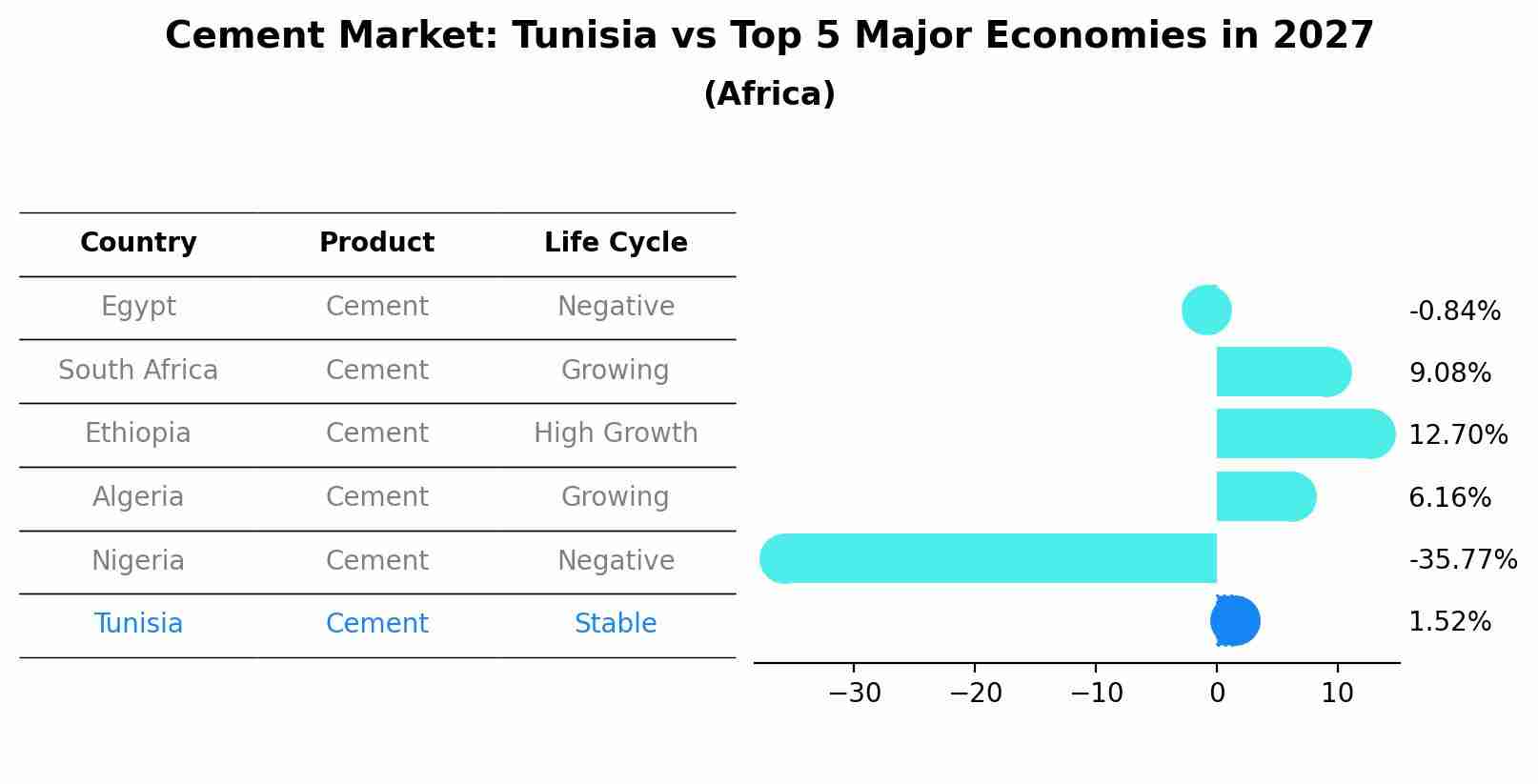
Tunisia Cement Market Growth Rate
According to 6Wresearch internal database and industry insights, the Tunisia Cement Market is projected to grow at a compound annual growth rate (CAGR) of 5.4% during the forecast period from 2026 to 2032.
Topics Covered in the Tunisia Cement Market Report
The Tunisia Cement Market report thoroughly covers the market by product and application, providing an unbiased and detailed analysis of ongoing market trends, opportunities, challenges, and market drivers, helping stakeholders align their strategies with current and future market dynamics.
Tunisia Cement Market Highlights
| Report Name | Tunisia Cement Market |
| Forecast period | 2026–2032 |
| CAGR | 5.4% |
| Growing Sector | Construction Materials |
Tunisia Cement Market Synopsis
Tunisia Cement Market is experiencing consistent growth driven by the growing infrastructure development and urbanization throughout the country. Increasing demand for residential and commercial construction is supporting market growth. In addition, government funding for transportation, energy, and infrastructure projects is increasing cement demand. Moreover, the increasing focus on sustainable construction methods and the use of efficient, eco-friendly materials is significantly contributing to Tunisia Cement Market Growth over the forecast period.
Evaluation of Growth Drivers in the Tunisia Cement Market
Below mentioned are some prominent drivers and their impact on the market dynamics:
| Drivers | Primary Segments Affected | Why It Matters (Evidence) |
| Infrastructure Development | Portland Cement | Large-scale road, bridge, and public projects increase cement demand. |
| Urbanization Growth | Residential Segment | Rising population in urban areas drives housing construction. |
| Government Investments | Infrastructure Segment | Government spending increases cement demand in large-scale projects. |
| Sustainable Construction Trends | Others | Low-impact cement alternatives are gaining momentum in the market. |
| Industrial Expansion | Non-residential Segment | Expansion of factories and commercial buildings drives increased usage. |
Tunisia Cement Market Size is projected to grow at a CAGR of 5.4% from 2026 to 2032. The Tunisia Cement Market continues to grow at a steady pace, driven by, increasing housing demand, infrastructure development, and growing government investments across key regions. Moreover, the use of eco-friendly materials and advancements in production efficiency are strengthening market growth. In addition, urbanization and industrial activities are contributing to higher cement consumption. Together, these factors are supporting steady development, enhancing capacity utilization, and ensuring a stable and long-term growth trajectory for the Tunisia cement industry over the forecast period.
Evaluation of Restraints in the Tunisia Cement Market
Below mentioned are some major restraints and their influence on the market dynamics:
| Restraints | Primary Segments Affected | What This Means (Evidence) |
| High Energy Costs | All Segments | Cement production is energy-intensive, increasing operational costs. |
| Environmental Concerns | Portland Cement | Emissions regulations may limit production expansion. |
| Price Volatility | All Segments | Variation in raw material prices affect the pricing plans. |
| Limited Export Opportunities | Others | Trade regulations can affect income generation. |
| Infrastructure Gaps | Residential Segment | Delays in projects may reduce demand. |
Tunisia Cement Market Challenges
There are several challenges faced by the Tunisia Cement Industry including high operating costs attributable to energy consumption and stringent government emission standards, along with price volatility and increased competition for market share resulting in lower profit margins. Moreover, companies must work toward increasing production efficiencies, developing new energy-efficient processes, improving cost-effectiveness, and entering into new markets to counteract these issues while strengthening supply chains and enhancing operational resilience across the industry.
Tunisia Cement Market Trends
Here are some major trends changing the Tunisia Cement Market Growth dynamics:
- Growing Demand for Sustainable Cement – As more people become aware of the environmental impact of traditional cement alternatives and are looking for more sustainable options, there has been an increase in the demand for low-carbon cement products.
- Technological Advancements in Production – Technological advancements in cement manufacturing are allowing companies to produce better quality and more cost-effective products.
- Infrastructure Development Expansion – In addition, investment in infrastructure development (including roads, ports and other public projects) is having a significant impact on cement sales.
Investment Opportunities in the Tunisia Cement Market
The Tunisia Cement Market presents several investment opportunities, including:
- Infrastructure development projects: Rising government spending on public infrastructure means more opportunities for cement manufacturing businesses.
- Technological upgrades: Innovation in technology in production processes will increase efficiency and decrease operational cost.
- Export market development: Developing export markets globally helps driven revenue and widen market reach.
Top 5 Leading Players in the Tunisia Cement Market
Below is the list of prominent companies leading the Tunisia Cement Market Share:
1. Société des Ciments de Bizerte
| Company Name | Société des Ciments de Bizerte |
| Headquarters | Bizerte, Tunisia |
| Established | 1953 |
| Website | - |
Société des Ciments de Bizerte is a key player in Tunisia’s cement industry, providing high-quality cement products for infrastructure and construction projects with a focus on sustainability.
2. Ciments de Gabès
| Company Name | Ciments de Gabès |
| Headquarters | Gabès, Tunisia |
| Established | 1973 |
| Website | - |
Ciments de Gabès is a major cement manufacturer known for its wide product portfolio and contribution to large-scale construction projects across Tunisia.
3. Les Ciments de Jebel Oust
| Company Name | Les Ciments de Jebel Oust |
| Headquarters | Zaghouan, Tunisia |
| Established | 1978 |
| Website | - |
The company specializes in producing Portland cement and plays a significant role in supporting infrastructure and housing development.
4. Carthage Cement
| Company Name | Carthage Cement |
| Headquarters | Tunis, Tunisia |
| Established | 2008 |
| Website | - |
Carthage Cement is a leading cement producer focusing on modern production techniques and sustainability, supplying cement for major infrastructure projects.
5. SOTACIB (Société Tunisienne Andalous de Ciment Blanc)
| Company Name | SOTACIB (Société Tunisienne Andalous de Ciment Blanc) |
| Headquarters | Feriana, Tunisia |
| Established | 1987 |
| Website | - |
SOTACIB specializes in white cement production and caters to both domestic and export markets with high-quality products.
Government Regulations in the Tunisia Cement Market
According to Tunisian government data, the Ministry of Industries, Mines, and the Environment has put in place regulatory requirements to protect the environment and ensure that internationally accepted quality standards are met for production of cement. They also provide programmes designed to help improve energy efficiency and promote clean technologies. Finally, infrastructure projects such as roads and houses are putting additional demand for cement as well as creating synergies that enhance sustainability, maintain quality and promote future growth of the market.
Future Insights of the Tunisia Cement Market
The outlook for the Tunisia Cement Market remains positive, driven by rising infrastructure investments and continuous urban development across the country. Rising demand for residential housing, along with the expansion of public infrastructure projects such as roads and transportation systems, is expected to drive market growth. At the same time, better production processes and increased attention to sustainability are improving efficiency and helping reduce environmental strain. All these factors together are expected to keep the market on a stable growth path over the long run.
Market Segmentation Analysis
The report offers a comprehensive study of the following market segments and their leading categories:
By Product - Portland Cement to Dominate the Market
According to Ritika Kalra, Senior Research Analyst, 6Wresearch, Portland cement is expected to dominate the Tunisia Cement Market due to its widespread application in construction projects, including residential buildings, roads, and bridges. Its high strength, durability, and cost-effectiveness make it the preferred choice for infrastructure development.
By Application - Non-residential/Infrastructure to Dominate the Market
The infrastructure and non-residential segment is expected to dominate the Tunisia Cement Market due to increased government spending on roads, bridges, and public services.
Key Attractiveness of the Report
- 10 Years of Market Numbers.
- Historical Data Starting from 2022 to 2025.
- Base Year: 2025.
- Forecast Data until 2032.
- Key Performance Indicators Impacting the Market.
- Major Upcoming Developments and Projects.
Key Highlights of the Report:
- Tunisia Cement Market Outlook
- Market Size of Tunisia Cement Market, 2025
- Forecast of Tunisia Cement Market, 2032
- Historical Data and Forecast of Tunisia Cement Revenues & Volume for the Period 2022 - 2032
- Tunisia Cement Market Trend Evolution
- Tunisia Cement Market Drivers and Challenges
- Tunisia Cement Price Trends
- Tunisia Cement Porter's Five Forces
- Tunisia Cement Industry Life Cycle
- Historical Data and Forecast of Tunisia Cement Market Revenues & Volume By Product for the Period 2022 - 2032
- Historical Data and Forecast of Tunisia Cement Market Revenues & Volume By Portland for the Period 2022 - 2032
- Historical Data and Forecast of Tunisia Cement Market Revenues & Volume By Others for the Period 2022 - 2032
- Historical Data and Forecast of Tunisia Cement Market Revenues & Volume By Application for the Period 2022 - 2032
- Historical Data and Forecast of Tunisia Cement Market Revenues & Volume By Residential for the Period 2022 - 2032
- Historical Data and Forecast of Tunisia Cement Market Revenues & Volume By Non-residential/Infrastructure for the Period 2022 - 2032
- Tunisia Cement Import Export Trade Statistics
- Market Opportunity Assessment By Product
- Market Opportunity Assessment By Application
- Tunisia Cement Top Companies Market Share
- Tunisia Cement Competitive Benchmarking By Technical and Operational Parameters
- Tunisia Cement Company Profiles
- Tunisia Cement Key Strategic Recommendations
Market Covered
The report offers a comprehensive study of the subsequent market segments:
By Product:
- Portland
- Others
By Application:
- Residential
- Non-residential/Infrastructure






































