Tunisia Dyestuff For Cotton Market Size, Share & Growth Rate
The Tunisia Dyestuff For Cotton Market was estimated at USD 1054 Million in 2025 and is projected to reach USD 1514 Million by 2032, growing at a CAGR of 5.3% from 2026 to 2032. This growth is being driven by the increasing demand for vibrant and high-quality dyed cotton fabrics in both local and international markets. Additionally, the shift towards eco-friendly and sustainable dyeing practices is encouraging innovation and a re-evaluation of traditional methodologies within the sector.
Tunisia Dyestuff For Cotton Market Year-wise Growth Rate and Key Drivers
This graph highlights how the Tunisia Dyestuff For Cotton Market has steadily grown over the years, supported by major growth factors.
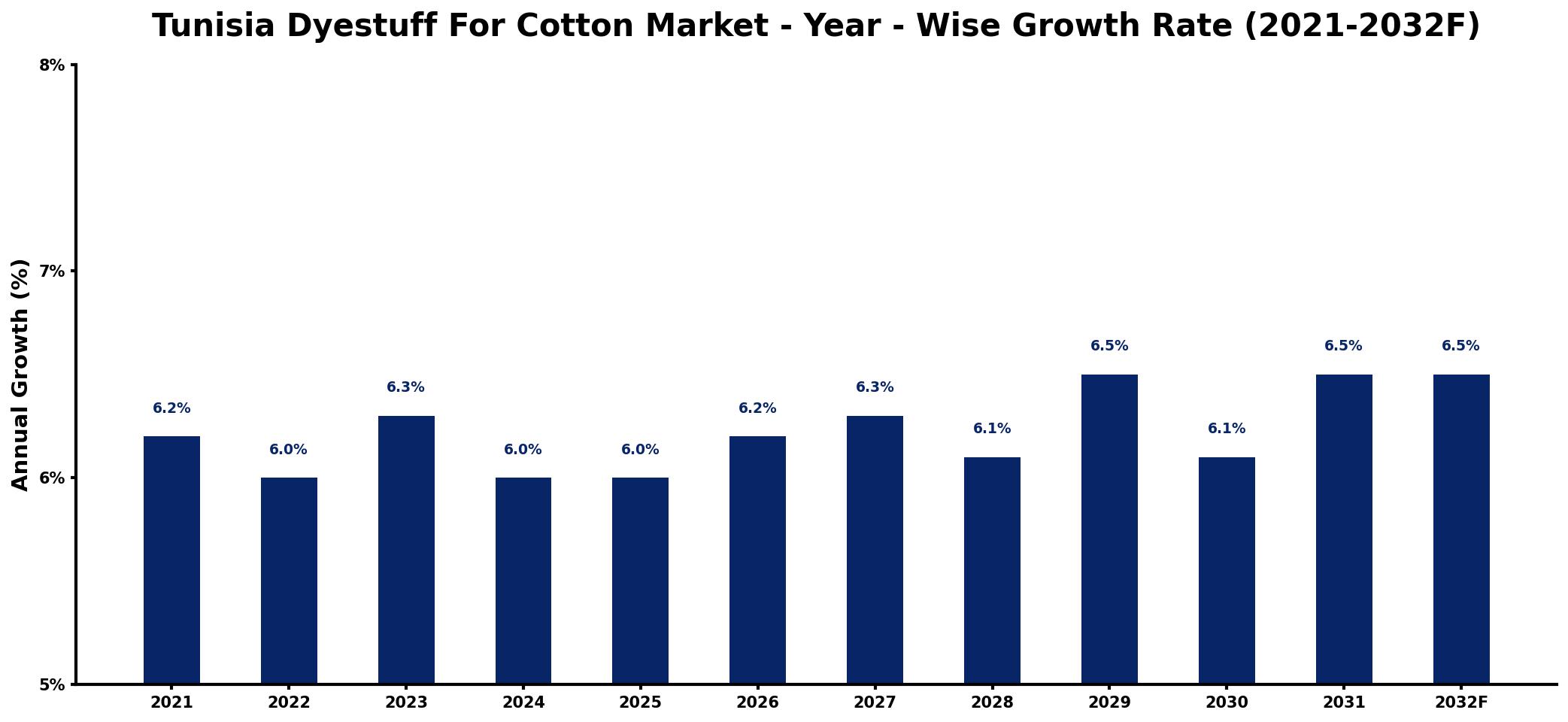
The table below presents the year‑wise growth rates along with the key drivers influencing the market
| Year | Growth Rate | Major Drivers |
| 2021 | 6.2% | Increased textile manufacturing capacity |
| 2022 | 6.0% | Growing demand for sustainable solutions |
| 2023 | 6.3% | Expansion of export markets |
| 2024 | 6.0% | Rise in fashion industry trends |
| 2025 | 6.0% | Investments in advanced technologies |
| 2026 | 6.2% | Strengthened local supply chains |
| 2027 | 6.3% | Emergence of eco-friendly alternatives |
| 2028 | 6.1% | Increased consumer awareness initiatives |
| 2029 | 6.5% | Growth in e-commerce platforms |
| 2030 | 6.1% | Boost in regional trade agreements |
| 2031 | 6.5% | expanding industrial usage applications |
| 2032 | 6.5% | Innovations in color application techniques |
Note: Market size estimations and growth projections presented in this report are based on 6Wresearch's proprietary forecasting methodology, utilizing the latest available industry data, government publications, and primary research inputs.
Tunisia Dyestuff For Cotton Market Synopsis
The Tunisia dyestuff for cotton market is currently witnessing robust momentum fueled by the vibrant textile industry. As manufacturers strive to meet evolving consumer preferences, there is a marked trend toward innovative and sustainable dye solutions. However, while the market is poised for growth, it is also navigating challenges related to raw material sourcing and environmental regulations.
Looking ahead, the market is likely to continue evolving, embracing technological advancements and sustainability practices. The increasing adoption of digital printing and eco-friendly dyestuffs not only aligns with global trends but also presents new opportunities for manufacturers to differentiate their offerings and expand market reach.
Tunisia Dyestuff For Cotton Market Key Takeaways
- The market is projected to grow at a CAGR of 5.3% from 2026 to 2032.
- Sustainable and natural dyes are gaining traction among consumers and manufacturers alike.
- Investment in innovative dyeing technologies is crucial for staying competitive.
- The government is actively supporting eco-friendly practices within the textile sector.
- Supply chain challenges related to imported materials require strategic partnerships.
Evaluation of Restraints in Tunisia Dyestuff For Cotton Market
Several factors currently limit the growth of the Tunisia dyestuff for cotton market. Chief among these are the fluctuating prices of raw materials, which can disrupt production schedules and margins for manufacturers. Furthermore, the increasing competition from international suppliers presents additional pressure, making it challenging for local firms to maintain market share. The reliance on imported dyes and chemicals also raises concerns regarding supply chain stability and pricing volatility. To address these restraints, it is vital for companies to invest in sustainable practices and innovative technologies, as well as to develop robust relationships with suppliers and customers.
Tunisia Dyestuff For Cotton Market Trends
A significant trend shaping the Tunisia dyestuff for cotton market is the increased focus on eco-friendly dyeing methods, spurred by consumer demand for sustainable products. Companies are investing in research to develop plant-based and organic dye options, thus aligning with global sustainability initiatives. Additionally, the emergence of digital printing technologies allows for more efficient production processes and greater customization in dye applications, enabling manufacturers to respond swiftly to market demands.
Tunisia Dyestuff For Cotton Market Opportunities
The Tunisia dyestuff for cotton market is ripe with opportunities for investment and expansion. Given the increasing domestic and international demand for dyed cotton textiles, companies producing high-quality dyestuffs stand to benefit significantly. Moreover, initiatives that focus on innovative and sustainable dyeing solutions offer lucrative avenues for research and development. Strategic investments in distribution networks and partnerships will also be key in leveraging Tunisias geographic advantage as a bridge between Europe and Africa.
Government Initiatives in the Tunisia Dyestuff For Cotton Market
The Tunisian government has been proactive in implementing policies that support the dyestuff for cotton market, particularly in terms of sustainability and industry growth. This includes enacting environmental regulations to manage chemical use during the dyeing process, providing incentives for companies to adopt greener practices, and fostering partnerships with international organizations to enhance the quality and competitiveness of local products. These initiatives aim to not only bolster the textile sector but also ensure compliance with global environmental standards.
Future Insights of the Tunisia Dyestuff For Cotton Market
Looking towards 2026-2032, the Tunisia dyestuff for cotton market is expected to continue its upward trajectory, driven by heightened demand for dyed textiles in various sectors, including fashion and home textiles. The ongoing shift toward sustainable practices, coupled with government support for innovation, positions the market for growth. However, fluctuations in raw material prices and competition from synthetic alternatives will require ongoing vigilance and adaptation by local manufacturers.
Tunisia Dyestuff For Cotton Market Latest Developments (2025 - 2026)
In recent months, the Tunisia dyestuff for cotton market has seen notable developments, including a surge in the adoption of eco-friendly dye formulations and increased collaboration among stakeholders within the textile supply chain. Companies are also exploring partnerships aimed at expanding their product offerings in response to consumer preferences for sustainable textiles. Additionally, innovations in digital dyeing technology are being embraced to enhance production efficiency and responsiveness to market trends.
Tunisia Dyestuff For Cotton Market - Key Attractiveness of the Report
- 10 Years of Market Numbers
- Historical Data Starting from 2022 to 2025
- Base Year: 2025
- Forecast Data until 2032
- Key Performance Indicators Impacting the Market
- Major Upcoming Developments and Projects
Key Highlights of the Report:
- Tunisia Dyestuff For Cotton Market Outlook
- Market Size of Tunisia Dyestuff For Cotton Market, 2025
- Forecast of Tunisia Dyestuff For Cotton Market, 2032
- Historical Data and Forecast of Tunisia Dyestuff For Cotton Revenues & Volume for the Period 2022-2032F
- Tunisia Dyestuff For Cotton Market Trend Evolution
- Tunisia Dyestuff For Cotton Market Drivers and Challenges
- Tunisia Dyestuff For Cotton Price Trends
- Tunisia Dyestuff For Cotton Porter's Five Forces
- Tunisia Dyestuff For Cotton Industry Life Cycle
- Historical Data and Forecast of Tunisia Dyestuff For Cotton Market Revenues & Volume By Types for the Period 2022-2032F
- Historical Data and Forecast of Tunisia Dyestuff For Cotton Market Revenues & Volume By Reactive Dyes for the Period 2022-2032F
- Historical Data and Forecast of Tunisia Dyestuff For Cotton Market Revenues & Volume By Disperse Dyes for the Period 2022-2032F
- Historical Data and Forecast of Tunisia Dyestuff For Cotton Market Revenues & Volume By Direct Dyes for the Period 2022-2032F
- Historical Data and Forecast of Tunisia Dyestuff For Cotton Market Revenues & Volume By Sulfur Dyes for the Period 2022-2032F
- Historical Data and Forecast of Tunisia Dyestuff For Cotton Market Revenues & Volume By Optical Brighteners for the Period 2022-2032F
- Historical Data and Forecast of Tunisia Dyestuff For Cotton Market Revenues & Volume By Applications for the Period 2022-2032F
- Historical Data and Forecast of Tunisia Dyestuff For Cotton Market Revenues & Volume By Non-Woven for the Period 2022-2032F
- Historical Data and Forecast of Tunisia Dyestuff For Cotton Market Revenues & Volume By Health Care for the Period 2022-2032F
- Historical Data and Forecast of Tunisia Dyestuff For Cotton Market Revenues & Volume By Personal Care for the Period 2022-2032F
- Historical Data and Forecast of Tunisia Dyestuff For Cotton Market Revenues & Volume By Others for the Period 2022-2032F
- Tunisia Dyestuff For Cotton Import Export Trade Statistics
- Market Opportunity Assessment By Types
- Market Opportunity Assessment By Applications
- Tunisia Dyestuff For Cotton Top Companies Market Share
- Tunisia Dyestuff For Cotton Competitive Benchmarking By Technical and Operational Parameters
- Tunisia Dyestuff For Cotton Company Profiles
- Tunisia Dyestuff For Cotton Key Strategic Recommendations






































