Tunisia Facade Market Size, Share & Growth Rate
The Tunisia Facade Market was estimated at USD 391 Million in 2025 and is projected to reach USD 538 Million by 2032, growing at a CAGR of 4.7% from 2026 to 2032. This growth trajectory is primarily fueled by the surge in construction activities across residential, commercial, and industrial sectors. Additionally, the increasing demand for energy-efficient and aesthetically pleasing facades is driving investments in innovative materials and advanced technologies.
Tunisia Facade Market Year-wise Growth Rate and Key Drivers
This graph highlights how the Tunisia Facade Market has steadily grown over the years, supported by major growth factors.
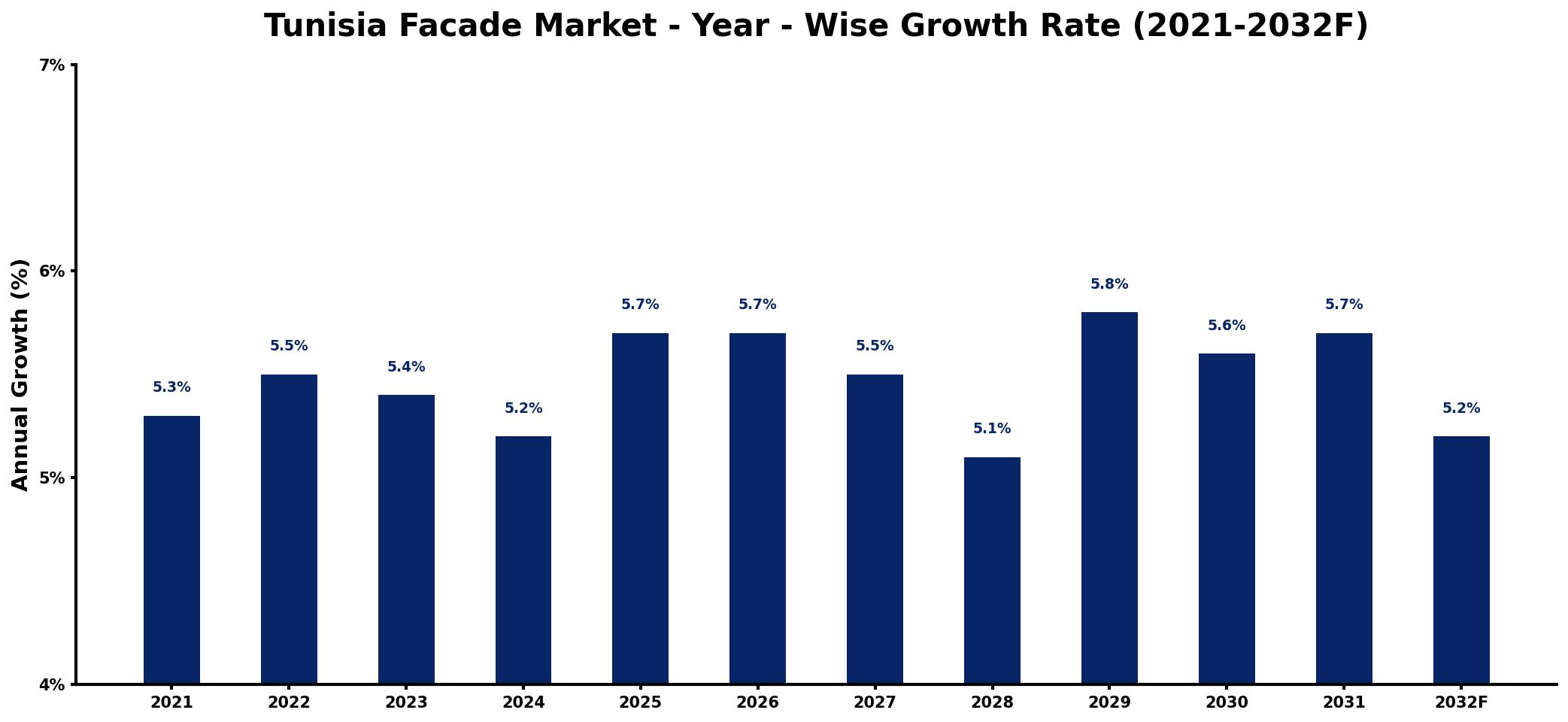
The table below presents the year‑wise growth rates along with the key drivers influencing the market
| Year | Growth Rate | Major Drivers |
| 2021 | 5.3% | Increased urban construction projects |
| 2022 | 5.5% | Rising demand for sustainable designs |
| 2023 | 5.4% | Growth in commercial real estate |
| 2024 | 5.2% | Expansion of infrastructure initiatives |
| 2025 | 5.7% | Increased foreign investment influx |
| 2026 | 5.7% | Surge in residential developments |
| 2027 | 5.5% | Growing interest in energy efficiency |
| 2028 | 5.1% | Development of smart city projects |
| 2029 | 5.8% | Emergence of eco-friendly materials |
| 2030 | 5.6% | Boost in public sector spending |
| 2031 | 5.7% | Rise in renovation activity |
| 2032 | 5.2% | Increasing focus on aesthetic appeal |
Note: Market size estimations and growth projections presented in this report are based on 6Wresearch's proprietary forecasting methodology, utilizing the latest available industry data, government publications, and primary research inputs.
Tunisia Facade Market Synopsis
The demand for facade solutions in Tunisia is significantly influenced by a growing preference for sustainable materials and cutting-edge designs. This trend is evident in the adoption of curtain walls, cladding systems, and insulated panels, which not only enhance aesthetic appeal but also contribute to energy efficiency.
Moreover, as urbanization accelerates, the focus on integrating green spaces and natural light into building designs has become a hallmark of modern architecture. Key stakeholders are responding to these demands through investment in research and development, aiming to tailor facade solutions that meet the unique needs of the Tunisian market.
Tunisia Facade Market Key Takeaways
- The market is driven by increasing construction activities and urbanization.
- There is a notable shift towards energy-efficient and sustainable building materials.
- Customized facade solutions are becoming crucial as client needs evolve.
- The adoption of advanced materials like glass, aluminum, and composites is on the rise.
- Government policies are promoting sustainable building practices and local innovation.
Evaluation of Restraints in Tunisia Facade Market
Despite the promising growth, the Tunisia Facade Market faces several constraints. A significant challenge is the scarcity of skilled labor and specialized expertise, which can impede the quality and timely completion of facade installation projects. Fluctuating raw material prices can also pose a risk to cost management, adversely affecting profitability. Additionally, regulatory hurdles and bureaucratic delays can prolong project timelines and elevate costs, making it essential for market players to strategically navigate these obstacles to achieve sustainable growth.
Tunisia Facade Market Trends
The current trend in the Tunisia Facade Market leans heavily towards sustainability and energy efficiency. Key developments include the growing demand for materials that enhance insulation and reduce energy consumption. Innovative facade designs that incorporate elements such as ventilation systems and natural light are gaining traction, as stakeholders seek to create environments that prioritize comfort and environmental sustainability. Furthermore, the use of advanced materials such as composites and aluminum continues to reshape the market, offering more design flexibility and durability.
Tunisia Facade Market Opportunities
Investment opportunities in the Tunisia Facade Market are abundant, driven by the expanding construction sector. Companies focusing on energy-efficient facade materials like insulated glass and ventilated systems are well-positioned for growth. Moreover, as architectural trends shift towards innovative designs, there is a strong potential for companies that specialize in advanced facade technologies. Engaging in research and development to adapt to these evolving needs represents a strategic pathway for investors seeking to capitalize on the market's momentum.
Government Initiatives in the Tunisia Facade Market
The Tunisian government has established various policies to regulate and foster growth in the facade market. Building codes set rigorous standards for materials and designs to ensure safety and aesthetic harmony in construction. Moreover, the government actively incentivizes the use of sustainable materials and technologies, promoting environmentally friendly practices. Efforts to support local production and curb illegal construction also reflect the government's commitment to preserving Tunisia's architectural heritage while advancing economic development.
Future Insights of the Tunisia Facade Market
Looking ahead to 2026-2032, the Tunisia Facade Market is expected to maintain a robust growth trajectory driven by a growing emphasis on energy efficiency and aesthetic value in building exteriors. Ongoing urban development and infrastructure projects will further fuel demand. The government's continued promotion of green building technologies and advanced materials is likely to create an environment conducive to innovation. Overall, the landscape is evolving, presenting diverse opportunities for facade system providers and construction companies alike.
Tunisia Facade Market Latest Developments (2025 - 2026)
Recent developments in the Tunisia Facade Market have been marked by a significant shift towards sustainable building practices. Notable initiatives include collaborations between local authorities and industry players to promote energy-efficient technologies. Additionally, numerous projects are underway that emphasize innovative design features, integrating modern materials with traditional aesthetics, reflecting a unique blend of heritage and contemporary architecture.
Tunisia Facade Market - Key Attractiveness of the Report
- 10 Years of Market Numbers
- Historical Data Starting from 2022 to 2025
- Base Year: 2025
- Forecast Data until 2032
- Key Performance Indicators Impacting the Market
- Major Upcoming Developments and Projects
Key Highlights of the Report:
- Tunisia Facade Market Outlook
- Market Size of Tunisia Facade Market, 2025
- Forecast of Tunisia Facade Market, 2032
- Historical Data and Forecast of Tunisia Facade Revenues & Volume for the Period 2022-2032F
- Tunisia Facade Market Trend Evolution
- Tunisia Facade Market Drivers and Challenges
- Tunisia Facade Price Trends
- Tunisia Facade Porter's Five Forces
- Tunisia Facade Industry Life Cycle
- Historical Data and Forecast of Tunisia Facade Market Revenues & Volume By Product for the Period 2022-2032F
- Historical Data and Forecast of Tunisia Facade Market Revenues & Volume By Ventilated Facades for the Period 2022-2032F
- Historical Data and Forecast of Tunisia Facade Market Revenues & Volume By Non-ventilated Facades for the Period 2022-2032F
- Historical Data and Forecast of Tunisia Facade Market Revenues & Volume By Others for the Period 2022-2032F
- Historical Data and Forecast of Tunisia Facade Market Revenues & Volume By End-use for the Period 2022-2032F
- Historical Data and Forecast of Tunisia Facade Market Revenues & Volume By Commercial for the Period 2022-2032F
- Historical Data and Forecast of Tunisia Facade Market Revenues & Volume By Residential for the Period 2022-2032F
- Historical Data and Forecast of Tunisia Facade Market Revenues & Volume By Industrial for the Period 2022-2032F
- Tunisia Facade Import Export Trade Statistics
- Market Opportunity Assessment By Product
- Market Opportunity Assessment By End-use
- Tunisia Facade Top Companies Market Share
- Tunisia Facade Competitive Benchmarking By Technical and Operational Parameters
- Tunisia Facade Company Profiles
- Tunisia Facade Key Strategic Recommendations






































