Tunisia Gallium Market Size Growth Rate
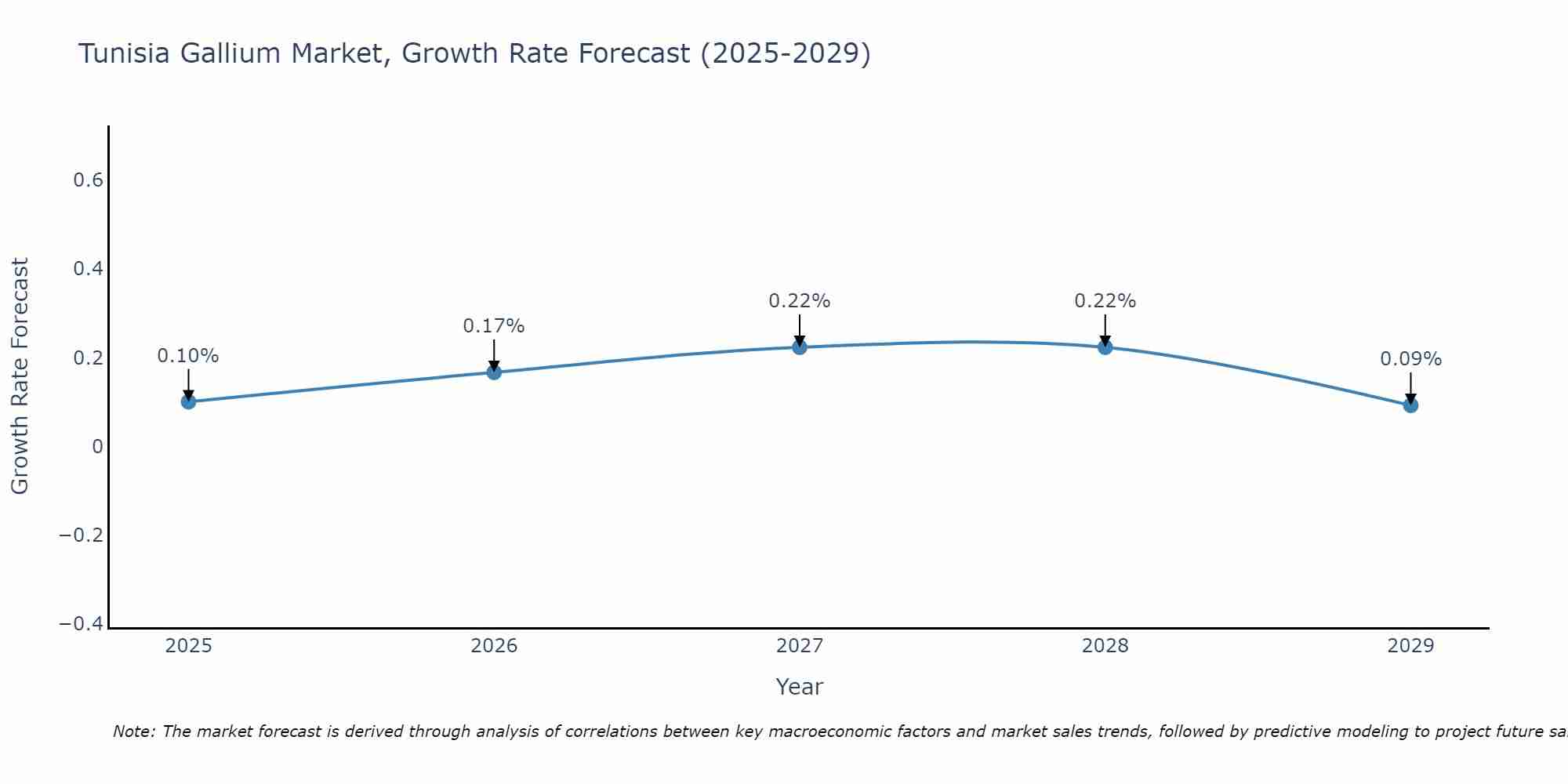
The Tunisia Gallium Market is projected to witness mixed growth rate patterns during 2025 to 2029. Growth accelerates to 0.22% in 2027, following an initial rate of 0.10%, before easing to 0.09% at the end of the period.
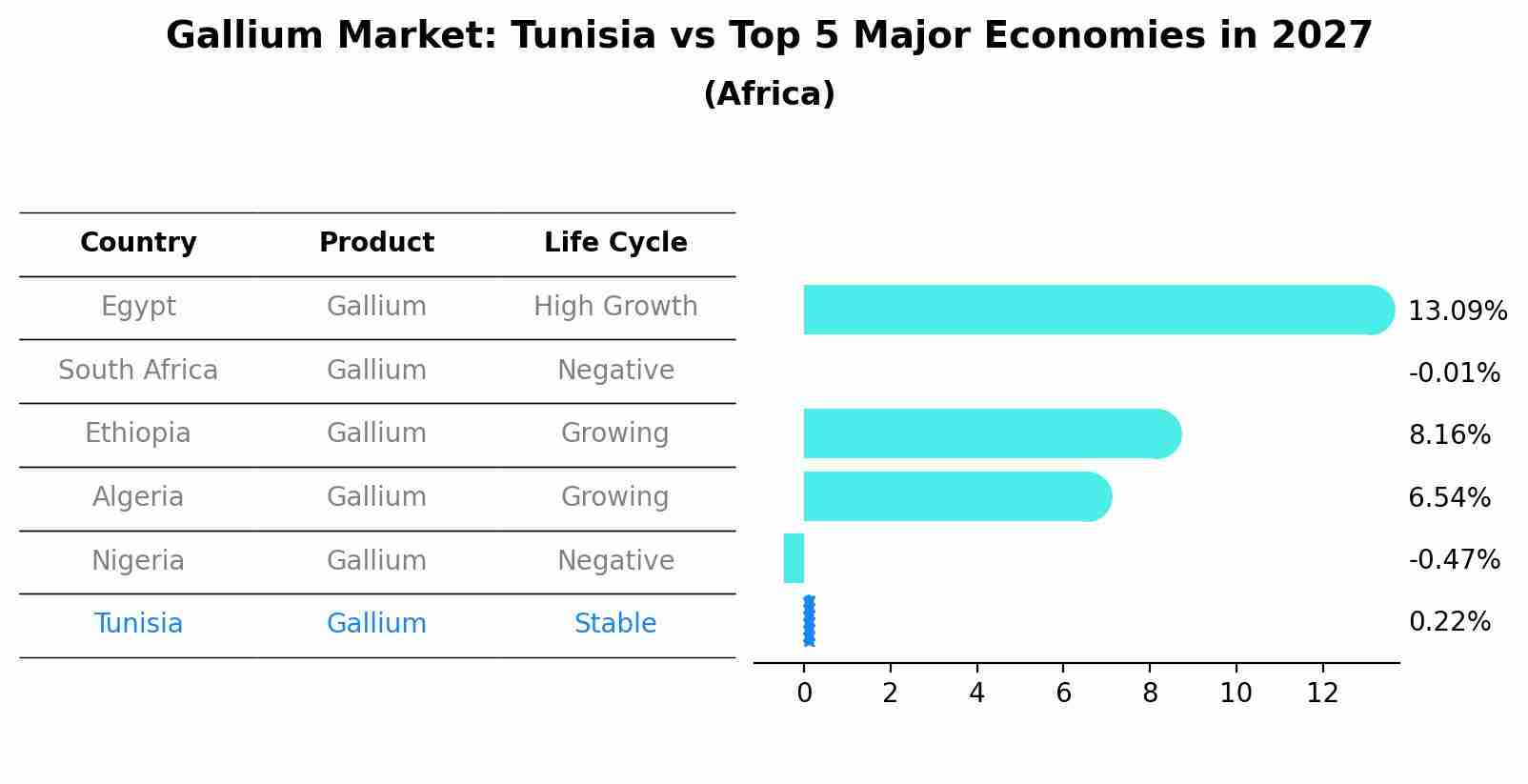
Gallium Market: Tunisia vs Top 5 Major Economies in 2027 (Africa)
By 2027, the Gallium market in Tunisia is anticipated to reach a growth rate of 0.22%, as part of an increasingly competitive Africa region, where Egypt remains at the forefront, supported by South Africa, Ethiopia, Algeria and Nigeria, driving innovations and market adoption across sectors.
Tunisia Gallium Market Overview
The Tunisia Gallium market is experiencing steady growth driven by increasing demand from the electronics and semiconductor industries. Gallium, a rare metal with unique properties, is utilized in the production of high-performance semiconductors, LEDs, and solar panels. The market in Tunisia benefits from the country`s abundant reserves of gallium, along with its strategic location for export to European and African markets. Key players in the Tunisia Gallium market include mining companies, manufacturers, and technology firms that rely on gallium for their products. The market is expected to continue its growth trajectory due to the expanding applications of gallium in advanced technologies and the increasing investment in research and development within the country.
Tunisia Gallium Market Trends
The Tunisia Gallium Market is experiencing steady growth due to the increasing demand for gallium in the electronics and semiconductor industries. Gallium is a key component in the production of LEDs, solar panels, and semiconductor devices, driving its demand in Tunisia. The market is also benefiting from the growing adoption of gallium nitride (GaN) technology in various applications such as power electronics and RF devices. Additionally, the push towards sustainability and renewable energy sources is further fueling the demand for gallium in the production of solar cells and LEDs. As a result, Tunisia is witnessing a rise in gallium production and export activities, with a focus on quality and efficiency to meet the evolving market demands.
Tunisia Gallium Market Challenges
In the Tunisia Gallium market, challenges primarily revolve around limited domestic production capacity and dependence on imports. The country currently does not have significant gallium reserves and relies heavily on imports to meet its industrial needs, leading to vulnerability to supply chain disruptions and price fluctuations in the global market. Additionally, the lack of a well-established infrastructure and technology for gallium production and processing within the country poses a challenge in terms of competitiveness and cost-effectiveness. Furthermore, the relatively niche market for gallium products in Tunisia compared to other industrial metals adds complexity to market dynamics and market growth potential. Overall, developing a more sustainable and self-sufficient gallium supply chain while expanding domestic demand for gallium-based products are key challenges facing the Tunisia Gallium market.
Tunisia Gallium Market Investment Opportunities
The Tunisia Gallium Market presents promising investment opportunities due to increasing demand for gallium in various high-tech industries such as electronics, solar energy, and telecommunications. With a limited global supply of gallium and growing applications in advanced technologies like 5G networks and semiconductors, investing in Tunisia`s gallium sector could prove to be lucrative. Additionally, Tunisia`s strategic location, stable political environment, and government support for expanding the high-tech industry make it an attractive destination for gallium investors. By tapping into this niche market and leveraging Tunisia`s potential as a gallium producer, investors can capitalize on the growing demand for this essential element in cutting-edge technologies.
Tunisia Gallium Market Government Policy
The Tunisian government has implemented various policies to support the gallium market in the country. These policies include offering incentives and subsidies to attract foreign investors, promoting research and development in the gallium industry, and implementing regulations to ensure sustainable extraction and production practices. Additionally, the government has been focusing on creating a conducive business environment by streamlining administrative procedures and providing support for local gallium producers. Overall, Tunisia`s policies aim to boost the growth of the gallium market, enhance competitiveness, and position the country as a key player in the global gallium industry.
Tunisia Gallium Market Future Outlook
The future outlook for the Tunisia Gallium Market appears promising, with an anticipated growth trajectory driven by increasing demand for gallium in various industries such as electronics, telecommunications, and renewable energy. As a key component in semiconductors and solar panels, gallium`s unique properties make it essential for cutting-edge technologies. The growing trend towards miniaturization and efficiency in electronic devices is expected to further boost the demand for gallium in the coming years. Additionally, the country`s strategic location and existing infrastructure make it well-positioned to capitalize on the expanding global market for gallium. However, challenges such as price volatility and supply chain disruptions could impact market growth, necessitating a strategic approach to ensure sustainability and competitiveness in the Tunisia Gallium Market.
Key Highlights of the Report:
- Tunisia Gallium Market Outlook
- Market Size of Tunisia Gallium Market, 2024
- Forecast of Tunisia Gallium Market, 2031
- Historical Data and Forecast of Tunisia Gallium Revenues & Volume for the Period 2021 - 2031
- Tunisia Gallium Market Trend Evolution
- Tunisia Gallium Market Drivers and Challenges
- Tunisia Gallium Price Trends
- Tunisia Gallium Porter's Five Forces
- Tunisia Gallium Industry Life Cycle
- Historical Data and Forecast of Tunisia Gallium Market Revenues & Volume By Applications for the Period 2021 - 2031
- Historical Data and Forecast of Tunisia Gallium Market Revenues & Volume By LED for the Period 2021 - 2031
- Historical Data and Forecast of Tunisia Gallium Market Revenues & Volume By Laser Diodes for the Period 2021 - 2031
- Historical Data and Forecast of Tunisia Gallium Market Revenues & Volume By Integrated Circuits for the Period 2021 - 2031
- Historical Data and Forecast of Tunisia Gallium Market Revenues & Volume By Solar Cells for the Period 2021 - 2031
- Tunisia Gallium Import Export Trade Statistics
- Market Opportunity Assessment By Applications
- Tunisia Gallium Top Companies Market Share
- Tunisia Gallium Competitive Benchmarking By Technical and Operational Parameters
- Tunisia Gallium Company Profiles
- Tunisia Gallium Key Strategic Recommendations






































