Tunisia Ice maker Market Size Growth Rate
The Tunisia Ice maker Market is poised for steady growth rate improvements from 2025 to 2029. Commencing at 0.00% in 2025, growth builds up to 0.00% by 2029.

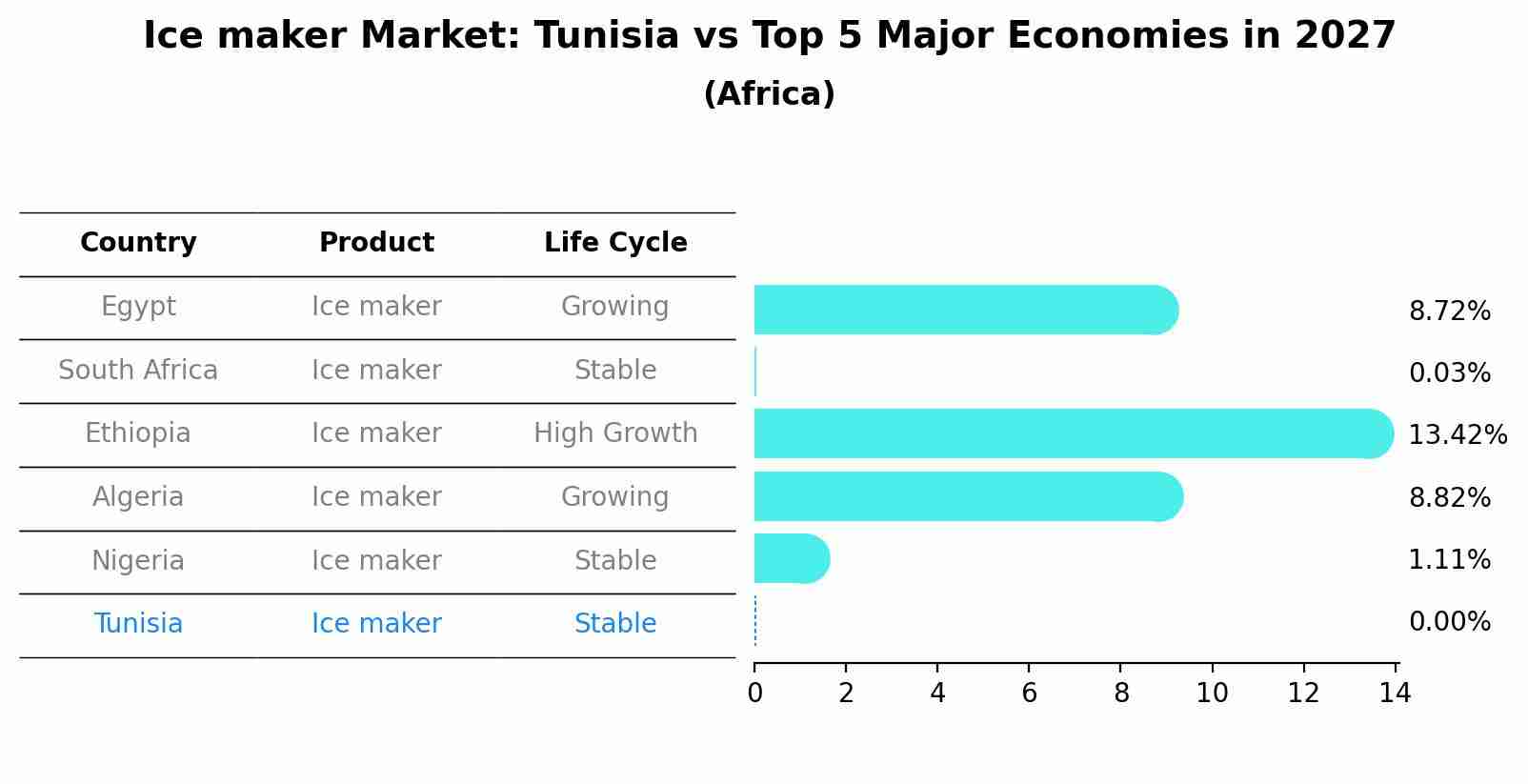
Ice maker Market: Tunisia vs Top 5 Major Economies in 2027 (Africa)
By 2027, the Ice maker market in Tunisia is anticipated to reach a growth rate of 0.00%, as part of an increasingly competitive Africa region, where Egypt remains at the forefront, supported by South Africa, Ethiopia, Algeria and Nigeria, driving innovations and market adoption across sectors.
Tunisia Ice maker Market Overview
The Tunisia ice maker market is experiencing steady growth due to the increasing demand for ice across various industries such as hospitality, healthcare, and food & beverage. The market is driven by factors such as the rising number of hotels, restaurants, and cafes, as well as the growing popularity of packaged beverages and frozen food products. Key players in the market are focusing on product innovations to cater to the diverse requirements of end-users and enhance energy efficiency. Additionally, the adoption of advanced technologies like smart ice makers and eco-friendly refrigerants is expected to further propel market growth. The competitive landscape is characterized by the presence of both local and international manufacturers offering a wide range of ice maker products to meet the evolving needs of customers in Tunisia.
Tunisia Ice maker Market Trends
The Tunisia ice maker market is experiencing a shift towards more energy-efficient and environmentally friendly products. Consumers are increasingly seeking ice makers with higher energy efficiency ratings to reduce electricity consumption and operational costs. There is also a growing demand for ice makers that use eco-friendly refrigerants to minimize environmental impact. Additionally, there is a trend towards compact and portable ice makers that are suitable for small households or outdoor activities. Smart features such as app connectivity and automatic cleaning functions are also gaining popularity among consumers looking for convenience and ease of use. Overall, the market is moving towards more sustainable and user-friendly ice maker options to meet the evolving needs and preferences of consumers in Tunisia.
Tunisia Ice maker Market Challenges
In the Tunisia ice maker market, some of the challenges faced include unreliable power supply leading to interruptions in ice production, fluctuating demand due to seasonal variations in tourism and agricultural activities, competition from imported ice makers offering lower prices, and the need for continuous innovation to meet changing consumer preferences. Additionally, limited access to financing for small ice maker businesses hinders their growth potential, while stringent regulations on water usage and waste disposal add to operational costs. Overall, navigating these challenges requires ice maker companies in Tunisia to adopt flexible business strategies, invest in efficient technologies, and build strong relationships with suppliers and customers to remain competitive in the market.
Tunisia Ice maker Market Investment Opportunities
The Tunisia ice maker market presents opportunities for investment due to the country`s growing tourism industry, increasing demand for cold beverages, and expanding food and hospitality sector. With the rising temperatures and need for ice in various applications such as restaurants, hotels, and events, there is a growing market for commercial ice makers. Investing in energy-efficient and environmentally friendly ice making technologies could be a strategic move in this market. Additionally, providing innovative solutions such as portable ice makers for outdoor events or catering services could cater to specific customer needs. Collaboration with local businesses and distributors can also help penetrate the market effectively. Overall, the Tunisia ice maker market offers potential for investment and growth for those looking to capitalize on the country`s evolving hospitality and tourism sectors.
Tunisia Ice maker Market Government Policy
The Tunisian government has implemented various policies to regulate the ice maker market in the country. These policies include quality standards to ensure that ice produced is safe for consumption, licensing requirements for ice maker businesses to operate legally, and environmental regulations to minimize the impact of ice making on the environment. Additionally, there are tax incentives and subsidies provided to encourage the use of energy-efficient and environmentally friendly ice making equipment. The government also closely monitors and inspects ice maker facilities to enforce compliance with these regulations and standards. Overall, these policies aim to promote the growth of the ice maker market in Tunisia while ensuring the safety of consumers and the protection of the environment.
Tunisia Ice maker Market Future Outlook
The Tunisia ice maker market is poised for significant growth in the upcoming years. The increasing demand for chilled beverages in both commercial and residential sectors, coupled with a rising hospitality industry, is expected to drive the market forward. Additionally, advancements in technology leading to more energy-efficient and innovative ice maker models will further boost market growth. The growing trend of hosting events and parties in Tunisia is also anticipated to contribute to the increasing adoption of ice makers. With a focus on convenience and efficiency, consumers are likely to invest in ice makers to meet their cooling needs. Overall, the future outlook for the Tunisia ice maker market appears promising with substantial opportunities for manufacturers and suppliers to capitalize on the growing demand.
Key Highlights of the Report:
- Tunisia Ice maker Market Outlook
- Market Size of Tunisia Ice maker Market, 2021
- Forecast of Tunisia Ice maker Market, 2027
- Historical Data and Forecast of Tunisia Ice maker Revenues & Volume for the Period 2018 - 2027
- Tunisia Ice maker Market Trend Evolution
- Tunisia Ice maker Market Drivers and Challenges
- Tunisia Ice maker Price Trends
- Tunisia Ice maker Porter's Five Forces
- Tunisia Ice maker Industry Life Cycle
- Historical Data and Forecast of Tunisia Ice maker Market Revenues & Volume By Product type for the Period 2018 - 2027
- Historical Data and Forecast of Tunisia Ice maker Market Revenues & Volume By Ice Cube Maker for the Period 2018 - 2027
- Historical Data and Forecast of Tunisia Ice maker Market Revenues & Volume By Ice Flake Maker for the Period 2018 - 2027
- Historical Data and Forecast of Tunisia Ice maker Market Revenues & Volume By Ice Nugget Maker for the Period 2018 - 2027
- Historical Data and Forecast of Tunisia Ice maker Market Revenues & Volume By Others for the Period 2018 - 2027
- Historical Data and Forecast of Tunisia Ice maker Market Revenues & Volume By Component for the Period 2018 - 2027
- Historical Data and Forecast of Tunisia Ice maker Market Revenues & Volume By Condenser for the Period 2018 - 2027
- Historical Data and Forecast of Tunisia Ice maker Market Revenues & Volume By Evaporator for the Period 2018 - 2027
- Historical Data and Forecast of Tunisia Ice maker Market Revenues & Volume By Throttle Valve for the Period 2018 - 2027
- Historical Data and Forecast of Tunisia Ice maker Market Revenues & Volume By Compressor for the Period 2018 - 2027
- Historical Data and Forecast of Tunisia Ice maker Market Revenues & Volume By Motors for the Period 2018 - 2027
- Historical Data and Forecast of Tunisia Ice maker Market Revenues & Volume By Heating Elements for the Period 2018 - 2027
- Historical Data and Forecast of Tunisia Ice maker Market Revenues & Volume By Application for the Period 2018 - 2027
- Historical Data and Forecast of Tunisia Ice maker Market Revenues & Volume By Residential for the Period 2018 - 2027
- Historical Data and Forecast of Tunisia Ice maker Market Revenues & Volume By Commercial for the Period 2018 - 2027
- Tunisia Ice maker Import Export Trade Statistics
- Market Opportunity Assessment By Product type
- Market Opportunity Assessment By Component
- Market Opportunity Assessment By Application
- Tunisia Ice maker Top Companies Market Share
- Tunisia Ice maker Competitive Benchmarking By Technical and Operational Parameters
- Tunisia Ice maker Company Profiles
- Tunisia Ice maker Key Strategic Recommendations






































