Tunisia Paving Blocks Market Summary
The tunisia paving blocks market was estimated at USD 1325 Million in 2025 and is projected to reach USD 1915 Million by 2032, growing at a CAGR of 6.2% from 2026 to 2032.
Tunisia Paving Blocks Market Year-wise Growth Rate and Key Drivers
This graph highlights how the Tunisia Paving Blocks Market has steadily grown over the past five years, supported by major growth factors.
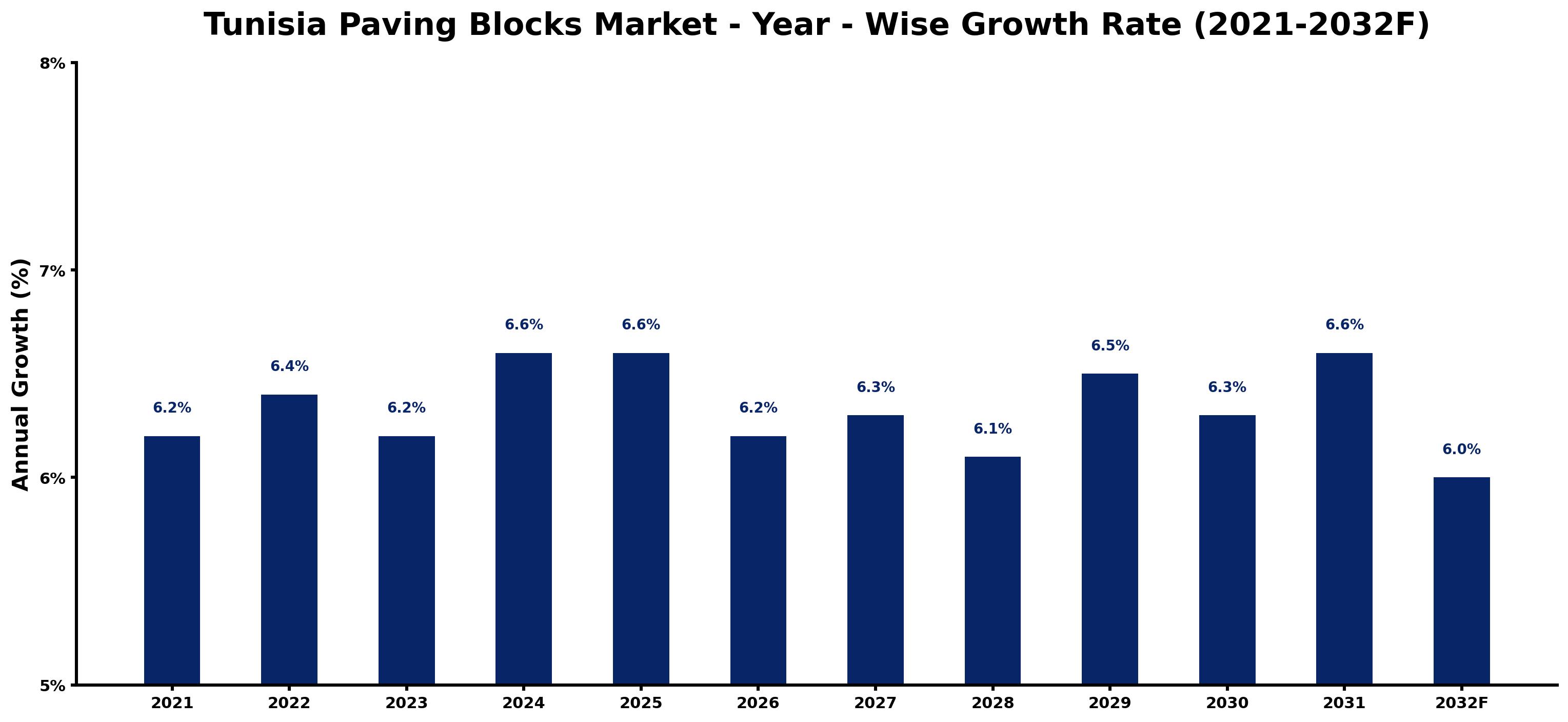
The table below presents the year wise growth rates along with the key drivers influencing the market
| Year | Growth Rate | Major Drivers |
| 2021 | 6.2% | Local construction projects commenced, boosting the need for durable paving solutions. |
| 2022 | 6.4% | Climate resilience strategies prompted increased use of permeable paving materials. |
| 2023 | 6.2% | Urbanization trends escalated, driving demand for improved infrastructure and paving solutions. |
| 2024 | 6.6% | Investment in tourism infrastructure led to a surge in commercial paving projects. |
| 2025 | 6.6% | High-quality road networks became essential for logistics and economic expansion. |
| 2026 | 6.2% | Sustainable construction practices gained traction, impacting paving material selection. |
| 2027 | 6.3% | Rising interest in eco-friendly construction led to growth in recycled paving blocks. |
| 2028 | 6.1% | Technological advancements in manufacturing processes enhanced paving block durability and efficiency. |
| 2029 | 6.5% | Regional markets expanded, increasing competition and innovation in paving block designs. |
| 2030 | 6.3% | Government urban development agendas emphasized modernized public spaces using paving blocks. |
| 2031 | 6.6% | Partnerships between local manufacturers and international firms fostered product diversification. |
| 2032 | 6.0% | Consumer preferences shifted towards aesthetically pleasing, customizable paving solutions. |
Note - Market size estimations and growth projections presented in this report are based on 6Wresearch's advanced forecasting approach, validated with industry datasets as of June 2026.
Tunisia Paving Blocks Market Synopsis
The Tunisia Paving Blocks Market is projected to reach 6.2% and witness significant growth during the forecast period (2026-2032). The market is poised to register a compound annual growth rate (CAGR) of over 4.6% during this period, driven primarily by rising construction activities across the nation. The ongoing urbanization trends, coupled with increased investment in infrastructure, are expected to further enhance the demand for paving blocks. However, challenges such as escalating raw material costs and stringent regulations regarding the installation and usage of paving blocks may impede the market's expansion. As cities increasingly adapt to modern aesthetics, the paving blocks market in Tunisia is likely to experience new opportunities, particularly in enhancing the visual appeal of urban landscapes.
Tunisia Paving Blocks Market Growth Drivers
Several factors are driving the growth of the Tunisia paving blocks market. Firstly, the surge in construction activities across various sectors, including residential, commercial, and public infrastructure, has significantly boosted the demand for high-quality paving solutions. As urbanization accelerates, cities are prioritizing the development of roads, walkways, and other paved areas to accommodate increasing populations.
- The government's infrastructure initiatives, which focus on enhancing transport networks and urban landscapes, are creating substantial demand for paving blocks, further supporting market growth.
- A rise in public and private sector investments in construction projects is stimulating the need for durable and aesthetically pleasing paving solutions.
- Additionally, technological advancements in the production of paving blocks are improving their durability and design, attracting more customers to choose these products over traditional options.
- Increased awareness among consumers regarding the aesthetic and functional benefits of well-paved surfaces is influencing purchasing decisions positively.
- Moreover, the growing trend of sustainable construction practices is leading to the adoption of eco-friendly paving blocks, further expanding the market horizons.
Tunisia Paving Blocks Market Challenges and Restraints
Despite its promising outlook, the Tunisia paving blocks market faces certain challenges that may restrict growth. One significant factor is the rising cost of raw materials, which can impact the pricing strategies of manufacturers and, consequently, consumer demand.
- Furthermore, stringent regulatory policies concerning the installation and usage of paving blocks can complicate compliance for businesses, potentially leading to additional costs and delays.
- Market players might also grapple with competition from alternative paving solutions, which could offer lower costs or unique characteristics.
- The lack of awareness regarding the advantages of high-quality paving blocks among certain segments of the population could also hinder market penetration.
- Lastly, the pace of urbanization varies significantly across different regions in Tunisia, creating uneven demand for paving blocks and challenging targeted marketing efforts.
Tunisia Paving Blocks Market Trends and Opportunities
The Tunisia paving blocks market is undergoing significant transformation driven by emerging trends and opportunities. As urbanization continues to rise, there is a noticeable shift towards innovative paving materials that enhance both functionality and aesthetic appeal.
- The demand for stamped and colored paving blocks is on the rise, driven by consumer preferences for visually appealing and customizable options.
- Moreover, the integration of technology in manufacturing processes is optimizing production efficiency and product quality, making it a key area for investment.
- The trend towards sustainable and eco-friendly construction materials is also creating opportunities for paving block manufacturers who can provide greener solutions.
- Public awareness campaigns about the benefits of high-quality pavements could educate consumers and encourage higher adoption rates.
- Finally, collaborations with urban planners and architects to incorporate innovative paving designs into urban development projects are set to expand market opportunities.
Tunisia Paving Blocks Market Government Investment and Initiatives
The Tunisian government is actively investing in infrastructure development, which plays a crucial role in the growth of the paving blocks market. Key initiatives include increased public spending aimed at improving transportation networks and urban infrastructures, which are essential for economic growth.
- Infrastructure projects are a priority for the government, leading to higher demand for paving blocks in road construction, pedestrian paths, and urban spaces.
- Tax incentives and subsidies for eco-friendly building materials are encouraging manufacturers to innovate and offer sustainable paving solutions, aligning with the global shift towards green practices.
- The government is also implementing regulations that promote the use of high-quality materials, ensuring that paving blocks meet safety and durability standards.
- Investment in urban renewal projects is generating demand for high-quality and aesthetically pleasing paving blocks, enhancing urban environments.
- Collaboration between government and private sectors is essential in developing comprehensive plans for urban development, further facilitating market growth.
Tunisia Paving Blocks Market Latest Developments (May 2025 - June 2026)
In the period between May 2025 and June 2026, the Tunisia paving blocks market has seen several significant developments. A notable trend is the ongoing innovation in paving block designs, as manufacturers adapt to changing consumer preferences for durability and aesthetics.
- Additionally, there has been an uptick in projects focusing on urban beautification, where paving blocks play a vital role in enhancing public spaces.
- The government's commitment to sustainable development is resulting in the introduction of new regulations supporting eco-friendly paving materials, boosting market dynamics.
- A growing number of partnerships between construction companies and local governments are emerging to promote best practices in the usage of paving blocks.
- Moreover, the rise in infrastructural investments is creating further opportunities for manufacturers to expand their offerings and improve product quality.
- Overall, this period has been characterized by a collaborative approach among various stakeholders aimed at enhancing the paving blocks market in Tunisia.
Tunisia Paving Blocks Market - Key Attractiveness of the Report
- 10 Years of Market Numbers
- Historical Data Starting from 2022 to 2025
- Base Year: 2025
- Forecast Data until 2032
- Key Performance Indicators Impacting the Market
- Major Upcoming Developments and Projects
- What factors are contributing to the growth of the Tunisia paving blocks market?
- How is the government supporting the paving blocks market in Tunisia?
- What challenges does the paving blocks market face in Tunisia?
- Which trends are shaping the future of the Tunisia paving blocks market?
Key Highlights of the Report:
- Tunisia Paving Blocks Market Outlook
- Market Size of Tunisia Paving Blocks Market, 2025
- Forecast of Tunisia Paving Blocks Market, 2032F
- Historical Data and Forecast of Tunisia Paving Blocks Revenues & Volume for the Period 2022-2032F
- Tunisia Paving Blocks Market Trend Evolution
- Tunisia Paving Blocks Market Drivers and Challenges
- Tunisia Paving Blocks Price Trends
- Tunisia Paving Blocks Porter's Five Forces
- Tunisia Paving Blocks Industry Life Cycle
- Historical Data and Forecast of Tunisia Paving Blocks Market Revenues & Volume By Product for the Period 2022-2032F
- Historical Data and Forecast of Tunisia Paving Blocks Market Revenues & Volume By Pavers for the Period 2022-2032F
- Historical Data and Forecast of Tunisia Paving Blocks Market Revenues & Volume By Glazed Clay Bricks for the Period 2022-2032F
- Historical Data and Forecast of Tunisia Paving Blocks Market Revenues & Volume By Wall Block for the Period 2022-2032F
- Historical Data and Forecast of Tunisia Paving Blocks Market Revenues & Volume By Material for the Period 2022-2032F
- Historical Data and Forecast of Tunisia Paving Blocks Market Revenues & Volume By Clay for the Period 2022-2032F
- Historical Data and Forecast of Tunisia Paving Blocks Market Revenues & Volume By Building Bricks for the Period 2022-2032F
- Historical Data and Forecast of Tunisia Paving Blocks Market Revenues & Volume By Concrete for the Period 2022-2032F
- Historical Data and Forecast of Tunisia Paving Blocks Market Revenues & Volume By End-users for the Period 2022-2032F
- Historical Data and Forecast of Tunisia Paving Blocks Market Revenues & Volume By General for the Period 2022-2032F
- Historical Data and Forecast of Tunisia Paving Blocks Market Revenues & Volume By Structural for the Period 2022-2032F
- Historical Data and Forecast of Tunisia Paving Blocks Market Revenues & Volume By Hardscaping for the Period 2022-2032F
- Historical Data and Forecast of Tunisia Paving Blocks Market Revenues & Volume By Siding for the Period 2022-2032F
- Historical Data and Forecast of Tunisia Paving Blocks Market Revenues & Volume By Fireplace for the Period 2022-2032F
- Historical Data and Forecast of Tunisia Paving Blocks Market Revenues & Volume By Other for the Period 2022-2032F
- Tunisia Paving Blocks Import Export Trade Statistics
- Market Opportunity Assessment By Product
- Market Opportunity Assessment By Material
- Market Opportunity Assessment By End-users
- Tunisia Paving Blocks Top Companies Market Share
- Tunisia Paving Blocks Competitive Benchmarking By Technical and Operational Parameters
- Tunisia Paving Blocks Company Profiles
- Tunisia Paving Blocks Key Strategic Recommendations






































