Tunisia Power Supply Market Summary
The tunisia power supply market was estimated at USD 198 Million in 2025 and is projected to reach USD 273 Million by 2032, growing at a CAGR of 5.8% from 2026 to 2032.
Tunisia Power Supply Market Year-wise Growth Rate and Key Drivers
This graph highlights how the Tunisia Power Supply Market has steadily grown over the past five years, supported by major growth factors.
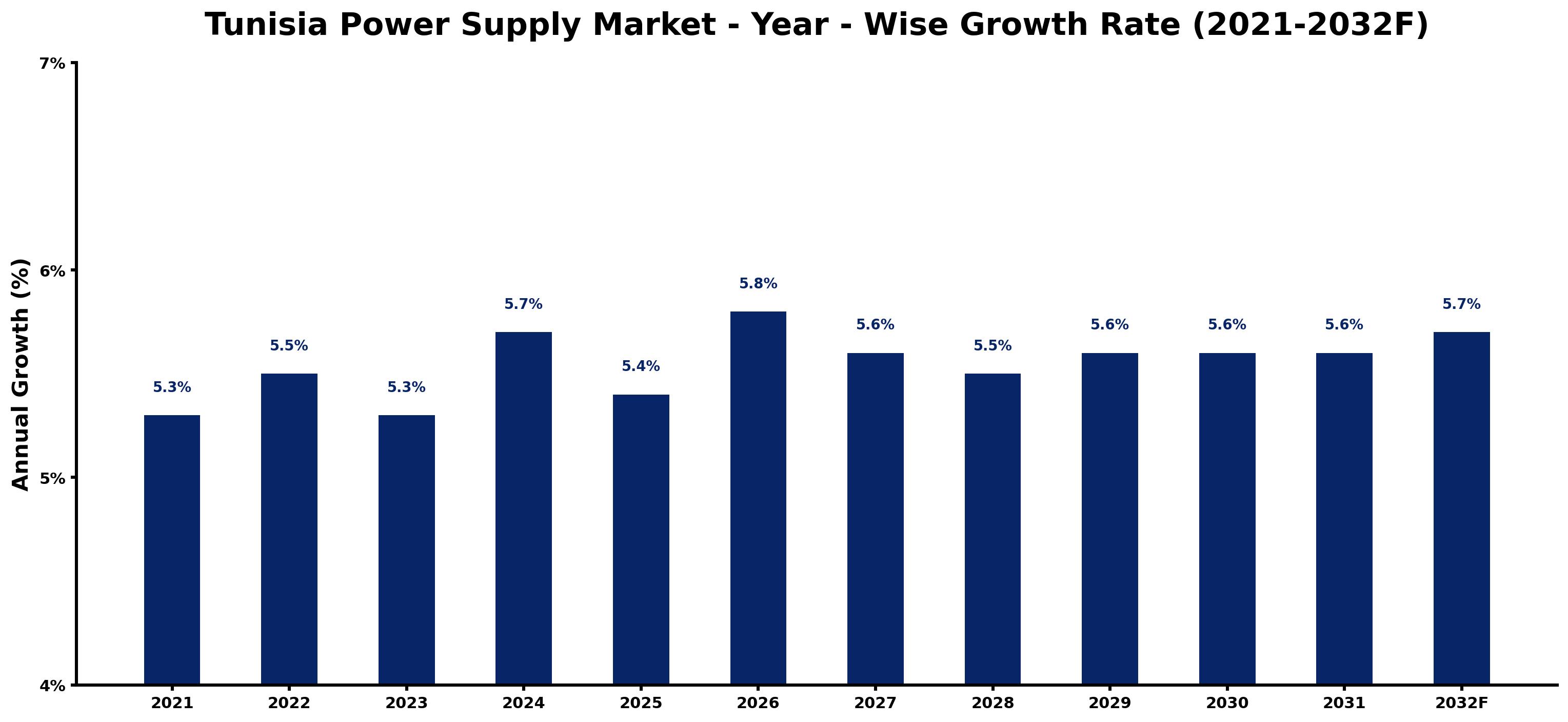
The table below presents the year wise growth rates along with the key drivers influencing the market
| Year | Growth Rate | Major Drivers |
| 2021 | 5.3% | Energy diversification efforts underscore the need for renewable energy solutions. |
| 2022 | 5.5% | Investment in solar farms reflects Tunisia's abundant sunlight and energy potential. |
| 2023 | 5.3% | Rising urbanization trends create increased electricity consumption in major cities. |
| 2024 | 5.7% | Infrastructure upgrades enhance grid reliability, reducing outages across the country. |
| 2025 | 5.4% | Emerging private sector players challenge incumbents, fostering competitive pricing models. |
| 2026 | 5.8% | Local manufacturing of solar equipment reduces dependence on imported technologies. |
| 2027 | 5.6% | Technological partnerships enhance energy efficiency, minimizing operational costs for utilities. |
| 2028 | 5.5% | International financing institutions boost funding for sustainability-driven projects. |
| 2029 | 5.6% | Climate change initiatives align with global trends towards cleaner energy sources. |
| 2030 | 5.6% | Public awareness campaigns educate citizens on energy conservation practices. |
| 2031 | 5.6% | Smart grid implementations enable better demand management and energy distribution. |
| 2032 | 5.7% | Collaborations with neighboring countries improve regional power-sharing capabilities. |
Note - Market size estimations and growth projections presented in this report are based on 6Wresearch's advanced forecasting approach, validated with industry datasets as of June 2026.
Tunisia Power Supply Market Synopsis
The Tunisia Power Supply Market is projected to reach 5.8% and witness significant growth during the forecast period (2026-2032). As the country progresses through a phase of escalating industrialization and urbanization, the demand for electricity is soaring, necessitating robust responses from industry stakeholders and policymakers alike. The integration of renewable energy alongside the enhancement of transmission infrastructure is pivotal in shaping the market dynamics.
Tunisia Power Supply Market Growth Drivers
The growth trajectory of the Tunisia Power Supply Market is primarily driven by several interrelated factors:
- Increasing electricity consumption is a critical driver. As residential and commercial sectors expand, the demand for reliable power supply escalates, prompting investments in capacity expansion and innovative solutions.
- Urbanization trends are significantly influencing market dynamics. The continuous migration to urban centers creates heightened demand for basic utilities, including electricity, fostering a need for an efficient power supply infrastructure.
- Industrialization is enhancing the demand for dependable energy sources. As Tunisia focuses on boosting its industrial output, the need for uninterrupted power supply systems, such as uninterruptible power supplies (UPS), has become increasingly pressing.
- The growing emphasis on renewable energy adoption is reshaping the market landscape. Government incentives and global trends towards sustainability are leading to significant investments in solar and wind energy projects.
- Technological advancements in energy efficiency are lowering operational costs. Innovations in smart grid technology and energy storage are aiding suppliers in managing electricity distribution more effectively.
Tunisia Power Supply Market Challenges and Restraints
Despite its promising growth prospects, the Tunisia Power Supply Market faces several challenges that require strategic management:
- Balancing supply and demand remains a notable challenge, particularly with fluctuating energy policies and economic uncertainties impacting consumption patterns.
- Grid stability and reliability are essential for integrating renewable sources. Achieving this goal entails significant investments in modernizing infrastructure and embracing technological solutions.
- Inequity in energy access persists, especially in rural and underserved regions. Policymakers strive to address these disparities to ensure that all segments of the population can benefit from reliable electricity.
- The dependence on imported fuels for power generation poses risks to energy security. Diversification of energy sources is necessary to mitigate this vulnerability.
- Regulatory challenges may hinder progress and investment in the power sector. As policies evolve, aligning them with market needs is critical for sustainable development.
Tunisia Power Supply Market Government Investment and Initiatives
The Tunisian government is actively implementing policies aimed at diversifying its energy portfolio while reducing reliance on imported fossil fuels. To facilitate this transition, several key initiatives have been established:
- Promoting renewable energy projects through favorable regulatory frameworks to encourage private sector participation and investment in wind and solar energy.
- Implementing policies that ensure the affordability of electricity tariffs for consumers, especially in lower-income demographics, thereby enhancing energy accessibility.
- Investing in modernizing the grid infrastructure to support the integration of distributed energy resources, ensuring a more resilient and stable power supply.
- Supporting public-private partnerships to accelerate investment in energy infrastructure, thereby driving technological advancements and capacity building.
- Establishing energy efficiency programs aimed at reducing consumption, decreasing costs, and promoting sustainable practices across various sectors.
Tunisia Power Supply Market Latest Developments (May 2025 - June 2026)
Recent developments in the Tunisia Power Supply Market indicate a proactive approach towards addressing both challenges and opportunities within the sector:
- The government has increased its focus on attracting foreign investment in renewable energy technologies, leading to collaborative projects with international stakeholders.
- A series of initiatives aimed at improving energy efficiency in industrial operations have been introduced, showcasing a commitment to sustainable practices.
- Public awareness campaigns regarding energy conservation and the benefits of renewable energy usage have gained momentum, aimed at fostering community involvement.
- Investments in smart grid technology have been prioritized, enhancing the capacity of the existing infrastructure to accommodate renewable energy sources.
- Strategic partnerships between government entities and research institutions have been formed to promote innovation in energy solutions, aligning with global sustainable development goals.
Tunisia Power Supply Market - Key Attractiveness of the Report
- 10 Years of Market Numbers
- Historical Data Starting from 2022 to 2025
- Base Year: 2025
- Forecast Data until 2032
- Key Performance Indicators Impacting the Market
- Major Upcoming Developments and Projects
Key Highlights of the Report:
- Tunisia Power Supply Market Outlook
- Market Size of Tunisia Power Supply Market, 2025
- Forecast of Tunisia Power Supply Market, 2032
- Historical Data and Forecast of Tunisia Power Supply Revenues & Volume for the Period 2022-2032F
- Tunisia Power Supply Market Trend Evolution
- Tunisia Power Supply Market Drivers and Challenges
- Tunisia Power Supply Price Trends
- Tunisia Power Supply Porter's Five Forces
- Tunisia Power Supply Industry Life Cycle
- Historical Data and Forecast of Tunisia Power Supply Market Revenues & Volume By Output Power for the Period 2022-2032F
- Historical Data and Forecast of Tunisia Power Supply Market Revenues & Volume By Power Supply With Low Output (500 W and Below) for the Period 2022-2032F
- Historical Data and Forecast of Tunisia Power Supply Market Revenues & Volume By Power Supply With Medium Output (500?1,000 W) for the Period 2022-2032F
- Historical Data and Forecast of Tunisia Power Supply Market Revenues & Volume By Power Supply With High Output (More Than 1,000 W) for the Period 2022-2032F
- Historical Data and Forecast of Tunisia Power Supply Market Revenues & Volume By Type for the Period 2022-2032F
- Historical Data and Forecast of Tunisia Power Supply Market Revenues & Volume By AC-DC Power Supply for the Period 2022-2032F
- Historical Data and Forecast of Tunisia Power Supply Market Revenues & Volume By DC-DC Power Supply for the Period 2022-2032F
- Historical Data and Forecast of Tunisia Power Supply Market Revenues & Volume By Vertical for the Period 2022-2032F
- Historical Data and Forecast of Tunisia Power Supply Market Revenues & Volume By Medical & Healthcare for the Period 2022-2032F
- Historical Data and Forecast of Tunisia Power Supply Market Revenues & Volume By Military & Aerospace for the Period 2022-2032F
- Historical Data and Forecast of Tunisia Power Supply Market Revenues & Volume By Telecommunications for the Period 2022-2032F
- Historical Data and Forecast of Tunisia Power Supply Market Revenues & Volume By Consumer Electronics for the Period 2022-2032F
- Historical Data and Forecast of Tunisia Power Supply Market Revenues & Volume By Transportation for the Period 2022-2032F
- Historical Data and Forecast of Tunisia Power Supply Market Revenues & Volume By Lighting for the Period 2022-2032F
- Historical Data and Forecast of Tunisia Power Supply Market Revenues & Volume By Food & Beverages for the Period 2022-2032F
- Historical Data and Forecast of Tunisia Power Supply Market Revenues & Volume By Industrial for the Period 2022-2032F
- Tunisia Power Supply Import Export Trade Statistics
- Market Opportunity Assessment By Output Power
- Market Opportunity Assessment By Type
- Market Opportunity Assessment By Vertical
- Tunisia Power Supply Top Companies Market Share
- Tunisia Power Supply Competitive Benchmarking By Technical and Operational Parameters
- Tunisia Power Supply Company Profiles
- Tunisia Power Supply Key Strategic Recommendations






































