Tunisia Wound Dressings Market Size, Share & Growth Rate
The Tunisia Wound Dressings Market was estimated at USD 230 Million in 2025 and is projected to reach USD 311 Million by 2032, growing at a CAGR of 4.4% from 2026 to 2032. This growth trajectory is primarily fueled by the increasing prevalence of chronic wounds and the expanding geriatric population. Moreover, the rising awareness surrounding advanced wound care solutions is transforming the market landscape, driving demand for innovative and effective wound management products.
Tunisia Wound Dressings Market Growth Rate Analysis (2021-2032)
The Tunisia wound dressings market has shown stable growth, with annual increases averaging around 5% between 2021 and 2023. The growth rate of 5.2% in 2021 slightly dipped to 5.0% in 2022 and 2023, primarily due to fluctuation in healthcare spending and supply chain challenges. However, a renewed focus on healthcare infrastructure and increased consumer demand for advanced wound care solutions led to an uptick to 5.6% in 2024. Looking ahead, growth is expected to hover around 5.1% to 5.5% through 2032, driven by ongoing investments in digital health technologies and expanding healthcare policies that prioritize wound management. This steady rise indicates a robust demand for innovative treatment options in Tunisia's evolving healthcare landscape.
Tunisia Wound Dressings Market Year-wise Growth Rate and Key Drivers
This graph highlights how the Tunisia Wound Dressings Market has steadily grown over the past five years, supported by major growth factors.
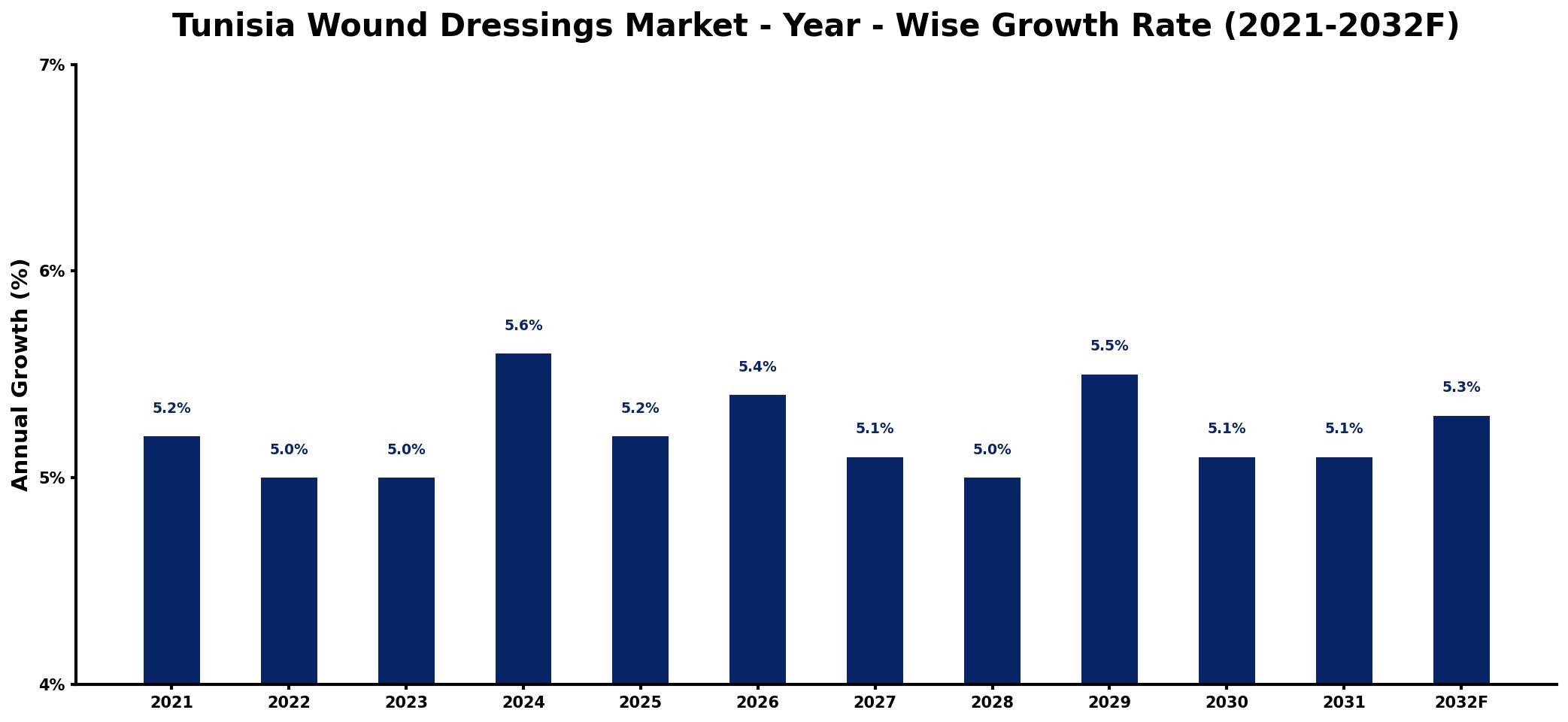
The table below presents the year‑wise growth rates along with the key drivers influencing the market
| Year | Growth Rate | Major Drivers |
| 2021 | 5.2% | Rising healthcare expenditure in region |
| 2022 | 5.0% | Increased prevalence of chronic conditions |
| 2023 | 5.0% | Growing awareness of infection control |
| 2024 | 5.6% | Expansion of healthcare infrastructure initiatives |
| 2025 | 5.2% | Surge in surgical procedures performed |
| 2026 | 5.4% | Technological advancements in healthcare |
| 2027 | 5.1% | Increase in aging population demographic |
| 2028 | 5.0% | Rising demand for home healthcare |
| 2029 | 5.5% | Enhanced focus on patient safety |
| 2030 | 5.1% | Growth of outpatient treatment centers |
| 2031 | 5.1% | Investment in medical research initiatives |
| 2032 | 5.3% | Strengthened regulatory frameworks established |
Note: Market size estimations and growth projections presented in this report are based on 6Wresearch's proprietary forecasting methodology, utilizing the latest available industry data, government publications, and primary research inputs.
Tunisia Wound Dressings Market Synopsis
The Tunisia wound dressings market is currently experiencing a shift towards advanced products that prioritize healing efficiency and infection control. With a rising number of chronic wound cases and a growing elderly demographic, the demand for modern dressings is becoming more pronounced. Healthcare practitioners are adopting these advanced solutions, leading to a dynamic market environment.
The market is characterized by a progressive transition from traditional dressings to modern alternatives, such as hydrogels and alginates. Key stakeholders are actively investing in research and development to introduce innovative wound care technologies. This focus on quality care solutions has the potential to significantly enhance patient outcomes and establish Tunisia as a competitive player in the wound care sector.
Tunisia Wound Dressings Market Key Takeaways
- The market is projected to grow steadily due to increasing chronic wound prevalence and a rising geriatric population.
- Advanced wound care products are gaining traction, displacing traditional dressing options.
- Healthcare professionals are adopting evidence-based practices, enhancing the demand for innovative wound management solutions.
- Investment in healthcare infrastructure and education is critical to overcoming barriers in wound care accessibility.
- Emerging technologies, such as antimicrobial dressings, are expected to drive future market growth.
Evaluation of Restraints in Tunisia Wound Dressings Market
Despite the promising growth prospects, the Tunisia wound dressings market faces several constraints. Access to advanced wound care technologies remains limited, particularly in rural areas, which can hinder effective wound management. Additionally, the high costs associated with specialized dressings may deter healthcare facilities and patients from utilizing these products. Awareness and education gaps regarding optimal wound care practices can also restrict market potential. Collaboration among stakeholders is essential to address these issues and enhance market accessibility.
Tunisia Wound Dressings Market Trends
The Tunisian wound dressings market is witnessing a clear trend toward advanced wound care products. Innovations such as foam dressings, hydrogels, and alginates are increasingly preferred due to their effectiveness in promoting faster healing while minimizing infection risks. Additionally, there is a growing emphasis on cost-effective solutions that cater to both healthcare facilities and patients. Companies are actively developing advanced technologies, including antimicrobial features and superior moisture management, to enhance overall patient outcomes.
Tunisia Wound Dressings Market Opportunities
Investment opportunities in the Tunisia wound dressings market are plentiful, driven by the rising incidence of chronic wounds, including diabetic ulcers and pressure sores. This situation creates significant demand for advanced wound care solutions. Moreover, investing in innovative technologies like antimicrobial and bioactive dressings can offer promising returns. Expanding distribution networks and forming strategic partnerships with healthcare providers will also be crucial for effective market penetration, especially as the government prioritizes improvements in healthcare infrastructure.
Government Initiatives in the Tunisia Wound Dressings Market
The Tunisian government has introduced regulatory measures to enhance the wound dressings market, requiring all medical devices, including wound dressings, to undergo a stringent approval process by the Ministry of Health. These policies ensure that products meet high standards of quality, safety, and efficacy. Furthermore, the government actively monitors pricing strategies to protect consumers from inflated costs, ensuring access to essential wound care solutions while fostering innovation within the sector.
Future Insights of the Tunisia Wound Dressings Market
Looking ahead to 2026-2032, the Tunisia wound dressings market is poised for continued growth. Factors such as the increasing prevalence of chronic wounds and the rising number of surgical procedures will contribute to heightened demand for advanced wound care products. Additionally, ongoing technological innovations, particularly in antimicrobial dressings, are expected to shape the market landscape. Nevertheless, addressing access barriers in rural regions and managing costs associated with advanced dressings will be critical to sustain market expansion.
Tunisia Wound Dressings Market Latest Developments (2025 - 2026)
Recent developments in the Tunisia wound dressings market indicate a positive shift towards innovative product offerings. Companies are focusing on enhancing product functionalities to meet the evolving needs of healthcare professionals and patients. Increased collaboration between healthcare providers and manufacturers is evident as they work together to improve wound management practices. Furthermore, public initiatives aimed at bolstering healthcare access and education are expected to influence market dynamics positively in the coming years.
Tunisia Wound Dressings Market - Key Attractiveness of the Report
- 10 Years of Market Numbers
- Historical Data Starting from 2022 to 2025
- Base Year: 2025
- Forecast Data until 2032
- Key Performance Indicators Impacting the Market
- Major Upcoming Developments and Projects
Key Highlights of the Report:
- Tunisia Wound Dressings Market Outlook
- Market Size of Tunisia Wound Dressings Market, 2025
- Forecast of Tunisia Wound Dressings Market, 2032
- Historical Data and Forecast of Tunisia Wound Dressings Revenues & Volume for the Period 2022-2032F
- Tunisia Wound Dressings Market Trend Evolution
- Tunisia Wound Dressings Market Drivers and Challenges
- Tunisia Wound Dressings Price Trends
- Tunisia Wound Dressings Porter's Five Forces
- Tunisia Wound Dressings Industry Life Cycle
- Historical Data and Forecast of Tunisia Wound Dressings Market Revenues & Volume By Type for the Period 2022-2032F
- Historical Data and Forecast of Tunisia Wound Dressings Market Revenues & Volume By Advanced Wound Dressings for the Period 2022-2032F
- Historical Data and Forecast of Tunisia Wound Dressings Market Revenues & Volume By Traditional Wound Dressings for the Period 2022-2032F
- Historical Data and Forecast of Tunisia Wound Dressings Market Revenues & Volume By Wound Type for the Period 2022-2032F
- Historical Data and Forecast of Tunisia Wound Dressings Market Revenues & Volume By Surgical and Traumatic Wounds for the Period 2022-2032F
- Historical Data and Forecast of Tunisia Wound Dressings Market Revenues & Volume By Diabetic Foot Ulcers for the Period 2022-2032F
- Historical Data and Forecast of Tunisia Wound Dressings Market Revenues & Volume By Pressure Ulcers for the Period 2022-2032F
- Historical Data and Forecast of Tunisia Wound Dressings Market Revenues & Volume By Venous Leg Ulcers for the Period 2022-2032F
- Historical Data and Forecast of Tunisia Wound Dressings Market Revenues & Volume By Burns and Other Wounds for the Period 2022-2032F
- Historical Data and Forecast of Tunisia Wound Dressings Market Revenues & Volume By End User for the Period 2022-2032F
- Historical Data and Forecast of Tunisia Wound Dressings Market Revenues & Volume By Hospitals, ASCs, and Clinics for the Period 2022-2032F
- Historical Data and Forecast of Tunisia Wound Dressings Market Revenues & Volume By Home Care Settings for the Period 2022-2032F
- Historical Data and Forecast of Tunisia Wound Dressings Market Revenues & Volume By Other End Users for the Period 2022-2032F
- Tunisia Wound Dressings Import Export Trade Statistics
- Market Opportunity Assessment By Type
- Market Opportunity Assessment By Wound Type
- Market Opportunity Assessment By End User
- Tunisia Wound Dressings Top Companies Market Share
- Tunisia Wound Dressings Competitive Benchmarking By Technical and Operational Parameters
- Tunisia Wound Dressings Company Profiles
- Tunisia Wound Dressings Key Strategic Recommendations






































