Turkey Hospital Equipment And Supplies Market Size, Share & Growth Rate
The Turkey Hospital Equipment And Supplies Market was estimated at USD 1296 Million in 2025 and is projected to reach USD 1856 Million by 2032, growing at a CAGR of 5.3% from 2026 to 2032. This promising growth trajectory is driven primarily by rising healthcare expenditure, increased investments in healthcare infrastructure, and the growing demand for advanced medical devices across hospitals and clinics. Coupled with a burgeoning population and a higher prevalence of chronic diseases, these factors solidify the foundation for sustained market expansion in Turkey.
Turkey Hospital Equipment And Supplies Market Year-wise Growth Rate and Key Drivers
This graph highlights how the Turkey Hospital Equipment And Supplies Market has steadily grown over the years, supported by major growth factors.
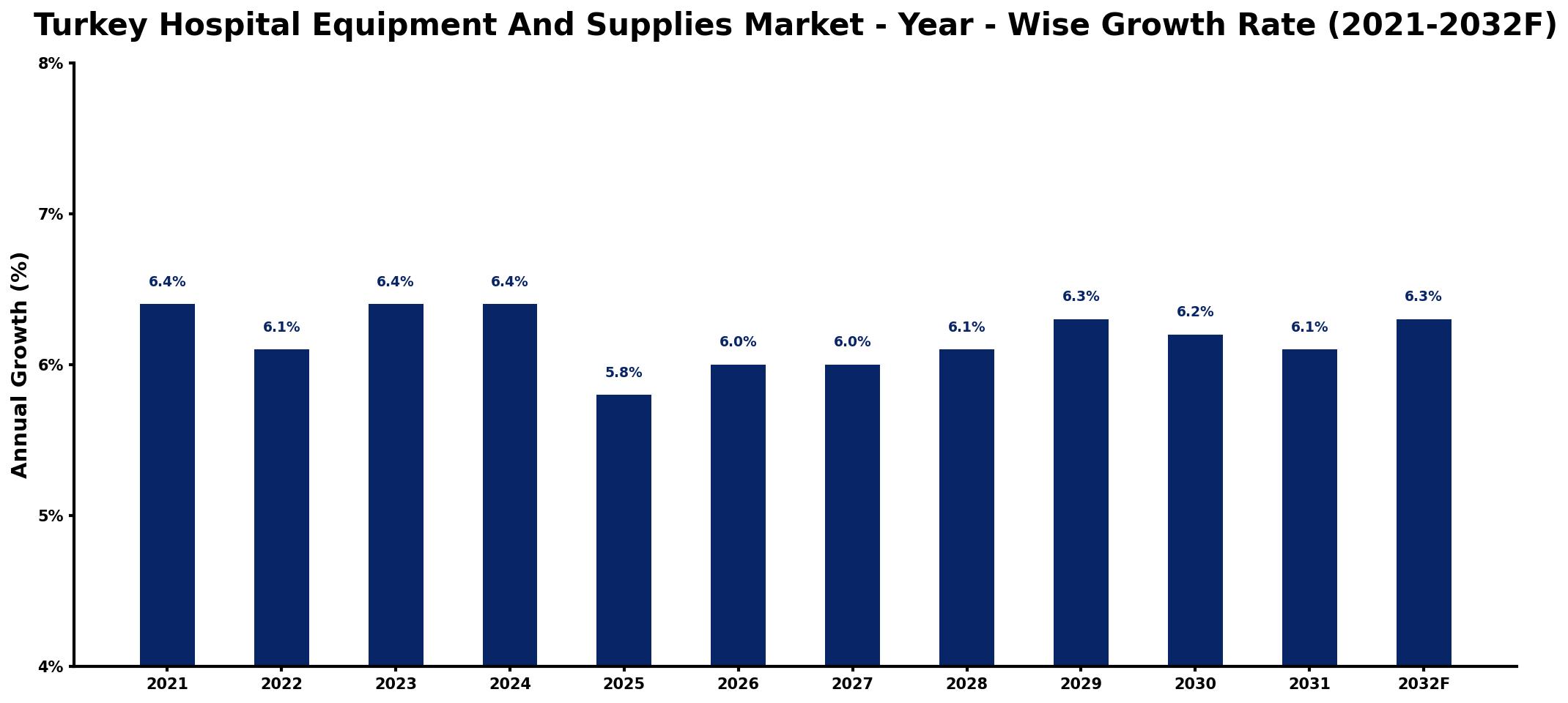
The table below presents the year‑wise growth rates along with the key drivers influencing the market
| Year | Growth Rate | Major Drivers |
| 2021 | 6.4% | Rising healthcare investments and spending |
| 2022 | 6.1% | Expanding telemedicine and digital health |
| 2023 | 6.4% | Increased aging population requirements |
| 2024 | 6.4% | Growing awareness of preventive care |
| 2025 | 5.8% | Emerging private sector opportunities |
| 2026 | 6.0% | Technological advancements in diagnostics |
| 2027 | 6.0% | Strengthening public health initiatives |
| 2028 | 6.1% | Surge in chronic disease management |
| 2029 | 6.3% | Enhanced healthcare infrastructure projects |
| 2030 | 6.2% | Focus on patient-centered care models |
| 2031 | 6.1% | Growing demand for outpatient services |
| 2032 | 6.3% | Innovations in healthcare financing options |
Note: Market size estimations and growth projections presented in this report are based on 6Wresearch's proprietary forecasting methodology, utilizing the latest available industry data, government publications, and primary research inputs.
Turkey Hospital Equipment And Supplies Market Synopsis
In recent years, Turkey has witnessed significant advancements in its healthcare system, marking a pivotal shift in hospital equipment and supplies. The integration of innovative medical technologies and devices has fundamentally transformed patient care, enabling more efficient diagnoses and treatment options.
This evolving landscape reflects a broader commitment to improving healthcare quality and accessibility. With a surge in government investment and a focus on enhancing healthcare infrastructure, the market is positioned for notable growth, benefiting both domestic and international stakeholders.
Turkey Hospital Equipment And Supplies Market Key Takeaways
- The market is projected to grow significantly, reaching USD 1856 Million by 2032.
- Increased healthcare spending and investments in infrastructure are driving market expansion.
- Government initiatives foster research and development in advanced medical technologies.
- The rising prevalence of chronic diseases necessitates the demand for high-quality medical equipment.
- Stringent regulatory standards ensure the safety and quality of medical products in the market.
Evaluation of Restraints in Turkey Hospital Equipment And Supplies Market
Despite its promising growth trajectory, the Turkey Hospital Equipment and Supplies Market faces several noteworthy restraints. High production costs pose a significant barrier, as manufacturers need to invest in advanced technologies to ensure the quality and safety of their products. Additionally, regulatory compliance with stringent quality standards can add layers of complexity to operations, further straining financial resources. The competitive landscape is also challenging, with international manufacturers consistently introducing innovative and cost-effective solutions. Lastly, economic fluctuations can directly impact healthcare spending priorities, affecting market demand and growth potential.
Turkey Hospital Equipment And Supplies Market Trends
Emerging trends within the Turkey Hospital Equipment and Supplies Market indicate a strong shift towards digital healthcare solutions, including telemedicine and remote patient monitoring. These advancements aim to enhance patient engagement and streamline healthcare delivery. Additionally, the adoption of artificial intelligence (AI) in diagnostics and treatment planning is gaining traction, reflecting a commitment to precision medicine. Sustainability is also becoming a focal point, with hospitals increasingly seeking eco-friendly medical supplies and equipment that align with global efforts towards environmental responsibility.
Turkey Hospital Equipment And Supplies Market Opportunities
The landscape of opportunities in the Turkey Hospital Equipment and Supplies Market is vast and diverse. Notably, there is significant potential for local manufacturers to develop innovative solutions tailored to the unique needs of the Turkish healthcare system. Collaboration with international technology firms can also pave the way for knowledge exchange and product enhancement. Furthermore, as chronic diseases become more prevalent, the demand for specialized equipment and supplies is likely to grow, providing an avenue for targeted investment and research. The focus on preventive care and outpatient services also opens doors for market players to introduce a broader range of medical devices.
Government Initiatives in the Turkey Hospital Equipment And Supplies Market
The Turkish government plays a pivotal role in bolstering the hospital equipment and supplies market through a series of initiatives aimed at fostering innovation and ensuring quality. Financial incentives such as grants and tax breaks encourage the development of advanced medical technologies. Moreover, policies promoting research and development are designed to enhance the competitiveness of domestic manufacturers. Stricter enforcement of quality and safety standards further elevates product reliability, ultimately benefitting healthcare providers and patients alike.
Future Insights of the Turkey Hospital Equipment And Supplies Market
Looking ahead to 2026-2032, the Turkey Hospital Equipment and Supplies Market is poised for continued growth and transformation. The ongoing emphasis on improving healthcare quality will drive demand for innovative medical devices and technology solutions. As the healthcare landscape evolves, industry stakeholders will need to adapt to shifting consumer expectations and regulatory requirements. Moreover, as chronic disease prevalence rises, the need for high-quality medical supplies will become even more critical, reinforcing the market's upward trajectory.
Turkey Hospital Equipment And Supplies Market Latest Developments (2025 - 2026)
Recent developments in the Turkey Hospital Equipment and Supplies Market have centered around technological advancements and strategic partnerships. There has been a noticeable increase in collaborations between healthcare institutions and technology firms aimed at integrating AI solutions within medical practices. Additionally, many local manufacturers are prioritizing sustainability in their product offerings, aligning with global trends. The government's proactive stance on healthcare infrastructure improvement also continues to influence market dynamics positively, encouraging innovation and investment.
Turkey Hospital Equipment And Supplies Market - Key Attractiveness of the Report
- 10 Years of Market Numbers
- Historical Data Starting from 2022 to 2025
- Base Year: 2025
- Forecast Data until 2032
- Key Performance Indicators Impacting the Market
- Major Upcoming Developments and Projects
Key Highlights of the Report:
- Turkey Hospital Equipment And Supplies Market Outlook
- Market Size of Turkey Hospital Equipment And Supplies Market, 2025
- Forecast of Turkey Hospital Equipment And Supplies Market, 2032
- Historical Data and Forecast of Turkey Hospital Equipment And Supplies Revenues & Volume for the Period 2022-2032F
- Turkey Hospital Equipment And Supplies Market Trend Evolution
- Turkey Hospital Equipment And Supplies Market Drivers and Challenges
- Turkey Hospital Equipment And Supplies Price Trends
- Turkey Hospital Equipment And Supplies Porter's Five Forces
- Turkey Hospital Equipment And Supplies Industry Life Cycle
- Historical Data and Forecast of Turkey Hospital Equipment And Supplies Market Revenues & Volume By Product for the Period 2022-2032F
- Historical Data and Forecast of Turkey Hospital Equipment And Supplies Market Revenues & Volume By Sterilization And Disinfectant Equipment for the Period 2022-2032F
- Historical Data and Forecast of Turkey Hospital Equipment And Supplies Market Revenues & Volume By Disposable Hospital Supplies Patient Examination Devices for the Period 2022-2032F
- Historical Data and Forecast of Turkey Hospital Equipment And Supplies Market Revenues & Volume By Syringes And Needles for the Period 2022-2032F
- Historical Data and Forecast of Turkey Hospital Equipment And Supplies Market Revenues & Volume By Application for the Period 2022-2032F
- Historical Data and Forecast of Turkey Hospital Equipment And Supplies Market Revenues & Volume By OEMs for the Period 2022-2032F
- Historical Data and Forecast of Turkey Hospital Equipment And Supplies Market Revenues & Volume By Aftermarket for the Period 2022-2032F
- Turkey Hospital Equipment And Supplies Import Export Trade Statistics
- Market Opportunity Assessment By Product
- Market Opportunity Assessment By Application
- Turkey Hospital Equipment And Supplies Top Companies Market Share
- Turkey Hospital Equipment And Supplies Competitive Benchmarking By Technical and Operational Parameters
- Turkey Hospital Equipment And Supplies Company Profiles
- Turkey Hospital Equipment And Supplies Key Strategic Recommendations






































