Turkey Intelligent Automation Market Size, Share & Growth Rate
The Turkey Intelligent Automation Market was estimated at USD 1120 Million in 2025 and is projected to reach USD 1909 Million by 2032, growing at a CAGR of 7.9% from 2026 to 2032. This significant growth can be attributed to the increasing integration of robotic process automation (RPA) and artificial intelligence (AI) technologies across various sectors, as businesses strive to enhance operational efficiency and reduce costs. As organizations in Turkey recognize the potential of intelligent automation to transform workflows and drive scalability, investment in these technologies is expected to surge, further propelling market dynamics.
Turkey Intelligent Automation Market Year-wise Growth Rate and Key Drivers
This graph highlights how the Turkey Intelligent Automation Market has steadily grown over the years, supported by major growth factors.
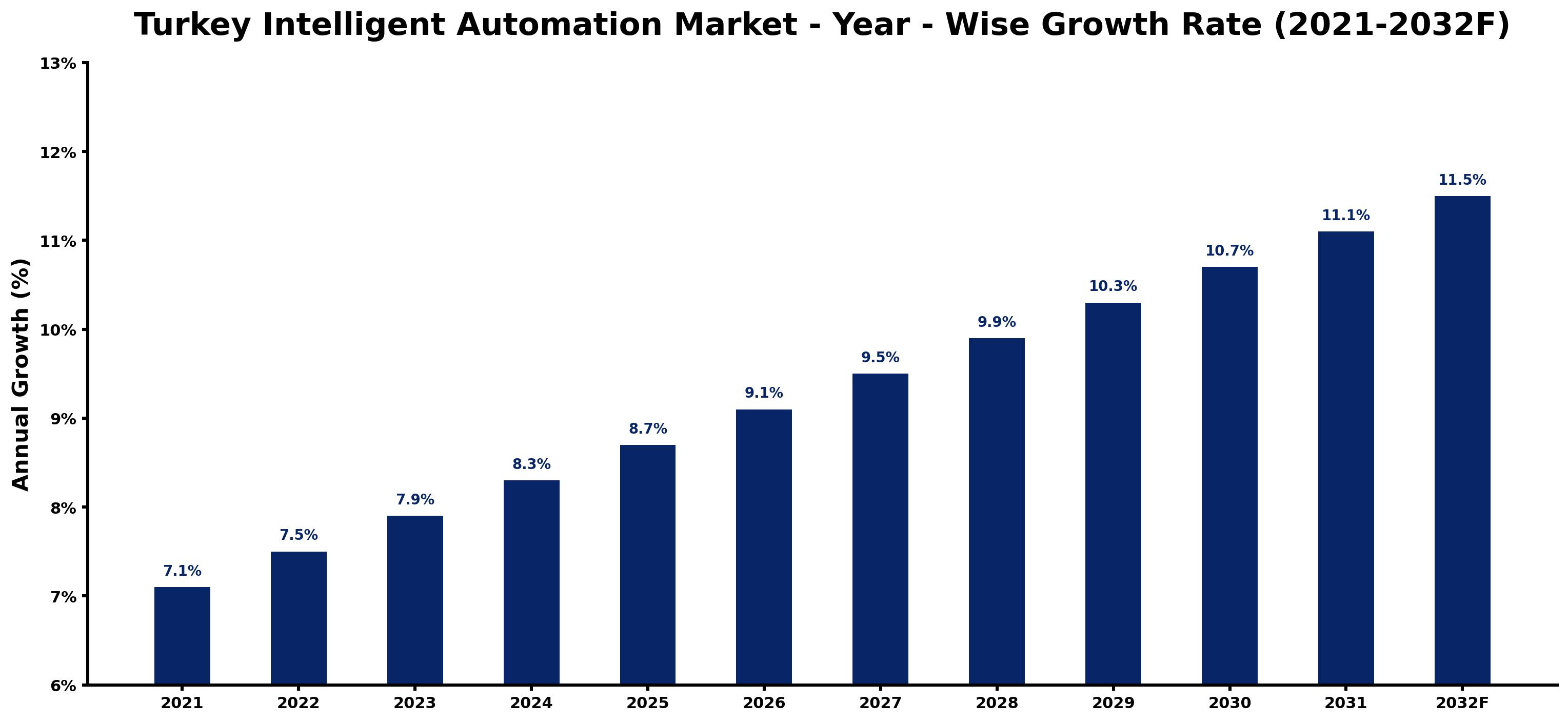
The table below presents the year‑wise growth rates along with the key drivers influencing the market
| Year | Growth Rate | Major Drivers |
| 2021 | 7.1% | Increasing smart city development projects |
| 2022 | 7.5% | Rapid growth in telecom and data center sectors |
| 2023 | 7.9% | Increasing industrial infrastructure investments |
| 2024 | 8.3% | Growing urbanization and commercial development |
| 2025 | 8.7% | Increasing industrial infrastructure investments |
| 2026 | 9.1% | Government infrastructure modernization initiatives |
| 2027 | 9.5% | Government infrastructure modernization initiatives |
| 2028 | 9.9% | Government infrastructure modernization initiatives |
| 2029 | 10.3% | Growing urbanization and commercial development |
| 2030 | 10.7% | Rising electricity demand across industries |
| 2031 | 11.1% | Rising electricity demand across industries |
| 2032 | 11.5% | Government infrastructure modernization initiatives |
Note - Market size estimations and growth projections presented in this report are based on 6Wresearch’s advanced forecasting approach, validated with industry datasets as of June 2026.
Turkey Intelligent Automation Market Synopsis
The adoption of robotic process automation is the strongest force currently shaping the Turkey Intelligent Automation Market. Businesses are increasingly leveraging RPA to automate repetitive tasks, thereby allowing human resources to focus on higher-value activities and innovative projects. This shift is particularly evident in sectors such as finance, healthcare, and manufacturing, where efficiency and accuracy are paramount.
Moreover, the integration of AI technologies is enhancing the capabilities of automation solutions, enabling real-time data analysis and decision-making processes. As companies look to harness the full potential of intelligent automation, the emphasis on collaborative systems that blend human expertise with technological efficiency becomes crucial for sustainable growth.
Turkey Intelligent Automation Market Key Takeaways
- Turkey's intelligent automation landscape is driven by a surge in RPA and AI adoption across diverse industries.
- Market growth is significantly influenced by the demand for increased operational efficiency and cost reduction.
- Implementation costs and the need for skilled professionals represent key barriers to widespread adoption.
- Government regulations aim to facilitate the responsible deployment of automation technologies to enhance competitiveness.
- The market is expected to witness significant advancements in AI capabilities, leading to smarter automation solutions.
Evaluation of Restraints in Turkey Intelligent Automation Market
Despite the promising growth trajectory, the Turkey Intelligent Automation Market faces several real restraints. High initial investment costs present a significant hurdle for many organizations considering automation technologies. Furthermore, the shift to intelligent automation often necessitates substantial changes in existing business processes, which can meet resistance from employees and management alike. The shortage of skilled professionals who can effectively design, implement, and manage these sophisticated systems further complicates matters, leading to delays in adoption and reduced effectiveness in execution.
Turkey Intelligent Automation Market Trends
Current trends in the Turkey Intelligent Automation Market indicate a move towards more collaborative automation solutions that integrate seamlessly with human workflows. Organizations are increasingly focusing on user-friendly interfaces and intuitive design, ensuring that automation technologies can be easily adopted by users without extensive training. Additionally, advancements in machine learning and natural language processing are set to enhance automation capabilities, allowing systems to become more adaptive and responsive to dynamic business environments.
Turkey Intelligent Automation Market Opportunities
The genuine growth and investment opportunities in the Turkey Intelligent Automation Market lie in sectors experiencing rapid digital transformation. For example, healthcare and logistics stand out as fields where intelligent automation can drive substantial efficiencies. As Turkish companies seek to improve operational resilience, the demand for customized automation solutions tailored to specific industry needs will likely increase, paving the way for innovative startups and established firms alike.
Government Initiatives in the Turkey Intelligent Automation Market
The Turkish government has recognized the importance of intelligent automation technologies in enhancing national productivity and competitiveness. Policies are being formulated to promote research and development in AI and automation, coupled with incentives for companies that adopt these technologies responsibly. There is a concerted effort to create a favorable regulatory environment that supports innovation while safeguarding ethical considerations and labor market stability.
Future Insights of the Turkey Intelligent Automation Market
Looking ahead to 2026-2032, the Turkey Intelligent Automation Market is poised for transformative growth. As more businesses embrace digital transformation, we anticipate a shift towards advanced technologies that enable complex decision-making and predictive analytics. This evolution will not only drive efficiency but also foster new business models centered around intelligent automation. The continuing emphasis on sustainability and responsible automation practices is likely to influence investment strategies, highlighting the need for solutions that are both effective and ethical.
Turkey Intelligent Automation Market Latest Developments (May 2025 - June 2026)
Recent developments in the Turkey Intelligent Automation Market indicate an acceleration in the deployment of automation technologies across various sectors. Companies are increasingly piloting integrated systems that blend AI with RPA, showcasing early successes in enhancing operational workflows. Additionally, partnerships between technology providers and academic institutions are emerging, aimed at addressing the skills gap in the workforce and fostering innovative solutions tailored for the Turkish market.
Turkey Intelligent Automation Market - Key Attractiveness of the Report
- 10 Years of Market Numbers
- Historical Data Starting from 2022 to 2025
- Base Year: 2025
- Forecast Data until 2032
- Key Performance Indicators Impacting the Market
- Major Upcoming Developments and Projects
Key Highlights of the Report:
- Turkey Intelligent Automation Market Outlook
- Market Size of Turkey Intelligent Automation Market, 2025
- Forecast of Turkey Intelligent Automation Market, 2032
- Historical Data and Forecast of Turkey Intelligent Automation Revenues & Volume for the Period 2022-2032F
- Turkey Intelligent Automation Market Trend Evolution
- Turkey Intelligent Automation Market Drivers and Challenges
- Turkey Intelligent Automation Price Trends
- Turkey Intelligent Automation Porter's Five Forces
- Turkey Intelligent Automation Industry Life Cycle
- Historical Data and Forecast of Turkey Intelligent Automation Market Revenues & Volume By Component for the Period 2022-2032F
- Historical Data and Forecast of Turkey Intelligent Automation Market Revenues & Volume By Solutions for the Period 2022-2032F
- Historical Data and Forecast of Turkey Intelligent Automation Market Revenues & Volume By Services for the Period 2022-2032F
- Historical Data and Forecast of Turkey Intelligent Automation Market Revenues & Volume By Managed Services for the Period 2022-2032F
- Historical Data and Forecast of Turkey Intelligent Automation Market Revenues & Volume By Verticals for the Period 2022-2032F
- Historical Data and Forecast of Turkey Intelligent Automation Market Revenues & Volume By BFSI for the Period 2022-2032F
- Historical Data and Forecast of Turkey Intelligent Automation Market Revenues & Volume By Healthcare for the Period 2022-2032F
- Historical Data and Forecast of Turkey Intelligent Automation Market Revenues & Volume By Retail for the Period 2022-2032F
- Historical Data and Forecast of Turkey Intelligent Automation Market Revenues & Volume By Government for the Period 2022-2032F
- Historical Data and Forecast of Turkey Intelligent Automation Market Revenues & Volume By Telecommunication for the Period 2022-2032F
- Historical Data and Forecast of Turkey Intelligent Automation Market Revenues & Volume By Utilities for the Period 2022-2032F
- Historical Data and Forecast of Turkey Intelligent Automation Market Revenues & Volume By Others for the Period 2022-2032F
- Historical Data and Forecast of Turkey Intelligent Automation Market Revenues & Volume By End users for the Period 2022-2032F
- Historical Data and Forecast of Turkey Intelligent Automation Market Revenues & Volume By Natural Language Processing for the Period 2022-2032F
- Historical Data and Forecast of Turkey Intelligent Automation Market Revenues & Volume By Machine & Deep Learning for the Period 2022-2032F
- Historical Data and Forecast of Turkey Intelligent Automation Market Revenues & Volume By Virtual Agents for the Period 2022-2032F
- Historical Data and Forecast of Turkey Intelligent Automation Market Revenues & Volume By Mini Bots & RPA for the Period 2022-2032F
- Historical Data and Forecast of Turkey Intelligent Automation Market Revenues & Volume By Computer Vision for the Period 2022-2032F
- Historical Data and Forecast of Turkey Intelligent Automation Market Revenues & Volume By Others for the Period 2022-2032F
- Turkey Intelligent Automation Import Export Trade Statistics
- Market Opportunity Assessment By Component
- Market Opportunity Assessment By Verticals
- Market Opportunity Assessment By End users
- Turkey Intelligent Automation Top Companies Market Share
- Turkey Intelligent Automation Competitive Benchmarking By Technical and Operational Parameters
- Turkey Intelligent Automation Company Profiles
- Turkey Intelligent Automation Key Strategic Recommendations






































