Turkey Kefir Market Size, Share & Growth Rate
The Turkey Kefir Market was estimated at USD 261 Million in 2025 and is projected to reach USD 343 Million by 2032, growing at a CAGR of 4.0% from 2026 to 2032. This growth trajectory is fueled by an increasing consumer demand for probiotic-rich foods, particularly among health-conscious individuals seeking natural options to enhance digestive health and immunity. The proliferation of kefir products across various platforms, including functional beverages and dietary supplements, further catalyzes market expansion.
Turkey Kefir Market Year-wise Growth Rate and Key Drivers
This graph highlights how the Turkey Kefir Market has steadily grown over the years, supported by major growth factors.
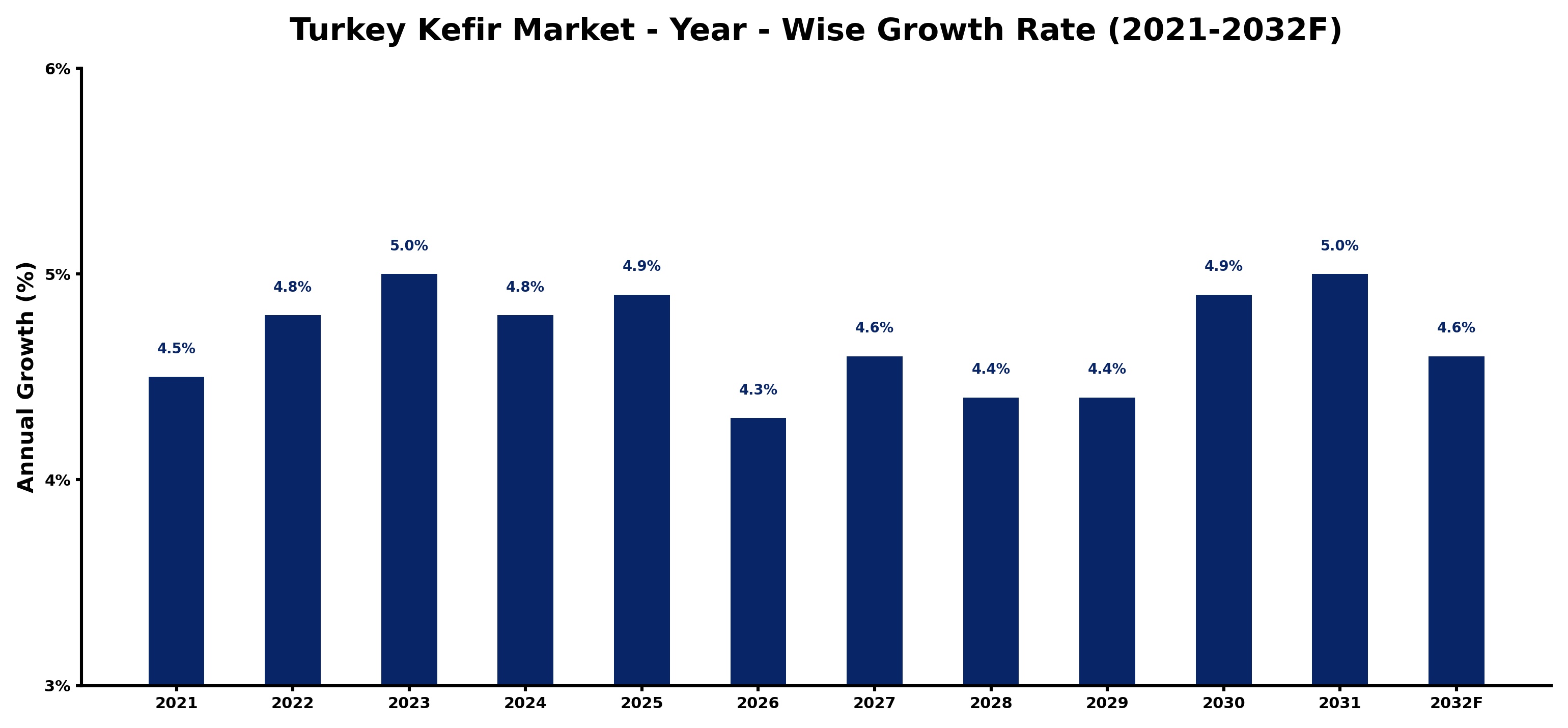
The table below presents the year‑wise growth rates along with the key drivers influencing the market
| Year | Growth Rate | Major Drivers |
| 2021 | 4.5% | Health benefits gained consumer attention |
| 2022 | 4.8% | Increased awareness of probiotics importance |
| 2023 | 5.0% | Diverse flavor offerings attracted consumers |
| 2024 | 4.8% | Sustainable packaging practices gained traction |
| 2025 | 4.9% | Growing demand for functional beverages |
| 2026 | 4.3% | Innovative marketing strategies enhanced visibility |
| 2027 | 4.6% | Local sourcing trends fostered loyalty |
| 2028 | 4.4% | Rising popularity of dairy alternatives |
| 2029 | 4.4% | Expansion of kefir product lines |
| 2030 | 4.9% | Collaborations with health influencers increased |
| 2031 | 5.0% | Increased distribution through e-commerce |
| 2032 | 4.6% | Consumer education programs enhanced knowledge |
Note - Market size estimations and growth projections presented in this report are based on 6Wresearch's advanced forecasting approach, validated with industry datasets as of June 2026.
Turkey Kefir Market Synopsis
In Turkey, kefir has gained traction as a staple in many households, not just as a beverage but also as a versatile ingredient in various culinary applications. The traditional roots of kefir in Turkish culture complement the modern health trends, creating a unique convergence that drives its consumption.
Moreover, the availability of kefir in multiple formats—such as drinks, powders, and yogurts—has expanded its appeal. The market is witnessing a surge in innovative products that cater to evolving consumer preferences, positioning kefir as an essential player in the health and wellness sector.
Turkey Kefir Market Key Takeaways
- Growing consumer awareness about probiotic benefits is significantly boosting demand.
- Kefir's adaptability in food products enhances its market presence.
- Turkish government initiatives support kefir production and promote public health.
- High production costs and quality maintenance present ongoing challenges.
- Competition from both local and international brands intensifies market dynamics.
Evaluation of Restraints in Turkey Kefir Market
Despite its positive growth outlook, the Turkey Kefir Market encounters significant restraints that could limit its potential. High production costs remain a critical barrier, particularly for small and medium enterprises striving to maintain quality while remaining competitive. The complexity involved in ensuring consistent product quality and safety standards is another challenge. There is an ongoing need for consumer education regarding the health benefits of kefir, which is essential for driving increased market penetration and consumer loyalty. A lack of awareness can hinder the broader adoption of kefir across diverse demographics.
Turkey Kefir Market Trends
Several trends are shaping the Turkey Kefir Market, primarily the rising interest in functional foods that provide health benefits beyond basic nutrition. Increasingly, consumers are gravitating towards beverages that are perceived as "natural" or "organic," which enhances kefir's attractiveness. Additionally, there is a noticeable trend toward plant-based and lactose-free kefir options, catering to a wider range of dietary preferences.
The incorporation of kefir into various health and wellness programs is also gaining traction, as more consumers seek products that align with their health goals. Innovations in flavors and forms are continuously emerging, indicating a dynamic approach within the market to cater to evolving tastes.
Turkey Kefir Market Opportunities
The Turkey Kefir Market presents considerable opportunities for growth and investment. Expanding distribution channels, particularly e-commerce platforms, can significantly enhance product accessibility. Moreover, the increasing awareness of gut health opens doors for targeted marketing strategies that resonate with health-conscious consumers. Partnerships with health professionals and nutritionists could further solidify kefir's reputation as a functional food, paving the way for greater market share.
Government Initiatives in the Turkey Kefir Market
The Turkish government has recognized the importance of kefir as a probiotic dairy product and has implemented supportive policies aimed at promoting its production. These initiatives include the establishment of food safety standards that ensure the quality and efficacy of kefir products. By fostering a conducive environment for production, the government helps to enhance public health outcomes and boosts consumer trust in these probiotic offerings.
Future Insights of the Turkey Kefir Market
Looking ahead to 2026-2032, the Turkey Kefir Market is poised for sustained growth, driven by shifting consumer preferences and an increasing focus on health and wellness. As awareness around the benefits of probiotics continues to grow, kefir's role in functional foods is likely to expand. Innovations in product offerings and collaborations with health sectors will further reinforce kefir's position in the market, establishing it as a staple for health-conscious consumers.
Turkey Kefir Market Latest Developments (May 2025 - June 2026)
Recent industry developments indicate a strategic shift towards enhancing consumer engagement and education around kefir. Initiatives focused on improving product quality and safety are becoming more prevalent, as companies invest in research and development to create innovative and diverse product lines. The competitive landscape is evolving, with new entrants focusing on niche markets, further invigorating consumer interest in this traditional yet modern dairy product.
Turkey Kefir Market - Key Attractiveness of the Report
- 10 Years of Market Numbers
- Historical Data Starting from 2022 to 2025
- Base Year: 2025
- Forecast Data until 2032
- Key Performance Indicators Impacting the Market
- Major Upcoming Developments and Projects
Key Highlights of the Report:
- Turkey Kefir Market Outlook
- Market Size of Turkey Kefir Market, 2025
- Forecast of Turkey Kefir Market, 2032
- Historical Data and Forecast of Turkey Kefir Revenues & Volume for the Period 2022-2032F
- Turkey Kefir Market Trend Evolution
- Turkey Kefir Market Drivers and Challenges
- Turkey Kefir Price Trends
- Turkey Kefir Porter's Five Forces
- Turkey Kefir Industry Life Cycle
- Historical Data and Forecast of Turkey Kefir Market Revenues & Volume By Nature for the Period 2022-2032F
- Historical Data and Forecast of Turkey Kefir Market Revenues & Volume By Organic for the Period 2022-2032F
- Historical Data and Forecast of Turkey Kefir Market Revenues & Volume By Conventional for the Period 2022-2032F
- Historical Data and Forecast of Turkey Kefir Market Revenues & Volume By Product Types for the Period 2022-2032F
- Historical Data and Forecast of Turkey Kefir Market Revenues & Volume By Flavored for the Period 2022-2032F
- Historical Data and Forecast of Turkey Kefir Market Revenues & Volume By Unflavored for the Period 2022-2032F
- Historical Data and Forecast of Turkey Kefir Market Revenues & Volume By Applications for the Period 2022-2032F
- Historical Data and Forecast of Turkey Kefir Market Revenues & Volume By Foods and beverages for the Period 2022-2032F
- Historical Data and Forecast of Turkey Kefir Market Revenues & Volume By Pharmaceutical for the Period 2022-2032F
- Historical Data and Forecast of Turkey Kefir Market Revenues & Volume By Source for the Period 2022-2032F
- Historical Data and Forecast of Turkey Kefir Market Revenues & Volume By Animal milk for the Period 2022-2032F
- Historical Data and Forecast of Turkey Kefir Market Revenues & Volume By Soy milk for the Period 2022-2032F
- Historical Data and Forecast of Turkey Kefir Market Revenues & Volume By Coconut milk for the Period 2022-2032F
- Historical Data and Forecast of Turkey Kefir Market Revenues & Volume By Others for the Period 2022-2032F
- Turkey Kefir Import Export Trade Statistics
- Market Opportunity Assessment By Nature
- Market Opportunity Assessment By Product Types
- Market Opportunity Assessment By Applications
- Market Opportunity Assessment By Source
- Turkey Kefir Top Companies Market Share
- Turkey Kefir Competitive Benchmarking By Technical and Operational Parameters
- Turkey Kefir Company Profiles
- Turkey Kefir Key Strategic Recommendations






































