Turkey Structural Steel Fabrication Market Size, Share & Growth Rate
The Turkey Structural Steel Fabrication Market was estimated at USD 1454 Million in 2025 and is projected to reach USD 2078 Million by 2032, growing at a CAGR of 5.2% from 2026 to 2032. This growth trajectory is primarily driven by the country's robust investments in infrastructure, commercial, and residential construction projects. The increasing need for high-quality steel products, coupled with the push for sustainable building practices, is further propelling market demand.
Turkey Structural Steel Fabrication Market Year-wise Growth Rate and Key Drivers
This graph highlights how the Turkey Structural Steel Fabrication Market has steadily grown over the years, supported by major growth factors.
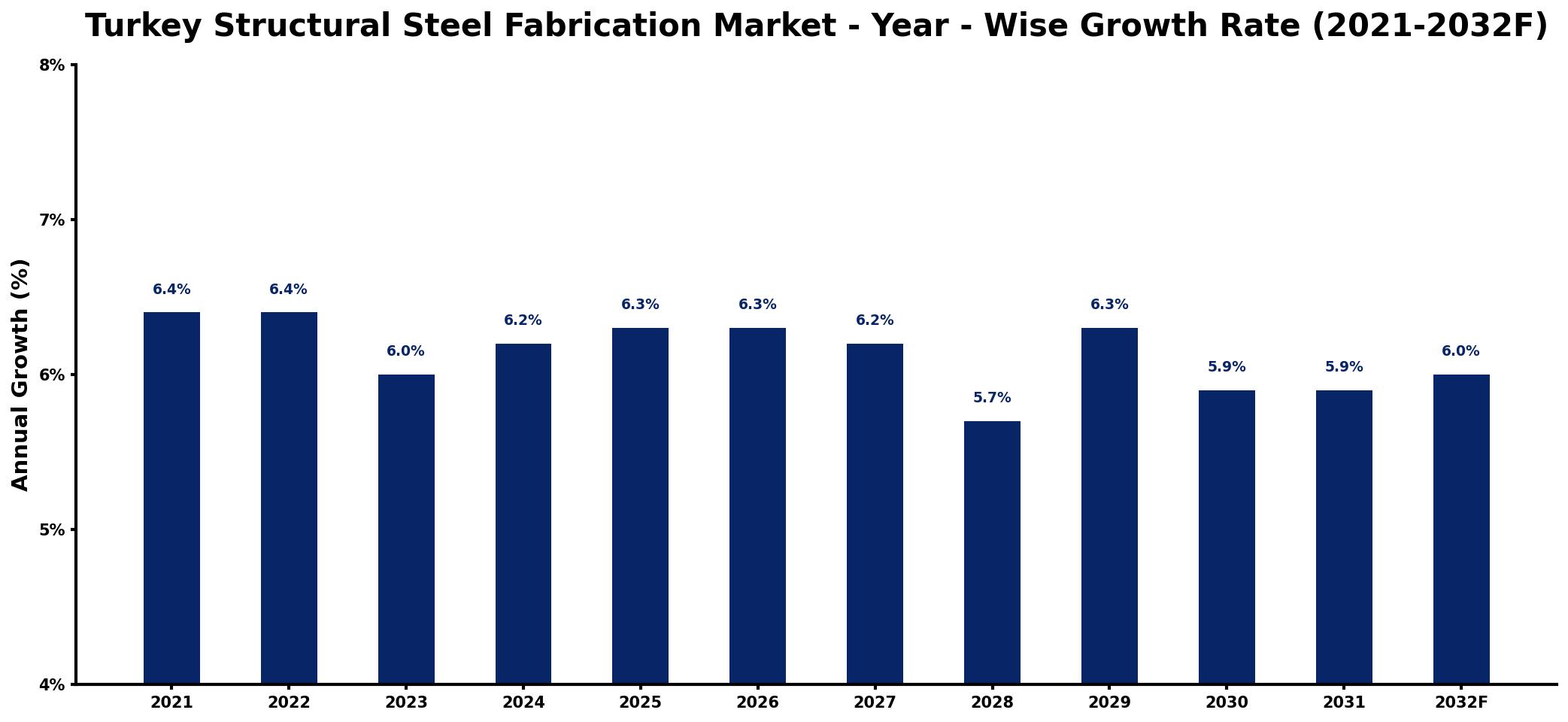
The table below presents the year‑wise growth rates along with the key drivers influencing the market
| Year | Growth Rate | Major Drivers |
| 2021 | 6.4% | Rising construction project investments |
| 2022 | 6.4% | Increased infrastructure development initiatives |
| 2023 | 6.0% | Growing urbanization and housing demand |
| 2024 | 6.2% | Expansion in renewable energy sector |
| 2025 | 6.3% | Surge in commercial building projects |
| 2026 | 6.3% | Boost in public transportation funding |
| 2027 | 6.2% | Emerging demand from industrial sectors |
| 2028 | 5.7% | Focus on sustainable building practices |
| 2029 | 6.3% | Increasing government infrastructure spending |
| 2030 | 5.9% | Technological advancements in construction |
| 2031 | 5.9% | Growing demand for residential complexes |
| 2032 | 6.0% | Expansion of logistics and warehousing |
Note: Market size estimations and growth projections presented in this report are based on 6Wresearch's proprietary forecasting methodology, utilizing the latest available industry data, government publications, and primary research inputs.
Turkey Structural Steel Fabrication Market Synopsis
Turkey's structural steel fabrication sector is witnessing a surge in demand due to a significant pipeline of infrastructure projects, including bridges, highways, and public buildings. This growth is supported by the local manufacturing capacity, which is expanding to meet the rising needs of the construction industry.
As the market evolves, there is a distinct trend towards adopting advanced technologies like CAD and BIM. These innovations not only streamline fabrication processes but also enhance precision and efficiency, positioning Turkish manufacturers competitively within the global landscape.
Turkey Structural Steel Fabrication Market Key Takeaways
- The market is projected to expand significantly, driven by ongoing construction and infrastructure projects.
- Technological advancements are leading to more efficient and sustainable fabrication processes.
- Government policies are promoting local production and sustainable practices in the sector.
- Investment in automation and collaboration with contractors offers lucrative growth opportunities.
- Demand for modular and prefabricated structures is increasing, enhancing project turnaround times.
Evaluation of Restraints in Turkey Structural Steel Fabrication Market
Despite its growth, the Turkey Structural Steel Fabrication Market faces challenges that can inhibit progress. Intense competition among local and international firms pressures margins, while fluctuating raw material prices complicate cost management. Furthermore, the need for continuous technological innovation is critical; companies must keep pace with evolving industry standards to remain relevant. Regulatory changes can also affect operational dynamics, posing additional hurdles for firms navigating compliance requirements amid economic uncertainties.
Turkey Structural Steel Fabrication Market Trends
A notable trend in the market is the growing emphasis on sustainability. Companies are increasingly adopting eco-friendly practices, focusing on minimizing waste during the fabrication process. Additionally, the rise of modular and prefabricated construction methods is gaining traction, resulting in quicker project completions and reduced labor costs. The integration of advanced fabrication technologies such as robotics and automation is enhancing operational efficiencies, leading to higher-quality output.
Turkey Structural Steel Fabrication Market Opportunities
Investment opportunities in Turkey's structural steel fabrication market are robust. Establishing new fabrication facilities or expanding existing ones can be highly advantageous given the increasing demand from various construction sectors. Moreover, investments in cutting-edge technologies will not only enhance efficiency but also enable manufacturers to offer superior products. Long-term partnerships with construction companies are also promising, allowing for stable demand and collaborative innovations.
Government Initiatives in the Turkey Structural Steel Fabrication Market
The Turkish government is actively supporting the structural steel fabrication market through various initiatives aimed at bolstering domestic production. Policies include tax incentives and subsidies for local manufacturers, aimed at enhancing competitiveness against imported steel products. Furthermore, there is a strong emphasis on promoting sustainable practices within the industry, aligning with global environmental standards and encouraging compliance with quality regulations. These initiatives create a conducive environment for market growth.
Future Insights of the Turkey Structural Steel Fabrication Market
Looking ahead, the future of the Turkey Structural Steel Fabrication Market appears promising. With urbanization on the rise and government initiatives driving infrastructure investments, demand for structural steel is expected to soar. Additionally, the integration of advanced technologies will likely streamline operations and improve product quality. As the market evolves, companies that embrace innovation and sustainability will be best positioned to capitalize on the burgeoning opportunities within the construction sector.
Turkey Structural Steel Fabrication Market Latest Developments (2025 - 2026)
Recent developments in the Turkey Structural Steel Fabrication Market indicate a shift towards automation and digitalization. Companies are investing in advanced fabrication technologies, including machine learning and AI, to enhance productivity and precision. Furthermore, the market is witnessing an increase in collaborative projects between fabricators and construction firms, aimed at optimizing resource utilization and accelerating project timelines. This trend is essential as the industry aims to meet the rising demand for efficient construction solutions.
Turkey Structural Steel Fabrication Market - Key Attractiveness of the Report
- 10 Years of Market Numbers
- Historical Data Starting from 2022 to 2025
- Base Year: 2025
- Forecast Data until 2032
- Key Performance Indicators Impacting the Market
- Major Upcoming Developments and Projects
Key Highlights of the Report:
- Turkey Structural Steel Fabrication Market Outlook
- Market Size of Turkey Structural Steel Fabrication Market, 2025
- Forecast of Turkey Structural Steel Fabrication Market, 2032
- Historical Data and Forecast of Turkey Structural Steel Fabrication Revenues & Volume for the Period 2022-2032F
- Turkey Structural Steel Fabrication Market Trend Evolution
- Turkey Structural Steel Fabrication Market Drivers and Challenges
- Turkey Structural Steel Fabrication Price Trends
- Turkey Structural Steel Fabrication Porter's Five Forces
- Turkey Structural Steel Fabrication Industry Life Cycle
- Historical Data and Forecast of Turkey Structural Steel Fabrication Market Revenues & Volume By End-user Industry for the Period 2022-2032F
- Historical Data and Forecast of Turkey Structural Steel Fabrication Market Revenues & Volume By Manufacturing for the Period 2022-2032F
- Historical Data and Forecast of Turkey Structural Steel Fabrication Market Revenues & Volume By Power and Energy for the Period 2022-2032F
- Historical Data and Forecast of Turkey Structural Steel Fabrication Market Revenues & Volume By Construction for the Period 2022-2032F
- Historical Data and Forecast of Turkey Structural Steel Fabrication Market Revenues & Volume By Oil and Gas for the Period 2022-2032F
- Historical Data and Forecast of Turkey Structural Steel Fabrication Market Revenues & Volume By Other for the Period 2022-2032F
- Historical Data and Forecast of Turkey Structural Steel Fabrication Market Revenues & Volume By Product Type for the Period 2022-2032F
- Historical Data and Forecast of Turkey Structural Steel Fabrication Market Revenues & Volume By Heavy Sectional Steel for the Period 2022-2032F
- Historical Data and Forecast of Turkey Structural Steel Fabrication Market Revenues & Volume By Light Sectional Steel for the Period 2022-2032F
- Historical Data and Forecast of Turkey Structural Steel Fabrication Market Revenues & Volume By Other for the Period 2022-2032F
- Turkey Structural Steel Fabrication Import Export Trade Statistics
- Market Opportunity Assessment By End-user Industry
- Market Opportunity Assessment By Product Type
- Turkey Structural Steel Fabrication Top Companies Market Share
- Turkey Structural Steel Fabrication Competitive Benchmarking By Technical and Operational Parameters
- Turkey Structural Steel Fabrication Company Profiles
- Turkey Structural Steel Fabrication Key Strategic Recommendations






































