Turkey Ultra Thin Glass Market Size, Share & Growth Rate
The Turkey Ultra Thin Glass Market was estimated at USD 745 Million in 2025 and is projected to reach USD 1068 Million by 2032, growing at a CAGR of 5.3% from 2026 to 2032. This growth trajectory is primarily fueled by the expanding applications of ultra thin glass in the electronics sector, automotive displays, and innovative construction projects. The technological advancements in glass manufacturing techniques, which enhance both the strength and thinness of glass products, are pivotal in meeting the increasing demand for high-performance and lightweight materials.
Turkey Ultra Thin Glass Market Year-wise Growth Rate and Key Drivers
This graph highlights how the Turkey Ultra Thin Glass Market has steadily grown over the years, supported by major growth factors.
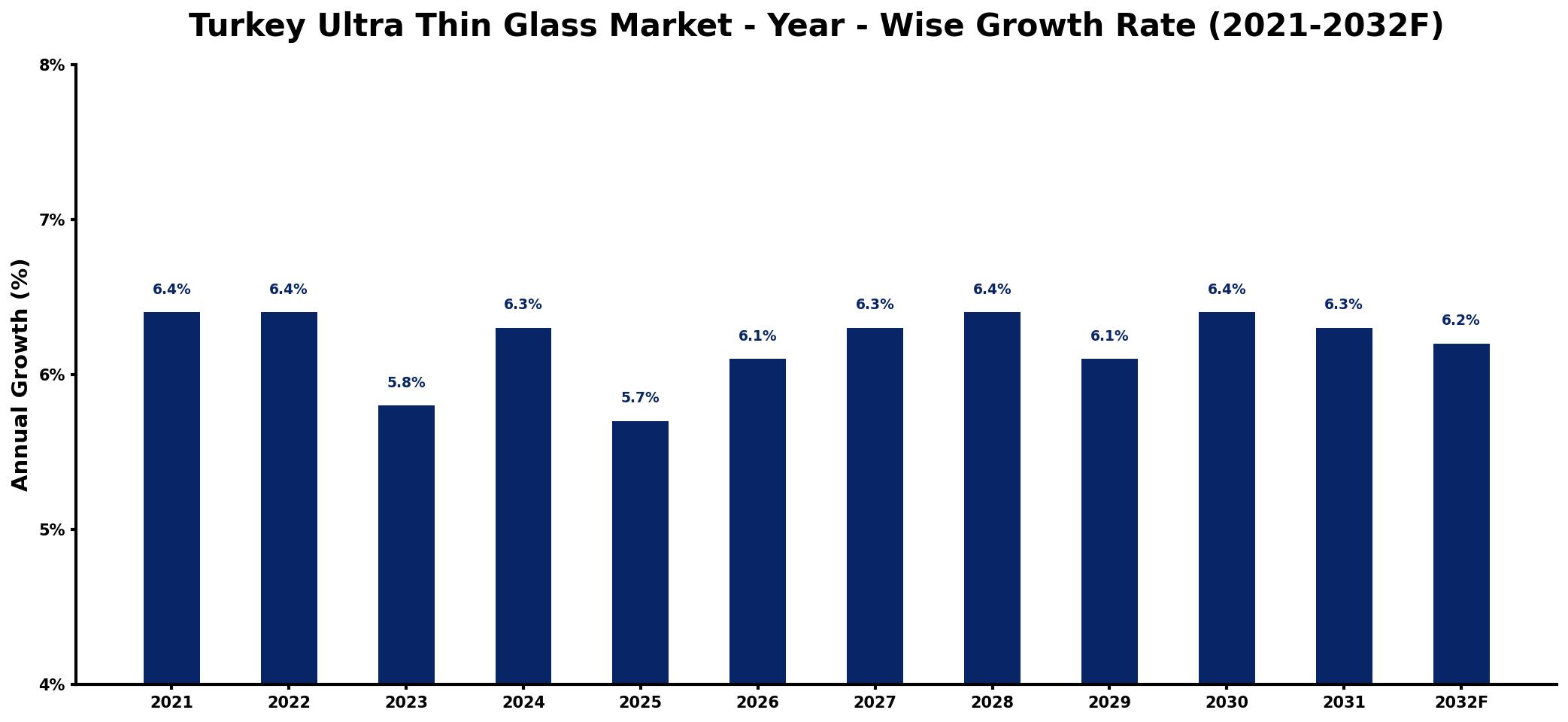
The table below presents the year‑wise growth rates along with the key drivers influencing the market
| Year | Growth Rate | Major Drivers |
| 2021 | 6.4% | Rising demand from electronics sector |
| 2022 | 6.4% | Increased investments in construction |
| 2023 | 5.8% | Growing automotive industry requirements |
| 2024 | 6.3% | Surge in renewable energy projects |
| 2025 | 5.7% | Expansion of consumer electronics market |
| 2026 | 6.1% | Advancements in manufacturing technologies |
| 2027 | 6.3% | Higher residential renovation activities |
| 2028 | 6.4% | Increased focus on energy efficiency |
| 2029 | 6.1% | Growth in luxury appliance sales |
| 2030 | 6.4% | Rising popularity of smart homes |
| 2031 | 6.3% | increased pharmaceutical industry usage |
| 2032 | 6.2% | Increased government infrastructure projects |
Note: Market size estimations and growth projections presented in this report are based on 6Wresearch's proprietary forecasting methodology, utilizing the latest available industry data, government publications, and primary research inputs.
Turkey Ultra Thin Glass Market Synopsis
Currently, the Turkey ultra thin glass market is thriving as various industries seek lighter, more durable materials. The adoption of ultra thin glass is notably increasing in consumer electronics, particularly in smartphones and tablets, where touch sensitivity and optical clarity are paramount.
Moreover, the automotive sector's ongoing transformation toward digitization and enhanced user interfaces further boosts demand. As vehicles increasingly rely on advanced displays, ultra thin glass is becoming essential for integrating these features seamlessly.
Turkey Ultra Thin Glass Market Key Takeaways
- The market is set to experience significant growth driven by demand from electronics and automotive sectors.
- Technological innovations are leading to the development of thinner and stronger glass products.
- Government policies support research and investment in ultra thin glass manufacturing.
- Challenges related to quality control during production are present but manageable.
- Environmental sustainability initiatives are prompting a shift towards recycling practices in the glass industry.
Evaluation of Restraints in Turkey Ultra Thin Glass Market
Despite the promising growth, the Turkey ultra thin glass market faces several critical restraints. Manufacturing ultra-thin glass sheets entails sophisticated processes that can lead to technological limitations. Additionally, the fragility of these products introduces quality control challenges, particularly during production and transportation. Regulatory standards regarding glass thickness and safety further complicate market dynamics, as they require constant adaptation from manufacturers to ensure compliance. These factors could potentially inhibit the speed at which the market expands, as companies navigate these complexities.
Turkey Ultra Thin Glass Market Trends
Several trends are shaping the Turkey ultra thin glass market. The shift towards lightweight materials across various sectors reflects a broader trend in sustainability and efficiency. Moreover, the proliferation of smart devices is fostering the demand for ultra-thin, touch-sensitive displays, leading to innovations in product design. Another notable trend is the increasing integration of ultra thin glass in automotive displays, enhancing user experiences and supporting the industrys digital transformation.
Turkey Ultra Thin Glass Market Opportunities
The Turkey ultra thin glass market presents numerous growth opportunities, particularly in the realms of renewable energy and smart technology. The rising deployment of solar panels that utilize ultra thin glass can significantly enhance energy efficiency. Additionally, there is potential for investment in advanced glass production technologies, especially those that focus on sustainability and recycling. With the Turkish government's support for innovation, market players can explore new avenues for product development and collaboration.
Government Initiatives in the Turkey Ultra Thin Glass Market
The Turkish government has taken proactive measures to bolster the ultra thin glass market through various initiatives. Policies emphasize the importance of technological innovation and stringent product quality standards. Funding programs aimed at research and development in glass manufacturing processes are being promoted, alongside incentives for investment in advanced technologies. These government efforts not only aim to enhance production capabilities but also encourage recycling initiatives to reduce the environmental impact associated with glass manufacturing.
Future Insights of the Turkey Ultra Thin Glass Market
Looking ahead to 2026-2032, the Turkey ultra thin glass market is poised for robust growth, driven by ongoing advancements in manufacturing technology and increasing applications across various industries. As consumer demand for high-performance electronic devices continues to surge, manufacturers are likely to invest in research that enhances the strength and performance of ultra thin glass. The automotive sector's transition towards digitized interfaces will further cement ultra thin glasss role as a critical component, fostering a more integrated, efficient market landscape.
Turkey Ultra Thin Glass Market Latest Developments (2025 - 2026)
Recent developments in the Turkey ultra thin glass market indicate a strong focus on technological advancements and sustainability. Innovations are increasingly centered on improving the durability and versatility of ultra thin glass products. Moreover, collaborations between manufacturers and research institutions are becoming common as both seek to enhance production efficiency and product quality. The emphasis on meeting international safety standards is also gaining traction, with efforts to streamline compliance processes across the board.
Turkey Ultra Thin Glass Market - Key Attractiveness of the Report
- 10 Years of Market Numbers
- Historical Data Starting from 2022 to 2025
- Base Year: 2025
- Forecast Data until 2032
- Key Performance Indicators Impacting the Market
- Major Upcoming Developments and Projects
Key Highlights of the Report:
- Turkey Ultra Thin Glass Market Outlook
- Market Size of Turkey Ultra Thin Glass Market, 2025
- Forecast of Turkey Ultra Thin Glass Market, 2032
- Historical Data and Forecast of Turkey Ultra Thin Glass Revenues & Volume for the Period 2022-2032F
- Turkey Ultra Thin Glass Market Trend Evolution
- Turkey Ultra Thin Glass Market Drivers and Challenges
- Turkey Ultra Thin Glass Price Trends
- Turkey Ultra Thin Glass Porter's Five Forces
- Turkey Ultra Thin Glass Industry Life Cycle
- Historical Data and Forecast of Turkey Ultra Thin Glass Market Revenues & Volume By Thickness for the Period 2022-2032F
- Historical Data and Forecast of Turkey Ultra Thin Glass Market Revenues & Volume By <0.1mm for the Period 2022-2032F
- Historical Data and Forecast of Turkey Ultra Thin Glass Market Revenues & Volume By 0.1mm-0.5mm for the Period 2022-2032F
- Historical Data and Forecast of Turkey Ultra Thin Glass Market Revenues & Volume By 0.5mm-1.0mm for the Period 2022-2032F
- Historical Data and Forecast of Turkey Ultra Thin Glass Market Revenues & Volume By Manufacturing Process for the Period 2022-2032F
- Historical Data and Forecast of Turkey Ultra Thin Glass Market Revenues & Volume By Float for the Period 2022-2032F
- Historical Data and Forecast of Turkey Ultra Thin Glass Market Revenues & Volume By Fusion for the Period 2022-2032F
- Historical Data and Forecast of Turkey Ultra Thin Glass Market Revenues & Volume By Down-Draw for the Period 2022-2032F
- Historical Data and Forecast of Turkey Ultra Thin Glass Market Revenues & Volume By Application for the Period 2022-2032F
- Historical Data and Forecast of Turkey Ultra Thin Glass Market Revenues & Volume By Semiconductor Substrate for the Period 2022-2032F
- Historical Data and Forecast of Turkey Ultra Thin Glass Market Revenues & Volume By Touch Panel Display for the Period 2022-2032F
- Historical Data and Forecast of Turkey Ultra Thin Glass Market Revenues & Volume By Fingerprint Sensor for the Period 2022-2032F
- Historical Data and Forecast of Turkey Ultra Thin Glass Market Revenues & Volume By Others for the Period 2022-2032F
- Historical Data and Forecast of Turkey Ultra Thin Glass Market Revenues & Volume By End-use Industry for the Period 2022-2032F
- Historical Data and Forecast of Turkey Ultra Thin Glass Market Revenues & Volume By Consumer Electronics for the Period 2022-2032F
- Historical Data and Forecast of Turkey Ultra Thin Glass Market Revenues & Volume By Automotive & Transportation for the Period 2022-2032F
- Historical Data and Forecast of Turkey Ultra Thin Glass Market Revenues & Volume By Medical & Healthcare for the Period 2022-2032F
- Historical Data and Forecast of Turkey Ultra Thin Glass Market Revenues & Volume By Others for the Period 2022-2032F
- Turkey Ultra Thin Glass Import Export Trade Statistics
- Market Opportunity Assessment By Thickness
- Market Opportunity Assessment By Manufacturing Process
- Market Opportunity Assessment By Application
- Market Opportunity Assessment By End-use Industry
- Turkey Ultra Thin Glass Top Companies Market Share
- Turkey Ultra Thin Glass Competitive Benchmarking By Technical and Operational Parameters
- Turkey Ultra Thin Glass Company Profiles
- Turkey Ultra Thin Glass Key Strategic Recommendations






































