United Arab Emirates (UAE) Acetate Yarn Market Size, Share & Growth Rate
The United Arab Emirates (UAE) Acetate Yarn Market was estimated at USD 424 Million in 2025 and is projected to reach USD 596 Million by 2032, growing at a CAGR of 5.0% from 2026 to 2032. This anticipated growth trajectory is being driven by an increasing demand for high-quality textiles that offer both aesthetic appeal and comfort. As the fashion sector embraces more luxurious yet affordable fabrics, acetate yarn is positioned well to capitalize on these evolving consumer trends.
United Arab Emirates (UAE) Acetate Yarn Market Year-wise Growth Rate and Key Drivers
This graph highlights how the United Arab Emirates (UAE) Acetate Yarn Market has steadily grown over the years, supported by major growth factors.
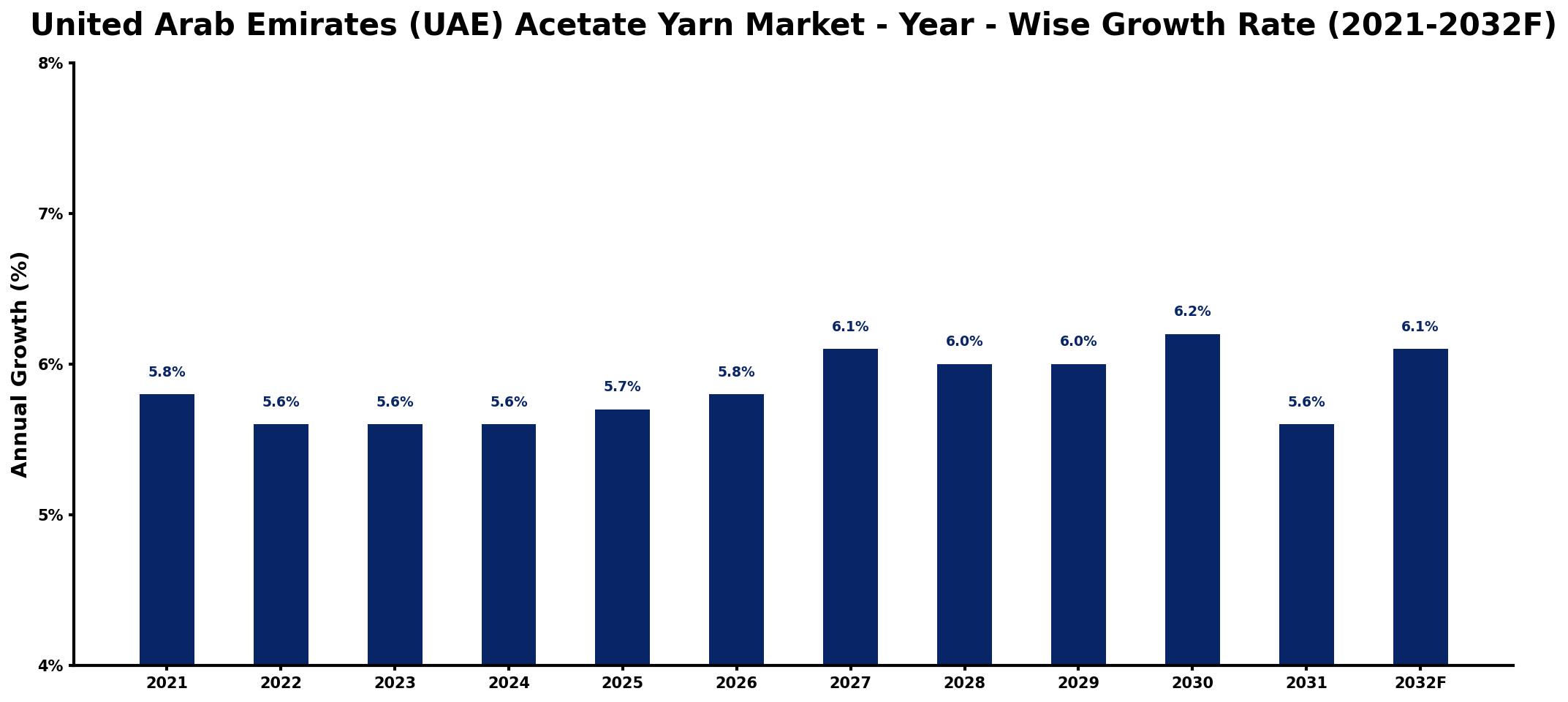
The table below presents the year‑wise growth rates along with the key drivers influencing the market
| Year | Growth Rate | Major Drivers |
| 2021 | 5.8% | Rising fashion industry demand |
| 2022 | 5.6% | Increased textile manufacturing investments |
| 2023 | 5.6% | Growing consumer preference sustainability |
| 2024 | 5.6% | Expansion of online retail channels |
| 2025 | 5.7% | Emerging markets driving consumption |
| 2026 | 5.8% | Technological advancements in production |
| 2027 | 6.1% | New fashion trends influencing usage |
| 2028 | 6.0% | Strengthening export opportunities abroad |
| 2029 | 6.0% | Enhanced product innovation initiatives |
| 2030 | 6.2% | Growing awareness of eco-friendly materials |
| 2031 | 5.6% | Diversification of application sectors |
| 2032 | 6.1% | Strengthened partnerships with retailers |
Note: Market size estimations and growth projections presented in this report are based on 6Wresearch's proprietary forecasting methodology, utilizing the latest available industry data, government publications, and primary research inputs.
United Arab Emirates (UAE) Acetate Yarn Market Synopsis
The UAE Acetate Yarn Market is gaining traction as a significant segment within the textile industry, characterized by its unique blend of elegance and affordability. With its smooth texture and lustrous appearance, acetate yarn serves as a preferred choice for a wide array of applications, from contemporary apparel to elegant home furnishings.
Moreover, the market's growth is closely linked to the broader economic landscape of the UAE, where a burgeoning middle class has shown an increasing inclination towards stylish and luxurious fabric options. This rising consumer base, coupled with a commitment to sustainability and eco-friendly textiles, is shaping the future of acetate yarn production in the region.
United Arab Emirates (UAE) Acetate Yarn Market Key Takeaways
- The market is benefiting from a growing preference for affordable luxury textiles.
- Consumer trends indicate a shift towards sustainable and eco-friendly materials.
- Acetate yarn's versatility lends itself to various textile applications.
- Global fluctuations in wood pulp prices pose challenges to production costs.
- The post-pandemic recovery phase presents new opportunities for market expansion.
Evaluation of Restraints in United Arab Emirates (UAE) Acetate Yarn Market
The UAE Acetate Yarn Market faces notable challenges primarily rooted in the sourcing of raw materials. The reliance on cellulose from wood pulp makes it vulnerable to supply chain disruptions, exacerbated by climate-related issues and increasing sustainability concerns. As consumer awareness about environmental issues grows, manufacturers are pressed to innovate in the realm of sustainable materials, which may require substantial investment in research and development. Such complexities contribute to fluctuating production costs, creating uncertainty in market pricing and competitiveness.
United Arab Emirates (UAE) Acetate Yarn Market Trends
Several trends are emerging that are reshaping the UAE Acetate Yarn Market. Notably, there is a growing inclination towards sustainable fashion, with consumers favoring fabrics that are both stylish and environmentally friendly. This trend is driving investments into alternative fiber sources and sustainable production practices. Additionally, the rising popularity of online retail is changing how textiles are marketed and sold, allowing for greater consumer access to acetate yarn products.
United Arab Emirates (UAE) Acetate Yarn Market Opportunities
The evolving landscape presents multiple growth opportunities for the UAE Acetate Yarn Market. The increasing demand for sustainable textiles opens avenues for companies to differentiate themselves through eco-friendly innovations. Furthermore, the regional expansion of fashion hubs and the diversification of the textile industry in the UAE are likely to spur demand for high-quality acetate yarn. Brands that focus on research, development, and sustainable practices are well-positioned to capture a growing market segment.
Government Initiatives in the United Arab Emirates (UAE) Acetate Yarn Market
The UAE government has demonstrated a proactive stance towards supporting the textile industry, including initiatives aimed at promoting sustainability and innovation. Policies encouraging investment in research and development for alternative fibers and sustainable practices are being prioritized. Additionally, public spending on infrastructure to support the textile manufacturing sector is paving the way for increased market growth and competitiveness.
Future Insights of the United Arab Emirates (UAE) Acetate Yarn Market
Looking ahead to 2026-2032, the UAE Acetate Yarn Market is poised for substantial growth driven by changing consumer preferences and the ongoing push towards sustainability. As the global fashion industry evolves, brands will increasingly seek to integrate eco-friendly textiles into their offerings. The market will benefit from technological advancements in fiber production, allowing for the creation of high-quality acetate yarn while addressing environmental concerns. The combination of these factors will further solidify the position of acetate yarn as a favored material in the regions textile landscape.
United Arab Emirates (UAE) Acetate Yarn Market Latest Developments (2025 - 2026)
Recent developments in the UAE Acetate Yarn Market indicate a shift towards innovative production methods aimed at enhancing sustainability. Companies are increasingly exploring partnerships focused on sustainable sourcing and eco-friendly production techniques. Additionally, the ongoing investment in technological advancements is enabling manufacturers to offer a broader range of high-quality acetate yarn products, thereby catering to the evolving demands of the fashion industry.
United Arab Emirates (UAE) Acetate Yarn Market - Key Attractiveness of the Report
- 10 Years of Market Numbers
- Historical Data Starting from 2022 to 2025
- Base Year: 2025
- Forecast Data until 2032
- Key Performance Indicators Impacting the Market
- Major Upcoming Developments and Projects
Key Highlights of the Report:
- United Arab Emirates (UAE) Acetate Yarn Market Outlook
- Market Size of United Arab Emirates (UAE) Acetate Yarn Market, 2025
- Forecast of United Arab Emirates (UAE) Acetate Yarn Market, 2032
- Historical Data and Forecast of United Arab Emirates (UAE) Acetate Yarn Revenues & Volume for the Period 2022-2032F
- United Arab Emirates (UAE) Acetate Yarn Market Trend Evolution
- United Arab Emirates (UAE) Acetate Yarn Market Drivers and Challenges
- United Arab Emirates (UAE) Acetate Yarn Price Trends
- United Arab Emirates (UAE) Acetate Yarn Porter's Five Forces
- United Arab Emirates (UAE) Acetate Yarn Industry Life Cycle
- Historical Data and Forecast of United Arab Emirates (UAE) Acetate Yarn Market Revenues & Volume By Type for the Period 2022-2032F
- Historical Data and Forecast of United Arab Emirates (UAE) Acetate Yarn Market Revenues & Volume By Triacetate Fiber for the Period 2022-2032F
- Historical Data and Forecast of United Arab Emirates (UAE) Acetate Yarn Market Revenues & Volume By Diacetate Fiber for the Period 2022-2032F
- Historical Data and Forecast of United Arab Emirates (UAE) Acetate Yarn Market Revenues & Volume By Application for the Period 2022-2032F
- Historical Data and Forecast of United Arab Emirates (UAE) Acetate Yarn Market Revenues & Volume By Ladies Clothing for the Period 2022-2032F
- Historical Data and Forecast of United Arab Emirates (UAE) Acetate Yarn Market Revenues & Volume By Clothes Lining for the Period 2022-2032F
- Historical Data and Forecast of United Arab Emirates (UAE) Acetate Yarn Market Revenues & Volume By Pajamas for the Period 2022-2032F
- Historical Data and Forecast of United Arab Emirates (UAE) Acetate Yarn Market Revenues & Volume By Label for the Period 2022-2032F
- Historical Data and Forecast of United Arab Emirates (UAE) Acetate Yarn Market Revenues & Volume By Others for the Period 2022-2032F
- United Arab Emirates (UAE) Acetate Yarn Import Export Trade Statistics
- Market Opportunity Assessment By Type
- Market Opportunity Assessment By Application
- United Arab Emirates (UAE) Acetate Yarn Top Companies Market Share
- United Arab Emirates (UAE) Acetate Yarn Competitive Benchmarking By Technical and Operational Parameters
- United Arab Emirates (UAE) Acetate Yarn Company Profiles
- United Arab Emirates (UAE) Acetate Yarn Key Strategic Recommendations






































