United Arab Emirates (UAE) Acoustic Guitar Market Size, Share & Growth Rate
The United Arab Emirates (UAE) Acoustic Guitar Market was estimated at USD 399 Million in 2025 and is projected to reach USD 551 Million by 2032, growing at a CAGR of 4.7% from 2026 to 2032. This growth trajectory is fueled by a robust cultural appreciation for music, alongside a flourishing community of aspiring musicians and music enthusiasts. Factors such as the proliferation of music academies and an expanding tourism sector further contribute to the increasing demand for acoustic guitars, reinforcing their position as a favored choice among musical instruments.
United Arab Emirates (UAE) Acoustic Guitar Market Year-wise Growth Rate and Key Drivers
This graph highlights how the United Arab Emirates (UAE) Acoustic Guitar Market has steadily grown over the years, supported by major growth factors.
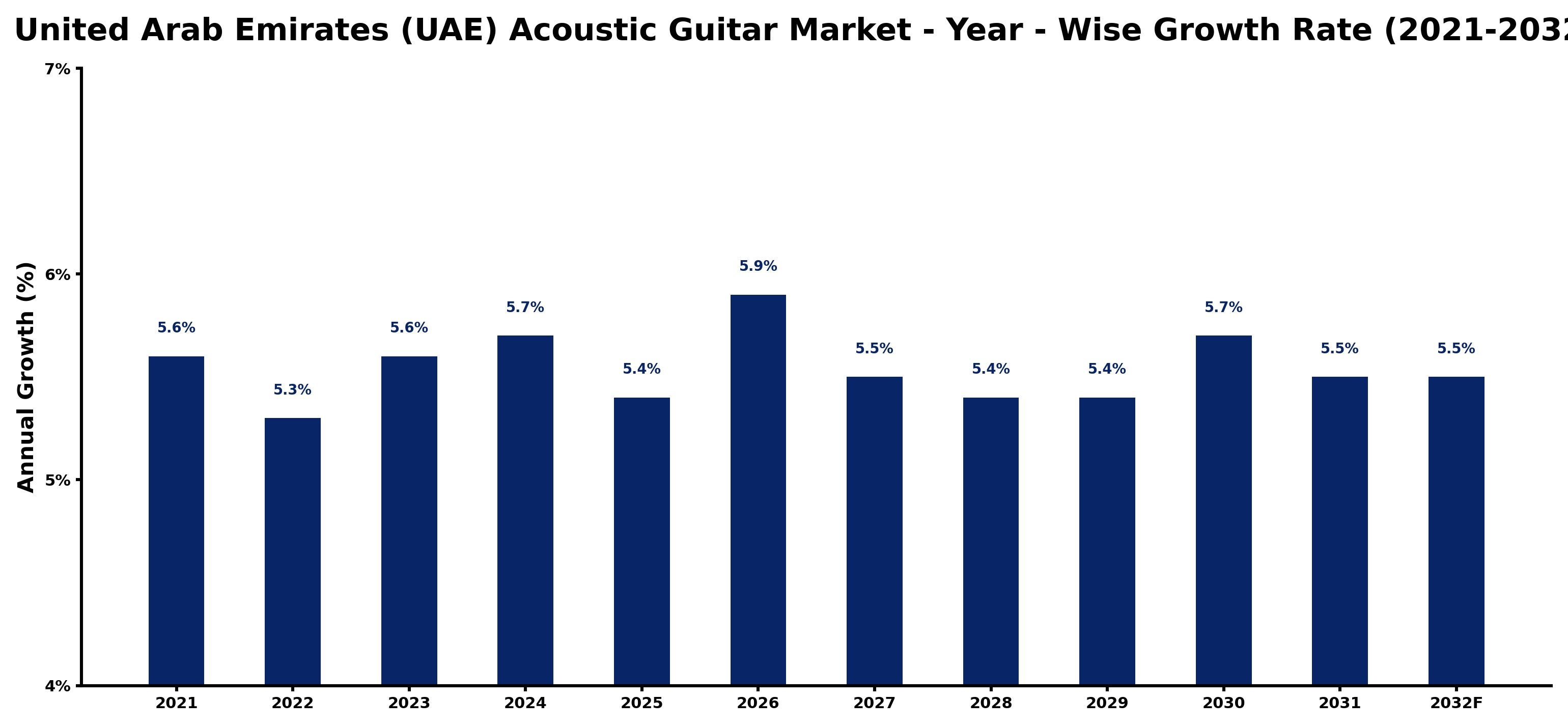
The table below presents the year‑wise growth rates along with the key drivers influencing the market
| Year | Growth Rate | Major Drivers |
| 2021 | 5.6% | Regional manufacturing investments boost acoustic guitar production capabilities |
| 2022 | 5.3% | Domestic guitar production scale up enhanced local wood processing capacity |
| 2023 | 5.6% | Smart manufacturing investments boost acoustic guitar production capabilities |
| 2024 | 5.7% | Smart manufacturing adoption boosts precision acoustic guitar production efficiency |
| 2025 | 5.4% | Accelerated tourism growth drives local acoustic guitar production expansion |
| 2026 | 5.9% | New manufacturing facilities boost acoustic guitar production capabilities |
| 2027 | 5.5% | Emerging local wood sourcing boosts acoustic guitar manufacturing capacity |
| 2028 | 5.4% | Local acoustic guitar production capacity aligns with tourism sector demands |
| 2029 | 5.4% | Smart manufacturing adoption boosted acoustic guitar production efficiency |
| 2030 | 5.7% | Local guitar production boosts demand for quality timber sourcing |
| 2031 | 5.5% | Local guitar manufacturers embrace smart technologies for improved production |
| 2032 | 5.5% | Increased acoustic guitar exports drive local wood sourcing activities |
Note - Market size estimations and growth projections presented in this report are based on 6Wresearch's advanced forecasting approach, validated with industry datasets as of June 2026.
United Arab Emirates (UAE) Acoustic Guitar Market Synopsis
The UAE Acoustic Guitar market is thriving in an environment rich with cultural diversity, which fosters a unique and vibrant music scene. The increasing interest in personal music expression has led to more individuals pursuing the art of guitar playing, making acoustic guitars an essential instrument for both amateurs and seasoned musicians.
Moreover, the impact of the Covid-19 pandemic catalyzed a significant shift in consumer behavior. With many people engaging in at-home activities, acoustic guitars surged in popularity as an accessible means of creative expression. As a result, sales of entry-level guitars and online learning resources experienced notable growth.
United Arab Emirates (UAE) Acoustic Guitar Market Key Takeaways
- The UAE's rich cultural landscape drives a growing interest in music education and instrument acquisition.
- The Covid-19 pandemic accelerated the trend of at-home music learning, benefiting entry-level acoustic guitar sales.
- Tourism in the UAE enhances the demand for acoustic guitars, as visitors seek immersive cultural experiences.
- Counterfeit products and competition from electronic instruments challenge market integrity.
- Music schools and community events play a vital role in encouraging the acquisition of acoustic guitars.
Evaluation of Restraints in United Arab Emirates (UAE) Acoustic Guitar Market
Despite its positive growth outlook, the UAE Acoustic Guitar market grapples with several challenges. Foremost among these is the increasing competition from electronic instruments, which appeal to a tech-savvy younger demographic. Additionally, the prevalence of counterfeit and low-quality guitars poses a threat to established brands and can negatively impact consumer trust. These factors could potentially hinder market growth if not addressed effectively.
United Arab Emirates (UAE) Acoustic Guitar Market Trends
Several trends are shaping the UAE Acoustic Guitar market, most notably the rising popularity of online music education platforms. As digital learning becomes more accessible, many learners prefer to start with acoustic guitars due to their versatility and ease of use. Furthermore, collaborations among local musicians and the establishment of music festivals are invigorating the market, fostering a culture that celebrates acoustic music and its varied genres.
United Arab Emirates (UAE) Acoustic Guitar Market Opportunities
The UAE Acoustic Guitar market presents promising opportunities for growth, particularly in enhancing consumer awareness of quality brands versus counterfeit products. Additionally, expanding online sales channels, including e-commerce platforms, could attract a wider audience. Another notable opportunity lies in partnerships with educational institutions to develop tailored guitar programs, further embedding acoustic guitars in the cultural fabric of the UAE.
Government Initiatives in the United Arab Emirates (UAE) Acoustic Guitar Market
The UAE government actively promotes cultural activities that encompass various forms of artistic expression, including music. Initiatives aimed at enhancing local music education through public funding, along with support for local festivals and music events, bolster the acoustic guitar market. Such programs cultivate an environment conducive to both learning and performing, further encouraging the adoption of musical instruments like acoustic guitars.
Future Insights of the United Arab Emirates (UAE) Acoustic Guitar Market
Looking ahead to the 2026-2032 period, the UAE Acoustic Guitar market is poised for continued growth driven by evolving consumer preferences and an increasingly connected world. The integration of technology in music education and performance will likely lead to innovations in acoustic guitar designs and features. As the culture of music continues to flourish, opportunities for niche markets, such as custom-made guitars and local artisanship, will emerge, further enriching the acoustic landscape of the UAE.
United Arab Emirates (UAE) Acoustic Guitar Market Latest Developments (May 2025 - June 2026)
Recent developments in the UAE Acoustic Guitar market indicate a shift towards sustainability, with manufacturers exploring eco-friendly materials for instrument production. Additionally, music retailers are enhancing their online presence, offering virtual consultations and personalized services to cater to a broader clientele. Educational institutions are also increasing collaborations with music brands to integrate guitar programs into their curricula, signaling a forward-thinking approach to music education.
United Arab Emirates (UAE) Acoustic Guitar Market - Key Attractiveness of the Report
- 10 Years of Market Numbers
- Historical Data Starting from 2022 to 2025
- Base Year: 2025
- Forecast Data until 2032
- Key Performance Indicators Impacting the Market
- Major Upcoming Developments and Projects
Key Highlights of the Report:
- United Arab Emirates (UAE) Acoustic Guitar Market Outlook
- Market Size of United Arab Emirates (UAE) Acoustic Guitar Market, 2025
- Forecast of United Arab Emirates (UAE) Acoustic Guitar Market, 2032
- Historical Data and Forecast of United Arab Emirates (UAE) Acoustic Guitar Revenues & Volume for the Period 2022-2032F
- United Arab Emirates (UAE) Acoustic Guitar Market Trend Evolution
- United Arab Emirates (UAE) Acoustic Guitar Market Drivers and Challenges
- United Arab Emirates (UAE) Acoustic Guitar Price Trends
- United Arab Emirates (UAE) Acoustic Guitar Porter's Five Forces
- United Arab Emirates (UAE) Acoustic Guitar Industry Life Cycle
- Historical Data and Forecast of United Arab Emirates (UAE) Acoustic Guitar Market Revenues & Volume By Product for the Period 2022-2032F
- Historical Data and Forecast of United Arab Emirates (UAE) Acoustic Guitar Market Revenues & Volume By Nylon/gut Stringed Guitars for the Period 2022-2032F
- Historical Data and Forecast of United Arab Emirates (UAE) Acoustic Guitar Market Revenues & Volume By Steel Stringed Guitars for the Period 2022-2032F
- Historical Data and Forecast of United Arab Emirates (UAE) Acoustic Guitar Market Revenues & Volume By Other for the Period 2022-2032F
- Historical Data and Forecast of United Arab Emirates (UAE) Acoustic Guitar Market Revenues & Volume By Application for the Period 2022-2032F
- Historical Data and Forecast of United Arab Emirates (UAE) Acoustic Guitar Market Revenues & Volume By Perform for the Period 2022-2032F
- Historical Data and Forecast of United Arab Emirates (UAE) Acoustic Guitar Market Revenues & Volume By Teaching for the Period 2022-2032F
- Historical Data and Forecast of United Arab Emirates (UAE) Acoustic Guitar Market Revenues & Volume By Other for the Period 2022-2032F
- United Arab Emirates (UAE) Acoustic Guitar Import Export Trade Statistics
- Market Opportunity Assessment By Product
- Market Opportunity Assessment By Application
- United Arab Emirates (UAE) Acoustic Guitar Top Companies Market Share
- United Arab Emirates (UAE) Acoustic Guitar Competitive Benchmarking By Technical and Operational Parameters
- United Arab Emirates (UAE) Acoustic Guitar Company Profiles
- United Arab Emirates (UAE) Acoustic Guitar Key Strategic Recommendations






































