United Arab Emirates (UAE) Aquaculture & Marine Products Market Size, Share & Growth Rate
The United Arab Emirates (UAE) Aquaculture & Marine Products Market was estimated at USD 407 Million in 2025 and is projected to reach USD 550 Million by 2032, growing at a CAGR of 4.4% from 2026 to 2032. This trajectory is primarily driven by a notable increase in seafood consumption among the local population, which is being bolstered by evolving dietary preferences that favor healthier food options. Furthermore, the commitment to sustainable fishing practices is enhancing domestic production capabilities, positioning the UAE as a key player in the aquaculture sector.
United Arab Emirates (UAE) Aquaculture & Marine Products Market Year-wise Growth Rate and Key Drivers
This graph highlights how the United Arab Emirates (UAE) Aquaculture & Marine Products Market has steadily grown over the years, supported by major growth factors.
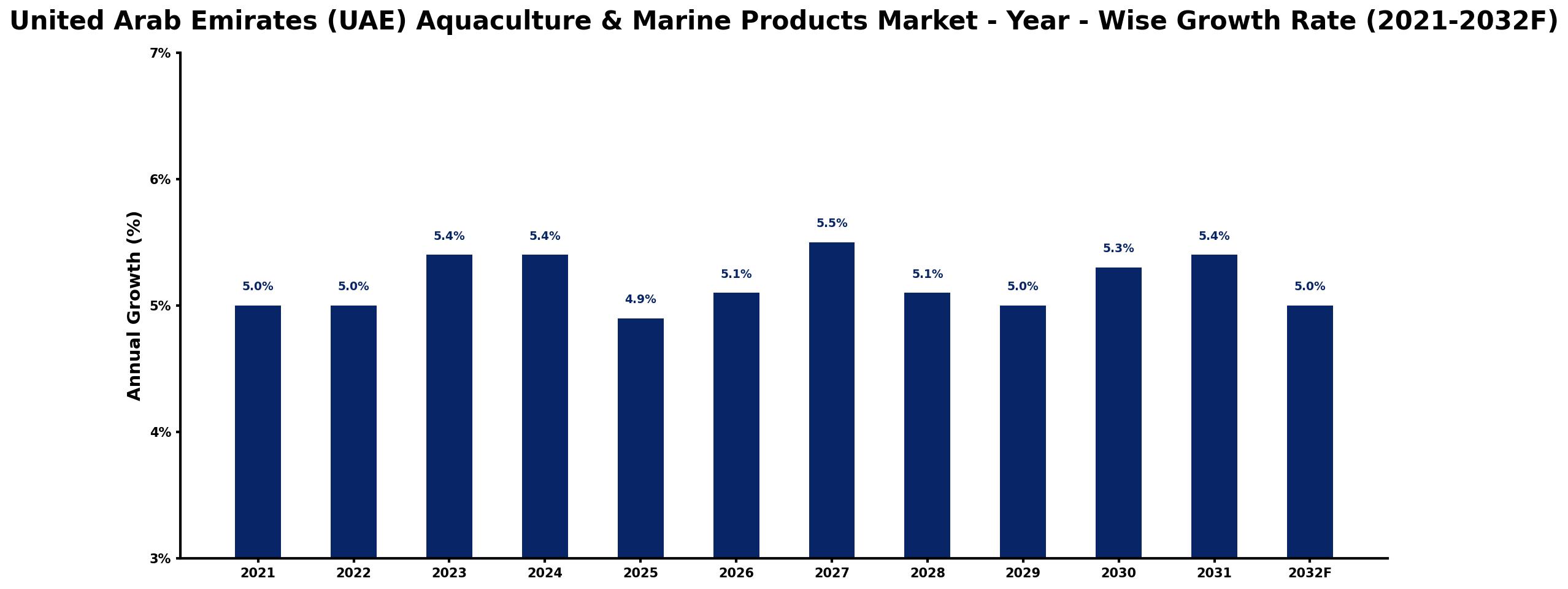
The table below presents the year‑wise growth rates along with the key drivers influencing the market
| Year | Growth Rate | Major Drivers |
| 2021 | 5.0% | Rising consumer health awareness |
| 2022 | 5.0% | Increased investment in sustainability |
| 2023 | 5.4% | Growing demand for local sourcing |
| 2024 | 5.4% | Expansion of distribution networks |
| 2025 | 4.9% | Emergence of eco-friendly practices |
| 2026 | 5.1% | Technological advancements in farming |
| 2027 | 5.5% | Surge in export opportunities |
| 2028 | 5.1% | Enhancement of regulatory frameworks |
| 2029 | 5.0% | Popularity of premium offerings |
| 2030 | 5.3% | improved raw material availability |
| 2031 | 5.4% | Strengthening of local partnerships |
| 2032 | 5.0% | Rising interest in alternative proteins |
Note: Market size estimations and growth projections presented in this report are based on 6Wresearch's proprietary forecasting methodology, utilizing the latest available industry data, government publications, and primary research inputs.
United Arab Emirates (UAE) Aquaculture & Marine Products Market Synopsis
In recent years, the UAE aquaculture industry has experienced significant momentum, reflecting a robust response to the increasing demand for seafood and the pressing need to replenish depleting wild fish stocks. As this market continues to expand, a future characterized by innovative aquaculture practices and enhanced production efficiency is emerging, setting a dynamic stage for growth.
With advancements in technology enabling the farming of diverse marine species in controlled environments, the UAE's aquaculture marine products market is well-positioned for sustainable growth. This shift not only caters to a growing population but also aligns with national goals for food security and self-sufficiency in seafood production.
- The market is projected to grow significantly, reaching USD 550 Million by 2032.
- Sustainable seafood production is becoming a cornerstone of the industry, driven by consumer demand.
- Technological advancements are enhancing efficiency and diversifying marine species farming.
- Government investments and initiatives are pivotal in boosting market capacity and quality standards.
- The industry continues to adapt to changing consumer preferences and environmental challenges.
Despite the optimistic outlook, several constraints challenge the UAE aquaculture market. The region's arid climate significantly affects the ability to maintain optimal water quality and environmental conditions essential for successful aquaculture operations. Industry players are tasked with balancing these environmental factors while ensuring the health and viability of various marine species. Furthermore, there are ongoing concerns regarding the management of resources, particularly in the face of increasing production demands and sustainability goals.
Key trends are shaping the UAE aquaculture market, prominently featuring the integration of advanced technologies like recirculating aquaculture systems (RAS) and aquaponics, which are enhancing sustainability and reducing waste. Additionally, there is a rising trend of consumer awareness around sourcing and sustainability, pushing producers to adopt more responsible practices. The shift towards organic and natural feed solutions is gaining traction, influencing both production methods and market offerings.
Growth and investment opportunities are abundant in the UAE aquaculture market, particularly in the realm of technological innovation. Companies that invest in state-of-the-art farming techniques, along with those that develop integrated supply chains, stand to benefit significantly. Additionally, partnerships with governmental and research institutions can facilitate advancements in aquaculture practices, leading to increased yield and sustainability.
The UAE government has implemented a variety of initiatives to bolster the aquaculture sector. These include funding programs aimed at increasing local production capabilities, alongside regulatory frameworks designed to ensure the sustainability of marine resources. Public spending on research and development is also fostering innovation, encouraging the adoption of environmentally friendly practices, and enhancing overall industry standards.
Looking towards 2026-2032, the UAE aquaculture market is set to experience transformative growth fueled by a synergy of technological advancements and increasing consumer consciousness about sustainability. As local production meets rising demand, the industry is expected to attract further investments. This combination of factors will reinforce the UAE's position as a leader in sustainable aquaculture, facilitating both economic growth and environmental stewardship.
In the recent period, the UAE aquaculture sector has been actively engaging in research collaborations to explore innovative farming techniques. Companies are focusing on expanding their production capabilities in response to the growing domestic market. Moreover, initiatives promoting eco-labeling are gaining traction, as consumers increasingly demand transparency regarding the sustainability of their seafood sources.
- 10 Years of Market Numbers
- Historical Data Starting from 2022 to 2025
- Base Year: 2025
- Forecast Data until 2032
- Key Performance Indicators Impacting the Market
- Major Upcoming Developments and Projects
Key Highlights of the Report:
- United Arab Emirates (UAE) Aquaculture & Marine Products Market Outlook
- Market Size of United Arab Emirates (UAE) Aquaculture & Marine Products Market, 2025
- Forecast of United Arab Emirates (UAE) Aquaculture & Marine Products Market, 2032
- Historical Data and Forecast of United Arab Emirates (UAE) Aquaculture & Marine Products Revenues & Volume for the Period 2022-2032F
- United Arab Emirates (UAE) Aquaculture & Marine Products Market Trend Evolution
- United Arab Emirates (UAE) Aquaculture & Marine Products Market Drivers and Challenges
- United Arab Emirates (UAE) Aquaculture & Marine Products Price Trends
- United Arab Emirates (UAE) Aquaculture & Marine Products Porter's Five Forces
- United Arab Emirates (UAE) Aquaculture & Marine Products Industry Life Cycle
- Historical Data and Forecast of United Arab Emirates (UAE) Aquaculture & Marine Products Market Revenues & Volume By Rearing Product Type for the Period 2022-2032F
- Historical Data and Forecast of United Arab Emirates (UAE) Aquaculture & Marine Products Market Revenues & Volume By Equipment for the Period 2022-2032F
- Historical Data and Forecast of United Arab Emirates (UAE) Aquaculture & Marine Products Market Revenues & Volume By Chemicals for the Period 2022-2032F
- Historical Data and Forecast of United Arab Emirates (UAE) Aquaculture & Marine Products Market Revenues & Volume By Pharmaceuticals for the Period 2022-2032F
- Historical Data and Forecast of United Arab Emirates (UAE) Aquaculture & Marine Products Market Revenues & Volume By Fertilizers for the Period 2022-2032F
- Historical Data and Forecast of United Arab Emirates (UAE) Aquaculture & Marine Products Market Revenues & Volume By Others for the Period 2022-2032F
- Historical Data and Forecast of United Arab Emirates (UAE) Aquaculture & Marine Products Market Revenues & Volume By Type for the Period 2022-2032F
- Historical Data and Forecast of United Arab Emirates (UAE) Aquaculture & Marine Products Market Revenues & Volume By Fisheries for the Period 2022-2032F
- Historical Data and Forecast of United Arab Emirates (UAE) Aquaculture & Marine Products Market Revenues & Volume By Seaweeds for the Period 2022-2032F
- Historical Data and Forecast of United Arab Emirates (UAE) Aquaculture & Marine Products Market Revenues & Volume By Microalgae for the Period 2022-2032F
- Historical Data and Forecast of United Arab Emirates (UAE) Aquaculture & Marine Products Market Revenues & Volume By Crustaceans for the Period 2022-2032F
- Historical Data and Forecast of United Arab Emirates (UAE) Aquaculture & Marine Products Market Revenues & Volume By Molluscs for the Period 2022-2032F
- Historical Data and Forecast of United Arab Emirates (UAE) Aquaculture & Marine Products Market Revenues & Volume By Others for the Period 2022-2032F
- Historical Data and Forecast of United Arab Emirates (UAE) Aquaculture & Marine Products Market Revenues & Volume By Production Type for the Period 2022-2032F
- Historical Data and Forecast of United Arab Emirates (UAE) Aquaculture & Marine Products Market Revenues & Volume By Small-Scale for the Period 2022-2032F
- Historical Data and Forecast of United Arab Emirates (UAE) Aquaculture & Marine Products Market Revenues & Volume By Medium & Large Scale for the Period 2022-2032F
- Historical Data and Forecast of United Arab Emirates (UAE) Aquaculture & Marine Products Market Revenues & Volume By Culture for the Period 2022-2032F
- Historical Data and Forecast of United Arab Emirates (UAE) Aquaculture & Marine Products Market Revenues & Volume By Freshwater for the Period 2022-2032F
- Historical Data and Forecast of United Arab Emirates (UAE) Aquaculture & Marine Products Market Revenues & Volume By Brackish Water for the Period 2022-2032F
- Historical Data and Forecast of United Arab Emirates (UAE) Aquaculture & Marine Products Market Revenues & Volume By Marine for the Period 2022-2032F
- United Arab Emirates (UAE) Aquaculture & Marine Products Import Export Trade Statistics
- Market Opportunity Assessment By Rearing Product Type
- Market Opportunity Assessment By Type
- Market Opportunity Assessment By Production Type
- Market Opportunity Assessment By Culture
- United Arab Emirates (UAE) Aquaculture & Marine Products Top Companies Market Share
- United Arab Emirates (UAE) Aquaculture & Marine Products Competitive Benchmarking By Technical and Operational Parameters
- United Arab Emirates (UAE) Aquaculture & Marine Products Company Profiles
- United Arab Emirates (UAE) Aquaculture & Marine Products Key Strategic Recommendations






































