United Arab Emirates (UAE) Dyestuff For Cotton Market Size, Share & Growth Rate
The United Arab Emirates (UAE) Dyestuff For Cotton Market was estimated at USD 444 Million in 2025 and is projected to reach USD 628 Million by 2032, growing at a CAGR of 5.1% from 2026 to 2032. This robust growth trajectory is primarily driven by the flourishing textile and apparel sector in the UAE, which continues to expand due to rising consumer demand for high-quality, aesthetically pleasing cotton fabrics. Additionally, the increasing emphasis on sustainable practices and eco-friendly dyestuffs aligns perfectly with global market trends, reinforcing the growth outlook.
United Arab Emirates (UAE) Dyestuff For Cotton Market Year-wise Growth Rate and Key Drivers
This graph highlights how the United Arab Emirates (UAE) Dyestuff For Cotton Market has steadily grown over the years, supported by major growth factors.
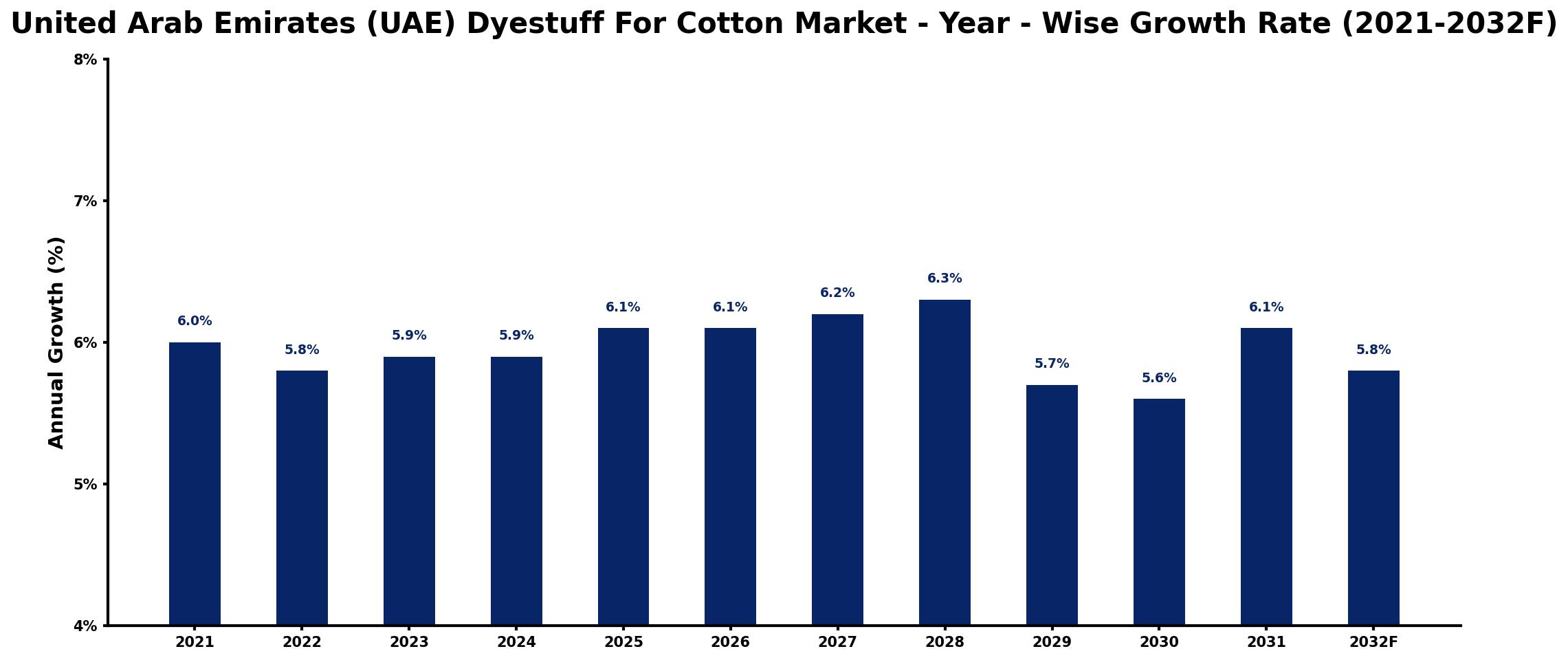
The table below presents the year‑wise growth rates along with the key drivers influencing the market
| Year | Growth Rate | Major Drivers |
| 2021 | 6.0% | Rising textile manufacturing activities |
| 2022 | 5.8% | Increased fashion industry demand |
| 2023 | 5.9% | Growing consumer preference sustainability |
| 2024 | 5.9% | Expansion of dyeing technologies |
| 2025 | 6.1% | Higher exports of finished textiles |
| 2026 | 6.1% | Emergence of eco-friendly alternatives |
| 2027 | 6.2% | Investment in research and development |
| 2028 | 6.3% | Surge in online retail platforms |
| 2029 | 5.7% | Shift towards local sourcing initiatives |
| 2030 | 5.6% | Advancements in dye application methods |
| 2031 | 6.1% | Growing popularity of custom designs |
| 2032 | 5.8% | Rising awareness of color trends |
Note: Market size estimations and growth projections presented in this report are based on 6Wresearch's proprietary forecasting methodology, utilizing the latest available industry data, government publications, and primary research inputs.
United Arab Emirates (UAE) Dyestuff For Cotton Market Synopsis
Currently, the UAE dyestuff for cotton market stands at a vital intersection of art and industry, where color innovation meets the practical needs of a growing textile landscape. The local market has shown a marked preference for colorfast and environmentally conscious products, reflecting a broader trend in global textiles towards sustainability.
The UAE's strategic location, combined with a booming tourism industry, has led to increased demand for vibrant cotton textiles. As local manufacturers respond to consumer expectations for rich hues and durable products, they are increasingly turning towards advanced dyeing technologies and eco-friendly solutions to meet these requirements.
United Arab Emirates (UAE) Dyestuff For Cotton Market Key Takeaways
- Growing consumer preference for sustainable and eco-friendly dyestuffs is reshaping market dynamics.
- Technological advancements in dyeing processes are enhancing the quality and longevity of cotton textiles.
- Fluctuating cotton prices pose a challenge for market participants, impacting profitability and supply chain management.
- The COVID-19 pandemic highlighted vulnerabilities in global supply chains, leading to shifts in production priorities.
- Increasing disposable income and fashion consciousness among consumers drive the demand for vibrant colored cotton fabrics.
Evaluation of Restraints in United Arab Emirates (UAE) Dyestuff For Cotton Market
Despite the positive growth outlook, the UAE dyestuff for cotton market faces significant challenges. Achieving desired color fastness remains a critical concern, particularly in the region's hot and humid climate, which can affect dye performance. Additionally, strict regulations regarding environmental and chemical safety compel businesses to invest heavily in compliance, thereby impacting operational costs. Fluctuating availability and prices of cotton further complicate planning and budgeting for manufacturers. To navigate these complexities, companies must adopt agile production methodologies and invest in responsive research and development efforts to align with evolving fashion trends.
United Arab Emirates (UAE) Dyestuff For Cotton Market Trends
Current trends indicate a robust shift towards natural and low-impact dyestuffs, as manufacturers respond to consumer demand for sustainability. Innovations in biodegradable dyes and water-efficient dyeing technologies are gaining traction. The market is also witnessing an increasing integration of digital printing techniques, which allow for customized designs and colors, catering to the unique tastes of local consumers. Furthermore, e-commerce growth is enabling greater access to diverse dyestuff options, further enhancing market appeal.
United Arab Emirates (UAE) Dyestuff For Cotton Market Opportunities
Significant investment opportunities exist in the UAE dyestuff for cotton market, particularly in the area of eco-friendly dyes. As sustainability becomes a focal point for consumers, manufacturers who innovate and offer environmentally safe alternatives can capture a larger market share. There is also potential for collaborative ventures between local producers and international dyestuff firms, leveraging expertise in sustainable practices and new technologies. Additionally, capitalizing on the rising demand for personalized cotton textiles can yield high returns, especially in niche segments targeting luxury and bespoke markets.
Government Initiatives in the United Arab Emirates (UAE) Dyestuff For Cotton Market
The UAE government is actively promoting initiatives that support sustainable practices in the textile industry, encouraging the adoption of eco-friendly dyestuffs. Public spending on infrastructure improvements and technology upgrades within the manufacturing sector is on the rise. Furthermore, incentives for research and development in sustainable dyeing techniques align well with national goals of diversifying the economy and reducing environmental impact, fostering a more resilient dyestuff market.
Future Insights of the United Arab Emirates (UAE) Dyestuff For Cotton Market
Looking ahead, the UAE dyestuff for cotton market is poised for steady growth as consumer preferences continue to evolve. The anticipated surge in demand for innovative and sustainable dyeing solutions indicates that manufacturers who adapt swiftly to these changes will likely thrive. The integration of technology, such as AI and automation in production processes, will further streamline operations, allowing companies to meet the increasing expectations for customization and quality. As the market evolves, a focus on sustainability will not only be a competitive advantage but also a necessity.
United Arab Emirates (UAE) Dyestuff For Cotton Market Latest Developments (2025 - 2026)
The dyestuff for cotton market in the UAE has recently witnessed a shift toward innovative dye technologies, with several manufacturers investing in sustainable solutions. The industry is also experiencing collaboration between local and international entities, aimed at enhancing production capabilities and meeting growing consumer demands for quality and eco-friendliness. Additionally, ongoing research efforts into biodegradable dyestuffs highlight a commitment to environmental stewardship, reflecting the market's adaptive strategies in a changing landscape.
United Arab Emirates (UAE) Dyestuff For Cotton Market - Key Attractiveness of the Report
- 10 Years of Market Numbers
- Historical Data Starting from 2022 to 2025
- Base Year: 2025
- Forecast Data until 2032
- Key Performance Indicators Impacting the Market
- Major Upcoming Developments and Projects
Key Highlights of the Report:
- United Arab Emirates (UAE) Dyestuff For Cotton Market Outlook
- Market Size of United Arab Emirates (UAE) Dyestuff For Cotton Market, 2025
- Forecast of United Arab Emirates (UAE) Dyestuff For Cotton Market, 2032
- Historical Data and Forecast of United Arab Emirates (UAE) Dyestuff For Cotton Revenues & Volume for the Period 2022-2032F
- United Arab Emirates (UAE) Dyestuff For Cotton Market Trend Evolution
- United Arab Emirates (UAE) Dyestuff For Cotton Market Drivers and Challenges
- United Arab Emirates (UAE) Dyestuff For Cotton Price Trends
- United Arab Emirates (UAE) Dyestuff For Cotton Porter's Five Forces
- United Arab Emirates (UAE) Dyestuff For Cotton Industry Life Cycle
- Historical Data and Forecast of United Arab Emirates (UAE) Dyestuff For Cotton Market Revenues & Volume By Types for the Period 2022-2032F
- Historical Data and Forecast of United Arab Emirates (UAE) Dyestuff For Cotton Market Revenues & Volume By Reactive Dyes for the Period 2022-2032F
- Historical Data and Forecast of United Arab Emirates (UAE) Dyestuff For Cotton Market Revenues & Volume By Disperse Dyes for the Period 2022-2032F
- Historical Data and Forecast of United Arab Emirates (UAE) Dyestuff For Cotton Market Revenues & Volume By Direct Dyes for the Period 2022-2032F
- Historical Data and Forecast of United Arab Emirates (UAE) Dyestuff For Cotton Market Revenues & Volume By Sulfur Dyes for the Period 2022-2032F
- Historical Data and Forecast of United Arab Emirates (UAE) Dyestuff For Cotton Market Revenues & Volume By Optical Brighteners for the Period 2022-2032F
- Historical Data and Forecast of United Arab Emirates (UAE) Dyestuff For Cotton Market Revenues & Volume By Applications for the Period 2022-2032F
- Historical Data and Forecast of United Arab Emirates (UAE) Dyestuff For Cotton Market Revenues & Volume By Non-Woven for the Period 2022-2032F
- Historical Data and Forecast of United Arab Emirates (UAE) Dyestuff For Cotton Market Revenues & Volume By Health Care for the Period 2022-2032F
- Historical Data and Forecast of United Arab Emirates (UAE) Dyestuff For Cotton Market Revenues & Volume By Personal Care for the Period 2022-2032F
- Historical Data and Forecast of United Arab Emirates (UAE) Dyestuff For Cotton Market Revenues & Volume By Others for the Period 2022-2032F
- United Arab Emirates (UAE) Dyestuff For Cotton Import Export Trade Statistics
- Market Opportunity Assessment By Types
- Market Opportunity Assessment By Applications
- United Arab Emirates (UAE) Dyestuff For Cotton Top Companies Market Share
- United Arab Emirates (UAE) Dyestuff For Cotton Competitive Benchmarking By Technical and Operational Parameters
- United Arab Emirates (UAE) Dyestuff For Cotton Company Profiles
- United Arab Emirates (UAE) Dyestuff For Cotton Key Strategic Recommendations






































