United Arab Emirates (UAE) Edible Beans Market Size, Share & Growth Rate
The United Arab Emirates (UAE) Edible Beans Market was estimated at USD 347 Million in 2025 and is projected to reach USD 479 Million by 2032, growing at a CAGR of 4.7% from 2026 to 2032. This growth trajectory is fueled by an increasing health awareness among consumers, pushing demand for plant-based protein sources. Moreover, the burgeoning food and beverage sector in the UAE is enhancing the culinary appeal of various bean types, further driving consumption.
United Arab Emirates (UAE) Edible Beans Market Year-wise Growth Rate and Key Drivers
This graph highlights how the United Arab Emirates (UAE) Edible Beans Market has steadily grown over the years, supported by major growth factors.
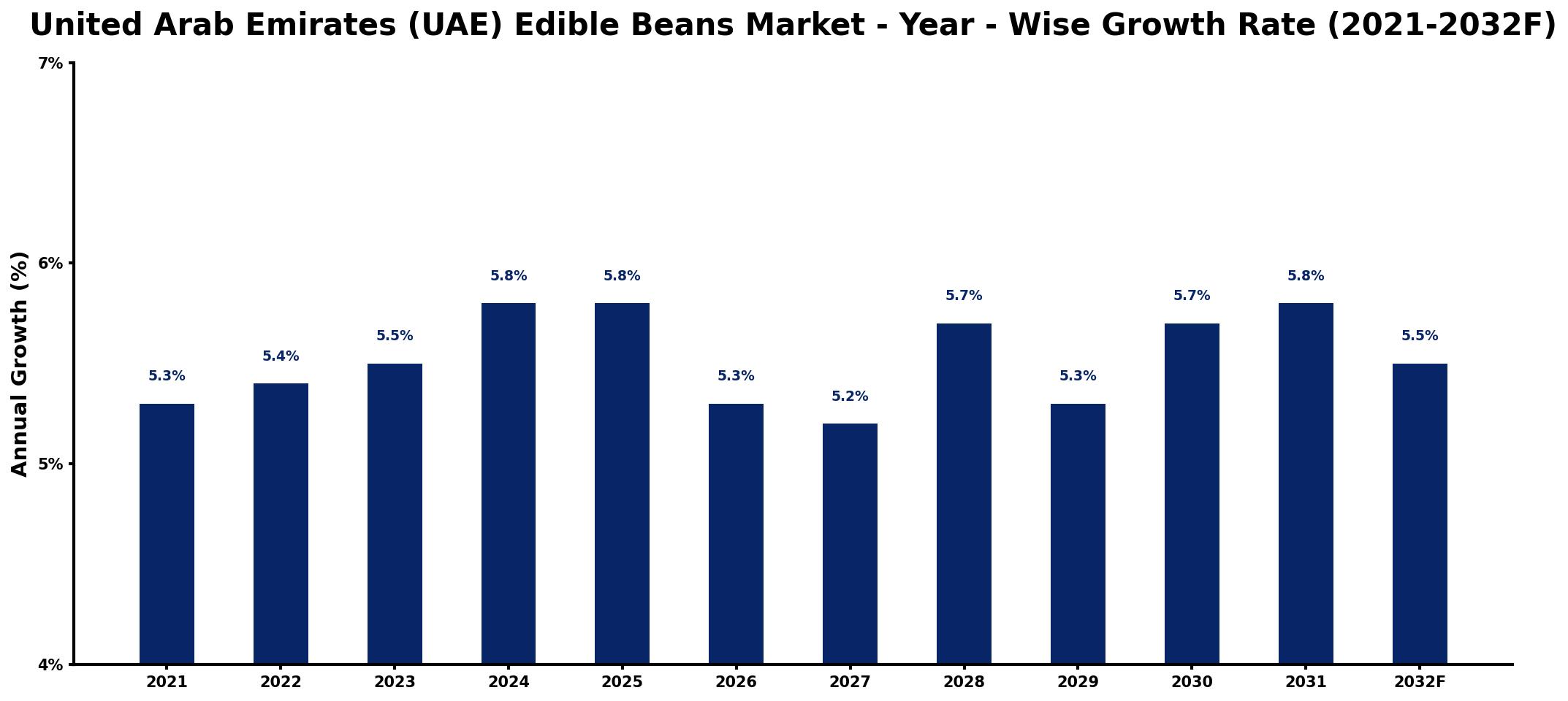
The table below presents the year‑wise growth rates along with the key drivers influencing the market
| Year | Growth Rate | Major Drivers |
| 2021 | 5.3% | Rising health consciousness among consumers |
| 2022 | 5.4% | Increased popularity of plant-based diets |
| 2023 | 5.5% | Growing demand for sustainable proteins |
| 2024 | 5.8% | Expansion of food processing facilities |
| 2025 | 5.8% | Increased investments in agriculture technology |
| 2026 | 5.3% | Rising exports to new markets |
| 2027 | 5.2% | Growth in organic food sector |
| 2028 | 5.7% | Innovation in food product development |
| 2029 | 5.3% | Strengthening local supply chains |
| 2030 | 5.7% | Enhanced distribution network efficiency |
| 2031 | 5.8% | Collaboration with food service industry |
| 2032 | 5.5% | Increasing awareness of nutritional benefits |
Note: Market size estimations and growth projections presented in this report are based on 6Wresearch's proprietary forecasting methodology, utilizing the latest available industry data, government publications, and primary research inputs.
United Arab Emirates (UAE) Edible Beans Market Synopsis
The UAE Edible Beans Market showcases a vibrant and evolving sector, responding dynamically to shifts in consumer dietary habits. With a diverse range of bean varieties like kidney beans and chickpeas, the market not only caters to traditional cuisines but also adapts to contemporary culinary trends.
As the nation moves towards healthier eating patterns, the edible beans market has become a focal point for nutritional value, affordability, and versatility in meal preparation. Consumers are increasingly recognizing the benefits of integrating beans into their diets, further enhancing market potential.
United Arab Emirates (UAE) Edible Beans Market Key Takeaways
- The market is witnessing a strong uptick due to heightened health consciousness among consumers.
- A diverse array of beans is available, catering to both local and international culinary preferences.
- Population growth and an expanding food and beverage industry are contributing to increased demand.
- Challenges remain in import dependency and the need for improved domestic sourcing strategies.
- Consumer education on the nutritional benefits of beans is critical for sustained market growth.
Evaluation of Restraints in United Arab Emirates (UAE) Edible Beans Market
The UAE Edible Beans Market faces significant restraints that hinder its growth potential. Primarily, the country's reliance on imports due to challenging agricultural conditions limits local supply and can lead to price volatility. Fluctuations in global production also pose risks, compounded by climate change impacts. Furthermore, inconsistencies in quality and safety standards of imported beans can erode consumer trust. The presence of alternative protein sources, alongside insufficient consumer awareness regarding the benefits and uses of beans, adds further complexity to market dynamics.
United Arab Emirates (UAE) Edible Beans Market Trends
Current trends indicate a growing inclination towards organic and sustainably sourced edible beans among consumers in the UAE. Enhanced culinary creativity, driven by an influx of international cuisine, is expanding the usage of beans in diverse dishes. Additionally, the rise of plant-based diets continues to influence purchasing decisions, propelling demand for healthier, protein-rich alternatives. Technological advancements in food processing and preservation are also helping to maintain product quality and shelf life, creating new opportunities for market players.
United Arab Emirates (UAE) Edible Beans Market Opportunities
There are substantial opportunities for growth within the UAE Edible Beans Market, particularly as consumer preferences shift towards sustainable and nutritious food options. Investing in local cultivation initiatives could alleviate import dependence and enhance supply stability. Additionally, innovative marketing strategies focusing on the health benefits of edible beans can educate consumers and stimulate demand. Collaborations with the growing food processing sector can also lead to product diversification, appealing to a broader consumer base.
Government Initiatives in the United Arab Emirates (UAE) Edible Beans Market
The government of the UAE is actively promoting initiatives aimed at bolstering the agricultural sector, which indirectly benefits the edible beans market. Through investments in sustainable farming practices and agricultural technology, there is a concerted effort to improve local production capabilities. Furthermore, policies that encourage food safety and quality standards are essential in building consumer confidence. These initiatives reflect a broader commitment to enhancing food security and promoting healthier eating habits across the nation.
Future Insights of the United Arab Emirates (UAE) Edible Beans Market
Looking ahead to the 2026-2032 period, the UAE Edible Beans Market is poised for robust growth as consumer trends increasingly favor plant-based diets. The projected market size increase, combined with ongoing government support for agriculture, suggests a favorable environment for development. Innovations in product offerings and enhancements in local supply chains will likely play critical roles in expanding market reach. Furthermore, as awareness of health benefits grows, the market is expected to see a consistent rise in demand, solidifying beans as a staple in the UAE's culinary landscape.
United Arab Emirates (UAE) Edible Beans Market Latest Developments (2025 - 2026)
Recent developments in the UAE Edible Beans Market have centered around enhancing import efficiencies and exploring local production opportunities. Market players are increasingly adopting sustainable sourcing practices to align with consumer preferences for health-oriented products. Additionally, there is a noticeable shift towards innovative packaging solutions aimed at reducing waste and improving product shelf life. Efforts to educate the consumer base about the versatility of beans in meals are also gaining momentum, signaling a broader market adaptation to evolving dietary trends.
United Arab Emirates (UAE) Edible Beans Market - Key Attractiveness of the Report
- 10 Years of Market Numbers
- Historical Data Starting from 2022 to 2025
- Base Year: 2025
- Forecast Data until 2032
- Key Performance Indicators Impacting the Market
- Major Upcoming Developments and Projects
Key Highlights of the Report:
- United Arab Emirates (UAE) Edible Beans Market Outlook
- Market Size of United Arab Emirates (UAE) Edible Beans Market, 2025
- Forecast of United Arab Emirates (UAE) Edible Beans Market, 2032
- Historical Data and Forecast of United Arab Emirates (UAE) Edible Beans Revenues & Volume for the Period 2022-2032F
- United Arab Emirates (UAE) Edible Beans Market Trend Evolution
- United Arab Emirates (UAE) Edible Beans Market Drivers and Challenges
- United Arab Emirates (UAE) Edible Beans Price Trends
- United Arab Emirates (UAE) Edible Beans Porter's Five Forces
- United Arab Emirates (UAE) Edible Beans Industry Life Cycle
- Historical Data and Forecast of United Arab Emirates (UAE) Edible Beans Market Revenues & Volume By Product Type for the Period 2022-2032F
- Historical Data and Forecast of United Arab Emirates (UAE) Edible Beans Market Revenues & Volume By Pinto Beans for the Period 2022-2032F
- Historical Data and Forecast of United Arab Emirates (UAE) Edible Beans Market Revenues & Volume By Navy Beans for the Period 2022-2032F
- Historical Data and Forecast of United Arab Emirates (UAE) Edible Beans Market Revenues & Volume By Great Northern Beans for the Period 2022-2032F
- Historical Data and Forecast of United Arab Emirates (UAE) Edible Beans Market Revenues & Volume By Red Kidney Beans for the Period 2022-2032F
- Historical Data and Forecast of United Arab Emirates (UAE) Edible Beans Market Revenues & Volume By Black Beans for the Period 2022-2032F
- Historical Data and Forecast of United Arab Emirates (UAE) Edible Beans Market Revenues & Volume By Yellow Beans for the Period 2022-2032F
- Historical Data and Forecast of United Arab Emirates (UAE) Edible Beans Market Revenues & Volume By Others for the Period 2022-2032F
- Historical Data and Forecast of United Arab Emirates (UAE) Edible Beans Market Revenues & Volume By Distribution Channel for the Period 2022-2032F
- Historical Data and Forecast of United Arab Emirates (UAE) Edible Beans Market Revenues & Volume By Supermarket/Hypermarket for the Period 2022-2032F
- Historical Data and Forecast of United Arab Emirates (UAE) Edible Beans Market Revenues & Volume By Online Stores for the Period 2022-2032F
- Historical Data and Forecast of United Arab Emirates (UAE) Edible Beans Market Revenues & Volume By Specialty Stores for the Period 2022-2032F
- Historical Data and Forecast of United Arab Emirates (UAE) Edible Beans Market Revenues & Volume By Other for the Period 2022-2032F
- Historical Data and Forecast of United Arab Emirates (UAE) Edible Beans Market Revenues & Volume By Application for the Period 2022-2032F
- Historical Data and Forecast of United Arab Emirates (UAE) Edible Beans Market Revenues & Volume By Household for the Period 2022-2032F
- Historical Data and Forecast of United Arab Emirates (UAE) Edible Beans Market Revenues & Volume By Restaurants for the Period 2022-2032F
- Historical Data and Forecast of United Arab Emirates (UAE) Edible Beans Market Revenues & Volume By Others for the Period 2022-2032F
- United Arab Emirates (UAE) Edible Beans Import Export Trade Statistics
- Market Opportunity Assessment By Product Type
- Market Opportunity Assessment By Distribution Channel
- Market Opportunity Assessment By Application
- United Arab Emirates (UAE) Edible Beans Top Companies Market Share
- United Arab Emirates (UAE) Edible Beans Competitive Benchmarking By Technical and Operational Parameters
- United Arab Emirates (UAE) Edible Beans Company Profiles
- United Arab Emirates (UAE) Edible Beans Key Strategic Recommendations






































