United Arab Emirates (UAE) Fish Market Size, Share & Growth Rate
The United Arab Emirates (UAE) Fish Market was estimated at USD 155 Million in 2025 and is projected to reach USD 211 Million by 2032, growing at a CAGR of 4.5% from 2026 to 2032. This growth trajectory is fueled by rising consumer demand for diverse seafood options, coupled with increasing awareness of the health benefits associated with seafood consumption. Additionally, the UAE's strategic position as a trading hub enhances import and export activities, allowing for a wider variety of products to enter the market.
United Arab Emirates (UAE) Fish Market Year-wise Growth Rate and Key Drivers
This graph highlights how the United Arab Emirates (UAE) Fish Market has steadily grown over the years, supported by major growth factors.
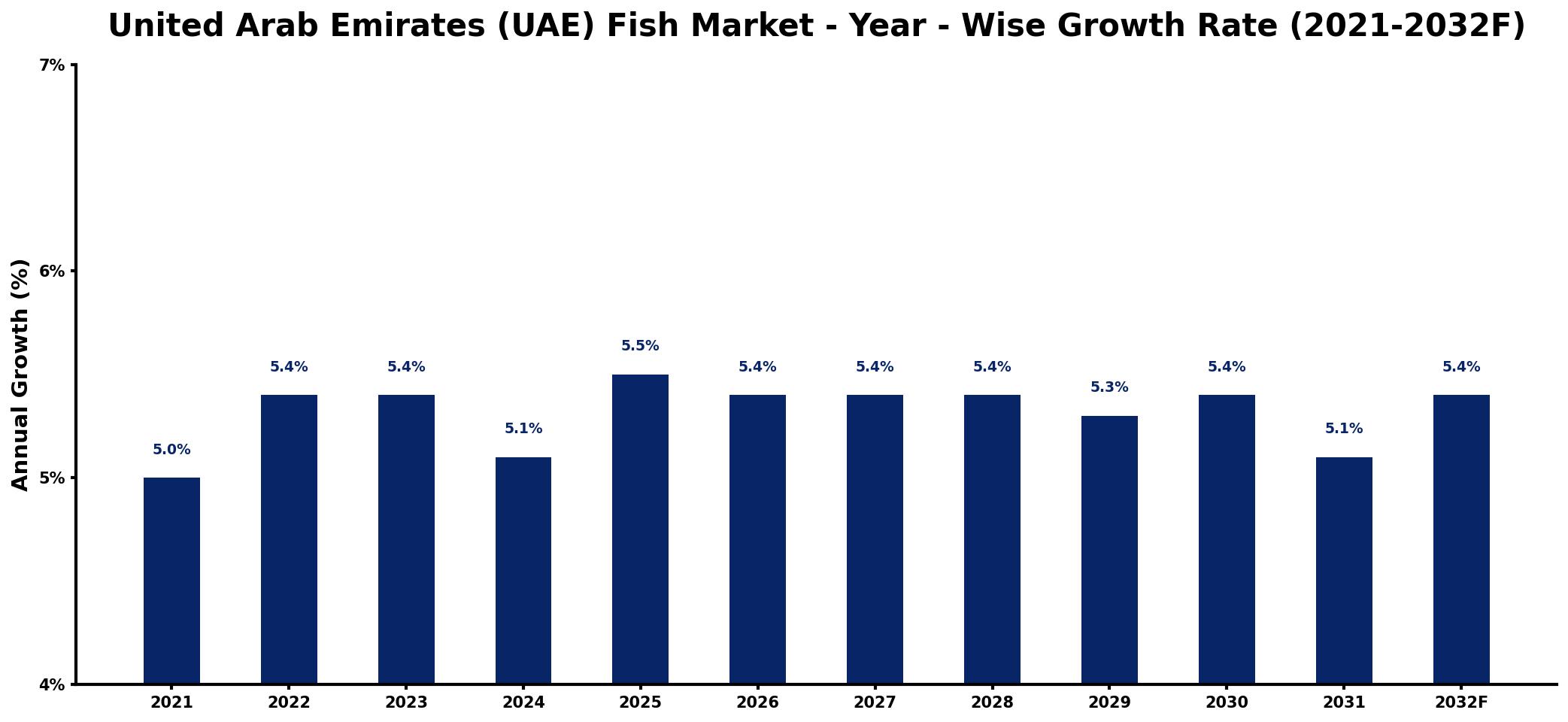
The table below presents the year‑wise growth rates along with the key drivers influencing the market
| Year | Growth Rate | Major Drivers |
| 2021 | 5.0% | Rising consumer health awareness |
| 2022 | 5.4% | Increased culinary tourism interest |
| 2023 | 5.4% | Growing demand for sustainability |
| 2024 | 5.1% | Expansion of retail distribution channels |
| 2025 | 5.5% | Enhanced aquaculture technologies adoption |
| 2026 | 5.4% | Surge in online food delivery |
| 2027 | 5.4% | Growing export market opportunities |
| 2028 | 5.4% | Investment in cold chain logistics |
| 2029 | 5.3% | Increased focus on local sourcing |
| 2030 | 5.4% | Development of value-added products |
| 2031 | 5.1% | Rising popularity of gourmet dining |
| 2032 | 5.4% | stronger distribution network expansion |
Note: Market size estimations and growth projections presented in this report are based on 6Wresearch's proprietary forecasting methodology, utilizing the latest available industry data, government publications, and primary research inputs.
United Arab Emirates (UAE) Fish Market Synopsis
The UAE Fish Market operates as a critical pillar of the country's food industry, showcasing an impressive variety of local catches alongside imported seafood. This dynamic marketplace not only supports local fishermen but also responds to the diverse culinary preferences of the UAEs international population, ensuring an ever-evolving array of seafood products.
Despite the abundance, the market faces significant sustainability challenges, such as overfishing and habitat degradation. It is essential for stakeholders to balance consumer demand with conservation efforts, ensuring that fish stocks remain viable for future generations while also meeting the immediate needs of the population.
United Arab Emirates (UAE) Fish Market Key Takeaways
- The UAE fish market is a vibrant hub for seafood trade, serving a diverse consumer base.
- Significant growth is anticipated due to rising demand for health-conscious food options.
- Sustainability and quality control are critical challenges affecting market dynamics.
- Import policies are vital for maintaining a consistent supply of diverse seafood products.
- Key stakeholders are actively working on conservation initiatives alongside market demands.
Evaluation of Restraints in United Arab Emirates (UAE) Fish Market
The UAE Fish Market faces constraints that could hinder its growth, particularly regarding sustainability and regulatory challenges. Overfishing poses a significant threat, leading to declining fish stocks and habitat degradation. Furthermore, strict import regulations and quality control measures complicate supply chain dynamics, often leading to increased costs and limited product availability. Market players must navigate these complexities to ensure both compliance with conservation efforts and profitability.
United Arab Emirates (UAE) Fish Market Trends
Emerging trends within the UAE Fish Market include a growing consumer preference for sustainable seafood options and organic products. This shift is prompting suppliers to adopt eco-friendly practices and promote responsible sourcing. Additionally, the use of advanced technologies for inventory management and traceability is becoming more common, ensuring transparency and enhancing consumer confidence in seafood safety.
United Arab Emirates (UAE) Fish Market Opportunities
Opportunities for growth in the UAE Fish Market lie primarily in the expansion of value-added seafood products. The increasing popularity of ready-to-eat and marinated seafood options caters to busy consumers seeking convenience without sacrificing health. Additionally, tapping into e-commerce platforms for seafood distribution can provide significant growth potential, enhancing access to a wider customer base.
Government Initiatives in the United Arab Emirates (UAE) Fish Market
The UAE government has initiated various programs aimed at promoting sustainable fishing practices and boosting local fisheries. Investments in marine conservation efforts, along with support for research into aquaculture, are central to these initiatives. Furthermore, public awareness campaigns are designed to educate consumers on the importance of sustainable seafood choices, ultimately fostering a more responsible market environment.
Future Insights of the United Arab Emirates (UAE) Fish Market
Looking ahead, the UAE Fish Market is expected to evolve significantly by 2032, as sustainability and consumer health continue to shape industry dynamics. With a focus on technological innovations and eco-friendly practices, the market is likely to attract investment that aligns with environmental objectives. As consumer preferences lean increasingly toward transparency and quality, stakeholders will have to adapt rapidly to maintain competitiveness while supporting sustainable practices.
United Arab Emirates (UAE) Fish Market Latest Developments (2025 - 2026)
In recent months, the UAE Fish Market has seen an uptick in collaborations between local fisheries and international seafood suppliers, aimed at diversifying product offerings. Innovations in packaging technology have also emerged, allowing for longer shelf-life and enhanced freshness of seafood products. Regulatory authorities are increasingly focusing on stricter enforcement of quality standards, ensuring consumer safety amidst a growing market.
United Arab Emirates (UAE) Fish Market - Key Attractiveness of the Report
- 10 Years of Market Numbers
- Historical Data Starting from 2022 to 2025
- Base Year: 2025
- Forecast Data until 2032
- Key Performance Indicators Impacting the Market
- Major Upcoming Developments and Projects
Key Highlights of the Report:
- United Arab Emirates (UAE) Fish Market Outlook
- Market Size of United Arab Emirates (UAE) Fish Market, 2025
- Forecast of United Arab Emirates (UAE) Fish Market, 2032
- Historical Data and Forecast of United Arab Emirates (UAE) Fish Revenues & Volume for the Period 2022-2032F
- United Arab Emirates (UAE) Fish Market Trend Evolution
- United Arab Emirates (UAE) Fish Market Drivers and Challenges
- United Arab Emirates (UAE) Fish Price Trends
- United Arab Emirates (UAE) Fish Porter's Five Forces
- United Arab Emirates (UAE) Fish Industry Life Cycle
- Historical Data and Forecast of United Arab Emirates (UAE) Fish Market Revenues & Volume By Fish Type for the Period 2022-2032F
- Historical Data and Forecast of United Arab Emirates (UAE) Fish Market Revenues & Volume By Inland Fishes for the Period 2022-2032F
- Historical Data and Forecast of United Arab Emirates (UAE) Fish Market Revenues & Volume By Marine Fishes for the Period 2022-2032F
- Historical Data and Forecast of United Arab Emirates (UAE) Fish Market Revenues & Volume By Shrimps for the Period 2022-2032F
- Historical Data and Forecast of United Arab Emirates (UAE) Fish Market Revenues & Volume By Scampi for the Period 2022-2032F
- Historical Data and Forecast of United Arab Emirates (UAE) Fish Market Revenues & Volume By Product Type for the Period 2022-2032F
- Historical Data and Forecast of United Arab Emirates (UAE) Fish Market Revenues & Volume By Fresh for the Period 2022-2032F
- Historical Data and Forecast of United Arab Emirates (UAE) Fish Market Revenues & Volume By Frozen for the Period 2022-2032F
- Historical Data and Forecast of United Arab Emirates (UAE) Fish Market Revenues & Volume By Canned for the Period 2022-2032F
- Historical Data and Forecast of United Arab Emirates (UAE) Fish Market Revenues & Volume By Others for the Period 2022-2032F
- Historical Data and Forecast of United Arab Emirates (UAE) Fish Market Revenues & Volume By Distribution Channel for the Period 2022-2032F
- Historical Data and Forecast of United Arab Emirates (UAE) Fish Market Revenues & Volume By Retail for the Period 2022-2032F
- Historical Data and Forecast of United Arab Emirates (UAE) Fish Market Revenues & Volume By Institutional for the Period 2022-2032F
- Historical Data and Forecast of United Arab Emirates (UAE) Fish Market Revenues & Volume By Sector for the Period 2022-2032F
- Historical Data and Forecast of United Arab Emirates (UAE) Fish Market Revenues & Volume By Organised for the Period 2022-2032F
- Historical Data and Forecast of United Arab Emirates (UAE) Fish Market Revenues & Volume By Unorganised for the Period 2022-2032F
- United Arab Emirates (UAE) Fish Import Export Trade Statistics
- Market Opportunity Assessment By Fish Type
- Market Opportunity Assessment By Product Type
- Market Opportunity Assessment By Distribution Channel
- Market Opportunity Assessment By Sector
- United Arab Emirates (UAE) Fish Top Companies Market Share
- United Arab Emirates (UAE) Fish Competitive Benchmarking By Technical and Operational Parameters
- United Arab Emirates (UAE) Fish Company Profiles
- United Arab Emirates (UAE) Fish Key Strategic Recommendations






































