United Arab Emirates (UAE) Greenhouse, Nursery, And Flowers Market Size, Share & Growth Rate
The United Arab Emirates (UAE) Greenhouse, Nursery, And Flowers Market was estimated at USD 1350 Million in 2025 and is projected to reach USD 1960 Million by 2032, growing at a CAGR of 5.5% from 2026 to 2032. This impressive growth trajectory is primarily fueled by the increasing demand for unique ornamental plants and flowers amidst rapid urbanization. Additionally, a rising interest in gardening and landscaping further strengthens market dynamics, as both commercial ventures and hobbyists seek high-quality nursery products.
United Arab Emirates (UAE) Greenhouse, Nursery, And Flowers Market Year-wise Growth Rate and Key Drivers
This graph highlights how the United Arab Emirates (UAE) Greenhouse, Nursery, And Flowers Market has steadily grown over the years, supported by major growth factors.
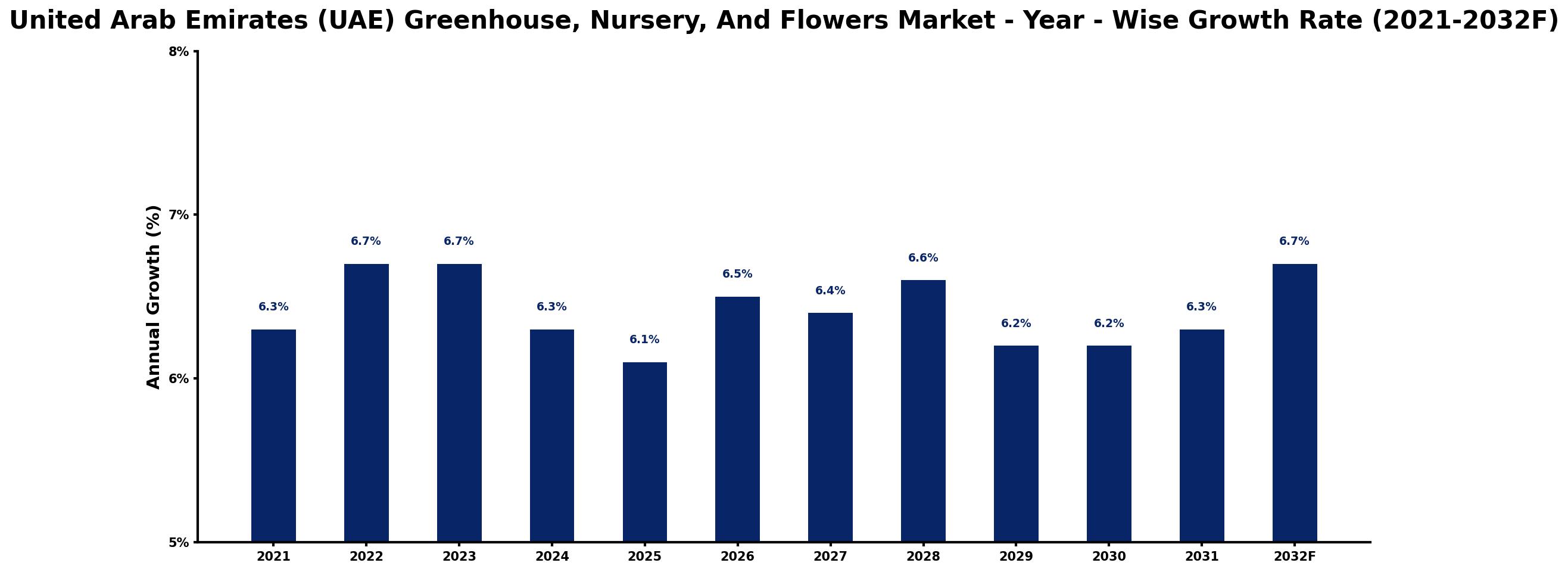
The table below presents the year‑wise growth rates along with the key drivers influencing the market
| Year | Growth Rate | Major Drivers |
| 2021 | 6.3% | Rising consumer interest in sustainability |
| 2022 | 6.7% | Increased investments in horticultural technology |
| 2023 | 6.7% | Growing demand for indoor plants |
| 2024 | 6.3% | Expansion of eco-friendly landscaping services |
| 2025 | 6.1% | Boost in urban gardening initiatives |
| 2026 | 6.5% | Surge in agricultural tourism activities |
| 2027 | 6.4% | rising export shipment volumes |
| 2028 | 6.6% | Development of smart irrigation systems |
| 2029 | 6.2% | Emergence of organic gardening trends |
| 2030 | 6.2% | Increased focus on biodiversity conservation |
| 2031 | 6.3% | Growth in green infrastructure projects |
| 2032 | 6.7% | Rise in community gardening programs |
Note: Market size estimations and growth projections presented in this report are based on 6Wresearch's proprietary forecasting methodology, utilizing the latest available industry data, government publications, and primary research inputs.
United Arab Emirates (UAE) Greenhouse, Nursery, And Flowers Market Synopsis
In recent years, the UAE greenhouse nursery and flowers market has experienced notable momentum, driven by urban development and a shift in consumer preferences towards aesthetic landscaping. As the market evolves, it is poised to embrace a broader range of unique plant varieties, reflecting an increasingly sophisticated consumer base.
Looking ahead, the market appears set to capitalize on emerging trends, such as eco-friendly practices and the incorporation of technology in horticulture. This evolution positions the UAE as not only a regional leader in ornamental horticulture but also as a competitive player in the international arena.
United Arab Emirates (UAE) Greenhouse, Nursery, And Flowers Market Key Takeaways
- The market is driven by rising demand for ornamental plants due to urbanization and gardening interests.
- Greenhouse technologies enable consistent production of high-quality plants, catering to both local and export needs.
- There is increasing consumer preference for unique and exotic plant varieties.
- Despite challenges, the market has shown resilience and adaptability, especially post-COVID-19.
- Investment in technology and sustainable practices is becoming crucial for future growth.
Evaluation of Restraints in United Arab Emirates (UAE) Greenhouse, Nursery, And Flowers Market
While the UAE greenhouse nursery and flowers market shows promising growth, several restraints are evident. A significant challenge lies in the specialized expertise required to maintain diverse plant species in controlled environments. This need for skilled labor can strain resources, particularly as competition intensifies with imported flowers and plants. Moreover, local growers face pressure to innovate continually, requiring consistent investment in technology and practices that can sometimes exceed available budgets, hindering potential growth.
United Arab Emirates (UAE) Greenhouse, Nursery, And Flowers Market Trends
Several trends are shaping the UAE greenhouse nursery and flowers market. The rise of sustainable and eco-friendly gardening practices is driving demand for organic plants and environmentally conscious products. Furthermore, digital solutions for horticulture are emerging, allowing growers to manage resources efficiently and streamline operations. These trends reflect a shift towards modernization, making the sector more accessible and appealing to a younger demographic.
United Arab Emirates (UAE) Greenhouse, Nursery, And Flowers Market Opportunities
Genuine growth opportunities lie in the increasing consumer inclination towards indoor gardening and landscaping. With more people spending time at home, the demand for indoor plants has surged, prompting nurseries to diversify their offerings. Additionally, the potential for international export remains robust, especially for unique plant varieties sought after in global markets. Investing in technology-driven solutions and eco-friendly practices can further enhance competitive advantages in this evolving landscape.
Government Initiatives in the United Arab Emirates (UAE) Greenhouse, Nursery, And Flowers Market
The UAE government has been instrumental in supporting the greenhouse nursery and flowers market through various initiatives. Public spending on landscaping and beautification projects has increased, underscoring the commitment to enhancing urban aesthetics. Moreover, incentives for sustainable agriculture and research into advanced greenhouse technologies promote innovation. These initiatives align with broader national goals of environmental sustainability and economic diversification.
Future Insights of the United Arab Emirates (UAE) Greenhouse, Nursery, And Flowers Market
From 2026 to 2032, the UAE greenhouse nursery and flowers market is anticipated to evolve significantly. The integration of smart technologies and precision horticulture is expected to streamline operations and boost productivity. Additionally, a heightened focus on sustainability will likely redefine consumer expectations, leading to increased demand for eco-friendly products. Overall, the market is poised for sustained growth, with opportunities for innovative and adaptive businesses to thrive in a competitive environment.
United Arab Emirates (UAE) Greenhouse, Nursery, And Flowers Market Latest Developments (2025 - 2026)
Recently, the UAE greenhouse nursery and flowers market has seen a shift towards incorporating advanced technologies, including automated irrigation systems and climate-controlled greenhouses. Additionally, there has been a noticeable increase in collaborations between local growers and tech companies, facilitating knowledge exchange and boosting productivity. The trend towards sustainability continues to gain traction, with nurseries increasingly adopting organic practices to cater to environmentally conscious consumers.
United Arab Emirates (UAE) Greenhouse, Nursery, And Flowers Market - Key Attractiveness of the Report
- 10 Years of Market Numbers
- Historical Data Starting from 2022 to 2025
- Base Year: 2025
- Forecast Data until 2032
- Key Performance Indicators Impacting the Market
- Major Upcoming Developments and Projects
Key Highlights of the Report:
- United Arab Emirates (UAE) Greenhouse, Nursery, And Flowers Market Outlook
- Market Size of United Arab Emirates (UAE) Greenhouse, Nursery, And Flowers Market, 2025
- Forecast of United Arab Emirates (UAE) Greenhouse, Nursery, And Flowers Market, 2032
- Historical Data and Forecast of United Arab Emirates (UAE) Greenhouse, Nursery, And Flowers Revenues & Volume for the Period 2022-2032F
- United Arab Emirates (UAE) Greenhouse, Nursery, And Flowers Market Trend Evolution
- United Arab Emirates (UAE) Greenhouse, Nursery, And Flowers Market Drivers and Challenges
- United Arab Emirates (UAE) Greenhouse, Nursery, And Flowers Price Trends
- United Arab Emirates (UAE) Greenhouse, Nursery, And Flowers Porter's Five Forces
- United Arab Emirates (UAE) Greenhouse, Nursery, And Flowers Industry Life Cycle
- Historical Data and Forecast of United Arab Emirates (UAE) Greenhouse, Nursery, And Flowers Market Revenues & Volume By Type for the Period 2022-2032F
- Historical Data and Forecast of United Arab Emirates (UAE) Greenhouse, Nursery, And Flowers Market Revenues & Volume By Food Crops Grown Under Cover for the Period 2022-2032F
- Historical Data and Forecast of United Arab Emirates (UAE) Greenhouse, Nursery, And Flowers Market Revenues & Volume By Nursery and Floriculture Production for the Period 2022-2032F
- Historical Data and Forecast of United Arab Emirates (UAE) Greenhouse, Nursery, And Flowers Market Revenues & Volume By End-User for the Period 2022-2032F
- Historical Data and Forecast of United Arab Emirates (UAE) Greenhouse, Nursery, And Flowers Market Revenues & Volume By B2B for the Period 2022-2032F
- Historical Data and Forecast of United Arab Emirates (UAE) Greenhouse, Nursery, And Flowers Market Revenues & Volume By B2C for the Period 2022-2032F
- United Arab Emirates (UAE) Greenhouse, Nursery, And Flowers Import Export Trade Statistics
- Market Opportunity Assessment By Type
- Market Opportunity Assessment By End-User
- United Arab Emirates (UAE) Greenhouse, Nursery, And Flowers Top Companies Market Share
- United Arab Emirates (UAE) Greenhouse, Nursery, And Flowers Competitive Benchmarking By Technical and Operational Parameters
- United Arab Emirates (UAE) Greenhouse, Nursery, And Flowers Company Profiles
- United Arab Emirates (UAE) Greenhouse, Nursery, And Flowers Key Strategic Recommendations






































