United Arab Emirates (UAE) Isoprene Market Size, Share & Growth Rate
The United Arab Emirates (UAE) Isoprene Market was estimated at USD 472 Million in 2025 and is projected to reach USD 691 Million by 2032, growing at a CAGR of 5.6% from 2026 to 2032. This growth trajectory is largely fueled by the robust expansion of the rubber and polymer industries within the UAE, as well as the surging demand for synthetic rubber across various applications. Furthermore, the UAE's strategic initiatives to bolster its position in the regional petrochemical landscape are instrumental in driving this market forward.
United Arab Emirates (UAE) Isoprene Market Year-wise Growth Rate and Key Drivers
This graph highlights how the United Arab Emirates (UAE) Isoprene Market has steadily grown over the years, supported by major growth factors.
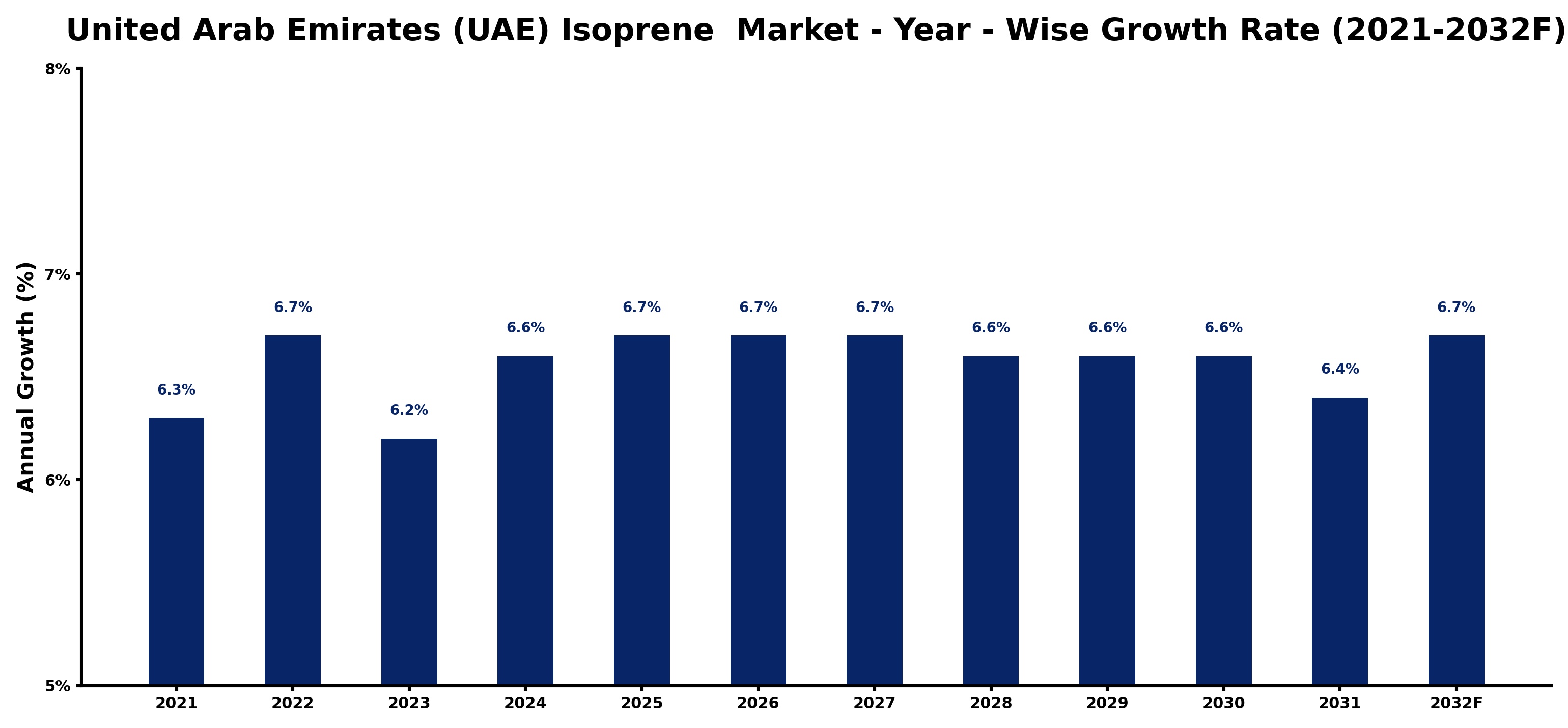
The table below presents the year‑wise growth rates along with the key drivers influencing the market
| Year | Growth Rate | Major Drivers |
| 2021 | 6.3% | Growing urbanization and commercial development |
| 2022 | 6.7% | Rapid growth in telecom and data center sectors |
| 2023 | 6.2% | Government infrastructure modernization initiatives |
| 2024 | 6.6% | Increasing adoption of advanced technologies |
| 2025 | 6.7% | Increasing industrial automation investments |
| 2026 | 6.7% | Growing renewable energy integration projects |
| 2027 | 6.7% | Increasing industrial automation investments |
| 2028 | 6.6% | Expansion of commercial construction activities |
| 2029 | 6.6% | Government infrastructure modernization initiatives |
| 2030 | 6.6% | Increasing industrial automation investments |
| 2031 | 6.4% | Increasing industrial infrastructure investments |
| 2032 | 6.7% | Growing renewable energy integration projects |
Note - Market size estimations and growth projections presented in this report are based on 6Wresearch's advanced forecasting approach, validated with industry datasets as of June 2026.
United Arab Emirates (UAE) Isoprene Market Synopsis
The UAE is currently witnessing a dynamic shift in its isoprene market, underpinned by an increase in domestic production and the rising application of synthetic rubber in automotive and industrial sectors. This shift reflects the country's ongoing commitment to diversifying its petrochemical offerings while addressing the growing regional demand for high-quality rubber products.
Given the strategic initiatives to enhance local manufacturing capabilities, the isoprene market in the UAE is positioned for considerable growth. Investments in advanced refining technologies and supply chain optimizations are crucial as the country aims to meet escalating demands across various sectors, particularly automotive and manufacturing.
United Arab Emirates (UAE) Isoprene Market Key Takeaways
- The UAE isoprene market is driven by strong demand from the rubber and polymer sectors.
- Investments in local manufacturing and supply chain enhancements are pivotal for market growth.
- Robust expansion in the automotive industry is significantly boosting isoprene consumption.
- The market is expected to adapt quickly as it recovers from pandemic-related disruptions.
- Technological advancements in isoprene extraction and refining are key to future competitiveness.
Evaluation of Restraints in United Arab Emirates (UAE) Isoprene Market
While the UAE isoprene market exhibits promising growth potential, several constraints are at play. The volatility of raw material prices remains a notable concern, as fluctuations in global energy markets can directly impact isoprene production costs. Additionally, competition from countries with established rubber industries poses challenges, requiring the UAE to enhance its technological capabilities for isoprene extraction and refining to maintain market relevance.
United Arab Emirates (UAE) Isoprene Market Trends
The market is currently experiencing significant trends that are reshaping the industry landscape. Notably, the increasing focus on sustainable practices is influencing raw material sourcing and production methods. Moreover, advancements in synthetic rubber technology are leading to the development of high-performance materials that meet evolving customer demands. Additionally, the push for electric vehicles is shaping the demand for innovative rubber solutions, impacting isoprene consumption patterns.
United Arab Emirates (UAE) Isoprene Market Opportunities
Opportunities abound within the UAE isoprene market as industries pivot to meet new challenges. With the growing emphasis on sustainability, there is an increasing demand for eco-friendly materials that can replace traditional rubber products. Additionally, collaborative ventures with global players can facilitate knowledge exchange and technological enhancements, positioning UAE firms to capture larger market shares. Furthermore, investments in R&D to innovate new applications for isoprene can open doors to previously untapped sectors.
Government Initiatives in the United Arab Emirates (UAE) Isoprene Market
The UAE government has implemented several initiatives aimed at enhancing the petrochemical sector, which is vital for the isoprene market. Policies that promote local manufacturing, alongside financial incentives for R&D, are designed to elevate the industry's capabilities. Furthermore, strategic partnerships between public and private sectors are encouraged to foster innovation in production processes and sustainability practices, ensuring that the UAE remains competitive on a global scale.
Future Insights of the United Arab Emirates (UAE) Isoprene Market
Looking ahead to the 2026-2032 period, the UAE isoprene market is poised for robust growth, fueled by sustained demand from the rubber and polymer industries. The anticipated rise in electric vehicle production will likely drive innovations in synthetic rubber applications. Furthermore, ongoing efforts to optimize the supply chain and enhance technological capabilities will bolster the UAE's position as a leading player in the regional petrochemical landscape.
United Arab Emirates (UAE) Isoprene Market Latest Developments (May 2025 - June 2026)
Recent developments within the UAE isoprene market indicate a significant focus on technological advancements and sustainable production practices. Companies are increasingly investing in new extraction methods aimed at improving efficiency and reducing environmental impact. In addition, collaborations between local firms and international technology providers are emerging as a strategy to enhance product offerings and meet evolving market demands.
United Arab Emirates (UAE) Isoprene Market - Key Attractiveness of the Report
- 10 Years of Market Numbers
- Historical Data Starting from 2022 to 2025
- Base Year: 2025
- Forecast Data until 2032
- Key Performance Indicators Impacting the Market
- Major Upcoming Developments and Projects
Key Highlights of the Report:
- United Arab Emirates (UAE) Isoprene Market Outlook
- Market Size of United Arab Emirates (UAE) Isoprene Market, 2025
- Forecast of United Arab Emirates (UAE) Isoprene Market, 2032
- Historical Data and Forecast of United Arab Emirates (UAE) Isoprene Revenues & Volume for the Period 2022-2032F
- United Arab Emirates (UAE) Isoprene Market Trend Evolution
- United Arab Emirates (UAE) Isoprene Market Drivers and Challenges
- United Arab Emirates (UAE) Isoprene Price Trends
- United Arab Emirates (UAE) Isoprene Porter's Five Forces
- United Arab Emirates (UAE) Isoprene Industry Life Cycle
- Historical Data and Forecast of United Arab Emirates (UAE) Isoprene Market Revenues & Volume By Type for the Period 2022-2032F
- Historical Data and Forecast of United Arab Emirates (UAE) Isoprene Market Revenues & Volume By Polymer Grade for the Period 2022-2032F
- Historical Data and Forecast of United Arab Emirates (UAE) Isoprene Market Revenues & Volume By Chemical Grade for the Period 2022-2032F
- Historical Data and Forecast of United Arab Emirates (UAE) Isoprene Market Revenues & Volume By Application for the Period 2022-2032F
- Historical Data and Forecast of United Arab Emirates (UAE) Isoprene Market Revenues & Volume By Polyisoprene (IR) for the Period 2022-2032F
- Historical Data and Forecast of United Arab Emirates (UAE) Isoprene Market Revenues & Volume By Styrene-isoprene-styrene (SIS) for the Period 2022-2032F
- Historical Data and Forecast of United Arab Emirates (UAE) Isoprene Market Revenues & Volume By Isobutylene-isoprene rubber (IIR) for the Period 2022-2032F
- Historical Data and Forecast of United Arab Emirates (UAE) Isoprene Market Revenues & Volume By Others for the Period 2022-2032F
- Historical Data and Forecast of United Arab Emirates (UAE) Isoprene Market Revenues & Volume By End-use Industry for the Period 2022-2032F
- Historical Data and Forecast of United Arab Emirates (UAE) Isoprene Market Revenues & Volume By Tires for the Period 2022-2032F
- Historical Data and Forecast of United Arab Emirates (UAE) Isoprene Market Revenues & Volume By Non-tires for the Period 2022-2032F
- Historical Data and Forecast of United Arab Emirates (UAE) Isoprene Market Revenues & Volume By Adhesives for the Period 2022-2032F
- Historical Data and Forecast of United Arab Emirates (UAE) Isoprene Market Revenues & Volume By Others for the Period 2022-2032F
- United Arab Emirates (UAE) Isoprene Import Export Trade Statistics
- Market Opportunity Assessment By Type
- Market Opportunity Assessment By Application
- Market Opportunity Assessment By End-use Industry
- United Arab Emirates (UAE) Isoprene Top Companies Market Share
- United Arab Emirates (UAE) Isoprene Competitive Benchmarking By Technical and Operational Parameters
- United Arab Emirates (UAE) Isoprene Company Profiles
- United Arab Emirates (UAE) Isoprene Key Strategic Recommendations






































