Vietnam Isoprene Market Size, Share & Growth Rate
The Vietnam Isoprene Market was estimated at USD 1027 Million in 2025 and is projected to reach USD 1457 Million by 2032, growing at a CAGR of 5.1% from 2026 to 2032. This upward trajectory is predominantly fueled by the burgeoning automotive and tire industries, which are expanding rapidly due to Vietnam's economic growth and rising motorization. As these sectors evolve, the demand for high-quality synthetic rubber, particularly isoprene, is expected to follow suit, further invigorating the market landscape.
Vietnam Isoprene Market Year-wise Growth Rate and Key Drivers
This graph highlights how the Vietnam Isoprene Market has steadily grown over the years, supported by major growth factors.
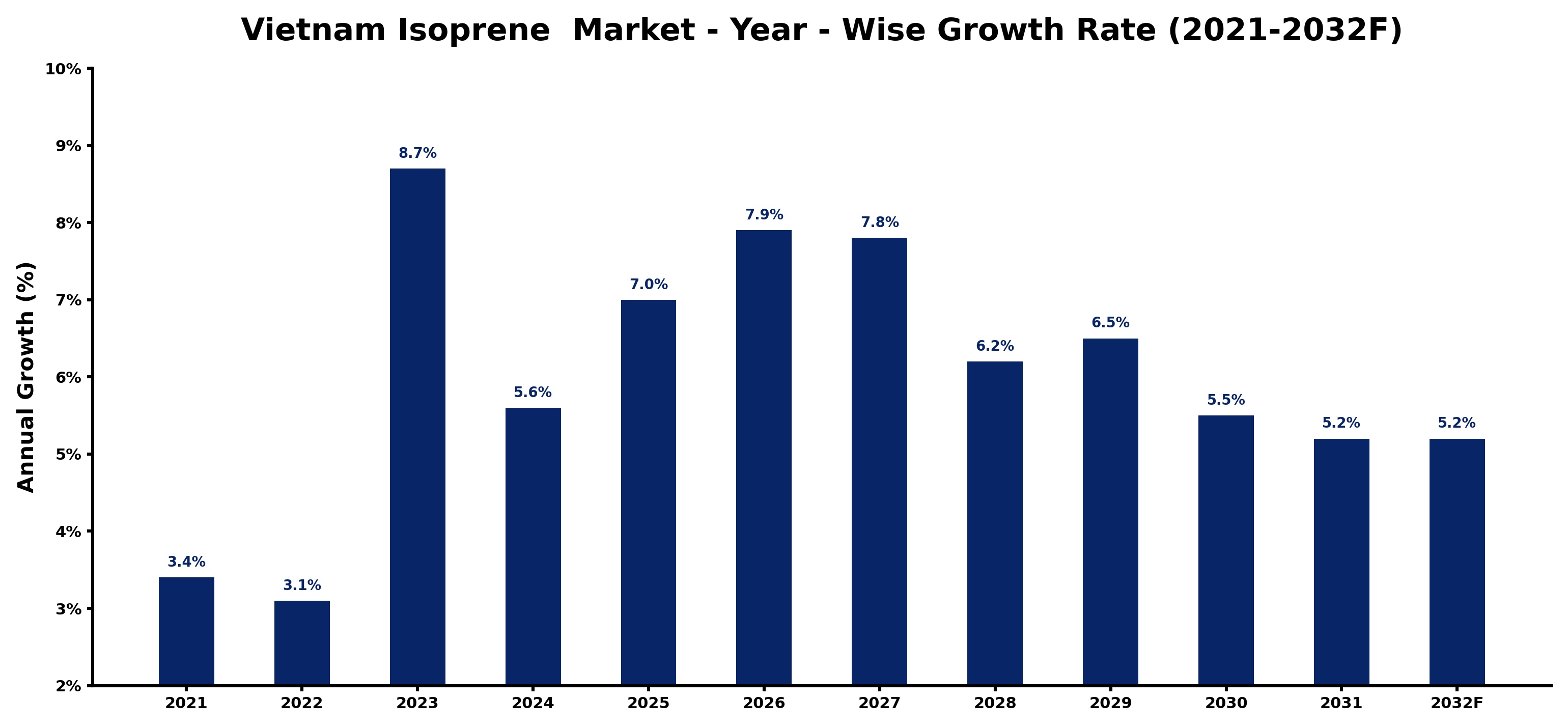
The table below presents the year‑wise growth rates along with the key drivers influencing the market
| Year | Growth Rate | Major Drivers |
| 2021 | 3.4% | Expansion of transportation and logistics networks |
| 2022 | 3.1% | Expansion of transportation and logistics networks |
| 2023 | 8.7% | Rapid growth in telecom and data center sectors |
| 2024 | 5.6% | Growing urbanization and commercial development |
| 2025 | 7.0% | Growing renewable energy integration projects |
| 2026 | 7.9% | Expansion of transportation and logistics networks |
| 2027 | 7.8% | Increasing adoption of advanced technologies |
| 2028 | 6.2% | Rapid growth in telecom and data center sectors |
| 2029 | 6.5% | Expansion of commercial construction activities |
| 2030 | 5.5% | Increasing industrial infrastructure investments |
| 2031 | 5.2% | Government infrastructure modernization initiatives |
| 2032 | 5.2% | Expansion of transportation and logistics networks |
Note - Market size estimations and growth projections presented in this report are based on 6Wresearch’s advanced forecasting approach, validated with industry datasets as of June 2026.
Vietnam Isoprene Market Synopsis
The driving force behind the Vietnam Isoprene market currently lies in the automotive sector's resurgence post-pandemic. This revival not only amplifies the demand for isoprene but also underscores the industry's reliance on high-quality synthetic rubber for tire manufacturing. As automotive production ramps up, isoprene's role as an essential raw material is further solidified.
In tandem with the automotive industry, the tire manufacturing landscape is undergoing significant transformations, with technological advancements and sustainability initiatives gaining traction. These shifts are not only reshaping production methods but are also increasing the demand for innovative applications of isoprene in synthetic rubber products.
Vietnam Isoprene Market Key Takeaways
- The Vietnam Isoprene market is primarily driven by the automotive and tire industries.
- Rising motorization in Vietnam contributes significantly to increased tire demand and, consequently, isoprene consumption.
- Technological innovations are enhancing production processes and the sustainability of isoprene applications.
- Supply chain resilience and diversification remain critical in navigating market uncertainties.
- The market is expected to recover and expand as global trade stabilizes in the post-COVID-19 environment.
Evaluation of Restraints in Vietnam Isoprene Market
Despite its promising outlook, the Vietnam Isoprene market faces significant constraints, particularly related to supply chain vulnerabilities. Being primarily derived from petrochemical sources, fluctuations in crude oil prices can disrupt production and availability of isoprene. Furthermore, geopolitical tensions may exacerbate these issues, impacting the stability of supply chains. To counteract these challenges, stakeholders must consider diversifying their supply sources and building resilience into their operations, ensuring a steady supply of isoprene to meet the growing demand.
Vietnam Isoprene Market Trends
Several current and emerging trends are shaping the Vietnam Isoprene market, with a notable emphasis on sustainable production practices. The increasing focus on environmental concerns has prompted manufacturers to explore eco-friendly alternatives and innovations in synthetic rubber applications. Additionally, advancements in polymer technology are enabling more efficient use of isoprene, further enhancing its applicability in various sectors. As the market evolves, these trends will likely play a pivotal role in guiding future developments.
Vietnam Isoprene Market Opportunities
Significant opportunities for growth and investment abound within the Vietnam Isoprene market, particularly in the context of new product development and technological advancements. As manufacturers seek to meet the demands of a changing market landscape, innovations in isoprene applications for the automotive and tire industries will be critical. Moreover, as Vietnam continues to promote policies favoring industrial growth, companies can capitalize on governmental support to bolster production capabilities and market reach.
Government Initiatives in the Vietnam Isoprene Market
The Vietnamese government has been actively promoting initiatives to bolster the automotive and manufacturing sectors, which are crucial drivers of the Isoprene market. This includes investment in infrastructure improvements and favorable policies aimed at enhancing production efficiency. Additionally, there is a growing focus on sustainability and environmental standards, pushing manufacturers toward cleaner production methods. These initiatives aim to create a more robust industrial framework, ultimately benefiting stakeholders in the isoprene supply chain.
Future Insights of the Vietnam Isoprene Market
Looking ahead to the period between 2026 and 2032, the Vietnam Isoprene market is set to experience notable growth, driven by the ongoing advancements in automotive technologies and the rising demand for synthetic rubber. The growing emphasis on sustainability will likely push manufacturers toward innovations that not only enhance product performance but also minimize environmental impact. Stakeholders who prioritize adaptability and invest in emerging trends will be well-positioned to capitalize on the evolving market dynamics.
Vietnam Isoprene Market Latest Developments (May 2025 - June 2026)
Recent developments in the Vietnam Isoprene market have highlighted an increasing focus on technological innovations aimed at improving production efficiency and sustainability. Industry participants are actively pursuing collaborations to enhance product applications, ensuring they remain competitive in a dynamic market environment. Additionally, as the automotive sector continues to rebound from pandemic-related disruptions, stakeholders are aligning their strategies to capture emerging opportunities within this revitalizing landscape.
Vietnam Isoprene Market - Key Attractiveness of the Report
- 10 Years of Market Numbers
- Historical Data Starting from 2022 to 2025
- Base Year: 2025
- Forecast Data until 2032
- Key Performance Indicators Impacting the Market
- Major Upcoming Developments and Projects
Key Highlights of the Report:
- Vietnam Isoprene Market Outlook
- Market Size of Vietnam Isoprene Market, 2025
- Forecast of Vietnam Isoprene Market, 2032
- Historical Data and Forecast of Vietnam Isoprene Revenues & Volume for the Period 2022-2032F
- Vietnam Isoprene Market Trend Evolution
- Vietnam Isoprene Market Drivers and Challenges
- Vietnam Isoprene Price Trends
- Vietnam Isoprene Porter's Five Forces
- Vietnam Isoprene Industry Life Cycle
- Historical Data and Forecast of Vietnam Isoprene Market Revenues & Volume By Type for the Period 2022-2032F
- Historical Data and Forecast of Vietnam Isoprene Market Revenues & Volume By Polymer Grade for the Period 2022-2032F
- Historical Data and Forecast of Vietnam Isoprene Market Revenues & Volume By Chemical Grade for the Period 2022-2032F
- Historical Data and Forecast of Vietnam Isoprene Market Revenues & Volume By Application for the Period 2022-2032F
- Historical Data and Forecast of Vietnam Isoprene Market Revenues & Volume By Polyisoprene (IR) for the Period 2022-2032F
- Historical Data and Forecast of Vietnam Isoprene Market Revenues & Volume By Styrene-isoprene-styrene (SIS) for the Period 2022-2032F
- Historical Data and Forecast of Vietnam Isoprene Market Revenues & Volume By Isobutylene-isoprene rubber (IIR) for the Period 2022-2032F
- Historical Data and Forecast of Vietnam Isoprene Market Revenues & Volume By Others for the Period 2022-2032F
- Historical Data and Forecast of Vietnam Isoprene Market Revenues & Volume By End-use Industry for the Period 2022-2032F
- Historical Data and Forecast of Vietnam Isoprene Market Revenues & Volume By Tires for the Period 2022-2032F
- Historical Data and Forecast of Vietnam Isoprene Market Revenues & Volume By Non-tires for the Period 2022-2032F
- Historical Data and Forecast of Vietnam Isoprene Market Revenues & Volume By Adhesives for the Period 2022-2032F
- Historical Data and Forecast of Vietnam Isoprene Market Revenues & Volume By Others for the Period 2022-2032F
- Vietnam Isoprene Import Export Trade Statistics
- Market Opportunity Assessment By Type
- Market Opportunity Assessment By Application
- Market Opportunity Assessment By End-use Industry
- Vietnam Isoprene Top Companies Market Share
- Vietnam Isoprene Competitive Benchmarking By Technical and Operational Parameters
- Vietnam Isoprene Company Profiles
- Vietnam Isoprene Key Strategic Recommendations






































