United Arab Emirates (UAE) IT Services Market Size & Growth Rate (2026-2032)
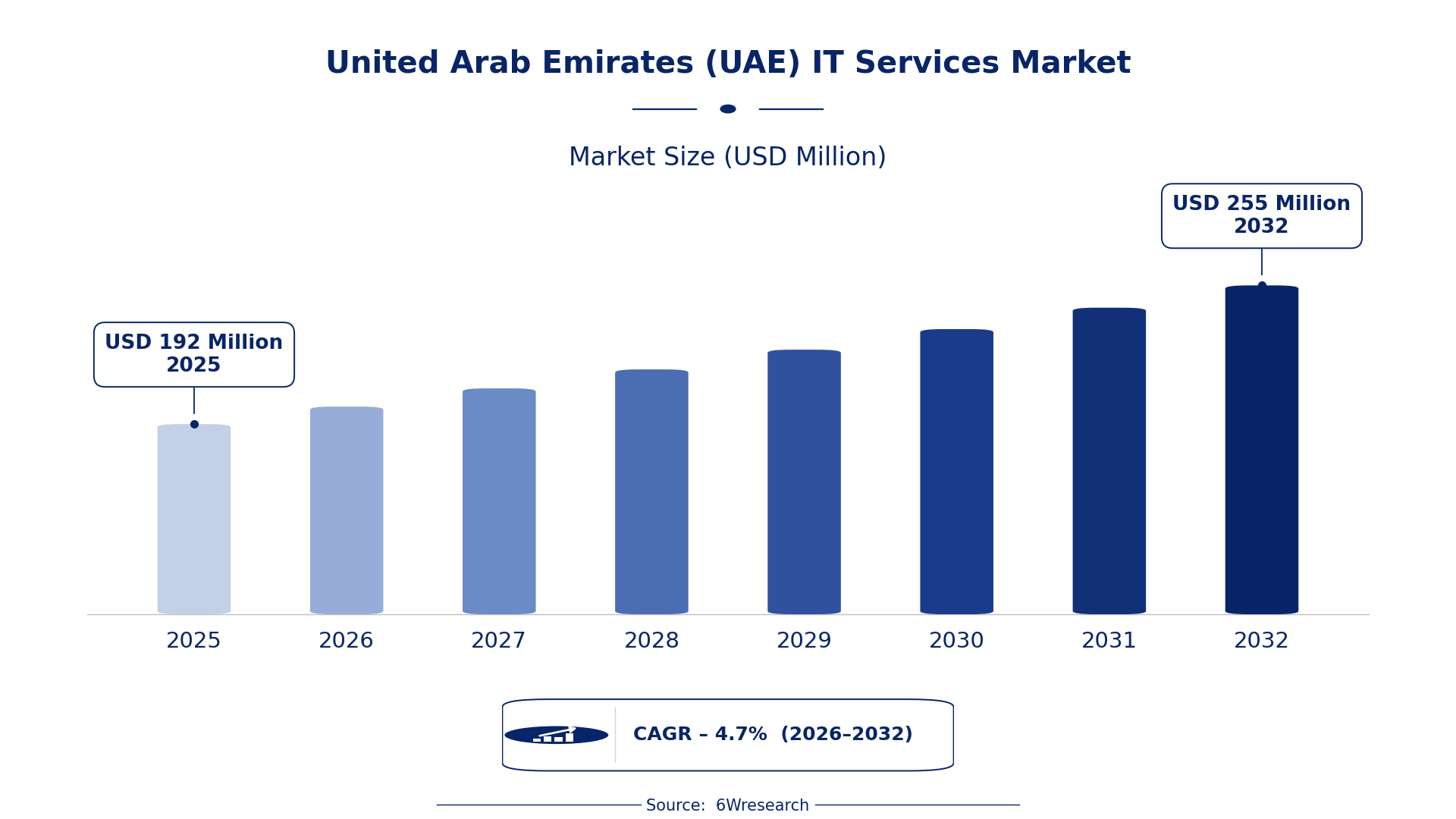
The United Arab Emirates (UAE) IT Services Market was estimated at USD 192 Million in 2025 and is projected to reach USD 255 Million by 2032, growing at a CAGR of 4.7% from 2026 to 2032.
United Arab Emirates (UAE) IT Services Market Synopsis
The UAE's IT Services market is witnessing significant momentum, driven by the country's ambition to become a global technology hub. As organizations increasingly prioritize digital transformation, the demand for IT services such as consulting, cloud solutions, and cybersecurity has surged, reflecting the urgent need for enhanced operational efficiency and competitive advantage.
This market thrives on a mix of government initiatives and private sector investments aimed at fostering innovation. As the UAE continues to push for smart city projects and infrastructure upgrades, IT service providers are positioned as essential partners in this journey, addressing the complexities of modern digital ecosystems.
United Arab Emirates (UAE) IT Services Market Year-wise Growth Rate and Key Drivers
This graph illustrates the annual growth rates of the United Arab Emirates (UAE) IT Services Market from 2021 to 2032, highlighting a steady upward trajectory and projected expansion over the forecast period.
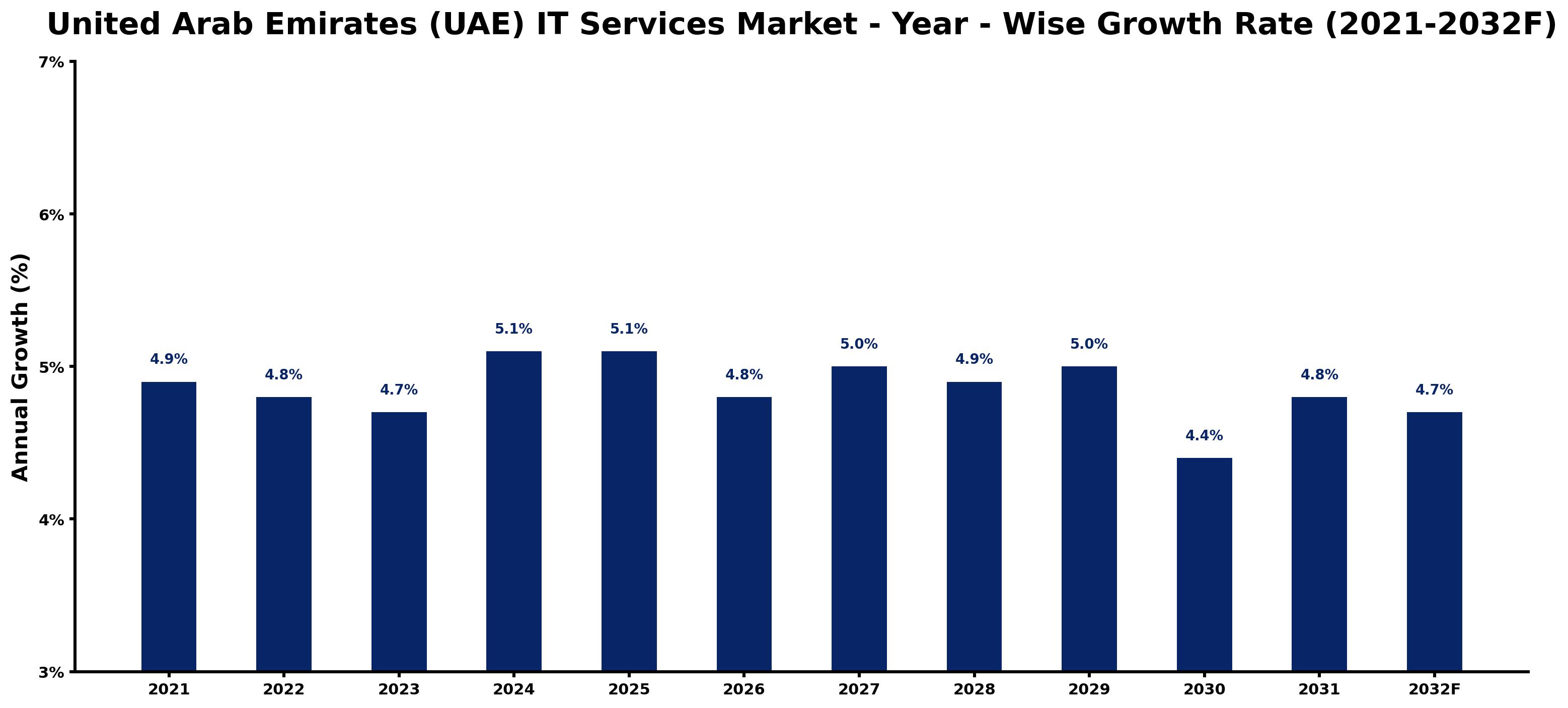
The table below presents the year‑wise growth rates along with the key drivers influencing the market
| Year | Growth Rate | Major Drivers |
| 2021 | 4.9% | UAE digital transformation initiatives boosting IT services adoption. |
| 2022 | 4.8% | Government's AI strategy driving IT infrastructure investments. |
| 2023 | 4.7% | Rising cybersecurity threats necessitating enhanced IT services. |
| 2024 | 5.1% | 5G rollout enhancing demand for IT service solutions. |
| 2025 | 5.1% | UAE's hosting of global events increasing IT service needs. |
| 2026 | 4.8% | Local SMEs adopting cloud solutions for business continuity. |
| 2027 | 5.0% | Smart city projects requiring extensive IT service support. |
| 2028 | 4.9% | Increased reliance on remote work driving IT service growth. |
| 2029 | 5.0% | E-commerce expansion necessitating robust IT service frameworks. |
| 2030 | 4.4% | Government regulations mandating digital data management solutions. |
| 2031 | 4.8% | Exponentially growing tech startups requiring specialized IT services. |
| 2032 | 4.7% | Emphasis on sustainability driving IT-driven green initiatives. |
Note: Market size estimations and growth projections presented in this report are based on 6Wresearch's proprietary forecasting methodology, utilizing the latest available industry data, government publications, and primary research inputs.
United Arab Emirates (UAE) IT Services Market Key Takeaways
Below are some of the specific key takeaways from the market, including:
- The UAE IT Services market is on a steady growth trajectory, with a forecasted CAGR of 4.8% from 2026 to 2032.
- Cloud computing and cybersecurity services are driving major demand as organizations enhance their digital infrastructures.
- Government initiatives focused on smart cities are significantly influencing IT services adoption across sectors.
- The market faces challenges related to talent shortages and the need for compliance with evolving data protection regulations.
- Emerging technologies like AI and data analytics are set to reshape service offerings in the coming years.
Evaluation of Restraints in United Arab Emirates (UAE) IT Services Market
Despite its promising outlook, the UAE IT Services market is held back by several key constraints. A major issue is the ongoing struggle to find skilled professionals in specialized IT fields, creating gaps in service delivery. Companies must also contend with the dual pressures of maintaining service quality while managing costs. on top of that, the rapid pace of technological change demands constant adaptation from service providers, which can strain resources and impact long-term planning. Additionally, ensuring compliance with stringent data protection regulations adds another layer of complexity, necessitating ongoing investment in cybersecurity measures.
United Arab Emirates (UAE) IT Services Market Trends
Several trends are shaping the UAE IT Services market. The shift towards cloud-based solutions continues to dominate, with organizations moving critical workloads to cloud environments for greater agility and cost efficiency. Cybersecurity remains a top priority, as businesses increasingly recognize the importance of protecting sensitive data amid rising cyber threats. The integration of AI and machine learning into IT services is also gaining traction, as companies seek to leverage data analytics for better decision-making. Lastly, the push for sustainable technology solutions is becoming evident, as organizations aim to align their IT strategies with environmental goals.
United Arab Emirates (UAE) IT Services Market Opportunities
The demand for IT services in the UAE presents various growth opportunities. Companies can capitalize on the need for cloud migration services, particularly among small and medium enterprises (SMEs) that are still in the early stages of digital transformation. The focus on cybersecurity solutions offers a lucrative avenue, especially as regulatory requirements tighten. There's also a notable opportunity in the development and integration of AI-driven applications, as organizations look to enhance their operational efficiencies. Finally, partnerships between public and private sectors in smart city initiatives are set to create a fertile ground for IT service providers.
Government Initiatives in the United Arab Emirates (UAE) IT Services Market
Government policies play a crucial role in shaping the UAE IT Services market. The UAE government is heavily investing in digital infrastructure, which directly influences the demand for various IT services. With a focus on innovation and smart technologies, public sector priorities are aligned with the goals of enhancing the overall digital economy. These initiatives not only encourage private sector participation but also ensure that regulatory frameworks support the rapid evolution of IT services.
- A national digital infrastructure upgrade programme now in its rollout phase, aimed at enhancing connectivity across urban and rural areas.
- Current initiatives promoting smart city projects that integrate advanced IT services, expected to foster significant partnerships with private tech firms.
- A regulatory framework introduced in 2025 mandating enhanced data protection measures for IT service providers to safeguard consumer information.
- Upcoming plans for a public-private initiative targeting the expansion of IT training programmes, addressing the skills gap in the workforce.
- Recently launched smart government initiatives focusing on digitizing public services to improve citizen engagement and service delivery.
Future Insights of the United Arab Emirates (UAE) IT Services Market
Looking ahead, the UAE IT Services market is expected to continue its upward trajectory through 2032. As organizations deepen their digital transformation efforts, the demand for advanced IT solutions will expand. We anticipate a substantial rise in investments directed toward cybersecurity and cloud services, driven by both private enterprises and government initiatives. The integration of emerging technologies like AI will further redefine service offerings, creating an environment ripe for innovation and competitive differentiation. This strategic evolution will position the UAE as a leader in the regional IT services sector.
United Arab Emirates (UAE) IT Services Market Latest Developments
Recent activity in the UAE IT Services market reflects a strong push towards modernization and innovation. As organizations adapt to new technologies, the focus has shifted to enhancing service delivery and operational efficiencies. This momentum is supported by ongoing government initiatives aimed at fostering a digital-first economy.
- A major technology vendor launched a new cybersecurity framework in early 2025, aimed at protecting businesses from emerging cyber threats.
- An initiative that began in mid-2025 focuses on the deployment of cloud computing solutions across public sector entities, enhancing service efficiency.
- By late 2025, a leading regional operator is expected to complete its rollout of a comprehensive managed IT services platform for SMEs.
- Upcoming plans for a joint venture between technology firms to develop AI-driven analytics solutions for various industries, set to kick off in early 2026.
- Currently ongoing is a project that integrates smart technologies into traditional industries, enhancing productivity through digital transformation.
United Arab Emirates (UAE) IT Services Market - Key Attractiveness of the Report
- 10 Years of Market Numbers
- Historical Data Starting from 2022 to 2025
- Base Year: 2025
- Forecast Data until 2032
- Key Performance Indicators Impacting the Market
- Major Upcoming Developments and Projects
Key Highlights of the Report:
- United Arab Emirates (UAE) IT Services Market Outlook
- Market Size of United Arab Emirates (UAE) IT Services Market, 2025
- Forecast of United Arab Emirates (UAE) IT Services Market, 2032
- Historical Data and Forecast of United Arab Emirates (UAE) IT Services Revenues & Volume for the Period 2022-2032F
- United Arab Emirates (UAE) IT Services Market Trend Evolution
- United Arab Emirates (UAE) IT Services Market Drivers and Challenges
- United Arab Emirates (UAE) IT Services Price Trends
- United Arab Emirates (UAE) IT Services Porter's Five Forces
- United Arab Emirates (UAE) IT Services Industry Life Cycle
- Historical Data and Forecast of United Arab Emirates (UAE) IT Services Market Revenues & Volume By Vertical for the Period 2022-2032F
- Historical Data and Forecast of United Arab Emirates (UAE) IT Services Market Revenues & Volume By Government and defense for the Period 2022-2032F
- Historical Data and Forecast of United Arab Emirates (UAE) IT Services Market Revenues & Volume By Banking, Financial Services, and Insurance (BFSI) for the Period 2022-2032F
- Historical Data and Forecast of United Arab Emirates (UAE) IT Services Market Revenues & Volume By Healthcare for the Period 2022-2032F
- Historical Data and Forecast of United Arab Emirates (UAE) IT Services Market Revenues & Volume By Media and entertainment for the Period 2022-2032F
- Historical Data and Forecast of United Arab Emirates (UAE) IT Services Market Revenues & Volume By Consumer goods and retail for the Period 2022-2032F
- Historical Data and Forecast of United Arab Emirates (UAE) IT Services Market Revenues & Volume By IT and telecom for the Period 2022-2032F
- Historical Data and Forecast of United Arab Emirates (UAE) IT Services Market Revenues & Volume By Business Function for the Period 2022-2032F
- Historical Data and Forecast of United Arab Emirates (UAE) IT Services Market Revenues & Volume By Human Resources for the Period 2022-2032F
- Historical Data and Forecast of United Arab Emirates (UAE) IT Services Market Revenues & Volume By Finance and Accounting for the Period 2022-2032F
- Historical Data and Forecast of United Arab Emirates (UAE) IT Services Market Revenues & Volume By Sales and Marketing for the Period 2022-2032F
- Historical Data and Forecast of United Arab Emirates (UAE) IT Services Market Revenues & Volume By Supply Chain Management for the Period 2022-2032F
- Historical Data and Forecast of United Arab Emirates (UAE) IT Services Market Revenues & Volume By Operations and Support for the Period 2022-2032F
- Historical Data and Forecast of United Arab Emirates (UAE) IT Services Market Revenues & Volume By Manufacturing for the Period 2022-2032F
- Historical Data and Forecast of United Arab Emirates (UAE) IT Services Market Revenues & Volume By Deployment Mode for the Period 2022-2032F
- Historical Data and Forecast of United Arab Emirates (UAE) IT Services Market Revenues & Volume By On-premises for the Period 2022-2032F
- Historical Data and Forecast of United Arab Emirates (UAE) IT Services Market Revenues & Volume By Cloud for the Period 2022-2032F
- Historical Data and Forecast of United Arab Emirates (UAE) IT Services Market Revenues & Volume By Organization Size for the Period 2022-2032F
- Historical Data and Forecast of United Arab Emirates (UAE) IT Services Market Revenues & Volume By Large enterprises for the Period 2022-2032F
- Historical Data and Forecast of United Arab Emirates (UAE) IT Services Market Revenues & Volume By Small and Medium Enterprises (SMEs) for the Period 2022-2032F
- Historical Data and Forecast of United Arab Emirates (UAE) IT Services Market Revenues & Volume By Service Type for the Period 2022-2032F
- Historical Data and Forecast of United Arab Emirates (UAE) IT Services Market Revenues & Volume By Professional services for the Period 2022-2032F
- Historical Data and Forecast of United Arab Emirates (UAE) IT Services Market Revenues & Volume By Managed services for the Period 2022-2032F
- Historical Data and Forecast of United Arab Emirates (UAE) IT Services Market Revenues & Volume By Telecom services for the Period 2022-2032F
- United Arab Emirates (UAE) IT Services Import Export Trade Statistics
- Market Opportunity Assessment By Vertical
- Market Opportunity Assessment By Business Function
- Market Opportunity Assessment By Deployment Mode
- Market Opportunity Assessment By Organization Size
- Market Opportunity Assessment By Service Type
- United Arab Emirates (UAE) IT Services Top Companies Market Share
- United Arab Emirates (UAE) IT Services Competitive Benchmarking By Technical and Operational Parameters
- United Arab Emirates (UAE) IT Services Company Profiles
- United Arab Emirates (UAE) IT Services Key Strategic Recommendations






































