United Arab Emirates (UAE) Microtomes Market Size, Share & Growth Rate
The United Arab Emirates (UAE) Microtomes Market was estimated at USD 590 Million in 2025 and is projected to reach USD 857 Million by 2032, growing at a CAGR of 5.5% from 2026 to 2032. This robust growth trajectory is primarily driven by the increasing number of pathology and histology laboratories within the healthcare sector. As the demand for precise diagnostic tools grows alongside advancements in medical technology, microtomes are becoming indispensable for researchers and clinicians alike.
United Arab Emirates (UAE) Microtomes Market Year-wise Growth Rate and Key Drivers
This graph highlights how the United Arab Emirates (UAE) Microtomes Market has steadily grown over the years, supported by major growth factors.
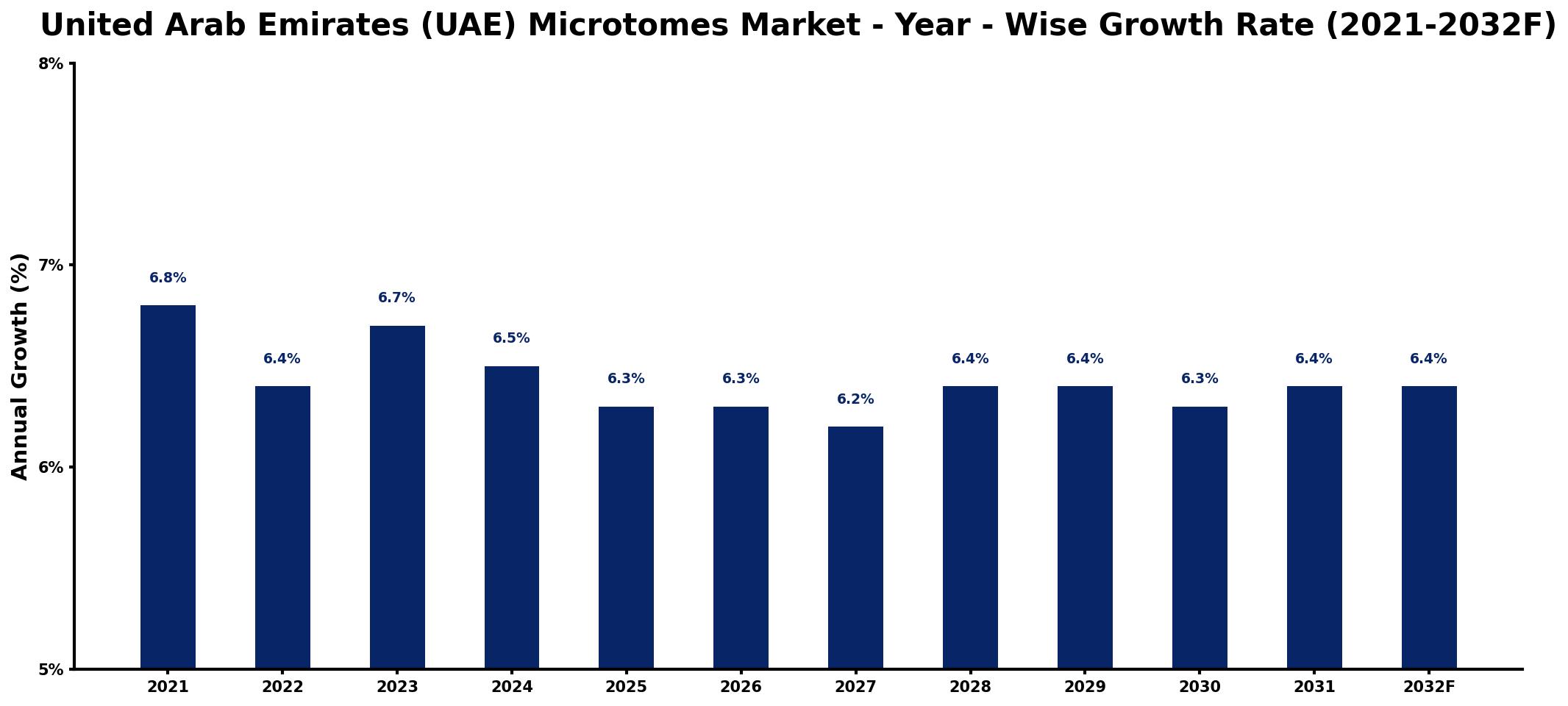
The table below presents the year‑wise growth rates along with the key drivers influencing the market
| Year | Growth Rate | Major Drivers |
| 2021 | 6.8% | Rising healthcare investments drive demand |
| 2022 | 6.4% | Increased research funding supports growth |
| 2023 | 6.7% | Technological advancements enhance applications |
| 2024 | 6.5% | Growing diagnostics market fuels expansion |
| 2025 | 6.3% | Surge in academic research initiatives |
| 2026 | 6.3% | Enhanced laboratory capabilities drive usage |
| 2027 | 6.2% | Higher demand for pathology services |
| 2028 | 6.4% | Expansion of healthcare infrastructure boosts |
| 2029 | 6.4% | Increased awareness of disease prevention |
| 2030 | 6.3% | Growing biopharmaceutical sector supports needs |
| 2031 | 6.4% | Investments in educational institutions rise |
| 2032 | 6.4% | Collaborations between industries enhance growth |
Note: Market size estimations and growth projections presented in this report are based on 6Wresearch's proprietary forecasting methodology, utilizing the latest available industry data, government publications, and primary research inputs.
United Arab Emirates (UAE) Microtomes Market Synopsis
The microtomes market in the UAE is currently experiencing a phase of expansion, fueled by a steady rise in healthcare services and a burgeoning emphasis on histological examinations. As laboratories enhance their capabilities to cater to a growing patient population, the need for advanced microtomes is surging.
Looking ahead, the market is poised for significant growth, bolstered by ongoing research initiatives and the continuous evolution of diagnostic practices. The shift towards more precise and efficient sample preparation techniques highlights an optimistic outlook for microtome technologies in the region.
United Arab Emirates (UAE) Microtomes Market Key Takeaways
- Growing demand for histological diagnostics is driving microtome adoption.
- Increased investment in healthcare infrastructure is expanding laboratory capabilities.
- Continuous innovation in cutting precision is essential for manufacturers.
- Training and support for end-users are vital for optimizing instrument performance.
- Research related to COVID-19 has proven resilient and impactful for the market.
Evaluation of Restraints in United Arab Emirates (UAE) Microtomes Market
While the UAE microtomes market is on an upward trajectory, it faces several restraints that may hinder its growth. One of the primary concerns is the need for ongoing innovation in sample preparation techniques, as manufacturers must continually enhance the precision of their instruments. Moreover, a gap in adequate training programs for end-users can lead to underutilization of these advanced tools. Ensuring that laboratory personnel are proficient in operating microtomes is critical for maximizing their effectiveness and maintaining high standards in tissue analysis.
United Arab Emirates (UAE) Microtomes Market Trends
The microtomes market in the UAE is witnessing a shift towards automation and digital integration, as laboratories seek to streamline operations and enhance accuracy. Increased utilization of automated microtomes is becoming a hallmark of modern histopathology practices. Furthermore, the growing emphasis on precision medicine is driving demand for specialized microtome applications in diverse research fields, thus expanding the market landscape.
United Arab Emirates (UAE) Microtomes Market Opportunities
The UAE microtomes market presents numerous opportunities for growth and investment, particularly in the realm of research and development. Companies that focus on innovative microtome designs and cutting-edge technology will likely capture significant market share. Additionally, expanding partnerships with healthcare institutions can lead to wider distribution channels and enhanced product visibility, providing a pathway for new entrants and established manufacturers alike to thrive.
Government Initiatives in the United Arab Emirates (UAE) Microtomes Market
The UAE government is actively promoting advancements in healthcare through various initiatives aimed at enhancing laboratory capabilities and research output. Public spending on healthcare infrastructure is increasing, and there are incentives for private sector investment in diagnostic technologies. Programs focused on medical research and development are also paving the way for enhanced collaboration between academic institutions and healthcare providers, fostering a conducive environment for the growth of the microtomes market.
Future Insights of the United Arab Emirates (UAE) Microtomes Market
From 2026 to 2032, the UAE microtomes market is expected to experience transformative growth, driven by technological advancements and a heightened focus on research applications. As healthcare providers invest in more sophisticated diagnostic tools, the market will likely evolve to incorporate smart technologies that enhance functionality and ease of use. Furthermore, as the importance of histological analysis continues to rise in disease diagnosis and treatment planning, the role of microtomes will become even more critical in shaping healthcare outcomes across the region.
United Arab Emirates (UAE) Microtomes Market Latest Developments (2025 - 2026)
In recent months, the UAE microtomes market has seen a surge in research collaborations aimed at improving tissue sample preservation techniques. Additionally, manufacturers are focusing on enhancing the user experience through innovative design changes and technological upgrades. These developments are indicative of a market that is responsive to both clinician needs and advancements in medical research. Furthermore, ongoing efforts to streamline supply chains have been initiated, ensuring that laboratories have timely access to high-quality instruments.
United Arab Emirates (UAE) Microtomes Market - Key Attractiveness of the Report
- 10 Years of Market Numbers
- Historical Data Starting from 2022 to 2025
- Base Year: 2025
- Forecast Data until 2032
- Key Performance Indicators Impacting the Market
- Major Upcoming Developments and Projects
Key Highlights of the Report:
- United Arab Emirates (UAE) Microtomes Market Outlook
- Market Size of United Arab Emirates (UAE) Microtomes Market, 2025
- Forecast of United Arab Emirates (UAE) Microtomes Market, 2032
- Historical Data and Forecast of United Arab Emirates (UAE) Microtomes Revenues & Volume for the Period 2022-2032F
- United Arab Emirates (UAE) Microtomes Market Trend Evolution
- United Arab Emirates (UAE) Microtomes Market Drivers and Challenges
- United Arab Emirates (UAE) Microtomes Price Trends
- United Arab Emirates (UAE) Microtomes Porter's Five Forces
- United Arab Emirates (UAE) Microtomes Industry Life Cycle
- Historical Data and Forecast of United Arab Emirates (UAE) Microtomes Market Revenues & Volume By Product for the Period 2022-2032F
- Historical Data and Forecast of United Arab Emirates (UAE) Microtomes Market Revenues & Volume By Microtome Devices for the Period 2022-2032F
- Historical Data and Forecast of United Arab Emirates (UAE) Microtomes Market Revenues & Volume By Accessories for the Period 2022-2032F
- Historical Data and Forecast of United Arab Emirates (UAE) Microtomes Market Revenues & Volume By Technology for the Period 2022-2032F
- Historical Data and Forecast of United Arab Emirates (UAE) Microtomes Market Revenues & Volume By Fully Automated for the Period 2022-2032F
- Historical Data and Forecast of United Arab Emirates (UAE) Microtomes Market Revenues & Volume By Semi-Automated for the Period 2022-2032F
- Historical Data and Forecast of United Arab Emirates (UAE) Microtomes Market Revenues & Volume By Manual for the Period 2022-2032F
- United Arab Emirates (UAE) Microtomes Import Export Trade Statistics
- Market Opportunity Assessment By Product
- Market Opportunity Assessment By Technology
- United Arab Emirates (UAE) Microtomes Top Companies Market Share
- United Arab Emirates (UAE) Microtomes Competitive Benchmarking By Technical and Operational Parameters
- United Arab Emirates (UAE) Microtomes Company Profiles
- United Arab Emirates (UAE) Microtomes Key Strategic Recommendations






































