United Arab Emirates Oil And Gas Pipeline Market Size Growth Rate
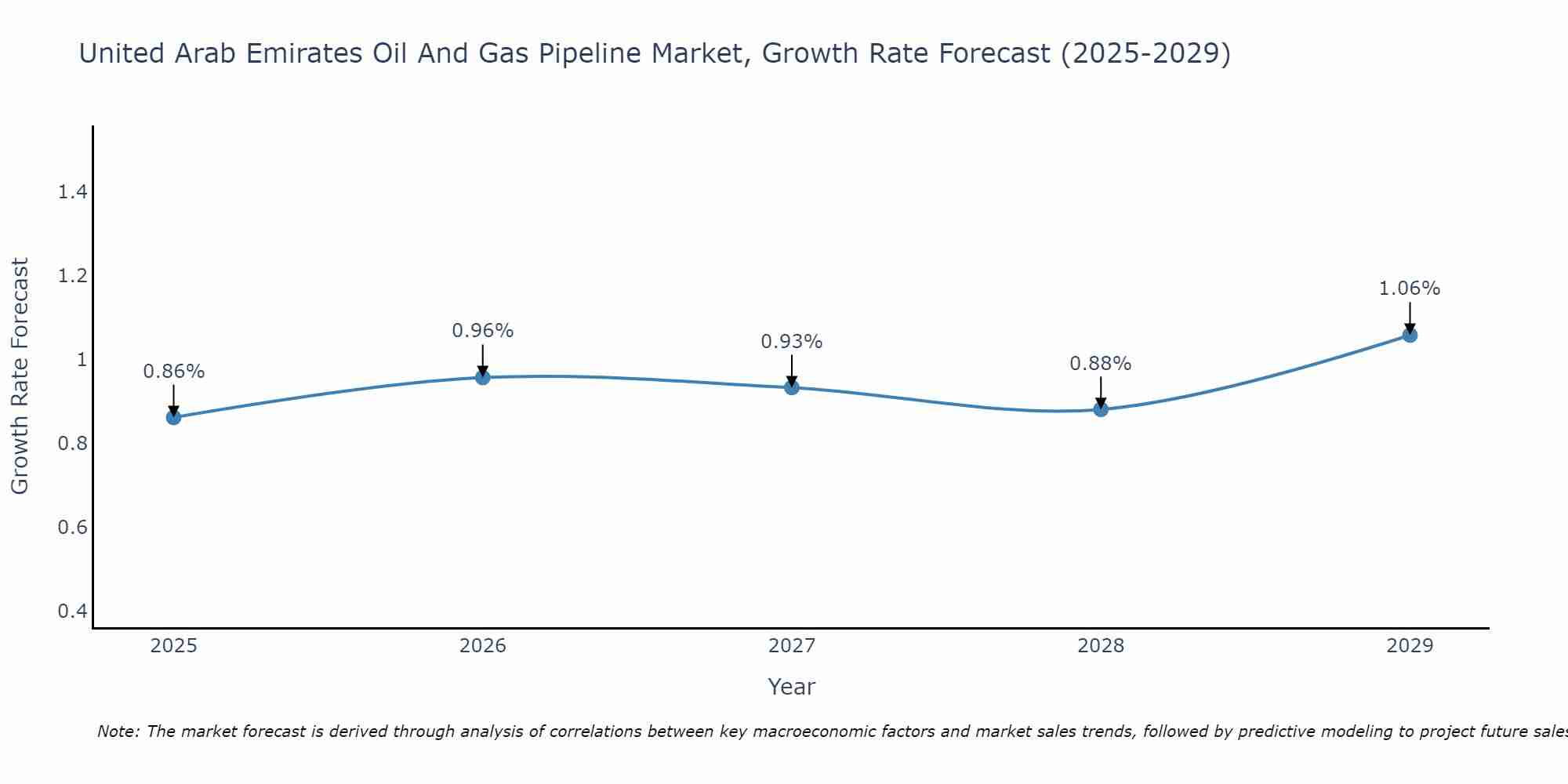
The United Arab Emirates Oil And Gas Pipeline Market is projected to witness mixed growth rate patterns during 2025 to 2029. Commencing at 0.86% in 2025, growth builds up to 1.06% by 2029.
United Arab Emirates (UAE) Oil And Gas Pipeline Market Synopsis
As a major player in the global energy sector, the UAE oil and gas pipeline market is of strategic importance. The country`s significant hydrocarbon reserves necessitate an extensive pipeline infrastructure for exploration, production, and transportation. Advanced technologies for pipeline construction, corrosion resistance, and monitoring systems are key areas of focus in this market.
Drivers of the market
The UAE oil and gas pipeline market is driven by the country`s significant role as a global energy hub. With vast reserves of oil and gas, there is a constant need for the construction and maintenance of pipelines to transport these resources. Additionally, the UAE investment in renewable energy sources has further fueled the growth of this market.
Challenges of the market
For the UAE oil and gas pipeline market, ensuring the security of critical infrastructure is a significant challenge. Safeguarding against potential security threats and maintaining the integrity of pipelines in harsh desert conditions demand constant vigilance and investment.
Covid-19 Impact of the market
The UAE oil and gas pipeline market experienced challenges during the pandemic due to a decrease in oil prices and reduced energy demand. Projects were delayed or scaled down as a result. The market had to adapt by focusing on maintenance and optimizing existing infrastructure.
Key Players of the market
In the UAE oil and gas pipeline market, leading companies include Abu Dhabi National Oil Company (ADNOC), Saudi Aramco, and Qatar Petroleum.
Key Highlights of the Report:
- United Arab Emirates (UAE) Oil And Gas Pipeline Market Outlook
- Market Size of United Arab Emirates (UAE) Oil And Gas Pipeline Market, 2024
- Forecast of United Arab Emirates (UAE) Oil And Gas Pipeline Market, 2031
- Historical Data and Forecast of United Arab Emirates (UAE) Oil And Gas Pipeline Revenues & Volume for the Period 2021-2031
- United Arab Emirates (UAE) Oil And Gas Pipeline Market Trend Evolution
- United Arab Emirates (UAE) Oil And Gas Pipeline Market Drivers and Challenges
- United Arab Emirates (UAE) Oil And Gas Pipeline Price Trends
- United Arab Emirates (UAE) Oil And Gas Pipeline Porter's Five Forces
- United Arab Emirates (UAE) Oil And Gas Pipeline Industry Life Cycle
- Historical Data and Forecast of United Arab Emirates (UAE) Oil And Gas Pipeline Market Revenues & Volume By Location of Deployment for the Period 2021-2031
- Historical Data and Forecast of United Arab Emirates (UAE) Oil And Gas Pipeline Market Revenues & Volume By Onshore for the Period 2021-2031
- Historical Data and Forecast of United Arab Emirates (UAE) Oil And Gas Pipeline Market Revenues & Volume By Offshore for the Period 2021-2031
- Historical Data and Forecast of United Arab Emirates (UAE) Oil And Gas Pipeline Market Revenues & Volume By Type for the Period 2021-2031
- Historical Data and Forecast of United Arab Emirates (UAE) Oil And Gas Pipeline Market Revenues & Volume By Crude Oil Pipeline for the Period 2021-2031
- Historical Data and Forecast of United Arab Emirates (UAE) Oil And Gas Pipeline Market Revenues & Volume By Gas Pipeline for the Period 2021-2031
- United Arab Emirates (UAE) Oil And Gas Pipeline Import Export Trade Statistics
- Market Opportunity Assessment By Location of Deployment
- Market Opportunity Assessment By Type
- United Arab Emirates (UAE) Oil And Gas Pipeline Top Companies Market Share
- United Arab Emirates (UAE) Oil And Gas Pipeline Competitive Benchmarking By Technical and Operational Parameters
- United Arab Emirates (UAE) Oil And Gas Pipeline Company Profiles
- United Arab Emirates (UAE) Oil And Gas Pipeline Key Strategic Recommendations






































