United Arab Emirates (UAE) Oil Country Tubular Goods Market Size, Share & Growth Rate
The United Arab Emirates (UAE) Oil Country Tubular Goods Market was estimated at USD 151 Million in 2025 and is projected to reach USD 200 Million by 2032, growing at a CAGR of 4.1% from 2026 to 2032. This growth is largely attributed to the UAE's ongoing commitment to enhancing its oil exploration and production capabilities, driven by favorable government policies and a strong demand for energy. The increasing activity in both onshore and offshore drilling operations further fuels the need for high-quality tubular goods essential for maintaining operational efficiency.
United Arab Emirates (UAE) Oil Country Tubular Goods Market Year-wise Growth Rate and Key Drivers
This graph highlights how the United Arab Emirates (UAE) Oil Country Tubular Goods Market has steadily grown over the years, supported by major growth factors.
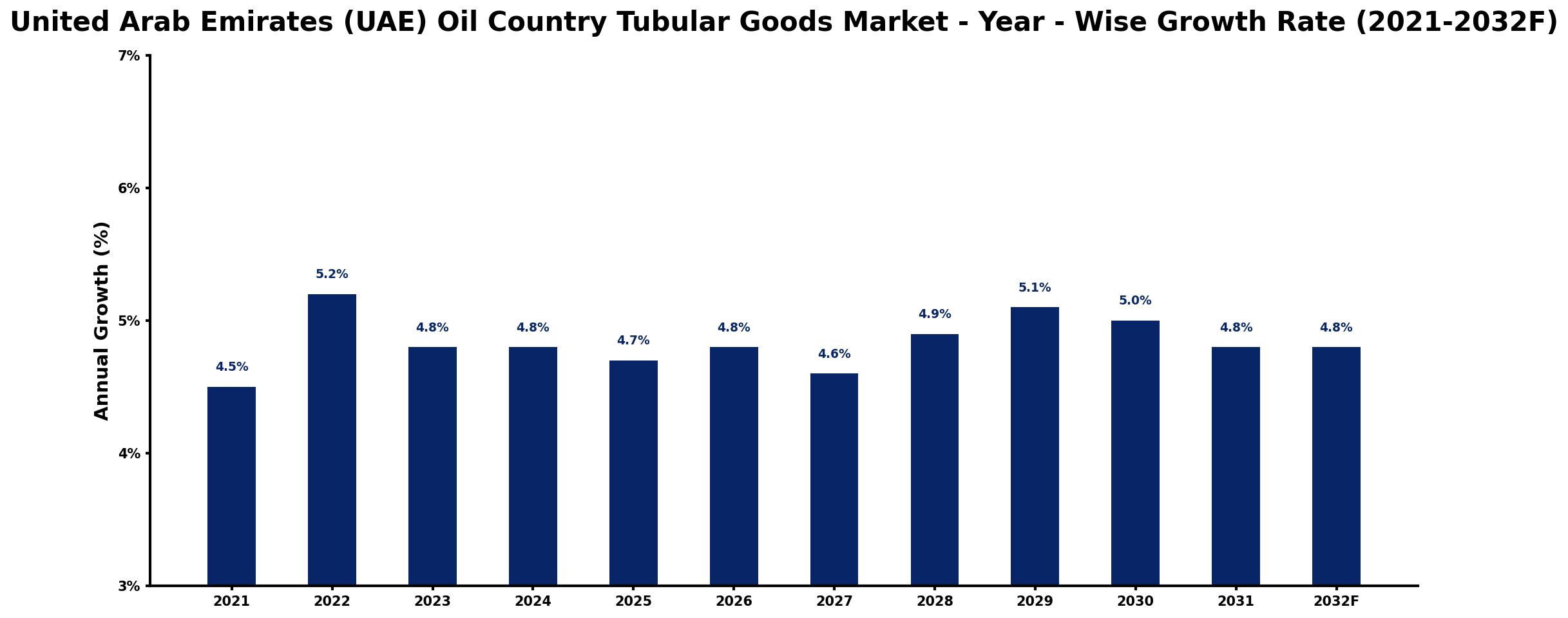
The table below presents the year‑wise growth rates along with the key drivers influencing the market
| Year | Growth Rate | Major Drivers |
| 2021 | 4.5% | Increased exploration and production activities |
| 2022 | 5.2% | Expansion of renewable energy projects |
| 2023 | 4.8% | Rising global energy demand trends |
| 2024 | 4.8% | Infrastructure development and upgrades |
| 2025 | 4.7% | Investment in advanced technologies |
| 2026 | 4.8% | Growing demand for energy security |
| 2027 | 4.6% | Strengthening regional trade partnerships |
| 2028 | 4.9% | Focus on sustainable energy initiatives |
| 2029 | 5.1% | Enhancements in logistics and supply |
| 2030 | 5.0% | Increasing foreign direct investments |
| 2031 | 4.8% | Development of new energy markets |
| 2032 | 4.8% | Advancements in manufacturing capabilities |
Note: Market size estimations and growth projections presented in this report are based on 6Wresearch's proprietary forecasting methodology, utilizing the latest available industry data, government publications, and primary research inputs.
United Arab Emirates (UAE) Oil Country Tubular Goods Market Synopsis
The demand for oil country tubular goods (OCTG) in the UAE is primarily driven by the country's substantial investments in its oil and gas sector. This focus has resulted in a sustained requirement for casing, tubing, and pipes essential for drilling and production processes. Additionally, the UAE's strategic initiatives aimed at expanding its energy resources are fostering growth in OCTG consumption across various projects.
Despite the prevailing challenges posed by fluctuating oil prices, the market demonstrates resilience, bolstered by ongoing governmental support and development in infrastructure. The necessity for durable and high-performing tubular goods is further highlighted as the region's drilling conditions become increasingly demanding, thus prioritizing quality over cost.
United Arab Emirates (UAE) Oil Country Tubular Goods Market Key Takeaways
- The market is projected to grow from USD 151 Million in 2025 to USD 200 Million by 2032.
- Strong government investments in oil exploration and production underpin market stability.
- Technological advancements in drilling methods are shaping the product requirements.
- Fluctuations in oil prices continue to impact market dynamics and demand.
- The need for high-quality OCTG to withstand harsh conditions drives innovation and competition.
Evaluation of Restraints in United Arab Emirates (UAE) Oil Country Tubular Goods Market
One of the primary constraints facing the UAE oil country tubular goods market is the volatility of oil prices, which can hinder exploration and production activities. This instability creates uncertainty for manufacturers and stakeholders, affecting long-term planning and investment. Furthermore, maintaining rigorous industry standards and ensuring product integrity is essential for manufacturers to differentiate themselves. The necessity for OCTG that can endure harsh drilling environments adds complexity to production processes and raises operational costs, potentially limiting market expansion.
United Arab Emirates (UAE) Oil Country Tubular Goods Market Trends
Current trends in the UAE oil country tubular goods market are closely linked to technological advancements in drilling and extraction methods. The growing adoption of smart drilling technologies and automation is influencing the demand for more sophisticated and durable OCTG products. Moreover, there is an increasing emphasis on sustainability, prompting manufacturers to develop eco-friendly tubular solutions that meet regulatory requirements and align with global environmental objectives.
United Arab Emirates (UAE) Oil Country Tubular Goods Market Opportunities
The market presents significant growth opportunities, particularly in the realm of high-performance OCTG designed for extreme drilling conditions. With ongoing initiatives to enhance oil recovery techniques, manufacturers can invest in R&D for specialized products that cater to these emerging needs. Additionally, as the UAE diversifies its energy portfolio, opportunities for OCTG in renewable energy applications, such as geothermal drilling, are becoming increasingly relevant.
Government Initiatives in the United Arab Emirates (UAE) Oil Country Tubular Goods Market
The UAE government actively supports its oil and gas sector through various initiatives aimed at enhancing exploration and production efficiency. Strategic investments in infrastructure, such as new pipelines and drilling technologies, are being implemented to maintain the UAE's position as a global energy leader. Furthermore, policies encouraging foreign investment and collaboration in the energy sector stimulate innovation and expand market access for OCTG suppliers.
Future Insights of the United Arab Emirates (UAE) Oil Country Tubular Goods Market
Looking ahead to 2026-2032, the UAE oil country tubular goods market is poised for growth, driven by an increasing focus on sustainability and efficiency in drilling operations. The rise of digital technologies and enhanced oil recovery methods will demand more advanced OCTG solutions. As global energy dynamics shift, the UAE's ability to adapt and innovate in its oil and gas practices will likely keep it at the forefront of the OCTG market, ensuring continued demand and investment.
United Arab Emirates (UAE) Oil Country Tubular Goods Market Latest Developments (2025 - 2026)
Recent developments in the UAE oil country tubular goods market indicate a strategic focus on enhancing product quality and adapting to technological advancements. Manufacturers are increasingly collaborating with energy companies to develop customized OCTG solutions that address specific operational challenges. Innovations aimed at improving product durability and reducing environmental impact are gaining traction, reflecting the market's adaptation to evolving industry demands.
United Arab Emirates (UAE) Oil Country Tubular Goods Market - Key Attractiveness of the Report
- 10 Years of Market Numbers
- Historical Data Starting from 2022 to 2025
- Base Year: 2025
- Forecast Data until 2032
- Key Performance Indicators Impacting the Market
- Major Upcoming Developments and Projects
Key Highlights of the Report:
- United Arab Emirates (UAE) Oil Country Tubular Goods Market Outlook
- Market Size of United Arab Emirates (UAE) Oil Country Tubular Goods Market, 2025
- Forecast of United Arab Emirates (UAE) Oil Country Tubular Goods Market, 2032
- Historical Data and Forecast of United Arab Emirates (UAE) Oil Country Tubular Goods Revenues & Volume for the Period 2022-2032F
- United Arab Emirates (UAE) Oil Country Tubular Goods Market Trend Evolution
- United Arab Emirates (UAE) Oil Country Tubular Goods Market Drivers and Challenges
- United Arab Emirates (UAE) Oil Country Tubular Goods Price Trends
- United Arab Emirates (UAE) Oil Country Tubular Goods Porter's Five Forces
- United Arab Emirates (UAE) Oil Country Tubular Goods Industry Life Cycle
- Historical Data and Forecast of United Arab Emirates (UAE) Oil Country Tubular Goods Market Revenues & Volume By Manufacturing Process for the Period 2022-2032F
- Historical Data and Forecast of United Arab Emirates (UAE) Oil Country Tubular Goods Market Revenues & Volume By Seamless for the Period 2022-2032F
- Historical Data and Forecast of United Arab Emirates (UAE) Oil Country Tubular Goods Market Revenues & Volume By Electric Resistance Welded for the Period 2022-2032F
- Historical Data and Forecast of United Arab Emirates (UAE) Oil Country Tubular Goods Market Revenues & Volume By Grade for the Period 2022-2032F
- Historical Data and Forecast of United Arab Emirates (UAE) Oil Country Tubular Goods Market Revenues & Volume By Premium Grade for the Period 2022-2032F
- Historical Data and Forecast of United Arab Emirates (UAE) Oil Country Tubular Goods Market Revenues & Volume By API Grade for the Period 2022-2032F
- United Arab Emirates (UAE) Oil Country Tubular Goods Import Export Trade Statistics
- Market Opportunity Assessment By Manufacturing Process
- Market Opportunity Assessment By Grade
- United Arab Emirates (UAE) Oil Country Tubular Goods Top Companies Market Share
- United Arab Emirates (UAE) Oil Country Tubular Goods Competitive Benchmarking By Technical and Operational Parameters
- United Arab Emirates (UAE) Oil Country Tubular Goods Company Profiles
- United Arab Emirates (UAE) Oil Country Tubular Goods Key Strategic Recommendations






































