United Arab Emirates (UAE) Oilfield Air Drilling Market Size, Share & Growth Rate
The United Arab Emirates (UAE) Oilfield Air Drilling Market was estimated at USD 858 Million in 2025 and is projected to reach USD 1462 Million by 2032, growing at a CAGR of 7.9% from 2026 to 2032. This growth trajectory reflects the increasing demand for advanced drilling techniques in the UAE, where companies are looking to enhance operational efficiencies while minimizing their ecological footprint. As offshore drilling activities expand and unconventional reserves gain focus, air drilling techniques are poised to revolutionize the region's approach to resource extraction.
United Arab Emirates (UAE) Oilfield Air Drilling Market Year-wise Growth Rate and Key Drivers
This graph highlights how the United Arab Emirates (UAE) Oilfield Air Drilling Market has steadily grown over the years, supported by major growth factors.
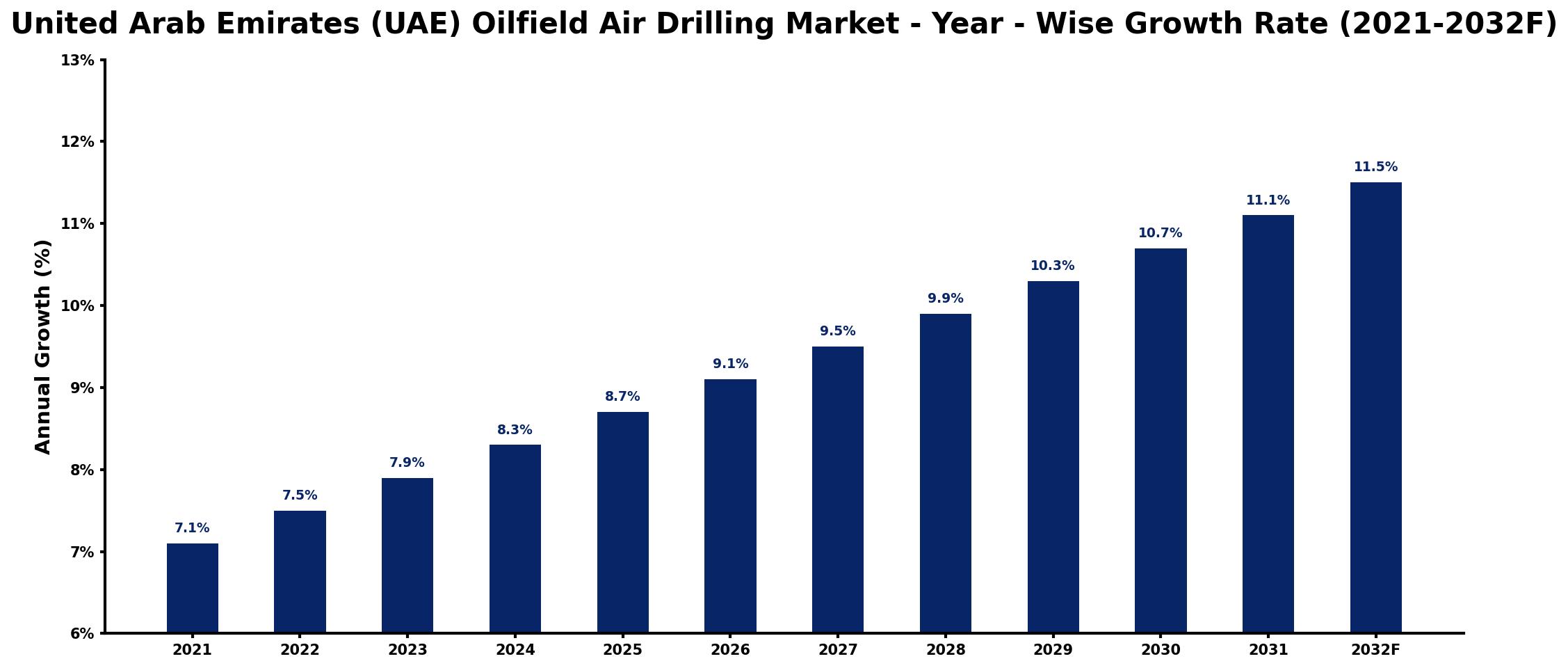
The table below presents the year‑wise growth rates along with the key drivers influencing the market
| Year | Growth Rate | Major Drivers |
| 2021 | 7.1% | Rising global energy demand |
| 2022 | 7.5% | Technological advancements in exploration |
| 2023 | 7.9% | Increased investment in infrastructure |
| 2024 | 8.3% | Growing focus on sustainability initiatives |
| 2025 | 8.7% | Expansion of renewable energy integration |
| 2026 | 9.1% | Emergence of new market players |
| 2027 | 9.5% | Strengthened regulatory frameworks enhancing safety |
| 2028 | 9.9% | Increased efficiency in resource extraction |
| 2029 | 10.3% | Higher demand for energy security |
| 2030 | 10.7% | improved processing technologies adoption |
| 2031 | 11.1% | Growing exploration in new regions |
| 2032 | 11.5% | Advancements in automation technologies |
Note: Market size estimations and growth projections presented in this report are based on 6Wresearch's proprietary forecasting methodology, utilizing the latest available industry data, government publications, and primary research inputs.
United Arab Emirates (UAE) Oilfield Air Drilling Market Synopsis
The UAE Oilfield Air Drilling market stands at the forefront of drilling innovation within the oil and gas sector. Recent developments have shown a marked increase in the adoption of air drilling technologies, which leverage compressed air to enhance drilling efficiency while concurrently mitigating environmental concerns. This shift not only reflects the industry's response to regulatory pressures but also highlights the potential for improved cost management.
The market is characterized by a unique blend of regional challenges and opportunities that demand specialized solutions. As exploration expands into more complex geological formations and offshore arenas, the demand for air drilling techniques is likely to accelerate, further positioning the UAE as a leader in innovative drilling methods across the Gulf region.
United Arab Emirates (UAE) Oilfield Air Drilling Market Key Takeaways
- The market is driven by the push for innovative drilling techniques to enhance efficiency and minimize environmental impact.
- Increased offshore drilling activities significantly contribute to the growing demand for air drilling solutions.
- The market is currently navigating challenges related to geological variability and supply chain reliability for specialized equipment.
- COVID-19 had a temporary impact on market activities, but recovery is underway as companies adapt their strategies.
- Key industry players are increasingly focused on advanced air drilling technologies that align with sustainability goals.
Evaluation of Restraints in United Arab Emirates (UAE) Oilfield Air Drilling Market
The UAE Oilfield Air Drilling market encounters several constraints that could impede its growth trajectory. One major concern is the optimization of drilling processes, which is essential for maintaining efficiency while adhering to environmental regulations. Operators must also navigate the complexities of varying geological formations, which can complicate drilling operations and affect performance outcomes. Furthermore, a reliable supply chain for specialized air drilling equipment is crucial, as any disruption could significantly impact project timelines and operational costs. Striking a balance between innovative air drilling methods and risk management remains a primary focus for stakeholders in this market.
United Arab Emirates (UAE) Oilfield Air Drilling Market Trends
The demand for air drilling technologies in the UAE is being shaped by several key trends. A growing emphasis on sustainability is steering oil and gas companies toward practices that reduce their environmental impact. Additionally, the rise of digitalization in drilling operations, including the use of data analytics and real-time monitoring, is paving the way for enhanced operational efficiencies. The trend toward unconventional drilling strategies, particularly in offshore environments, is also becoming prevalent, necessitating innovative approaches like air drilling that can manage challenges posed by complex geological conditions.
United Arab Emirates (UAE) Oilfield Air Drilling Market Opportunities
The UAE Oilfield Air Drilling market is poised for significant growth, presenting a range of investment opportunities for stakeholders. As the focus on unconventional resources intensifies, the need for innovative drilling solutions is paramount. Moreover, strategic partnerships between technology providers and oilfield service companies can lead to breakthroughs in air drilling efficiency. There is also an opportunity to enhance training programs for personnel to ensure effective implementation of air drilling technologies, thereby securing a competitive edge in the market.
Government Initiatives in the United Arab Emirates (UAE) Oilfield Air Drilling Market
The UAE government is actively promoting initiatives aimed at enhancing drilling efficiency and reducing environmental impact. This includes investments in research and development for new technologies, as well as incentives for companies adopting sustainable practices in their operations. Regulatory frameworks are being adapted to support innovative drilling methods, including air drilling, thereby encouraging industry players to explore environmentally friendly solutions. Public spending on infrastructure and technology further underscores the governments commitment to advancing the oil and gas sector.
Future Insights of the United Arab Emirates (UAE) Oilfield Air Drilling Market
Looking ahead to 2026-2032, the UAE Oilfield Air Drilling market is expected to continue its upward momentum. As oil prices stabilize, companies are likely to reinvest in exploration activities that demand advanced drilling technologies. The alignment of air drilling methods with sustainability targets will further drive adoption, as market players seek to differentiate themselves through innovative practices. Additionally, increased offshore activities combined with the exploration of challenging reservoirs will create a fertile ground for the growth of air drilling applications, solidifying the UAEs position as a leader in this specialized field.
United Arab Emirates (UAE) Oilfield Air Drilling Market Latest Developments (2025 - 2026)
In recent months, the UAE Oilfield Air Drilling market has witnessed a surge in collaborative efforts among key stakeholders focused on improving air drilling technologies. Companies are increasingly investing in research to enhance the efficiency of air drilling operations, particularly in challenging geological settings. Meanwhile, industry events and seminars are promoting knowledge-sharing on best practices, further fostering innovation. This proactive approach is indicative of a resilient market adapting to the complexities of contemporary drilling demands.
United Arab Emirates (UAE) Oilfield Air Drilling Market - Key Attractiveness of the Report
- 10 Years of Market Numbers
- Historical Data Starting from 2022 to 2025
- Base Year: 2025
- Forecast Data until 2032
- Key Performance Indicators Impacting the Market
- Major Upcoming Developments and Projects
Key Highlights of the Report:
- United Arab Emirates (UAE) Oilfield Air Drilling Market Outlook
- Market Size of United Arab Emirates (UAE) Oilfield Air Drilling Market, 2025
- Forecast of United Arab Emirates (UAE) Oilfield Air Drilling Market, 2032
- Historical Data and Forecast of United Arab Emirates (UAE) Oilfield Air Drilling Revenues & Volume for the Period 2022-2032F
- United Arab Emirates (UAE) Oilfield Air Drilling Market Trend Evolution
- United Arab Emirates (UAE) Oilfield Air Drilling Market Drivers and Challenges
- United Arab Emirates (UAE) Oilfield Air Drilling Price Trends
- United Arab Emirates (UAE) Oilfield Air Drilling Porter's Five Forces
- United Arab Emirates (UAE) Oilfield Air Drilling Industry Life Cycle
- Historical Data and Forecast of United Arab Emirates (UAE) Oilfield Air Drilling Market Revenues & Volume By Type for the Period 2022-2032F
- Historical Data and Forecast of United Arab Emirates (UAE) Oilfield Air Drilling Market Revenues & Volume By Dust for the Period 2022-2032F
- Historical Data and Forecast of United Arab Emirates (UAE) Oilfield Air Drilling Market Revenues & Volume By Aerated fluid for the Period 2022-2032F
- Historical Data and Forecast of United Arab Emirates (UAE) Oilfield Air Drilling Market Revenues & Volume By Foam for the Period 2022-2032F
- Historical Data and Forecast of United Arab Emirates (UAE) Oilfield Air Drilling Market Revenues & Volume By Mist for the Period 2022-2032F
- Historical Data and Forecast of United Arab Emirates (UAE) Oilfield Air Drilling Market Revenues & Volume By Nitrogen membrane for the Period 2022-2032F
- United Arab Emirates (UAE) Oilfield Air Drilling Import Export Trade Statistics
- Market Opportunity Assessment By Type
- United Arab Emirates (UAE) Oilfield Air Drilling Top Companies Market Share
- United Arab Emirates (UAE) Oilfield Air Drilling Competitive Benchmarking By Technical and Operational Parameters
- United Arab Emirates (UAE) Oilfield Air Drilling Company Profiles
- United Arab Emirates (UAE) Oilfield Air Drilling Key Strategic Recommendations






































