United Arab Emirates (UAE) Physical Security Market Size & Growth Rate (2026-2032)
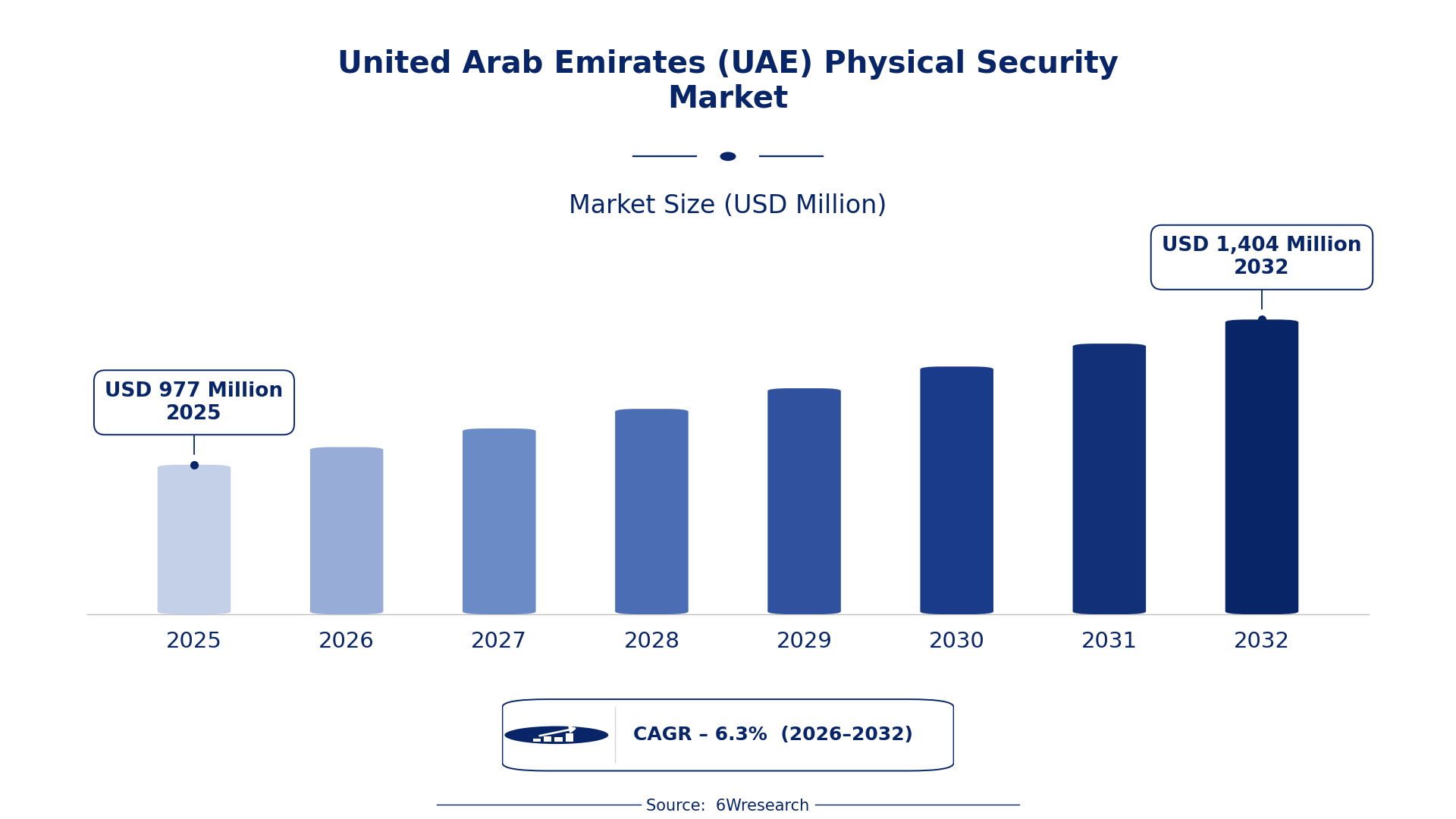
The United Arab Emirates (UAE) Physical Security Market was estimated at USD 977 Million in 2025 and is projected to reach USD 1404 Million by 2032, growing at a CAGR of 6.3% from 2026 to 2032.
United Arab Emirates (UAE) Physical Security Market Synopsis
The UAE Physical Security Market is gaining momentum as the nation elevates its focus on safeguarding essential infrastructure and assets. With burgeoning sectors like tourism and commerce, the demand for reliable security solutions has become more pronounced, influencing both public and private sector investments.
Key technologies such as surveillance systems, access control mechanisms, and perimeter security are witnessing heightened interest. This urgency stems from the nation’s strategic priorities to protect vital resources, including oil facilities, airports, and other critical infrastructures.
United Arab Emirates (UAE) Physical Security Market Year-wise Growth Rate and Key Drivers
This graph illustrates the annual growth rates of the United Arab Emirates (UAE) Physical Security Market from 2021 to 2032, highlighting a steady upward trajectory and projected expansion over the forecast period.
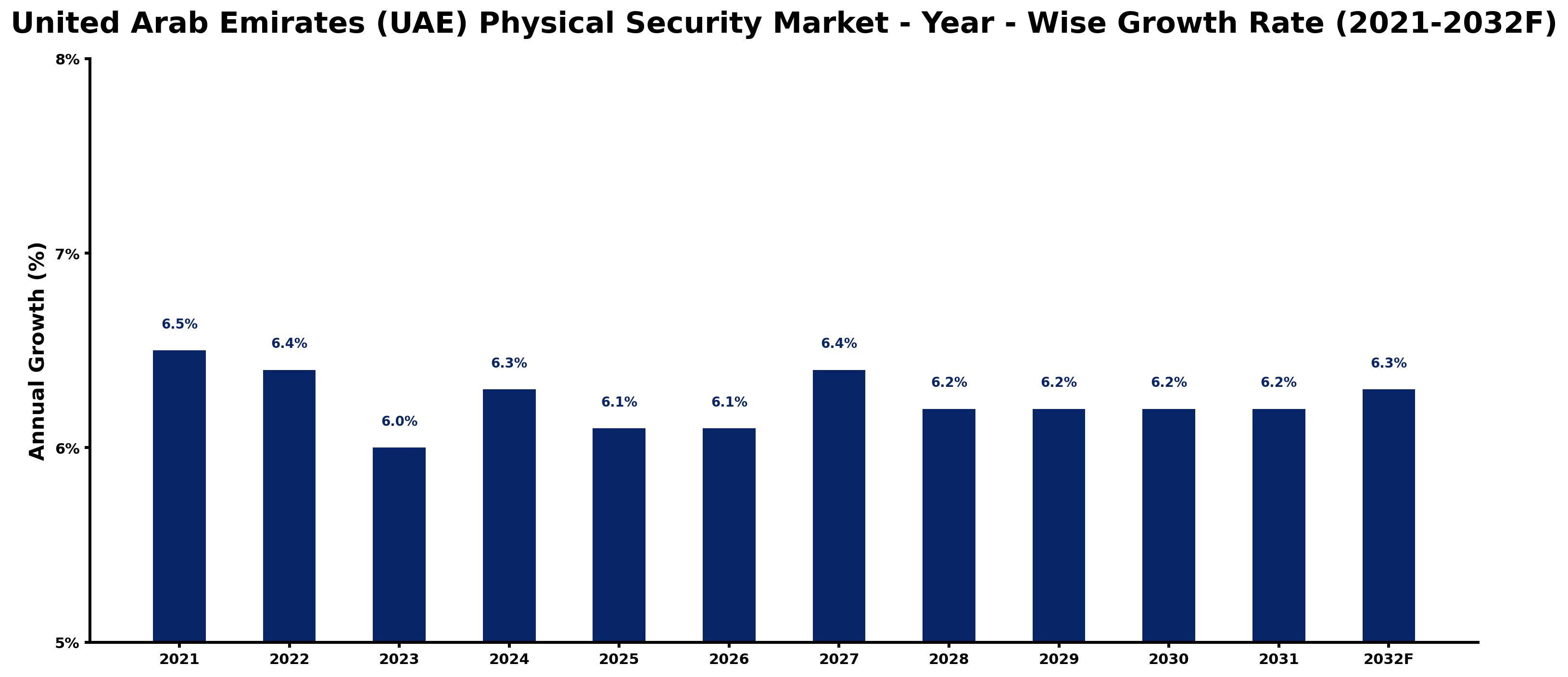
The table below presents the year‑wise growth rates along with the key drivers influencing the market
| Year | Growth Rate | Major Drivers |
| 2021 | 6.5% | Dubai Expo 2020 security requirements drove investments. |
| 2022 | 6.4% | Implementation of UAE Cybersecurity Strategy boosted demand. |
| 2023 | 6.0% | Adoption of smart surveillance systems by local authorities. |
| 2024 | 6.3% | Increased focus on protection for critical infrastructure sites. |
| 2025 | 6.1% | Rise in luxury property developments required enhanced security. |
| 2026 | 6.1% | Growth of tourism increased demand for safety solutions. |
| 2027 | 6.4% | Regulatory focus on public safety continued driving investments. |
| 2028 | 6.2% | Military partnerships enhanced physical security technology deployments. |
| 2029 | 6.2% | Rising expatriate population increased security system needs. |
| 2030 | 6.2% | Government incentive programs encouraged security service expansions. |
| 2031 | 6.2% | Emergence of new technology firms in security sector. |
| 2032 | 6.3% | Strategic initiatives for urban safety improvements spurred growth. |
Note: Market size estimations and growth projections presented in this report are based on 6Wresearch's proprietary forecasting methodology, utilizing the latest available industry data, government publications, and primary research inputs.
United Arab Emirates (UAE) Physical Security Market Key Takeaways
Below are some of the specific key takeaways from the market, including:
- The UAE's commitment to enhancing safety drives the growth of physical security solutions.
- Advanced technologies are increasingly integrated into traditional security measures.
- The ongoing development of smart cities necessitates innovative security strategies.
- Public-private collaborations are shaping the future of the security landscape.
- The rise of cyber-physical threats demands comprehensive security frameworks.
Evaluation of Restraints in United Arab Emirates (UAE) Physical Security Market
Despite the growing opportunities, the UAE Physical Security Market is not without its challenges. One major restraint lies in the rapid pace of urbanization, which complicates security protocols due to the interconnected nature of smart city systems. Integrating advanced technologies with existing traditional security methods can lead to operational complexities.
Another critical barrier is the need for scalable solutions that can adapt to evolving threats. The market's players must remain vigilant and proactive, ensuring their offerings align with the fast-changing security landscape while meeting stringent regulatory requirements.
United Arab Emirates (UAE) Physical Security Market Trends
Several trends are influencing the dynamics of the UAE Physical Security Market. A notable shift toward smart surveillance technologies is gaining traction, as organizations seek improved efficiency and monitoring capabilities. Biometric systems are becoming prevalent, providing secure access control tailored to the unique demands of businesses and public spaces.
Additionally, there is an increasing emphasis on integrated security solutions that provide comprehensive coverage across various sectors. As both the public and private sectors recognize the critical importance of safeguarding assets, collaborative efforts to enhance infrastructure security are on the rise.
United Arab Emirates (UAE) Physical Security Market Opportunities
Genuine growth opportunities abound in the UAE Physical Security Market. The ongoing development of smart cities presents an excellent chance for innovative security solutions to be deployed at scale. Companies that can provide integrated systems combining surveillance, access control, and cybersecurity stand to gain a competitive advantage.
on top of that, as the UAE government continues to invest in infrastructure projects, public-private partnerships are likely to flourish, facilitating the deployment of cutting-edge technologies. The rising threats in global security will further stimulate demand for comprehensive physical security solutions across various sectors.
Government Initiatives in the United Arab Emirates (UAE) Physical Security Market
Government initiatives play a crucial role in shaping the trajectory of the UAE Physical Security Market. The UAE administration prioritizes safety and security across public and private sectors, implementing stringent regulations that compel compliance. The investment in upgrading critical infrastructure underlines the government's commitment to advancing the security framework in the nation.
- A recently completed initiative focuses on enhancing surveillance infrastructure in key urban areas, aimed at improving public safety.
- Currently underway is a national campaign to bolster emergency response systems in collaboration with local law enforcement agencies.
- A planned public-private initiative is expected to launch by 2026, aimed at integrating AI-powered surveillance solutions across major commercial hubs.
- Ongoing assessments are being conducted on existing security frameworks to align with emerging global standards and practices.
- Future regulatory frameworks are being discussed to further strengthen cybersecurity measures alongside traditional physical security protocols.
Future Insights of the United Arab Emirates (UAE) Physical Security Market
Looking ahead to 2026-2032, the UAE Physical Security Market is set for robust growth as technological advancements continue to reshape security methodologies. Companies that stay ahead by adopting cutting-edge technologies like AI and machine learning will likely thrive in this evolving market.
on top of that, as the frequency and complexity of security threats rise, organizations will need to invest heavily in sophisticated systems that integrate physical and cyber security measures. The future landscape will favor firms that provide flexible and scalable solutions tailored to specific industry needs.
United Arab Emirates (UAE) Physical Security Market Latest Developments
Recent activity in the UAE Physical Security Market indicates a strategic pivot towards advanced technological solutions. Over the last year, companies have ramped up efforts to enhance surveillance systems and integrate new technologies to meet growing demands.
- A leading regional operator launched a state-of-the-art video surveillance system in mid-2025, which integrates AI capabilities for real-time monitoring.
- An initiative that began in late 2025 focuses on upgrading access control systems in high-security environments across various sectors.
- A major technology vendor is set to introduce an innovative biometric access solution in the second half of 2026, aimed at enhancing security at key facilities.
- Ongoing partnerships between private security firms and government agencies are expanding, as both sectors work together to improve overall security frameworks.
- A planned rollout expected in early 2027 will introduce enhanced cybersecurity measures in conjunction with physical security upgrades.
United Arab Emirates (UAE) Physical Security Market - Key Attractiveness of the Report
- 10 Years of Market Numbers
- Historical Data Starting from 2022 to 2025
- Base Year: 2025
- Forecast Data until 2032
- Key Performance Indicators Impacting the Market
- Major Upcoming Developments and Projects
Key Highlights of the Report:
- United Arab Emirates (UAE) Physical Security Market Outlook
- Market Size of United Arab Emirates (UAE) Physical Security Market, 2025
- Forecast of United Arab Emirates (UAE) Physical Security Market, 2032
- Historical Data and Forecast of United Arab Emirates (UAE) Physical Security Revenues & Volume for the Period 2022-2032F
- United Arab Emirates (UAE) Physical Security Market Trend Evolution
- United Arab Emirates (UAE) Physical Security Market Drivers and Challenges
- United Arab Emirates (UAE) Physical Security Price Trends
- United Arab Emirates (UAE) Physical Security Porter's Five Forces
- United Arab Emirates (UAE) Physical Security Industry Life Cycle
- Historical Data and Forecast of United Arab Emirates (UAE) Physical Security Market Revenues & Volume By Component for the Period 2022-2032F
- Historical Data and Forecast of United Arab Emirates (UAE) Physical Security Market Revenues & Volume By Systems (PACS, PSIM, PIAM, Video Surveillance, Fire and Life Safety) for the Period 2022-2032F
- Historical Data and Forecast of United Arab Emirates (UAE) Physical Security Market Revenues & Volume By Services for the Period 2022-2032F
- Historical Data and Forecast of United Arab Emirates (UAE) Physical Security Market Revenues & Volume By Vertical for the Period 2022-2032F
- Historical Data and Forecast of United Arab Emirates (UAE) Physical Security Market Revenues & Volume By BFSI for the Period 2022-2032F
- Historical Data and Forecast of United Arab Emirates (UAE) Physical Security Market Revenues & Volume By Government for the Period 2022-2032F
- Historical Data and Forecast of United Arab Emirates (UAE) Physical Security Market Revenues & Volume By Retail for the Period 2022-2032F
- Historical Data and Forecast of United Arab Emirates (UAE) Physical Security Market Revenues & Volume By Transportation for the Period 2022-2032F
- Historical Data and Forecast of United Arab Emirates (UAE) Physical Security Market Revenues & Volume By Residential for the Period 2022-2032F
- Historical Data and Forecast of United Arab Emirates (UAE) Physical Security Market Revenues & Volume By Telecom and IT for the Period 2022-2032F
- Historical Data and Forecast of United Arab Emirates (UAE) Physical Security Market Revenues & Volume By Other Verticals (Healthcare, Manufacturing, Energy and Utilities, and Education). for the Period 2022-2032F
- Historical Data and Forecast of United Arab Emirates (UAE) Physical Security Market Revenues & Volume By Organization Size for the Period 2022-2032F
- Historical Data and Forecast of United Arab Emirates (UAE) Physical Security Market Revenues & Volume By SMEs for the Period 2022-2032F
- Historical Data and Forecast of United Arab Emirates (UAE) Physical Security Market Revenues & Volume By Large Enterprises for the Period 2022-2032F
- United Arab Emirates (UAE) Physical Security Import Export Trade Statistics
- Market Opportunity Assessment By Component
- Market Opportunity Assessment By Vertical
- Market Opportunity Assessment By Organization Size
- United Arab Emirates (UAE) Physical Security Top Companies Market Share
- United Arab Emirates (UAE) Physical Security Competitive Benchmarking By Technical and Operational Parameters
- United Arab Emirates (UAE) Physical Security Company Profiles
- United Arab Emirates (UAE) Physical Security Key Strategic Recommendations






































