United Arab Emirates (UAE) Residential Boiler Market Size, Share & Growth Rate
The United Arab Emirates (UAE) Residential Boiler Market was estimated at USD 446 Million in 2025 and is projected to reach USD 612 Million by 2032, growing at a CAGR of 4.6% from 2026 to 2032. This positive trajectory is driven by factors such as rapid urbanization, a booming construction sector, and the growing emphasis on energy efficiency in residential heating solutions. With increasing environmental awareness and the rising standard of living, more consumers are gravitating toward modern, eco-friendly residential boilers.
United Arab Emirates (UAE) Residential Boiler Market Year-wise Growth Rate and Key Drivers
This graph highlights how the United Arab Emirates (UAE) Residential Boiler Market has steadily grown over the years, supported by major growth factors.
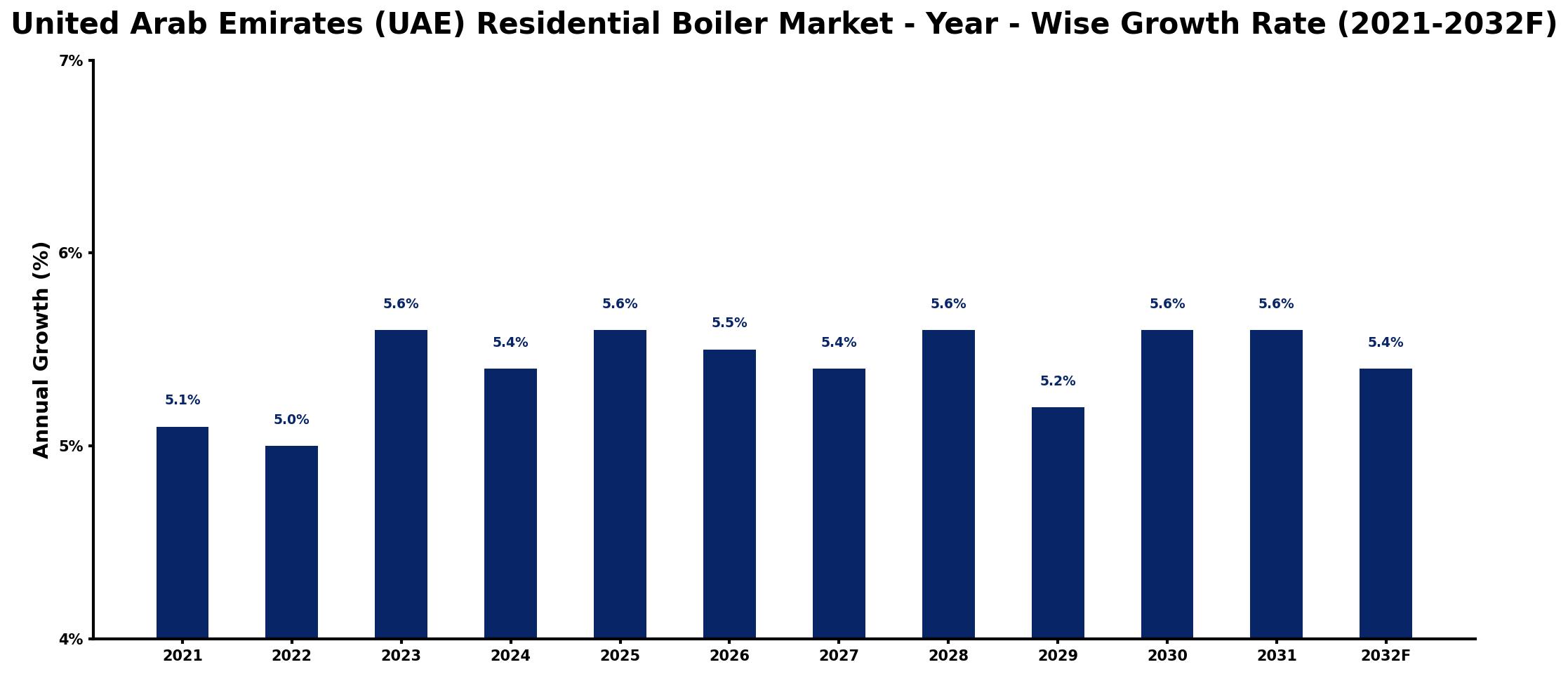
The table below presents the year‑wise growth rates along with the key drivers influencing the market
| Year | Growth Rate | Major Drivers |
| 2021 | 5.1% | Rising demand for heating solutions |
| 2022 | 5.0% | Increased investments in infrastructure |
| 2023 | 5.6% | Growing focus on energy efficiency |
| 2024 | 5.4% | Expansion of renewable energy projects |
| 2025 | 5.6% | Technological advancements in heating |
| 2026 | 5.5% | Surge in population and housing |
| 2027 | 5.4% | Enhanced government energy policies |
| 2028 | 5.6% | Growing awareness of sustainability |
| 2029 | 5.2% | Increased urban development initiatives |
| 2030 | 5.6% | Rising disposable income levels |
| 2031 | 5.6% | Focus on reducing carbon footprint |
| 2032 | 5.4% | increased overall sector activity |
Note: Market size estimations and growth projections presented in this report are based on 6Wresearch's proprietary forecasting methodology, utilizing the latest available industry data, government publications, and primary research inputs.
United Arab Emirates (UAE) Residential Boiler Market Synopsis
In recent years, the UAE residential boiler market has experienced significant momentum, with demand spiking as urban areas expand and lifestyles evolve. However, the future is poised for even greater transformation, as sustainability and innovative technology become more central to consumer choices.
As the government implements energy efficiency measures and promotes eco-friendly practices, market players must adapt to changing consumer preferences. This shift presents both challenges and opportunities, urging companies to invest in research and development to stay relevant and competitive.
United Arab Emirates (UAE) Residential Boiler Market Key Takeaways
- The market is driven by rapid urbanization and construction growth, especially in major cities.
- There is an increasing consumer preference for energy-efficient and sustainable heating solutions.
- The influx of expatriates and improved living standards are contributing to higher demand for quality residential boilers.
- Ongoing regulatory changes are pushing for enhanced energy efficiency standards.
- Innovation in eco-friendly technology is essential for companies aiming to capture market share.
Evaluation of Restraints in United Arab Emirates (UAE) Residential Boiler Market
While the UAE residential boiler market is on a growth path, several restraints pose challenges for manufacturers and stakeholders. The push for advanced energy efficiency standards is a significant hurdle, compelling companies to innovate rapidly while keeping their offerings affordable. Additionally, evolving consumer preferences indicate a shift towards smarter, more efficient systems, which may require substantial investments in R&D. Navigating these requirements while maintaining competitive pricing can strain resources and limit market agility.
United Arab Emirates (UAE) Residential Boiler Market Trends
Current trends in the UAE residential boiler market are significantly influenced by a heightened focus on sustainability. There is a marked shift towards integrating smart technologies in residential heating systems, allowing for greater energy management and efficiency. Furthermore, modular and compact boiler designs are gaining traction, aligning with urban living spaces that often prioritize space optimization. These trends reflect an industry increasingly driven by innovation, with eco-friendly materials and solutions at the forefront of development.
United Arab Emirates (UAE) Residential Boiler Market Opportunities
There are substantial growth opportunities in the UAE residential boiler market, particularly in renewable energy solutions. With government initiatives promoting sustainability, companies can explore innovative heating technologies, including solar thermal systems. Additionally, expanding into smart heating solutions that enhance energy efficiency through automation presents a significant avenue for growth. The increasing population and ongoing infrastructure projects will further elevate demand, making it a prime area for investment and development.
Government Initiatives in the United Arab Emirates (UAE) Residential Boiler Market
The UAE government is actively promoting sustainable practices and energy efficiency within the residential sector. Initiatives include regulatory frameworks aimed at reducing carbon footprints and enhancing overall energy efficiency. Public spending on infrastructure, coupled with incentives for the adoption of energy-efficient heating solutions, further stimulates growth in this market. These efforts align with the UAEs broader environmental goals and support the transition towards a sustainable future.
Future Insights of the United Arab Emirates (UAE) Residential Boiler Market
Looking ahead to 2026-2032, the UAE residential boiler market is expected to witness robust growth, driven by ongoing urbanization and regulatory support for sustainable heating solutions. The demand for high-efficiency residential boilers will likely increase as consumers become more aware of energy savings and environmental impacts. Advancements in technology will pave the way for innovative products that cater to evolving consumer needs, ensuring the market remains dynamic and competitive.
United Arab Emirates (UAE) Residential Boiler Market Latest Developments (2025 - 2026)
In recent months, the UAE residential boiler market has seen significant strides toward eco-friendly solutions, with industry players unveiling new models that emphasize energy efficiency and reduced emissions. Additionally, collaborations between technology firms and manufacturers have begun to focus on integrating smart technology into heating systems, aiming to improve user experience and efficiency. These trends underline the commitment of the sector to meet both consumer demands and regulatory expectations for sustainability.
United Arab Emirates (UAE) Residential Boiler Market - Key Attractiveness of the Report
- 10 Years of Market Numbers
- Historical Data Starting from 2022 to 2025
- Base Year: 2025
- Forecast Data until 2032
- Key Performance Indicators Impacting the Market
- Major Upcoming Developments and Projects
Key Highlights of the Report:
- United Arab Emirates (UAE) Residential Boiler Market Outlook
- Market Size of United Arab Emirates (UAE) Residential Boiler Market, 2025
- Forecast of United Arab Emirates (UAE) Residential Boiler Market, 2032
- Historical Data and Forecast of United Arab Emirates (UAE) Residential Boiler Revenues & Volume for the Period 2022-2032F
- United Arab Emirates (UAE) Residential Boiler Market Trend Evolution
- United Arab Emirates (UAE) Residential Boiler Market Drivers and Challenges
- United Arab Emirates (UAE) Residential Boiler Price Trends
- United Arab Emirates (UAE) Residential Boiler Porter's Five Forces
- United Arab Emirates (UAE) Residential Boiler Industry Life Cycle
- Historical Data and Forecast of United Arab Emirates (UAE) Residential Boiler Market Revenues & Volume By Type for the Period 2022-2032F
- Historical Data and Forecast of United Arab Emirates (UAE) Residential Boiler Market Revenues & Volume By Water Tube Boiler for the Period 2022-2032F
- Historical Data and Forecast of United Arab Emirates (UAE) Residential Boiler Market Revenues & Volume By Fire Tube Boiler for the Period 2022-2032F
- Historical Data and Forecast of United Arab Emirates (UAE) Residential Boiler Market Revenues & Volume By Electric Boiler for the Period 2022-2032F
- Historical Data and Forecast of United Arab Emirates (UAE) Residential Boiler Market Revenues & Volume By Fuel Type for the Period 2022-2032F
- Historical Data and Forecast of United Arab Emirates (UAE) Residential Boiler Market Revenues & Volume By Coal Fired for the Period 2022-2032F
- Historical Data and Forecast of United Arab Emirates (UAE) Residential Boiler Market Revenues & Volume By Oil Fired for the Period 2022-2032F
- Historical Data and Forecast of United Arab Emirates (UAE) Residential Boiler Market Revenues & Volume By Gas Fired for the Period 2022-2032F
- Historical Data and Forecast of United Arab Emirates (UAE) Residential Boiler Market Revenues & Volume By Others for the Period 2022-2032F
- Historical Data and Forecast of United Arab Emirates (UAE) Residential Boiler Market Revenues & Volume By Technology for the Period 2022-2032F
- Historical Data and Forecast of United Arab Emirates (UAE) Residential Boiler Market Revenues & Volume By Condensing for the Period 2022-2032F
- Historical Data and Forecast of United Arab Emirates (UAE) Residential Boiler Market Revenues & Volume By Non-condensing for the Period 2022-2032F
- United Arab Emirates (UAE) Residential Boiler Import Export Trade Statistics
- Market Opportunity Assessment By Type
- Market Opportunity Assessment By Fuel Type
- Market Opportunity Assessment By Technology
- United Arab Emirates (UAE) Residential Boiler Top Companies Market Share
- United Arab Emirates (UAE) Residential Boiler Competitive Benchmarking By Technical and Operational Parameters
- United Arab Emirates (UAE) Residential Boiler Company Profiles
- United Arab Emirates (UAE) Residential Boiler Key Strategic Recommendations






































