United Arab Emirates (UAE) Sodium Hydride Market Size, Share & Growth Rate
The United Arab Emirates (UAE) Sodium Hydride Market was estimated at USD 426 Million in 2025 and is projected to reach USD 621 Million by 2032, growing at a CAGR of 5.5% from 2026 to 2032. This robust growth trajectory is fueled by the expanding pharmaceutical sector, where sodium hydride's role in compound synthesis is increasingly critical. Additionally, the rising demand for clean energy solutions is driving the exploration of sodium hydride as a hydrogen storage medium, further propelling market expansion.
United Arab Emirates (UAE) Sodium Hydride Market Year-wise Growth Rate and Key Drivers
This graph highlights how the United Arab Emirates (UAE) Sodium Hydride Market has steadily grown over the years, supported by major growth factors.
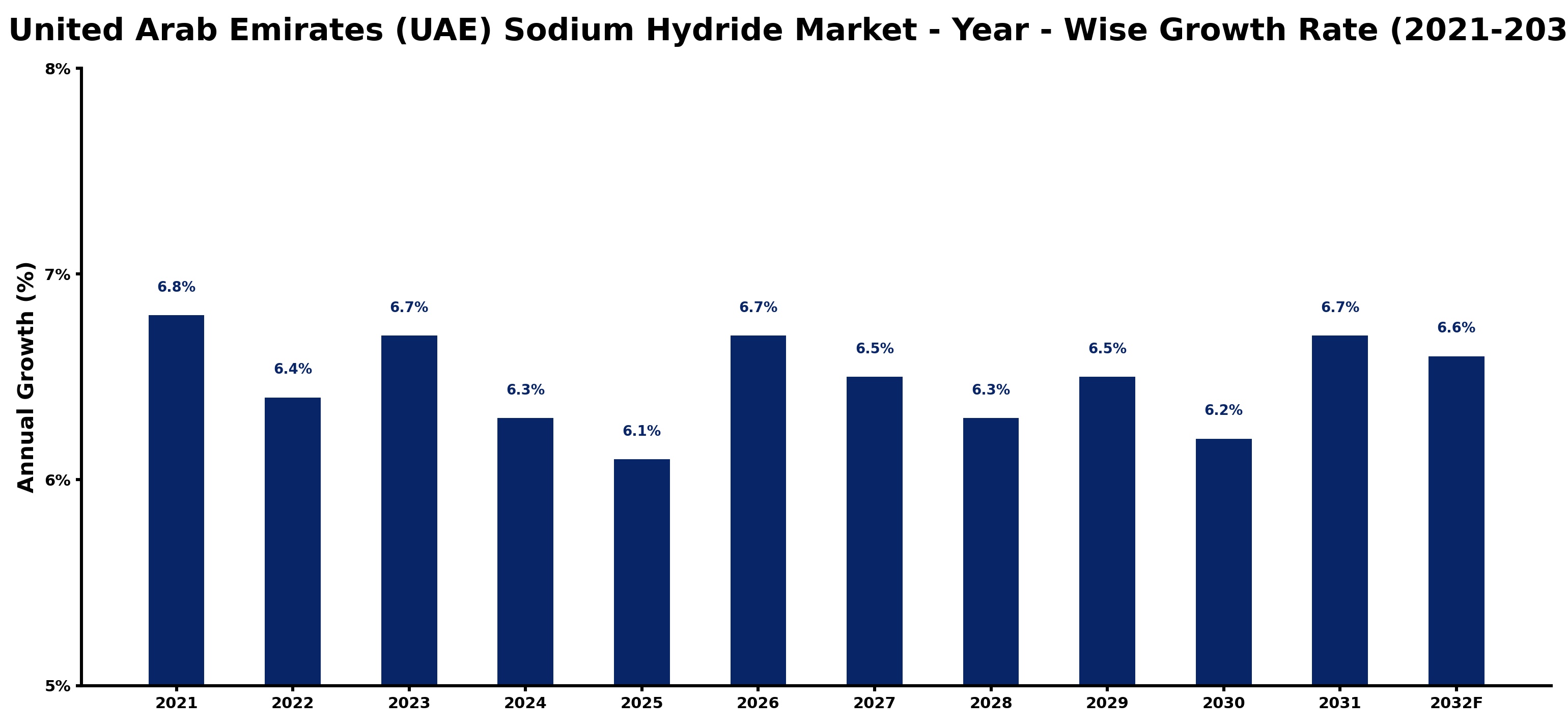
The table below presents the year‑wise growth rates along with the key drivers influencing the market
| Year | Growth Rate | Major Drivers |
| 2021 | 6.8% | Increased industrial applications emerged |
| 2022 | 6.4% | Rising demand from pharmaceuticals sector |
| 2023 | 6.7% | Growth in chemical manufacturing activities |
| 2024 | 6.3% | Emerging markets expanded consumption base |
| 2025 | 6.1% | Technological advancements enhanced production |
| 2026 | 6.7% | Sustainability initiatives drove innovation |
| 2027 | 6.5% | Rising investments in R&D activities |
| 2028 | 6.3% | Export opportunities increased significantly |
| 2029 | 6.5% | Strategic partnerships enhanced market reach |
| 2030 | 6.2% | Regulatory support encouraged market growth |
| 2031 | 6.7% | Consumer awareness of applications increased |
| 2032 | 6.6% | Market diversification strategies gained traction |
Note - Market size estimations and growth projections presented in this report are based on 6Wresearch's advanced forecasting approach, validated with industry datasets as of June 2026.
United Arab Emirates (UAE) Sodium Hydride Market Synopsis
In the UAE, the sodium hydride market has gained traction primarily due to its essential applications in pharmaceutical synthesis and chemical manufacturing. The local demand for fine chemicals, particularly in drug development, is facilitating the adoption of sodium hydride as a preferred reducing agent in numerous reactions.
Furthermore, the UAE's commitment to advancing clean energy technologies has spotlighted sodium hydride as a promising solution for hydrogen storage. This strategic positioning not only aligns with the country's sustainability goals but also enhances the market's appeal to investors and stakeholders looking to capitalize on green technologies.
United Arab Emirates (UAE) Sodium Hydride Market Key Takeaways
- Robust growth projected, driven by pharmaceutical applications and hydrogen storage needs.
- Significant role in drug synthesis enhances its relevance in the local market.
- Emerging trends towards sustainable energy solutions bolster demand for sodium hydride.
- Market faces safety and regulatory challenges that must be navigated for continued growth.
- Key players are vital for maintaining supply chain integrity and regulatory compliance.
Evaluation of Restraints in United Arab Emirates (UAE) Sodium Hydride Market
While the UAE sodium hydride market shows promising potential, certain restraints pose challenges to its growth. The reactivity of sodium hydride necessitates stringent safety measures during handling, storage, and transportation. Regulatory frameworks surrounding chemical management can lead to increased operational complexities and costs for manufacturers and distributors. Additionally, competition from alternative reducing agents and emerging hydrogen storage technologies could impede sodium hydride's market share if not effectively addressed.
United Arab Emirates (UAE) Sodium Hydride Market Trends
Current trends indicate a growing preference for sodium hydride in innovative chemical synthesis processes, particularly within the pharmaceutical sector. As drug developers seek more efficient methodologies, sodium hydride's strong reducing properties position it as a favored choice. Additionally, the shift towards renewable energy sources has intensified the investigation into sodium hydride's role in hydrogen storage, especially for fuel cells, highlighting a transformative phase in energy applications.
United Arab Emirates (UAE) Sodium Hydride Market Opportunities
The UAE sodium hydride market presents numerous growth opportunities, particularly within the pharmaceutical and clean energy sectors. Investment in research and development to enhance the efficiency of sodium hydride applications could yield significant rewards. Furthermore, collaborations with local universities and research institutions could drive innovation, positioning sodium hydride as a leading component in sustainable technology solutions. The push for clean energy initiatives opens additional avenues for market expansion as industries pivot towards eco-friendly practices.
Government Initiatives in the United Arab Emirates (UAE) Sodium Hydride Market
The UAE government has demonstrated a strong commitment to advancing sustainable energy practices, reflected in various policies and initiatives aimed at promoting hydrogen technology. This strategic direction not only encourages investment in hydrogen storage solutions but also supports research into sodium hydride's applications. By fostering an environment conducive to innovation, government initiatives are likely to further enhance the attractiveness of the sodium hydride market to both local and international stakeholders.
Future Insights of the United Arab Emirates (UAE) Sodium Hydride Market
Looking ahead to 2026-2032, the UAE sodium hydride market is poised for significant advancements, driven by ongoing developments in the pharmaceutical industry and clean energy sectors. As regulatory frameworks evolve to support safer handling practices, the market is expected to stabilize and expand. The integration of sodium hydride into new applications, particularly in the context of hydrogen storage, will likely catalyze growth, establishing the UAE as a critical player in the global sodium hydride landscape.
United Arab Emirates (UAE) Sodium Hydride Market Latest Developments (May 2025 - June 2026)
Recent developments in the UAE sodium hydride market have been characterized by increased collaborations between local chemical manufacturers and research institutions aimed at optimizing sodium hydride applications in pharmaceuticals. Additionally, ongoing government support for green technologies is fostering an environment where sodium hydride can be integrated into innovative hydrogen storage solutions. This alignment of market dynamics and policy support indicates a promising trajectory for the coming years.
United Arab Emirates (UAE) Sodium Hydride Market - Key Attractiveness of the Report
- 10 Years of Market Numbers
- Historical Data Starting from 2022 to 2025
- Base Year: 2025
- Forecast Data until 2032
- Key Performance Indicators Impacting the Market
- Major Upcoming Developments and Projects
Key Highlights of the Report:
- United Arab Emirates (UAE) Sodium Hydride Market Outlook
- Market Size of United Arab Emirates (UAE) Sodium Hydride Market, 2025
- Forecast of United Arab Emirates (UAE) Sodium Hydride Market, 2032
- Historical Data and Forecast of United Arab Emirates (UAE) Sodium Hydride Revenues & Volume for the Period 2022-2032F
- United Arab Emirates (UAE) Sodium Hydride Market Trend Evolution
- United Arab Emirates (UAE) Sodium Hydride Market Drivers and Challenges
- United Arab Emirates (UAE) Sodium Hydride Price Trends
- United Arab Emirates (UAE) Sodium Hydride Porter's Five Forces
- United Arab Emirates (UAE) Sodium Hydride Industry Life Cycle
- Historical Data and Forecast of United Arab Emirates (UAE) Sodium Hydride Market Revenues & Volume By Product Range for the Period 2022-2032F
- Historical Data and Forecast of United Arab Emirates (UAE) Sodium Hydride Market Revenues & Volume By Sodium Hydride 60% for the Period 2022-2032F
- Historical Data and Forecast of United Arab Emirates (UAE) Sodium Hydride Market Revenues & Volume By Sodium Hydride 55% for the Period 2022-2032F
- Historical Data and Forecast of United Arab Emirates (UAE) Sodium Hydride Market Revenues & Volume By Sodium Hydride 45% for the Period 2022-2032F
- Historical Data and Forecast of United Arab Emirates (UAE) Sodium Hydride Market Revenues & Volume By Other for the Period 2022-2032F
- Historical Data and Forecast of United Arab Emirates (UAE) Sodium Hydride Market Revenues & Volume By Application for the Period 2022-2032F
- Historical Data and Forecast of United Arab Emirates (UAE) Sodium Hydride Market Revenues & Volume By Chemical Industry for the Period 2022-2032F
- Historical Data and Forecast of United Arab Emirates (UAE) Sodium Hydride Market Revenues & Volume By Pharmaceutical Industry for the Period 2022-2032F
- Historical Data and Forecast of United Arab Emirates (UAE) Sodium Hydride Market Revenues & Volume By Pesticide Industry for the Period 2022-2032F
- United Arab Emirates (UAE) Sodium Hydride Import Export Trade Statistics
- Market Opportunity Assessment By Product Range
- Market Opportunity Assessment By Application
- United Arab Emirates (UAE) Sodium Hydride Top Companies Market Share
- United Arab Emirates (UAE) Sodium Hydride Competitive Benchmarking By Technical and Operational Parameters
- United Arab Emirates (UAE) Sodium Hydride Company Profiles
- United Arab Emirates (UAE) Sodium Hydride Key Strategic Recommendations






































