United Arab Emirates (UAE) Trolley Market Size, Share & Growth Rate
The United Arab Emirates (UAE) Trolley Market was estimated at USD 699 Million in 2025 and is projected to reach USD 1020 Million by 2032, growing at a CAGR of 5.5% from 2026 to 2032. This upward trajectory is largely fueled by increasing investments in the logistics and hospitality sectors, driven by a surge in tourism and e-commerce activities. The growing need for efficient material handling solutions across various industries in the UAE is further accelerating market expansion.
United Arab Emirates (UAE) Trolley Market Year-wise Growth Rate and Key Drivers
This graph highlights how the United Arab Emirates (UAE) Trolley Market has steadily grown over the years, supported by major growth factors.
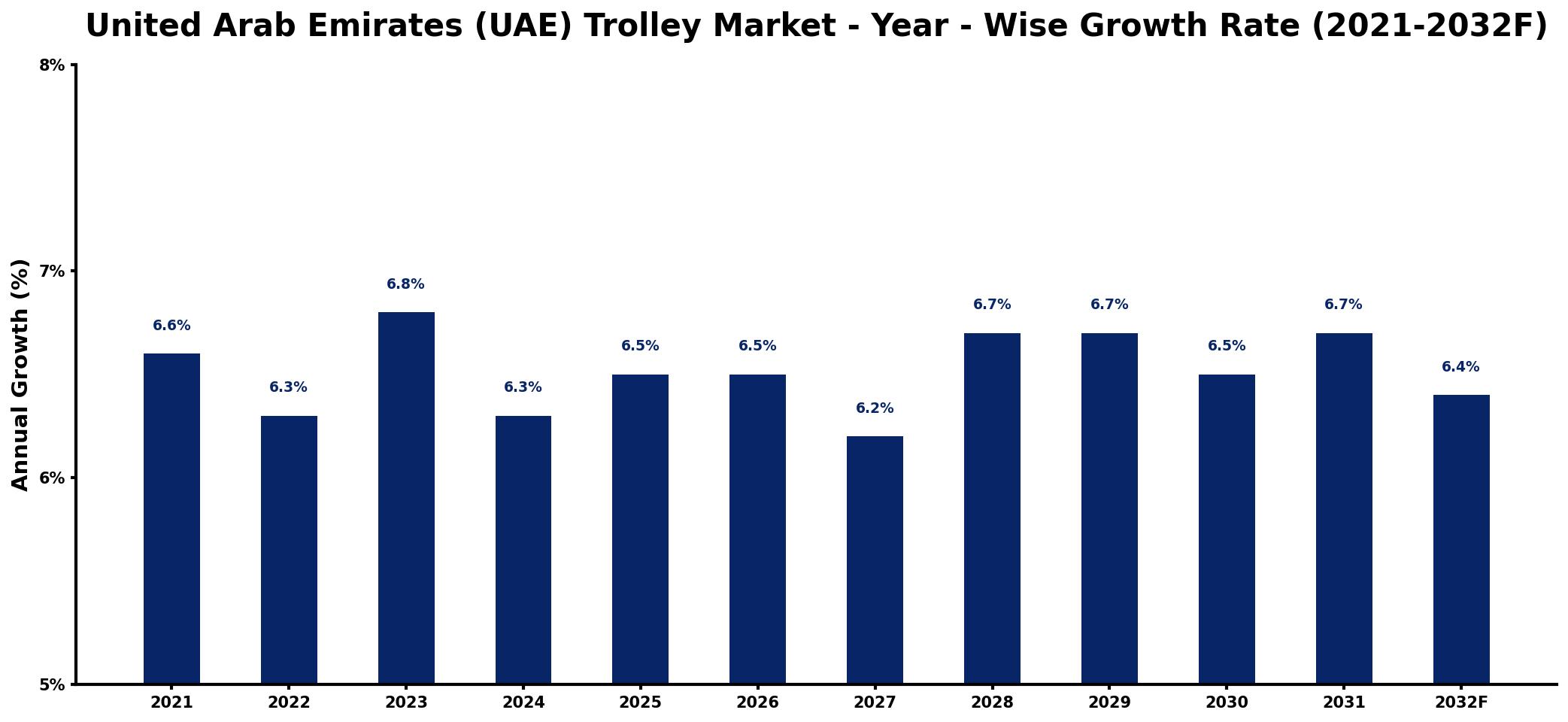
The table below presents the year‑wise growth rates along with the key drivers influencing the market
| Year | Growth Rate | Major Drivers |
| 2021 | 6.6% | Increased consumer spending habits |
| 2022 | 6.3% | Expansion of retail infrastructure |
| 2023 | 6.8% | Growing e-commerce market penetration |
| 2024 | 6.3% | Rise in urban population density |
| 2025 | 6.5% | Investment in logistics technology |
| 2026 | 6.5% | Shift towards sustainable practices |
| 2027 | 6.2% | expanding healthcare application demand |
| 2028 | 6.7% | Increased tourism and travel demand |
| 2029 | 6.7% | Growth in online grocery services |
| 2030 | 6.5% | Rising demand for convenience solutions |
| 2031 | 6.7% | growing regional consumption patterns |
| 2032 | 6.4% | Focus on customer experience enhancement |
Note: Market size estimations and growth projections presented in this report are based on 6Wresearch's proprietary forecasting methodology, utilizing the latest available industry data, government publications, and primary research inputs.
United Arab Emirates (UAE) Trolley Market Synopsis
In recent years, the UAE trolley market has gained substantial momentum as businesses prioritize operational efficiency and customer satisfaction. With a diverse array of trolleys catering to retail, hospitality, and industrial applications, the market is evolving. Looking ahead, the focus will be on innovation and automation, particularly in response to the growing demand for electric and automated trolleys.
Despite the challenges posed by shifts in consumer behavior, including the rise of e-commerce, the market is poised for growth. Manufacturers are investing in advanced materials and ergonomic designs to meet the unique demands of the UAEs dynamic business landscape. The emphasis on durability and mobility is expected to shape product offerings significantly.
United Arab Emirates (UAE) Trolley Market Key Takeaways
- The UAE trolley market is experiencing consistent growth driven by tourism, retail, and logistics sectors.
- Innovation in trolley designs and functionalities, including electric options, is gaining momentum.
- There is a notable shift towards automation and efficiency in material handling operations.
- Challenges from e-commerce and fluctuating raw material prices necessitate adaptive strategies from manufacturers.
- Key players are enhancing product features to ensure compliance with safety and quality standards.
Evaluation of Restraints in United Arab Emirates (UAE) Trolley Market
The UAE trolley market faces certain restraints that could impede its growth trajectory. The increasing preference for e-commerce has resulted in reduced demand for traditional trolleys within retail environments. Additionally, manufacturers must navigate the complexities of quality control and safety standards, as failure to comply can lead to product recalls and associated liabilities. The volatility in raw material prices can also affect profit margins, compelling companies to find cost-effective manufacturing methods while maintaining high standards.
United Arab Emirates (UAE) Trolley Market Trends
A variety of trends are shaping the UAE trolley market. Notably, there is a rising interest in sustainable materials, driven by increasing environmental awareness among consumers and businesses alike. Additionally, smart technology integration in trolleys, such as RFID tracking and automated navigation systems, is becoming more prevalent. As businesses seek to optimize logistics processes, the trend toward electric and automated trolleys is set to gain traction, aligning with broader goals of enhancing operational efficiency and reducing labor costs.
United Arab Emirates (UAE) Trolley Market Opportunities
The market presents genuine growth opportunities, particularly in the development of electric and automated trolleys. As industries move towards greater automation in their operations, manufacturers have the potential to capture significant market share by innovating in these areas. Furthermore, the expanding tourism sector offers a lucrative avenue for growth, as the need for efficient luggage handling solutions remains strong. The rising interest in sustainable practices also opens doors for companies to differentiate themselves through eco-friendly product offerings.
Government Initiatives in the United Arab Emirates (UAE) Trolley Market
The UAE government has implemented various initiatives to bolster the logistics and material handling sectors, which directly benefit the trolley market. Policies aimed at enhancing infrastructure development and encouraging foreign investment are pivotal. Public spending on transportation projects, alongside programs focusing on sustainability, are creating a conducive environment for market growth. The government's commitment to innovation and technology adoption further underscores the potential for expansion within the trolley segment.
Future Insights of the United Arab Emirates (UAE) Trolley Market
From 2026 to 2032, the UAE trolley market is expected to evolve significantly, driven by rapid technological advancements and changing consumer expectations. Companies that prioritize innovation, particularly in automation and eco-friendly solutions, will likely lead the market. With the ongoing expansion of the retail and tourism sectors, demand for diverse trolley solutions will continue to rise. It will be essential for players to adapt their offerings and marketing strategies to remain competitive in a shifting landscape.
United Arab Emirates (UAE) Trolley Market Latest Developments (2025 - 2026)
Recent developments in the UAE trolley market indicate a strong push towards integrating smart technologies into trolley designs. Additionally, there is an increasing focus on enhancing the durability and functionality of products to meet the rising demands of logistics and hospitality industries. Companies are also exploring partnerships to accelerate innovation and expand their product portfolios in response to market trends.
United Arab Emirates (UAE) Trolley Market - Key Attractiveness of the Report
- 10 Years of Market Numbers
- Historical Data Starting from 2022 to 2025
- Base Year: 2025
- Forecast Data until 2032
- Key Performance Indicators Impacting the Market
- Major Upcoming Developments and Projects
Key Highlights of the Report:
- United Arab Emirates (UAE) Trolley Market Outlook
- Market Size of United Arab Emirates (UAE) Trolley Market, 2025
- Forecast of United Arab Emirates (UAE) Trolley Market, 2032
- Historical Data and Forecast of United Arab Emirates (UAE) Trolley Revenues & Volume for the Period 2022-2032F
- United Arab Emirates (UAE) Trolley Market Trend Evolution
- United Arab Emirates (UAE) Trolley Market Drivers and Challenges
- United Arab Emirates (UAE) Trolley Price Trends
- United Arab Emirates (UAE) Trolley Porter's Five Forces
- United Arab Emirates (UAE) Trolley Industry Life Cycle
- Historical Data and Forecast of United Arab Emirates (UAE) Trolley Market Revenues & Volume By Product for the Period 2022-2032F
- Historical Data and Forecast of United Arab Emirates (UAE) Trolley Market Revenues & Volume By Manual for the Period 2022-2032F
- Historical Data and Forecast of United Arab Emirates (UAE) Trolley Market Revenues & Volume By Electric for the Period 2022-2032F
- Historical Data and Forecast of United Arab Emirates (UAE) Trolley Market Revenues & Volume By Application for the Period 2022-2032F
- Historical Data and Forecast of United Arab Emirates (UAE) Trolley Market Revenues & Volume By Commercial for the Period 2022-2032F
- Historical Data and Forecast of United Arab Emirates (UAE) Trolley Market Revenues & Volume By Non-commercial for the Period 2022-2032F
- Historical Data and Forecast of United Arab Emirates (UAE) Trolley Market Revenues & Volume By Distribution for the Period 2022-2032F
- Historical Data and Forecast of United Arab Emirates (UAE) Trolley Market Revenues & Volume By Offline for the Period 2022-2032F
- Historical Data and Forecast of United Arab Emirates (UAE) Trolley Market Revenues & Volume By Online for the Period 2022-2032F
- United Arab Emirates (UAE) Trolley Import Export Trade Statistics
- Market Opportunity Assessment By Product
- Market Opportunity Assessment By Application
- Market Opportunity Assessment By Distribution
- United Arab Emirates (UAE) Trolley Top Companies Market Share
- United Arab Emirates (UAE) Trolley Competitive Benchmarking By Technical and Operational Parameters
- United Arab Emirates (UAE) Trolley Company Profiles
- United Arab Emirates (UAE) Trolley Key Strategic Recommendations






































