United Kingdom (UK) Art and Sculpture Market Size, Share & Growth Rate
The United Kingdom (UK) Art and Sculpture Market was estimated at USD 229 Million in 2025 and is projected to reach USD 285 Million by 2032, growing at a CAGR of 3.2% from 2026 to 2032. This growth trajectory is driven by several factors, including increasing investment interest in art as an asset class and the rising popularity of contemporary and digital art forms. Furthermore, government support for the arts and an expanding collector base continue to stimulate market activity and engagement.
United Kingdom (UK) Art and Sculpture Market Year-wise Growth Rate and Key Drivers
This graph highlights how the United Kingdom (UK) Art and Sculpture Market has steadily grown over the years, supported by major growth factors.
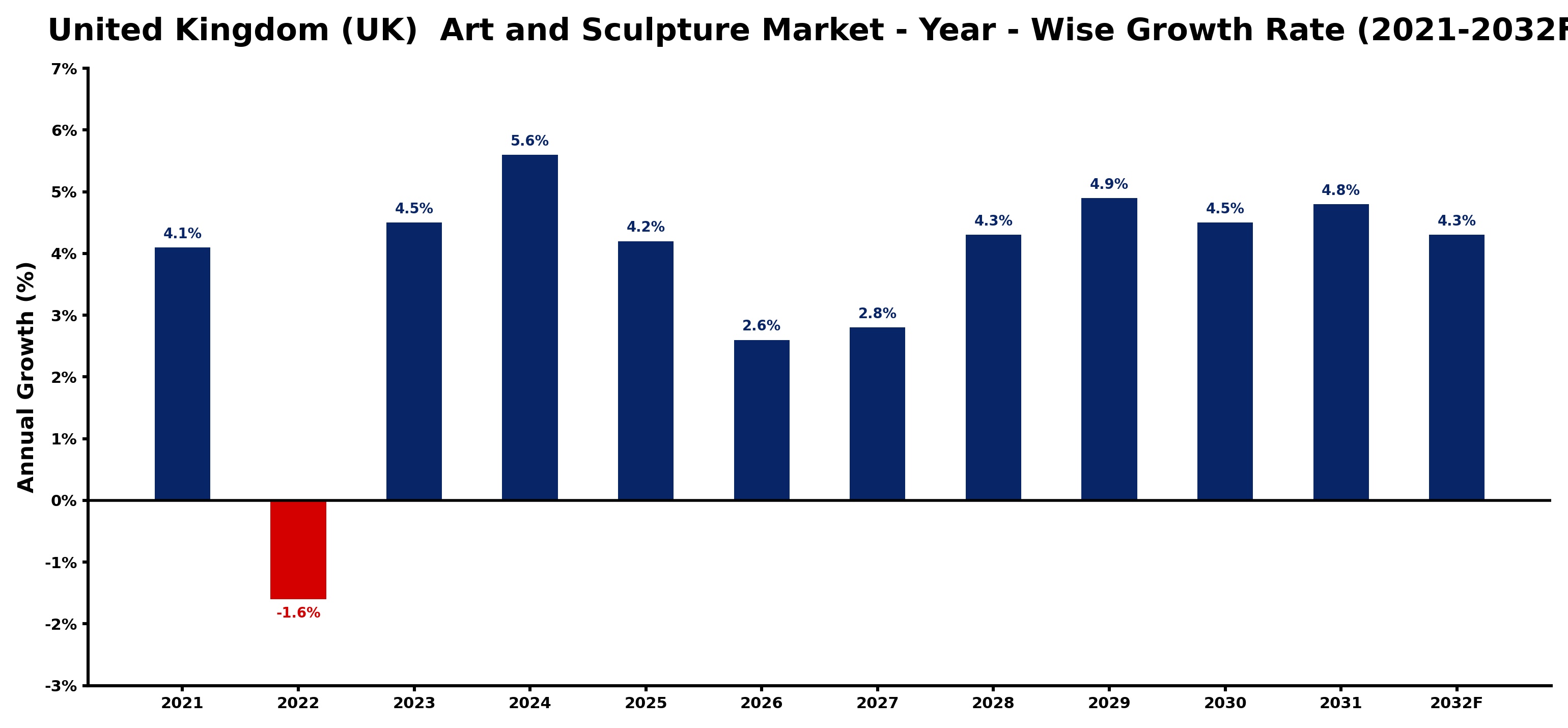
The table below presents the year‑wise growth rates along with the key drivers influencing the market
| Year | Growth Rate | Major Drivers |
| 2021 | 4.1% | Expansion of transportation and logistics networks |
| 2022 | -1.6% | Rapid growth in telecom and data center sectors |
| 2023 | 4.5% | Increasing industrial automation investments |
| 2024 | 5.6% | Government infrastructure modernization initiatives |
| 2025 | 4.2% | Increasing smart city development projects |
| 2026 | 2.6% | Increasing smart city development projects |
| 2027 | 2.8% | Growing renewable energy integration projects |
| 2028 | 4.3% | Growing urbanization and commercial development |
| 2029 | 4.9% | Increasing adoption of advanced technologies |
| 2030 | 4.5% | Increasing industrial infrastructure investments |
| 2031 | 4.8% | Growing urbanization and commercial development |
| 2032 | 4.3% | Increasing smart city development projects |
Note - Market size estimations and growth projections presented in this report are based on 6Wresearch’s advanced forecasting approach, validated with industry datasets as of June 2026.
United Kingdom (UK) Art and Sculpture Market Synopsis
Currently, the strongest force shaping the UK Art and Sculpture Market is the surge in digital art and non-fungible tokens (NFTs). Traditional galleries and artists are embracing these innovations, which are redefining ownership and consumption in the art world. This shift is fostering a more inclusive environment, allowing emerging talents and diverse voices to gain visibility and recognition.
Moreover, sustainability has become a central theme, with artists increasingly focusing on eco-friendly materials and themes. As collectors grow more environmentally conscious, there is a notable rise in demand for artworks that reflect a commitment to sustainability. This trend not only addresses current consumer preferences but also aligns with broader global movements towards environmental responsibility.
United Kingdom (UK) Art and Sculpture Market Key Takeaways
- The UK Art and Sculpture Market is set for steady growth, reaching USD 285 Million by 2032.
- Digital art and NFTs are transforming traditional buying and selling methods, attracting a new demographic of collectors.
- Emerging artists focusing on sustainability are gaining traction among eco-conscious buyers.
- Government initiatives are providing essential funding and support, bolstering the overall art ecosystem.
- Online platforms are becoming critical channels for art sales, expanding market access for artists and collectors alike.
Evaluation of Restraints in United Kingdom (UK) Art and Sculpture Market
Despite its vibrant character, the UK Art and Sculpture Market faces several restraints that can impede growth. Economic fluctuations pose a direct challenge to consumer spending on luxury items, including art. The uncertainty brought about by Brexit has further complicated international trade and exchange, leaving many stakeholders apprehensive about potential impacts on market dynamics. Additionally, traditional galleries may struggle to adapt to the swift pace of digital transformation, which can affect their competitiveness in an increasingly online marketplace.
United Kingdom (UK) Art and Sculpture Market Trends
The current trends in the UK Art and Sculpture Market are reflective of broader technological and cultural shifts. Digital art and NFTs are not just a fad; they are reshaping how art is created, owned, and valued. Furthermore, there is a marked increase in virtual exhibitions and online sales platforms, spurred by pandemic-induced changes in how audiences access art. This digital evolution allows for greater engagement with diverse art forms and fosters connections between artists and collectors worldwide.
Sustainability remains a key theme, with an increasing number of artists prioritizing eco-friendly practices. Collectors are now more inclined to invest in pieces that tell a story of environmental awareness or utilize sustainable materials. This trend aligns with the global movement towards sustainability, making it a prominent factor in shaping contemporary art practices within the UK.
United Kingdom (UK) Art and Sculpture Market Opportunities
The UK Art and Sculpture Market presents a wealth of opportunities for both seasoned investors and new collectors. As contemporary art and emerging artists gain recognition, investing in these sectors could yield substantial returns. Engaging with online platforms can broaden access to a diverse array of artworks, making it easier for collectors to discover unique pieces that resonate with their values and aesthetics. Additionally, the emphasis on sustainability opens new avenues for investment in eco-conscious artworks, appealing to a growing demographic of environmentally aware buyers.
Government Initiatives in the United Kingdom (UK) Art and Sculpture Market
Government policies play a vital role in sustaining the UK Art and Sculpture Market. Initiatives designed to promote artistic expression include funding and grants for both artists and institutions. Tax incentives for collectors help to stimulate investment in art, while measures aimed at protecting cultural heritage ensure that significant works remain accessible for future generations. Such policies foster a thriving artistic community and enhance public engagement with the arts.
Future Insights of the United Kingdom (UK) Art and Sculpture Market
Looking ahead to 2026-2032, the UK Art and Sculpture Market appears poised for sustained growth. Increasing cultural awareness and a more diverse collector base will likely bolster demand for unique and valuable artworks. The integration of technology in the art-buying experience will continue to evolve, facilitating connections between artists and collectors on a global scale. With the rich artistic heritage of the UK as a backdrop, the future of this market is filled with potential for innovation and expansion.
United Kingdom (UK) Art and Sculpture Market Latest Developments (May 2025 - June 2026)
Recent developments in the UK Art and Sculpture Market have highlighted a shift towards increased digital engagement, with many galleries adopting online platforms to reach broader audiences. Artists are also exploring innovative ways to present their work in virtual spaces, contributing to a dynamic and evolving art landscape. Additionally, there is a noticeable trend towards collaborations that blend traditional and contemporary practices, showcasing the versatility and adaptability of the UK art scene.
United Kingdom (UK) Art and Sculpture Market - Key Attractiveness of the Report
- 10 Years of Market Numbers
- Historical Data Starting from 2022 to 2025
- Base Year: 2025
- Forecast Data until 2032
- Key Performance Indicators Impacting the Market
- Major Upcoming Developments and Projects
Key Highlights of the Report:
- United Kingdom (UK) Art and Sculpture Market Outlook
- Market Size of United Kingdom (UK) Art and Sculpture Market, 2025
- Forecast of United Kingdom (UK) Art and Sculpture Market, 2032
- Historical Data and Forecast of United Kingdom (UK) Art and Sculpture Revenues & Volume for the Period 2022-2032F
- United Kingdom (UK) Art and Sculpture Market Trend Evolution
- United Kingdom (UK) Art and Sculpture Market Drivers and Challenges
- United Kingdom (UK) Art and Sculpture Price Trends
- United Kingdom (UK) Art and Sculpture Porter's Five Forces
- United Kingdom (UK) Art and Sculpture Industry Life Cycle
- Historical Data and Forecast of United Kingdom (UK) Art and Sculpture Market Revenues & Volume By Types for the Period 2022-2032F
- Historical Data and Forecast of United Kingdom (UK) Art and Sculpture Market Revenues & Volume By Artifacts for the Period 2022-2032F
- Historical Data and Forecast of United Kingdom (UK) Art and Sculpture Market Revenues & Volume By Sculpture for the Period 2022-2032F
- Historical Data and Forecast of United Kingdom (UK) Art and Sculpture Market Revenues & Volume By Sales Channel for the Period 2022-2032F
- Historical Data and Forecast of United Kingdom (UK) Art and Sculpture Market Revenues & Volume By Auction Houses for the Period 2022-2032F
- Historical Data and Forecast of United Kingdom (UK) Art and Sculpture Market Revenues & Volume By Dealers for the Period 2022-2032F
- Historical Data and Forecast of United Kingdom (UK) Art and Sculpture Market Revenues & Volume By Galleries for the Period 2022-2032F
- Historical Data and Forecast of United Kingdom (UK) Art and Sculpture Market Revenues & Volume By Art Fairs for the Period 2022-2032F
- Historical Data and Forecast of United Kingdom (UK) Art and Sculpture Market Revenues & Volume By Online Sales for the Period 2022-2032F
- Historical Data and Forecast of United Kingdom (UK) Art and Sculpture Market Revenues & Volume By Retail Outlets for the Period 2022-2032F
- Historical Data and Forecast of United Kingdom (UK) Art and Sculpture Market Revenues & Volume By Artists Studios for the Period 2022-2032F
- Historical Data and Forecast of United Kingdom (UK) Art and Sculpture Market Revenues & Volume By Others for the Period 2022-2032F
- Historical Data and Forecast of United Kingdom (UK) Art and Sculpture Market Revenues & Volume By End-user for the Period 2022-2032F
- Historical Data and Forecast of United Kingdom (UK) Art and Sculpture Market Revenues & Volume By Private Collectors for the Period 2022-2032F
- Historical Data and Forecast of United Kingdom (UK) Art and Sculpture Market Revenues & Volume By Museums for the Period 2022-2032F
- Historical Data and Forecast of United Kingdom (UK) Art and Sculpture Market Revenues & Volume By Real Estate Developers for the Period 2022-2032F
- Historical Data and Forecast of United Kingdom (UK) Art and Sculpture Market Revenues & Volume By Interior Designers for the Period 2022-2032F
- Historical Data and Forecast of United Kingdom (UK) Art and Sculpture Market Revenues & Volume By Residential Individual Buyers for the Period 2022-2032F
- Historical Data and Forecast of United Kingdom (UK) Art and Sculpture Market Revenues & Volume By Other Professionals for the Period 2022-2032F
- United Kingdom (UK) Art and Sculpture Import Export Trade Statistics
- Market Opportunity Assessment By Types
- Market Opportunity Assessment By Sales Channel
- Market Opportunity Assessment By End-user
- United Kingdom (UK) Art and Sculpture Top Companies Market Share
- United Kingdom (UK) Art and Sculpture Competitive Benchmarking By Technical and Operational Parameters
- United Kingdom (UK) Art and Sculpture Company Profiles
- United Kingdom (UK) Art and Sculpture Key Strategic Recommendations






































