United Kingdom (UK) Ascorbic Acid Market Size, Share & Growth Rate
The United Kingdom (UK) Ascorbic Acid Market was estimated at USD 236 Million in 2025 and is projected to reach USD 292 Million by 2032, growing at a CAGR of 3.1% from 2026 to 2032. This growth trajectory is primarily fueled by a heightened consumer consciousness regarding health and wellness, particularly in the wake of recent global health events. Additionally, the expanding application of ascorbic acid across diverse industries, including pharmaceuticals and food & beverages, is further driving demand.
United Kingdom (UK) Ascorbic Acid Market Year-wise Growth Rate and Key Drivers
This graph highlights how the United Kingdom (UK) Ascorbic Acid Market has steadily grown over the years, supported by major growth factors.
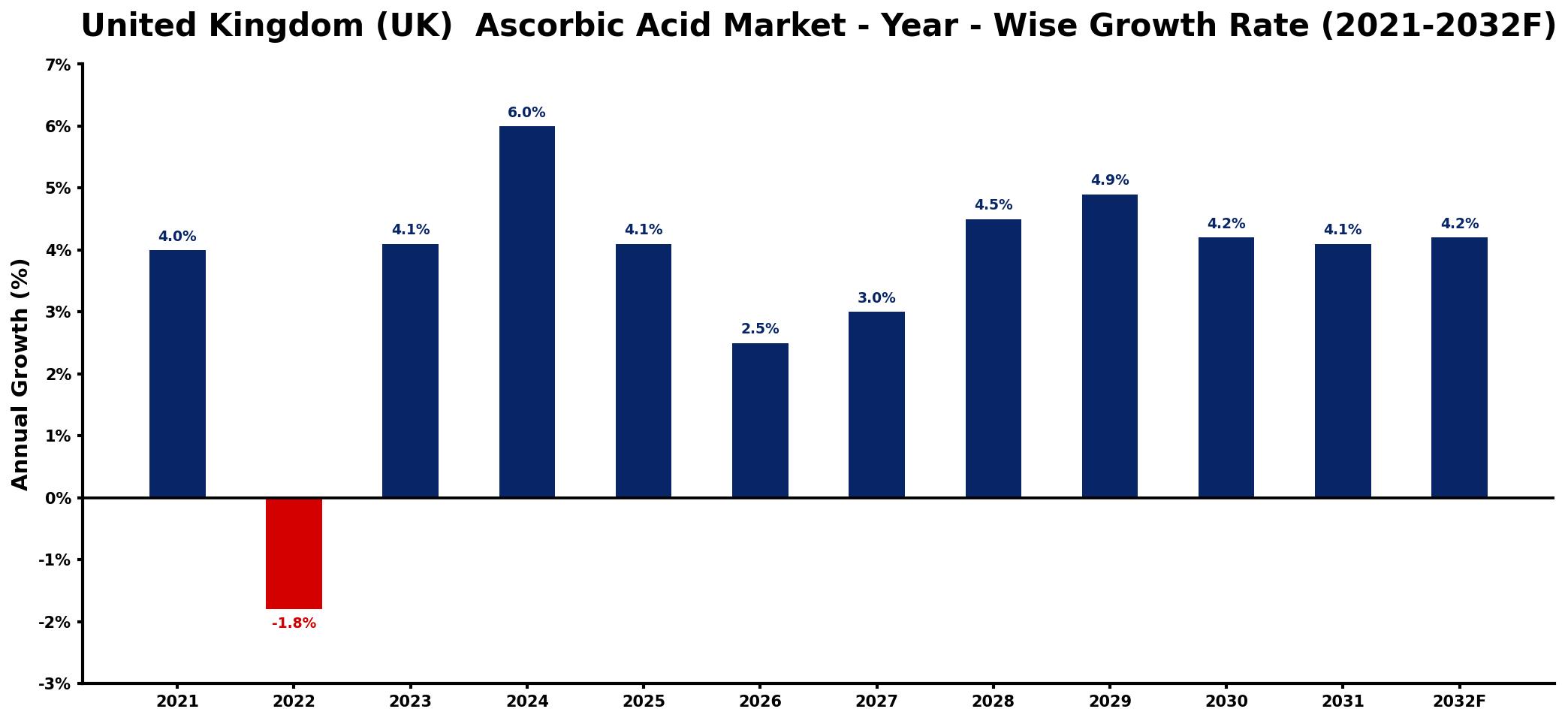
The table below presents the year‑wise growth rates along with the key drivers influencing the market
| Year | Growth Rate | Major Drivers |
| 2021 | 4.0% | Rising health consciousness among consumers |
| 2022 | -1.8% | Decrease in consumer spending habits |
| 2023 | 4.1% | Growing popularity of dietary supplements |
| 2024 | 6.0% | rising demand from electronics |
| 2025 | 4.1% | Expansion of functional food market |
| 2026 | 2.5% | strengthening underlying market demand |
| 2027 | 3.0% | Growth in e-commerce health sales |
| 2028 | 4.5% | Surge in preventive healthcare initiatives |
| 2029 | 4.9% | Increase in sports nutrition products |
| 2030 | 4.2% | increased production capacity utilization |
| 2031 | 4.1% | rising end-use demand growth |
| 2032 | 4.2% | improved processing technologies adoption |
Note: Market size estimations and growth projections presented in this report are based on 6Wresearch's proprietary forecasting methodology, utilizing the latest available industry data, government publications, and primary research inputs.
United Kingdom (UK) Ascorbic Acid Market Synopsis
The UK Ascorbic Acid market is currently experiencing a robust surge in demand, largely attributable to growing consumer awareness about the health benefits of Vitamin C. Its multifunctional roles, from serving as an essential nutrient to acting as a potent antioxidant, have made ascorbic acid a staple in various sectors.
In particular, the rise of clean label products and a preference for natural ingredients are shifting market dynamics. Manufacturers are responding with innovative formulations that emphasize sustainability and health, positioning themselves to capture the interest of the increasingly discerning UK consumer.
United Kingdom (UK) Ascorbic Acid Market Key Takeaways
- Increasing consumer focus on health and wellness is propelling demand for ascorbic acid.
- The market is characterized by innovation in product formulations and packaging.
- Natural and plant-based sources of Vitamin C are gaining traction among consumers.
- Online retail channels are emerging as popular platforms for purchasing ascorbic acid products.
- Sustainability initiatives are influencing production and sourcing practices in the industry.
Evaluation of Restraints in United Kingdom (UK) Ascorbic Acid Market
The United Kingdom (UK) Ascorbic Acid Market faces significant hurdles that could dampen its potential for growth. One of the key restraints is the volatility of raw material prices, which can disrupt supply chains and affect profit margins for manufacturers. Furthermore, increasing competition from alternative Vitamin C sources, coupled with stringent regulatory frameworks surrounding health claims and labeling, adds a layer of complexity for market players. These factors require companies to remain agile, focusing on innovation and compliance to navigate the challenging landscape effectively.
United Kingdom (UK) Ascorbic Acid Market Trends
Emerging trends in the UK Ascorbic Acid Market include a noticeable shift toward health-conscious and wellness-focused products. There is a growing consumer preference for supplements that utilize natural sources of Vitamin C, driving demand for products labeled as clean and organic. Additionally, the ongoing boom in e-commerce is reshaping how consumers purchase ascorbic acid products, with online platforms gaining popularity for their convenience and accessibility.
Manufacturers are increasingly adopting eco-friendly production techniques and sustainable packaging solutions to meet environmental standards and consumer expectations. This focus on sustainability is expected to further reshape market dynamics in the coming years.
United Kingdom (UK) Ascorbic Acid Market Opportunities
There are considerable investment opportunities within the United Kingdom's Ascorbic Acid market, particularly as the demand for dietary supplements and fortified foods continues to rise. Companies that invest in research and development to enhance product quality and explore new applications for ascorbic acid are likely to capture significant market share. Additionally, sustainable sourcing practices are becoming increasingly important, presenting an opportunity for businesses to align with eco-conscious consumer preferences. Strategic partnerships and collaborations across the supply chain can also enhance operational efficiency and product offerings.
Government Initiatives in the United Kingdom (UK) Ascorbic Acid Market
The regulatory landscape for the UK Ascorbic Acid Market is shaped by stringent government policies designed to ensure consumer safety and product efficacy. The UK Food Standards Agency plays a vital role in overseeing the safety and labeling of food additives, including ascorbic acid, ensuring compliance with established guidelines. In recent years, government initiatives have also emphasized the promotion of sustainable sourcing practices in food and dietary supplement production, aligning with broader environmental and health objectives.
Future Insights of the United Kingdom (UK) Ascorbic Acid Market
Looking ahead to 2026-2032, the United Kingdom (UK) Ascorbic Acid Market is positioned for steady growth. Factors such as increased awareness of the health benefits of Vitamin C and a continued shift toward natural and organic products are likely to drive market expansion. Innovations in production technology and the rising demand for convenient, health-oriented products will further enhance market dynamics. As consumer preferences continue to evolve, companies that adapt quickly and effectively to these trends will find ample opportunities for growth.
United Kingdom (UK) Ascorbic Acid Market Latest Developments (2025 - 2026)
Recent developments in the UK Ascorbic Acid Market indicate a growing trend toward the utilization of innovative extraction methods that improve yield and quality. Companies are increasingly focusing on product diversification and enhancing formulations to cater to the burgeoning demand for natural alternatives. Moreover, partnerships aimed at fostering research initiatives are paving the way for new applications, particularly in the health and wellness sector, signaling a transformative phase for the industry.
United Kingdom (UK) Ascorbic Acid Market - Key Attractiveness of the Report
- 10 Years of Market Numbers
- Historical Data Starting from 2022 to 2025
- Base Year: 2025
- Forecast Data until 2032
- Key Performance Indicators Impacting the Market
- Major Upcoming Developments and Projects
Key Highlights of the Report:
- United Kingdom (UK) Ascorbic Acid Market Outlook
- Market Size of United Kingdom (UK) Ascorbic Acid Market, 2025
- Forecast of United Kingdom (UK) Ascorbic Acid Market, 2032
- Historical Data and Forecast of United Kingdom (UK) Ascorbic Acid Revenues & Volume for the Period 2022-2032F
- United Kingdom (UK) Ascorbic Acid Market Trend Evolution
- United Kingdom (UK) Ascorbic Acid Market Drivers and Challenges
- United Kingdom (UK) Ascorbic Acid Price Trends
- United Kingdom (UK) Ascorbic Acid Porter's Five Forces
- United Kingdom (UK) Ascorbic Acid Industry Life Cycle
- Historical Data and Forecast of United Kingdom (UK) Ascorbic Acid Market Revenues & Volume By Grade for the Period 2022-2032F
- Historical Data and Forecast of United Kingdom (UK) Ascorbic Acid Market Revenues & Volume By Food & Pharmaceutical for the Period 2022-2032F
- Historical Data and Forecast of United Kingdom (UK) Ascorbic Acid Market Revenues & Volume By Industrial for the Period 2022-2032F
- Historical Data and Forecast of United Kingdom (UK) Ascorbic Acid Market Revenues & Volume By Application for the Period 2022-2032F
- Historical Data and Forecast of United Kingdom (UK) Ascorbic Acid Market Revenues & Volume By Food & Beverages for the Period 2022-2032F
- Historical Data and Forecast of United Kingdom (UK) Ascorbic Acid Market Revenues & Volume By Pharmaceutical for the Period 2022-2032F
- Historical Data and Forecast of United Kingdom (UK) Ascorbic Acid Market Revenues & Volume By Cosmetics for the Period 2022-2032F
- Historical Data and Forecast of United Kingdom (UK) Ascorbic Acid Market Revenues & Volume By Chemicals for the Period 2022-2032F
- Historical Data and Forecast of United Kingdom (UK) Ascorbic Acid Market Revenues & Volume By Agriculture for the Period 2022-2032F
- Historical Data and Forecast of United Kingdom (UK) Ascorbic Acid Market Revenues & Volume By Others for the Period 2022-2032F
- United Kingdom (UK) Ascorbic Acid Import Export Trade Statistics
- Market Opportunity Assessment By Grade
- Market Opportunity Assessment By Application
- United Kingdom (UK) Ascorbic Acid Top Companies Market Share
- United Kingdom (UK) Ascorbic Acid Competitive Benchmarking By Technical and Operational Parameters
- United Kingdom (UK) Ascorbic Acid Company Profiles
- United Kingdom (UK) Ascorbic Acid Key Strategic Recommendations






































