United Kingdom (UK) Electrical Components Market Size, Share & Growth Rate
The United Kingdom (UK) Electrical Components Market was estimated at USD 438 Million in 2025 and is projected to reach USD 543 Million by 2032, growing at a CAGR of 3.1% from 2026 to 2032. This growth trajectory is primarily fueled by the increasing demand for energy-efficient solutions as consumers and businesses prioritize sustainability. Furthermore, advancements in technology and the proliferation of smart devices are driving innovation and creating new applications for electrical components across various sectors.
United Kingdom (UK) Electrical Components Market Year-wise Growth Rate and Key Drivers
This graph highlights how the United Kingdom (UK) Electrical Components Market has steadily grown over the years, supported by major growth factors.
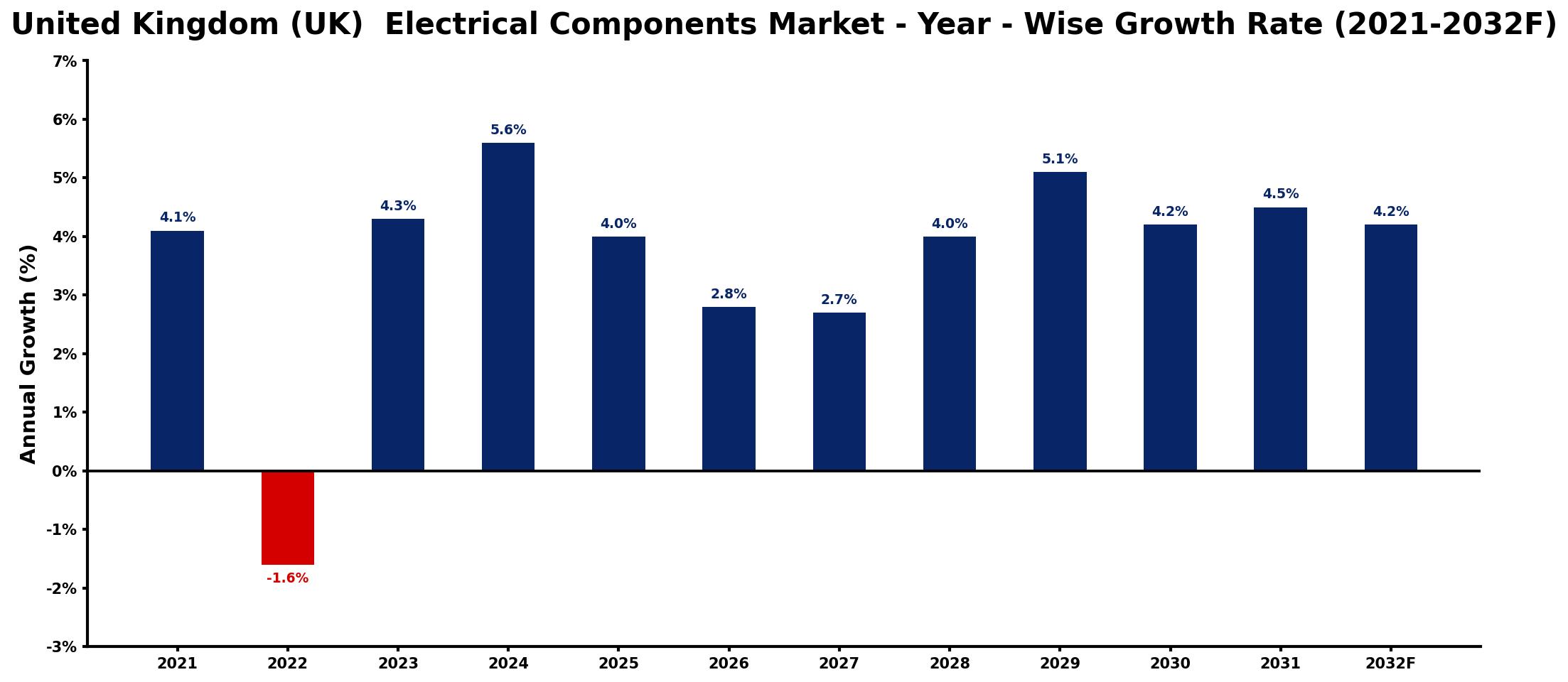
The table below presents the year‑wise growth rates along with the key drivers influencing the market
| Year | Growth Rate | Major Drivers |
| 2021 | 4.1% | Rising demand from renewable energy |
| 2022 | -1.6% | Slowdown in construction projects |
| 2023 | 4.3% | Increased investments in infrastructure |
| 2024 | 5.6% | Growing automation in manufacturing |
| 2025 | 4.0% | Expansion of smart home technologies |
| 2026 | 2.8% | Surge in electric vehicle production |
| 2027 | 2.7% | Growth in data center construction |
| 2028 | 4.0% | Increase in energy efficiency initiatives |
| 2029 | 5.1% | Boost in telecommunication upgrades |
| 2030 | 4.2% | Adoption of IoT applications |
| 2031 | 4.5% | Rise in sustainable energy projects |
| 2032 | 4.2% | Increased focus on industrial automation |
Note: Market size estimations and growth projections presented in this report are based on 6Wresearch's proprietary forecasting methodology, utilizing the latest available industry data, government publications, and primary research inputs.
United Kingdom (UK) Electrical Components Market Synopsis
The UK Electrical Components Market has witnessed robust momentum in recent years, propelled by rapid urbanization and a growing emphasis on renewable energy initiatives. As the market matures, it is now poised for a transformative phase, adapting to the evolving demands of technological advancement and sustainability.
Looking ahead, the market is expected to embrace digitalization and automation, driven by a push for enhanced efficiency across various industries. With the integration of smart technologies and energy-efficient products, stakeholders are redefining their strategies to remain competitive in this dynamic landscape.
United Kingdom (UK) Electrical Components Market Key Takeaways
- The market is characterized by a steady shift towards sustainable and energy-efficient electrical components.
- Technological advancements, particularly in IoT and automation, are reshaping product offerings.
- Investment opportunities are abundant in sectors like renewable energy and smart grid technologies.
- Government policies are promoting innovation, consumer safety, and environmental sustainability.
- The market is expected to face challenges related to supply chain disruptions and regulatory uncertainties.
Evaluation of Restraints in United Kingdom (UK) Electrical Components Market
Several factors currently restrain the UK Electrical Components Market from achieving its full potential. Rapid technological changes require continuous adaptation, posing a challenge for companies to stay ahead. Additionally, the competitive landscape is intensified by global players, driving pressure on pricing and innovation. Brexit-related uncertainties have further complicated trade relationships, introducing volatility in supply chains. These factors necessitate strategic planning and strong partnerships among stakeholders to navigate effectively.
United Kingdom (UK) Electrical Components Market Trends
The current trends in the UK Electrical Components Market reflect a profound shift towards energy efficiency and sustainability. Businesses and consumers alike are seeking components that minimize energy consumption, leading to increased demand for innovative solutions. Furthermore, the rise of smart home technology and interconnected devices is driving an evolution in product designs, enabling seamless integration and enhanced functionality.
Another significant trend is the acceleration towards renewable energy adoption. As the UK government prioritizes renewable initiatives, the market is seeing a surge in demand for components associated with solar energy, wind turbines, and other green technologies. Digitalization and automation also play a crucial role, prompting manufacturers to improve efficiency and reduce operational costs.
United Kingdom (UK) Electrical Components Market Opportunities
Opportunities within the UK Electrical Components Market are plentiful, particularly in sectors driving sustainability and innovation. Investment in smart grid technology is gaining momentum, as the UK seeks to modernize its energy infrastructure. Additionally, the rise in electric vehicle usage presents a substantial market for charging infrastructure and related components. The growth in IoT devices further signifies potential in automation and connectivity, encouraging companies to focus on developing integrated solutions that meet consumer demands.
Government Initiatives in the United Kingdom (UK) Electrical Components Market
The UK government has introduced a range of policies aimed at regulating the Electrical Components Market, emphasizing sustainability and safety. Notably, the Waste Electrical and Electronic Equipment (WEEE) Regulations mandate producers to manage and recycle electrical waste effectively. Furthermore, stringent product safety standards through the Electrical Equipment (Safety) Regulations ensure that components meet high safety requirements. Initiatives such as the Industrial Strategy Challenge Fund underscore the governments commitment to supporting research and development in advanced manufacturing technologies, fostering innovation across the sector.
Future Insights of the United Kingdom (UK) Electrical Components Market
The outlook for the UK Electrical Components Market from 2026 to 2032 appears promising, bolstered by an increasing focus on smart technologies and automation across various industries. The emphasis on sustainability and energy efficiency will further stimulate demand for advanced electrical components. As electric vehicles and renewable energy sources become increasingly mainstream, companies will have significant opportunities to innovate and expand their product lines. However, navigating potential regulatory hurdles and supply chain challenges will be crucial for sustained growth in this evolving market.
United Kingdom (UK) Electrical Components Market Latest Developments (2025 - 2026)
Recent developments in the UK Electrical Components Market indicate a strong trajectory towards integrating smart and energy-efficient technologies. Industry players are actively pursuing collaborations to enhance product offerings, particularly in renewable energy and IoT applications. The government continues to roll out initiatives to foster innovation while ensuring sustainability, influencing the strategic direction of market participants. As companies adapt to these shifts, the overall industry landscape is set for transformative change.
United Kingdom (UK) Electrical Components Market - Key Attractiveness of the Report
- 10 Years of Market Numbers
- Historical Data Starting from 2022 to 2025
- Base Year: 2025
- Forecast Data until 2032
- Key Performance Indicators Impacting the Market
- Major Upcoming Developments and Projects
Key Highlights of the Report:
- United Kingdom (UK) Electrical Components Market Outlook
- Market Size of United Kingdom (UK) Electrical Components Market, 2025
- Forecast of United Kingdom (UK) Electrical Components Market, 2032
- Historical Data and Forecast of United Kingdom (UK) Electrical Components Revenues & Volume for the Period 2022-2032F
- United Kingdom (UK) Electrical Components Market Trend Evolution
- United Kingdom (UK) Electrical Components Market Drivers and Challenges
- United Kingdom (UK) Electrical Components Price Trends
- United Kingdom (UK) Electrical Components Porter's Five Forces
- United Kingdom (UK) Electrical Components Industry Life Cycle
- Historical Data and Forecast of United Kingdom (UK) Electrical Components Market Revenues & Volume By Building Automation for the Period 2022-2032F
- Historical Data and Forecast of United Kingdom (UK) Electrical Components Market Revenues & Volume By Datacom Accessories for the Period 2022-2032F
- Historical Data and Forecast of United Kingdom (UK) Electrical Components Market Revenues & Volume By Security & wiring Accessories for the Period 2022-2032F
- Historical Data and Forecast of United Kingdom (UK) Electrical Components Market Revenues & Volume By Cables & Wires for the Period 2022-2032F
- Historical Data and Forecast of United Kingdom (UK) Electrical Components Market Revenues & Volume By Datacom Cables for the Period 2022-2032F
- Historical Data and Forecast of United Kingdom (UK) Electrical Components Market Revenues & Volume By LV Cables for the Period 2022-2032F
- Historical Data and Forecast of United Kingdom (UK) Electrical Components Market Revenues & Volume By MV&HV Cables for the Period 2022-2032F
- Historical Data and Forecast of United Kingdom (UK) Electrical Components Market Revenues & Volume By Special Cables for the Period 2022-2032F
- Historical Data and Forecast of United Kingdom (UK) Electrical Components Market Revenues & Volume By Industrial Automation for the Period 2022-2032F
- Historical Data and Forecast of United Kingdom (UK) Electrical Components Market Revenues & Volume By Automation Controls for the Period 2022-2032F
- Historical Data and Forecast of United Kingdom (UK) Electrical Components Market Revenues & Volume By Auxiliary Controls for the Period 2022-2032F
- Historical Data and Forecast of United Kingdom (UK) Electrical Components Market Revenues & Volume By Drives & Motion Controls for the Period 2022-2032F
- Historical Data and Forecast of United Kingdom (UK) Electrical Components Market Revenues & Volume By Measurement Controls and Relays for the Period 2022-2032F
- Historical Data and Forecast of United Kingdom (UK) Electrical Components Market Revenues & Volume By Lighting for the Period 2022-2032F
- Historical Data and Forecast of United Kingdom (UK) Electrical Components Market Revenues & Volume By Fixtures for the Period 2022-2032F
- Historical Data and Forecast of United Kingdom (UK) Electrical Components Market Revenues & Volume By Lamps & LEDs for the Period 2022-2032F
- Historical Data and Forecast of United Kingdom (UK) Electrical Components Market Revenues & Volume By Power Distribution for the Period 2022-2032F
- Historical Data and Forecast of United Kingdom (UK) Electrical Components Market Revenues & Volume By Cable Management for the Period 2022-2032F
- Historical Data and Forecast of United Kingdom (UK) Electrical Components Market Revenues & Volume By Enclosures & Panels for the Period 2022-2032F
- Historical Data and Forecast of United Kingdom (UK) Electrical Components Market Revenues & Volume By LV Electrical Distribution for the Period 2022-2032F
- Historical Data and Forecast of United Kingdom (UK) Electrical Components Market Revenues & Volume By Renewable Energies for the Period 2022-2032F
- Historical Data and Forecast of United Kingdom (UK) Electrical Components Market Revenues & Volume By HVAC for the Period 2022-2032F
- Historical Data and Forecast of United Kingdom (UK) Electrical Components Market Revenues & Volume By Renewable energy for the Period 2022-2032F
- Historical Data and Forecast of United Kingdom (UK) Electrical Components Market Revenues & Volume By Safety & Tools for the Period 2022-2032F
- Historical Data and Forecast of United Kingdom (UK) Electrical Components Market Revenues & Volume By Safety Equipment for the Period 2022-2032F
- Historical Data and Forecast of United Kingdom (UK) Electrical Components Market Revenues & Volume By Working Tools & Accessories for the Period 2022-2032F
- United Kingdom (UK) Electrical Components Import Export Trade Statistics
- Market Opportunity Assessment By Building Automation
- Market Opportunity Assessment By Cables & Wires
- Market Opportunity Assessment By Industrial Automation
- Market Opportunity Assessment By Lighting
- Market Opportunity Assessment By Power Distribution
- Market Opportunity Assessment By Renewable Energies
- Market Opportunity Assessment By Safety & Tools
- United Kingdom (UK) Electrical Components Top Companies Market Share
- United Kingdom (UK) Electrical Components Competitive Benchmarking By Technical and Operational Parameters
- United Kingdom (UK) Electrical Components Company Profiles
- United Kingdom (UK) Electrical Components Key Strategic Recommendations






































