United Kingdom (UK) Fencing Market Size, Share & Growth Rate
The United Kingdom (UK) Fencing Market was estimated at USD 190 Million in 2025 and is projected to reach USD 236 Million by 2032, growing at a CAGR of 3.1% from 2026 to 2032. This growth trajectory is fueled by an increasing emphasis on security and privacy among homeowners, alongside a rising trend of home improvements. Moreover, the demand for aesthetically pleasing and sustainable fencing options is pushing manufacturers to innovate and diversify their offerings, creating an environment ripe for expansion.
United Kingdom (UK) Fencing Market Year-wise Growth Rate and Key Drivers
This graph highlights how the United Kingdom (UK) Fencing Market has steadily grown over the years, supported by major growth factors.
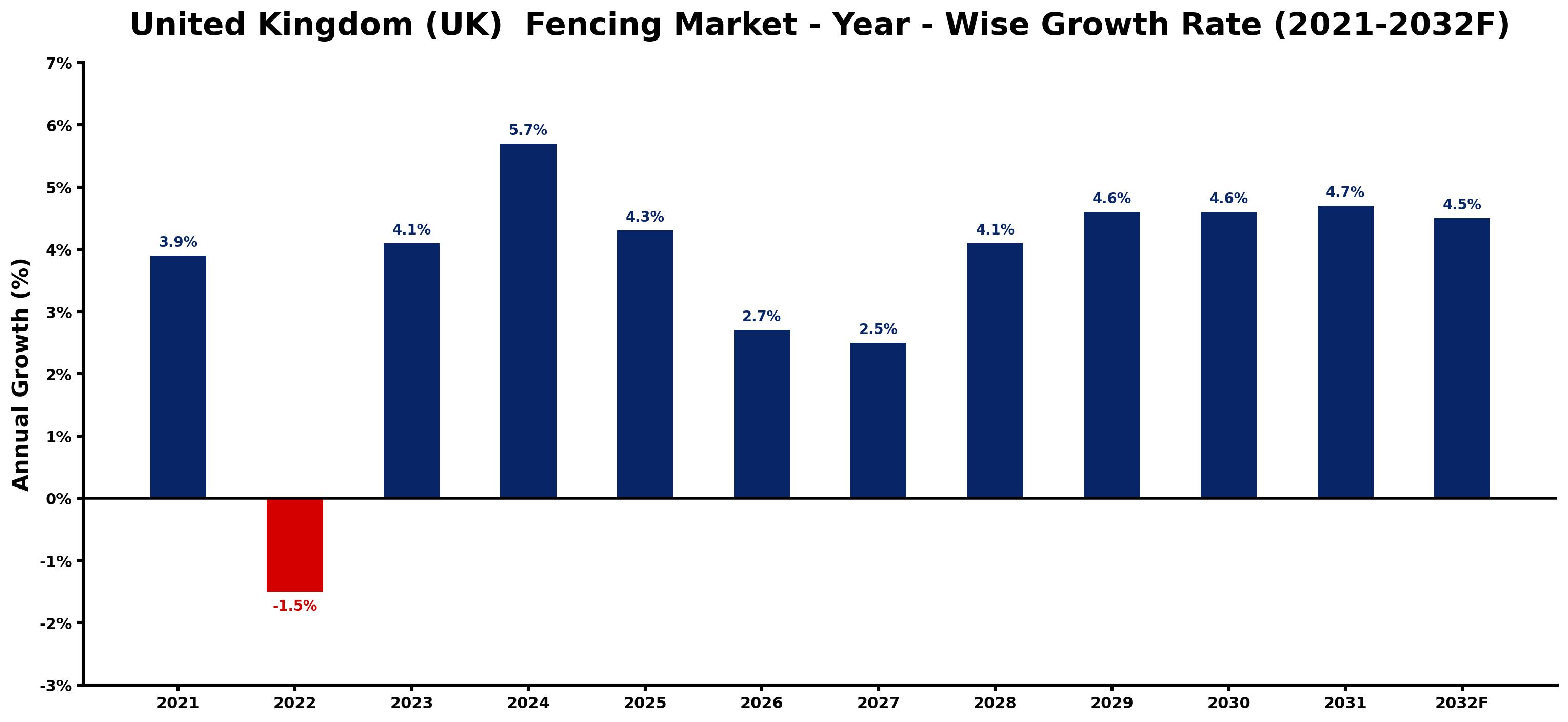
The table below presents the year‑wise growth rates along with the key drivers influencing the market
| Year | Growth Rate | Major Drivers |
| 2021 | 3.9% | Rapid growth in telecom and data center sectors |
| 2022 | -1.5% | Growing urbanization and commercial development |
| 2023 | 4.1% | Expansion of transportation and logistics networks |
| 2024 | 5.7% | Growing renewable energy integration projects |
| 2025 | 4.3% | Growing urbanization and commercial development |
| 2026 | 2.7% | Increasing adoption of advanced technologies |
| 2027 | 2.5% | Increasing smart city development projects |
| 2028 | 4.1% | Increasing adoption of advanced technologies |
| 2029 | 4.6% | Rapid growth in telecom and data center sectors |
| 2030 | 4.6% | Expansion of manufacturing activities |
| 2031 | 4.7% | Increasing industrial infrastructure investments |
| 2032 | 4.5% | Expansion of commercial construction activities |
Note - Market size estimations and growth projections presented in this report are based on 6Wresearch's advanced forecasting approach, validated with industry datasets as of June 2026.
United Kingdom (UK) Fencing Market Synopsis
The strongest force currently shaping the United Kingdom (UK) Fencing Market is the escalating consumer demand for eco-friendly materials. As awareness regarding environmental issues increases, homeowners and businesses alike are seeking sustainable fencing solutions that do not compromise on quality or aesthetics. This shift towards sustainability is driving innovation in product offerings, leading to a plethora of options that cater to eco-conscious consumers.
Additionally, the market is characterized by a growing trend towards DIY fencing installations. With more consumers opting to undertake fencing projects themselves, there is a rising demand for user-friendly products that simplify the installation process. As a result, companies are investing in designs that enable ease of assembly without sacrificing durability or visual appeal.
United Kingdom (UK) Fencing Market Key Takeaways
- The market is witnessing a substantial shift towards sustainable and eco-friendly fencing solutions.
- Increasing consumer interest in aesthetics is driving demand for decorative and customizable fencing designs.
- Technological advancements, including smart fencing systems, are becoming increasingly popular.
- DIY solutions are gaining traction as homeowners look to reduce installation costs.
- Urbanization and infrastructure development are key factors propelling market growth.
Evaluation of Restraints in United Kingdom (UK) Fencing Market
Despite its positive outlook, the United Kingdom (UK) Fencing Market faces several restraints. A key limitation is the intensifying competition from both domestic and international manufacturers, which pressures companies to keep prices competitive while maintaining quality. Rising raw material costs can squeeze profit margins, particularly for products like wood and metal. Additionally, the repercussions of Brexit, including potential trade tariffs and supply chain disruptions, could complicate the procurement of fencing materials. Regulatory compliance regarding safety and environmental standards also adds to the operational challenges, as companies must navigate these requirements to remain compliant and competitive.
United Kingdom (UK) Fencing Market Trends
The UK fencing market is currently seeing notable trends that are shaping consumer preferences and technology. Foremost among these is the demand for sustainable materials, such as bamboo and recycled plastics, as more consumers seek environmentally responsible options. Furthermore, there's a marked interest in smart fencing technologies, incorporating automation and monitoring features that offer enhanced security. Decorative designs are also gaining traction, driven by homeowners looking to enhance their property's visual appeal while ensuring privacy and security. In addition, the DIY trend is encouraging manufacturers to offer products that are easy to install and customizable.
United Kingdom (UK) Fencing Market Opportunities
Investment opportunities in the United Kingdom (UK) Fencing Market are abundant. The ongoing rise in construction activities, fueled by urbanization, presents a favorable environment for fencing suppliers and service providers. Investors can capitalize on the growing demand for security solutions, particularly in residential settings, as well as aesthetic fencing options that appeal to discerning homeowners. The integration of smart technologies into fencing solutions is also a promising avenue for investment, providing convenience and added security features. As eco-friendly materials gain traction, investing in sustainable fencing solutions can position companies as leaders in this evolving market.
Government Initiatives in the United Kingdom (UK) Fencing Market
Government policies are significantly influencing the UK fencing market, particularly in areas of safety and sustainability. Regulatory frameworks set stringent standards regarding fence height, materials used, and installation practices, aimed at ensuring public safety and environmental protection. Incentives are also available to promote sustainable manufacturing practices, encouraging businesses to adopt eco-friendly materials and processes. Additionally, government initiatives aimed at bolstering local manufacturing and supporting domestic suppliers are fostering a competitive landscape that benefits the UK economy.
Future Insights of the United Kingdom (UK) Fencing Market
Looking ahead to 2026-2032, the UK fencing market is poised for moderate growth, with trends indicating a heightened focus on security and aesthetics. Urbanization and infrastructure developments will drive demand as consumers increasingly prioritize durable and visually appealing fencing solutions. Innovations in materials and design, especially those that enhance sustainability, are likely to attract a broader customer base. Overall, the market is expected to evolve towards offering a mix of functionality, beauty, and eco-friendliness, meeting the diverse needs of modern consumers.
United Kingdom (UK) Fencing Market Latest Developments (May 2025 - June 2026)
Recent developments in the UK fencing market reflect a dynamic shift towards innovation and sustainability. Companies are increasingly introducing new product lines that focus on eco-friendly materials and advanced security features. Additionally, collaborations and partnerships among manufacturers are becoming more common, as firms seek to leverage each other's strengths and resources. Technological advancements in smart fencing systems are gaining attention, allowing for more integrated and user-friendly solutions. As the market adapts, these innovations are set to redefine consumer expectations and industry standards.
United Kingdom (UK) Fencing Market - Key Attractiveness of the Report
- 10 Years of Market Numbers
- Historical Data Starting from 2022 to 2025
- Base Year: 2025
- Forecast Data until 2032
- Key Performance Indicators Impacting the Market
- Major Upcoming Developments and Projects
Key Highlights of the Report:
- United Kingdom (UK) Fencing Market Outlook
- Market Size of United Kingdom (UK) Fencing Market, 2025
- Forecast of United Kingdom (UK) Fencing Market, 2032
- Historical Data and Forecast of United Kingdom (UK) Fencing Revenues & Volume for the Period 2022-2032F
- United Kingdom (UK) Fencing Market Trend Evolution
- United Kingdom (UK) Fencing Market Drivers and Challenges
- United Kingdom (UK) Fencing Price Trends
- United Kingdom (UK) Fencing Porter's Five Forces
- United Kingdom (UK) Fencing Industry Life Cycle
- Historical Data and Forecast of United Kingdom (UK) Fencing Market Revenues & Volume By Material for the Period 2022-2032F
- Historical Data and Forecast of United Kingdom (UK) Fencing Market Revenues & Volume By Metal for the Period 2022-2032F
- Historical Data and Forecast of United Kingdom (UK) Fencing Market Revenues & Volume By Wood for the Period 2022-2032F
- Historical Data and Forecast of United Kingdom (UK) Fencing Market Revenues & Volume By Plastic & Composite for the Period 2022-2032F
- Historical Data and Forecast of United Kingdom (UK) Fencing Market Revenues & Volume By Concrete for the Period 2022-2032F
- Historical Data and Forecast of United Kingdom (UK) Fencing Market Revenues & Volume By Distribution Channel for the Period 2022-2032F
- Historical Data and Forecast of United Kingdom (UK) Fencing Market Revenues & Volume By Online for the Period 2022-2032F
- Historical Data and Forecast of United Kingdom (UK) Fencing Market Revenues & Volume By Retail for the Period 2022-2032F
- Historical Data and Forecast of United Kingdom (UK) Fencing Market Revenues & Volume By Installation for the Period 2022-2032F
- Historical Data and Forecast of United Kingdom (UK) Fencing Market Revenues & Volume By Do-It-Yourself for the Period 2022-2032F
- Historical Data and Forecast of United Kingdom (UK) Fencing Market Revenues & Volume By Contractor for the Period 2022-2032F
- Historical Data and Forecast of United Kingdom (UK) Fencing Market Revenues & Volume By Application for the Period 2022-2032F
- Historical Data and Forecast of United Kingdom (UK) Fencing Market Revenues & Volume By Residential for the Period 2022-2032F
- Historical Data and Forecast of United Kingdom (UK) Fencing Market Revenues & Volume By Agricultural for the Period 2022-2032F
- Historical Data and Forecast of United Kingdom (UK) Fencing Market Revenues & Volume By Industrial for the Period 2022-2032F
- Historical Data and Forecast of United Kingdom (UK) Fencing Market Revenues & Volume By End-users for the Period 2022-2032F
- Historical Data and Forecast of United Kingdom (UK) Fencing Market Revenues & Volume By Government for the Period 2022-2032F
- Historical Data and Forecast of United Kingdom (UK) Fencing Market Revenues & Volume By Petroleum & Chemicals for the Period 2022-2032F
- Historical Data and Forecast of United Kingdom (UK) Fencing Market Revenues & Volume By Military & Defense for the Period 2022-2032F
- Historical Data and Forecast of United Kingdom (UK) Fencing Market Revenues & Volume By Mining for the Period 2022-2032F
- Historical Data and Forecast of United Kingdom (UK) Fencing Market Revenues & Volume By Energy & Power for the Period 2022-2032F
- Historical Data and Forecast of United Kingdom (UK) Fencing Market Revenues & Volume By Transport for the Period 2022-2032F
- Historical Data and Forecast of United Kingdom (UK) Fencing Market Revenues & Volume By Others for the Period 2022-2032F
- United Kingdom (UK) Fencing Import Export Trade Statistics
- Market Opportunity Assessment By Material
- Market Opportunity Assessment By Distribution Channel
- Market Opportunity Assessment By Installation
- Market Opportunity Assessment By Application
- Market Opportunity Assessment By End-users
- United Kingdom (UK) Fencing Top Companies Market Share
- United Kingdom (UK) Fencing Competitive Benchmarking By Technical and Operational Parameters
- United Kingdom (UK) Fencing Company Profiles
- United Kingdom (UK) Fencing Key Strategic Recommendations






































