United Kingdom (UK) Metal Fabrication Market Size, Share & Growth Rate
The United Kingdom (UK) Metal Fabrication Market was estimated at USD 402 Million in 2025 and is projected to reach USD 499 Million by 2032, growing at a CAGR of 3.1% from 2026 to 2032. This growth trajectory is bolstered by a significant surge in construction and infrastructure projects, reflecting an increasing demand for metal components. Furthermore, innovations in fabrication technologies, such as laser cutting and robotic welding, are enhancing operational efficiencies, ensuring the market remains responsive to diverse industry requirements.
United Kingdom (UK) Metal Fabrication Market Year-wise Growth Rate and Key Drivers
This graph highlights how the United Kingdom (UK) Metal Fabrication Market has steadily grown over the years, supported by major growth factors.
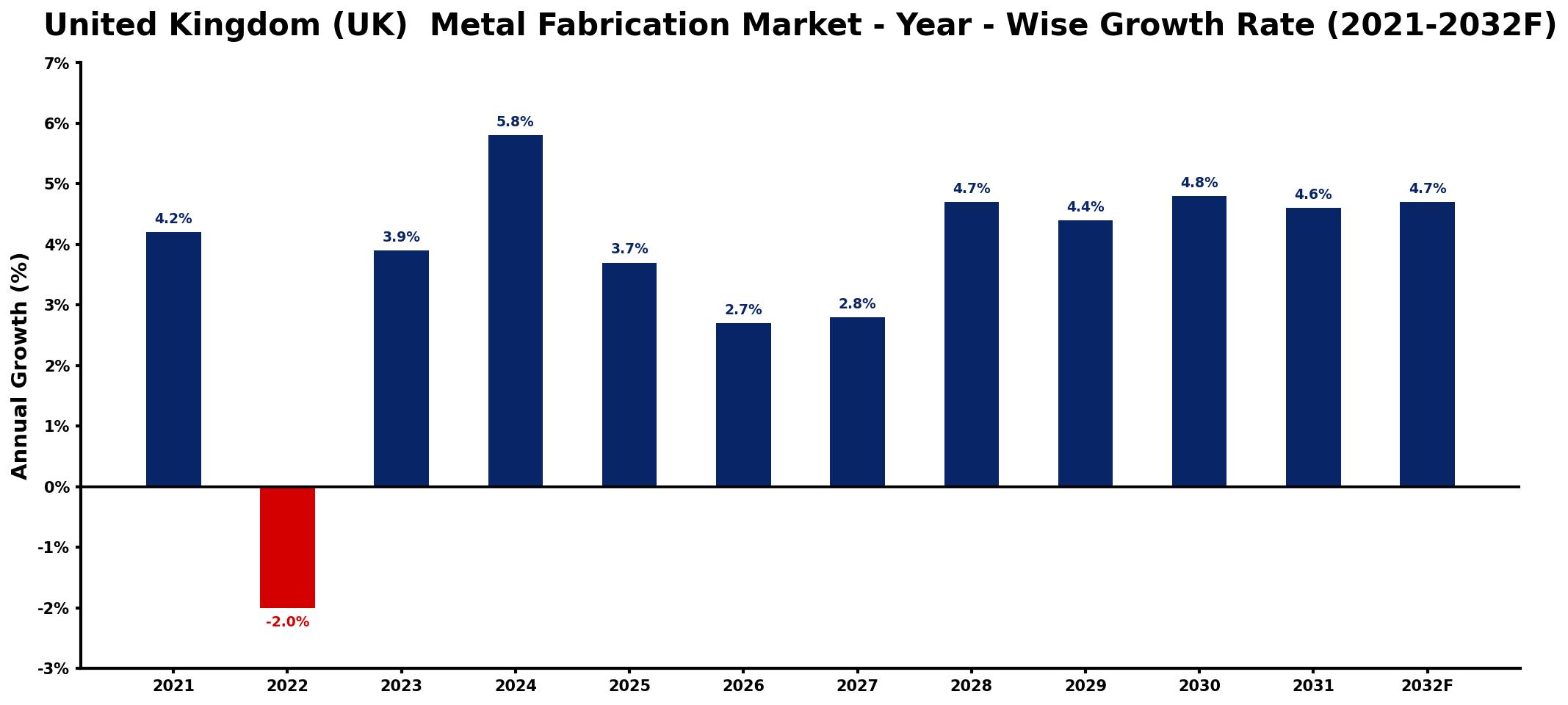
The table below presents the year‑wise growth rates along with the key drivers influencing the market
| Year | Growth Rate | Major Drivers |
| 2021 | 4.2% | Infrastructure projects drive demand |
| 2022 | -2.0% | Investment in projects slows down |
| 2023 | 3.9% | Renewable energy projects increase |
| 2024 | 5.8% | Automotive sector recovery strengthens |
| 2025 | 3.7% | Construction market shows growth |
| 2026 | 2.7% | Technological advancements enhance efficiency |
| 2027 | 2.8% | Aerospace industry expands production |
| 2028 | 4.7% | Green initiatives boost investments |
| 2029 | 4.4% | Demand from defense sector rises |
| 2030 | 4.8% | Consumer electronics sector grows |
| 2031 | 4.6% | Export opportunities increase significantly |
| 2032 | 4.7% | Urbanization trends drive projects |
Note: Market size estimations and growth projections presented in this report are based on 6Wresearch's proprietary forecasting methodology, utilizing the latest available industry data, government publications, and primary research inputs.
United Kingdom (UK) Metal Fabrication Market Synopsis
The UK metal fabrication market is characterized by its critical role in supporting various industrial sectors, including automotive, aerospace, and construction. Recent trends indicate a rising demand for customized metal products, driven by the need for precision and adaptability in manufacturing processes.
With advancements in technology and a growing emphasis on sustainability, the market is poised for evolution. The integration of digital manufacturing solutions is becoming essential as players seek to streamline operations while adhering to regulatory standards aimed at promoting workplace safety and environmental stewardship.
United Kingdom (UK) Metal Fabrication Market Key Takeaways
- The UK metal fabrication market is set to grow at a CAGR of 3.1% from 2026 to 2032.
- Increased investment in construction and infrastructure projects is fueling demand for metal components.
- Technological advancements such as robotic welding and laser cutting are improving fabrication efficiency.
- Government policies are focusing on sustainable practices and safety regulations.
- The demand for customized metal products is on the rise across various sectors.
Evaluation of Restraints in United Kingdom (UK) Metal Fabrication Market
Despite the promising growth trajectory, the UK metal fabrication market faces several constraints that could impede its progress. One primary challenge is optimizing manufacturing processes for customized metal components, which often require intricate design and high dimensional accuracy. This complexity necessitates advanced fabrication technologies and a skilled workforce, which can be difficult to maintain. Additionally, market participants must navigate cost pressures and the complexities of project scheduling, all while striving to integrate digital solutions that enhance supply chain efficiencies. Addressing these hurdles will be crucial for maximizing growth potential.
United Kingdom (UK) Metal Fabrication Market Trends
The UK metal fabrication market is witnessing several transformative trends shaping its future. Notably, there is a significant move towards automated processes, with robotic welding and precision laser cutting technologies gaining prominence. These innovations not only streamline production but also enhance accuracy and reduce waste. Moreover, the shift towards sustainability is driving companies to adopt eco-friendly practices in their operations, reflecting a broader commitment to environmental responsibility.
United Kingdom (UK) Metal Fabrication Market Opportunities
Opportunities for growth in the UK metal fabrication market are abundant, particularly in the context of renewable energy infrastructure. Investments in green technologies, coupled with ongoing construction projects, present a robust landscape for customized metal components. Additionally, as industries increasingly seek innovative and sustainable solutions, fabricators that can adapt quickly and offer tailored products stand to gain a competitive edge. Furthermore, the increasing integration of Industry 4.0 technologies can unlock new efficiencies, promoting higher production rates and improved product quality.
Government Initiatives in the United Kingdom (UK) Metal Fabrication Market
The UK government is actively promoting policies that facilitate sustainable manufacturing practices within the metal fabrication sector. Initiatives focused on improving workplace safety and environmental protection are central to this agenda. Regulatory frameworks are being refined to ensure compliance with safety standards, which fosters a more secure working environment while encouraging innovation. Additionally, public spending in infrastructure development is aligning with green objectives, thereby further supporting the growth of the metal fabrication industry.
Future Insights of the United Kingdom (UK) Metal Fabrication Market
Looking ahead to 2026-2032, the UK metal fabrication market is anticipated to undergo significant transformation driven by technological advancements and evolving industry needs. The convergence of automation, digitalization, and sustainable practices will be pivotal in shaping competitive dynamics. As market players increasingly invest in smart manufacturing techniques, the ability to deliver customized solutions at scale will define success. Overall, the outlook remains positive, with substantial opportunities to harness innovation and respond to market demands.
United Kingdom (UK) Metal Fabrication Market Latest Developments (2025 - 2026)
Recent developments within the UK metal fabrication market indicate a notable shift towards automated manufacturing processes. Companies are increasingly adopting advanced technologies to enhance productivity and meet rising demand for bespoke products. Additionally, there is a growing focus on collaboration between industry stakeholders to improve supply chain efficiencies and reduce lead times. This collaborative approach is essential as firms adapt to changing market conditions while striving to maintain high standards of safety and sustainability.
United Kingdom (UK) Metal Fabrication Market - Key Attractiveness of the Report
- 10 Years of Market Numbers
- Historical Data Starting from 2022 to 2025
- Base Year: 2025
- Forecast Data until 2032
- Key Performance Indicators Impacting the Market
- Major Upcoming Developments and Projects
Key Highlights of the Report:
- United Kingdom (UK) Metal Fabrication Market Outlook
- Market Size of United Kingdom (UK) Metal Fabrication Market, 2025
- Forecast of United Kingdom (UK) Metal Fabrication Market, 2032
- Historical Data and Forecast of United Kingdom (UK) Metal Fabrication Revenues & Volume for the Period 2022-2032F
- United Kingdom (UK) Metal Fabrication Market Trend Evolution
- United Kingdom (UK) Metal Fabrication Market Drivers and Challenges
- United Kingdom (UK) Metal Fabrication Price Trends
- United Kingdom (UK) Metal Fabrication Porter's Five Forces
- United Kingdom (UK) Metal Fabrication Industry Life Cycle
- Historical Data and Forecast of United Kingdom (UK) Metal Fabrication Market Revenues & Volume By End-user Industry for the Period 2022-2032F
- Historical Data and Forecast of United Kingdom (UK) Metal Fabrication Market Revenues & Volume By Manufacturing for the Period 2022-2032F
- Historical Data and Forecast of United Kingdom (UK) Metal Fabrication Market Revenues & Volume By Power and Utilities for the Period 2022-2032F
- Historical Data and Forecast of United Kingdom (UK) Metal Fabrication Market Revenues & Volume By Construction for the Period 2022-2032F
- Historical Data and Forecast of United Kingdom (UK) Metal Fabrication Market Revenues & Volume By Oil and Gas for the Period 2022-2032F
- Historical Data and Forecast of United Kingdom (UK) Metal Fabrication Market Revenues & Volume By Other End-user Industries for the Period 2022-2032F
- Historical Data and Forecast of United Kingdom (UK) Metal Fabrication Market Revenues & Volume By Metal Folding for the Period 2022-2032F
- Historical Data and Forecast of United Kingdom (UK) Metal Fabrication Market Revenues & Volume By Product category for the Period 2022-2032F
- Historical Data and Forecast of United Kingdom (UK) Metal Fabrication Market Revenues & Volume By Structural steel fabrication for the Period 2022-2032F
- Historical Data and Forecast of United Kingdom (UK) Metal Fabrication Market Revenues & Volume By Process Equipment Fabrication for the Period 2022-2032F
- United Kingdom (UK) Metal Fabrication Import Export Trade Statistics
- Market Opportunity Assessment By End-user Industry
- Market Opportunity Assessment By Product category
- United Kingdom (UK) Metal Fabrication Top Companies Market Share
- United Kingdom (UK) Metal Fabrication Competitive Benchmarking By Technical and Operational Parameters
- United Kingdom (UK) Metal Fabrication Company Profiles
- United Kingdom (UK) Metal Fabrication Key Strategic Recommendations






































