United Kingdom (UK) Mortar Market Summary
The united kingdom (uk) mortar market was estimated at USD 152 Million in 2025 and is projected to reach USD 188 Million by 2032, growing at a CAGR of 2.8% from 2026 to 2032.
United Kingdom (UK) Mortar Market Year-wise Growth Rate and Key Drivers
This graph highlights how the United Kingdom (UK) Mortar Market has steadily grown over the past five years, supported by major growth factors.
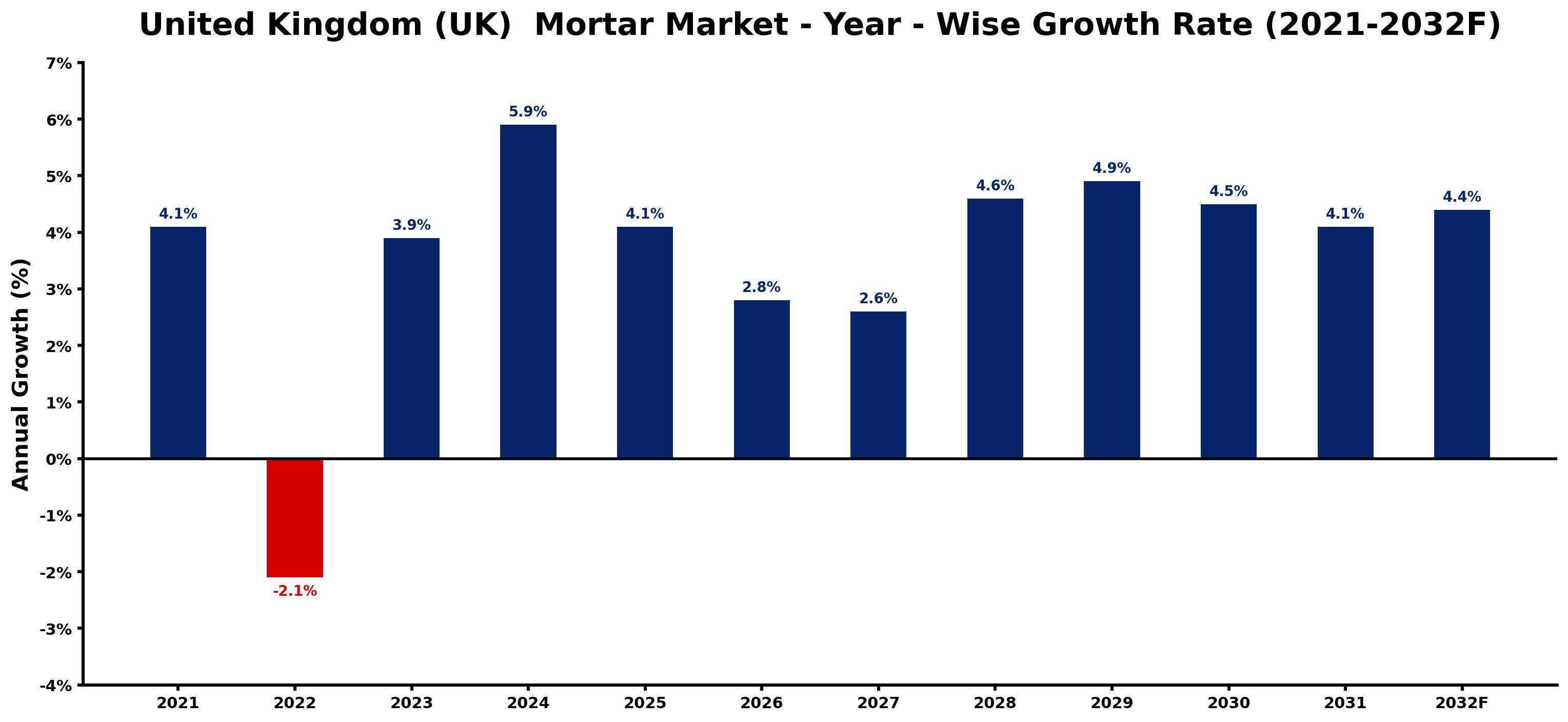
The table below presents the year wise growth rates along with the key drivers influencing the market
| Year | Growth Rate | Major Drivers |
| 2021 | 4.1% | Post-lockdown construction projects accelerated demand for high-quality mortar products. |
| 2022 | -2.1% | Increased competition from alternative construction materials eroded market share and exacerbated declining demand for mortar products. |
| 2023 | 3.9% | Urban regeneration initiatives in major cities fueled increased mortar consumption. |
| 2024 | 5.9% | Technological innovations in manufacturing improved mortar quality and efficiency significantly. |
| 2025 | 4.1% | Emerging residential projects expanded the market for specialized mortar formulations. |
| 2026 | 2.8% | Infrastructure upgrades became essential as the need for durable materials grew. |
| 2027 | 2.6% | Growing complexities in construction designs required advanced mortar application techniques. |
| 2028 | 4.6% | Economic recovery led to heightened investments in commercial construction projects nationwide. |
| 2029 | 4.9% | Shifts towards modular construction increased demand for lightweight mortar products. |
| 2030 | 4.5% | Collaboration between architects and contractors emphasized tailored mortar solutions for projects. |
| 2031 | 4.1% | Global supply chain resilience efforts intensified focus on local mortar production. |
| 2032 | 4.4% | Consumer preferences shifted towards aesthetically pleasing mortars for high-end residential markets. |
Note - Market size estimations and growth projections presented in this report are based on 6Wresearch's advanced forecasting approach, validated with industry datasets as of June 2026.
United Kingdom (UK) Mortar Market Synopsis
The United Kingdom (UK) Mortar Market is projected to reach 2.8% and witness significant growth during the forecast period (2026-2032). This market is rooted in the broader construction industry, influenced by increasing infrastructure development and a surge in residential construction activities. A diverse range of mortar types, including cement, lime, and gypsum-based products, are available to meet varying construction needs, reflecting the industry's adaptability and innovation.
United Kingdom (UK) Mortar Market Growth Drivers
Several key factors are propelling the growth of the United Kingdom (UK) Mortar Market. Firstly, the emphasis on sustainable building practices has led to a heightened demand for environmentally friendly mortar solutions. Secondly, infrastructure projects, including transportation networks and public building initiatives, are expected to stimulate considerable demand for mortar products. Thirdly, the increasing preference for pre-mixed and ready-to-use mortar solutions among contractors showcases a trend toward convenience and efficiency. Additionally, technological advancements in mortar formulations, such as self-healing properties and rapid setting times, are further driving market innovation. Lastly, the government's commitment to enhancing housing supply and infrastructure directly supports market expansion.
United Kingdom (UK) Mortar Market Trends and Opportunities
The current trends in the United Kingdom (UK) Mortar Market reflect a significant shift towards sustainability and technological advancement. Key trends include:
- Growing demand for eco-friendly mortar solutions driven by environmental concerns and regulations aimed at reducing carbon footprints.
- Adoption of advanced mortar technologies that enhance performance, such as self-healing mortars that respond to structural cracks.
- Increased interest in pre-mixed and ready-to-use mortars, which save time and labor costs on construction sites.
- Emphasis on product innovation, leading to the development of mortars with improved adhesion, durability, and thermal efficiency.
- Rising popularity of customized mortar solutions tailored to specific project requirements, enhancing functional performance across diverse applications.
United Kingdom (UK) Mortar Market Challenges and Restraints
While the United Kingdom (UK) Mortar Market exhibits promising growth potential, several challenges could impede progress. Notably, the volatility of raw material prices, including cement and aggregates, presents a significant challenge for manufacturers. Furthermore, economic fluctuations can affect overall demand within the construction sector, leading to uncertain sales patterns. Stricter environmental regulations may necessitate increased investments in sustainable production methods, potentially increasing operational costs. Additionally, competition among manufacturers compels constant innovation, which can strain resources. Lastly, skilled labor shortages in the construction industry may hinder the effective application and handling of advanced mortar products.
United Kingdom (UK) Mortar Market Investment Opportunities
The United Kingdom (UK) Mortar Market presents fertile grounds for investment, particularly in light of the ongoing construction boom. Key investment opportunities include:
- Engagement with suppliers and manufacturers specializing in sustainable and advanced mortar technologies, aligning with the market's shift toward green building practices.
- Investment in companies that focus on ready-mix and pre-packaged mortar solutions, addressing the demand for convenience and time efficiency on construction sites.
- Exploring opportunities within the renovation sector, specifically targeting historical restoration projects requiring specialized mortar applications.
- Supporting innovative research and development initiatives aimed at enhancing the performance capabilities of existing mortar products.
- Investing in training programs to bridge the skills gap in the construction workforce, ensuring that labor can effectively utilize advanced mortar technologies.
United Kingdom (UK) Mortar Market Government Investment and Initiatives
Government policies play a crucial role in shaping the United Kingdom (UK) Mortar Market, focusing primarily on sustainability, safety, and quality assurance. Initiatives promoting sustainable construction materials are in alignment with national climate goals. Quality control protocols ensure that mortar products meet stringent performance standards, enhancing the overall safety and durability of structures. The government actively encourages the use of innovative building materials through grants and incentives, aimed at fostering a more resilient construction industry. Furthermore, strict health and safety regulations govern the production and application of mortars, ensuring worker safety and compliance with public health standards. These combined efforts aim to bolster innovation while maintaining market integrity.
United Kingdom (UK) Mortar Market Latest Developments (May 2025 - June 2026)
Recent developments in the United Kingdom (UK) Mortar Market indicate a strong shift towards advanced product offerings and sustainability. Manufacturers are increasingly investing in research and development to create mortars with enhanced mechanical properties and reduced environmental impact. The rise of smart construction techniques has led to the incorporation of digital tools that optimize mortar application processes, improving efficiency on job sites. Additionally, collaborations between public and private sectors have strengthened infrastructure investment, leading to increased demand for high-quality mortar solutions. Overall, these developments reflect a dynamic market poised for further growth in the face of evolving industry demands.
United Kingdom (UK) Mortar Market - Key Attractiveness of the Report
- 10 Years of Market Numbers
- Historical Data Starting from 2022 to 2025
- Base Year: 2025
- Forecast Data until 2032
- Key Performance Indicators Impacting the Market
- Major Upcoming Developments and Projects
Key Highlights of the Report:
- United Kingdom (UK) Mortar Market Outlook
- Market Size of United Kingdom (UK) Mortar Market, 2025
- Forecast of United Kingdom (UK) Mortar Market, 2032F
- Historical Data and Forecast of United Kingdom (UK) Mortar Revenues & Volume for the Period 2022-2032F
- United Kingdom (UK) Mortar Market Trend Evolution
- United Kingdom (UK) Mortar Market Drivers and Challenges
- United Kingdom (UK) Mortar Price Trends
- United Kingdom (UK) Mortar Porter's Five Forces
- United Kingdom (UK) Mortar Industry Life Cycle
- Historical Data and Forecast of United Kingdom (UK) Mortar Market Revenues & Volume By Type for the Period 2022-2032F
- Historical Data and Forecast of United Kingdom (UK) Mortar Market Revenues & Volume By Wet Mixed Mortar for the Period 2022-2032F
- Historical Data and Forecast of United Kingdom (UK) Mortar Market Revenues & Volume By Dry Mortar for the Period 2022-2032F
- Historical Data and Forecast of United Kingdom (UK) Mortar Market Revenues & Volume By Application for the Period 2022-2032F
- Historical Data and Forecast of United Kingdom (UK) Mortar Market Revenues & Volume By Construction Industry for the Period 2022-2032F
- Historical Data and Forecast of United Kingdom (UK) Mortar Market Revenues & Volume By Home Decoration Industry for the Period 2022-2032F
- Historical Data and Forecast of United Kingdom (UK) Mortar Market Revenues & Volume By Others for the Period 2022-2032F
- United Kingdom (UK) Mortar Import Export Trade Statistics
- Market Opportunity Assessment By Type
- Market Opportunity Assessment By Application
- United Kingdom (UK) Mortar Top Companies Market Share
- United Kingdom (UK) Mortar Competitive Benchmarking By Technical and Operational Parameters
- United Kingdom (UK) Mortar Company Profiles
- United Kingdom (UK) Mortar Key Strategic Recommendations






































