United Kingdom (UK) Physical Security Market Size & Growth Rate (2026-2032)
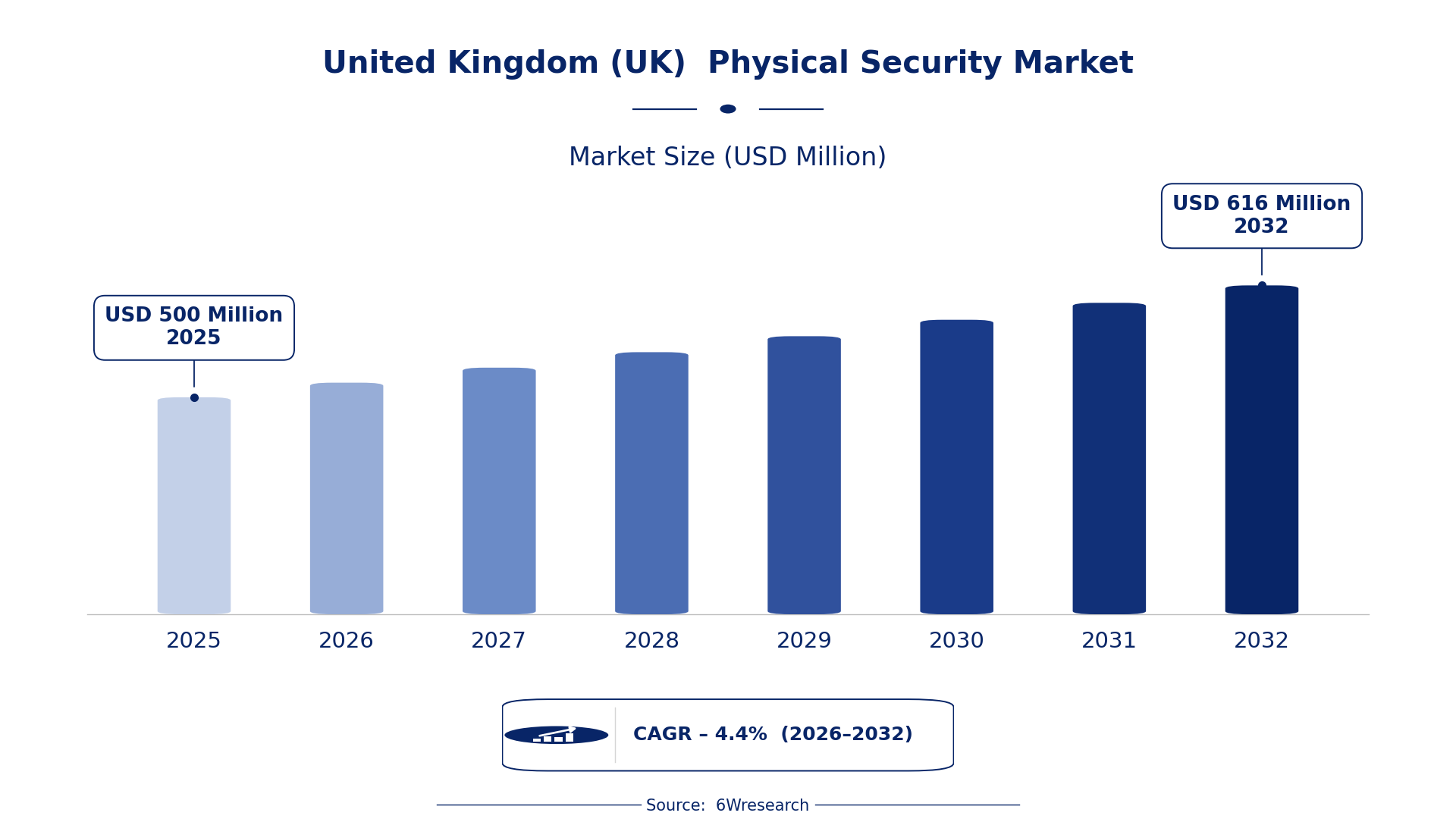
The United Kingdom (UK) Physical Security Market was estimated at USD 500 Million in 2025 and is projected to reach USD 616 Million by 2032, growing at a CAGR of 4.4% from 2026 to 2032.
United Kingdom (UK) Physical Security Market Synopsis
The escalating security concerns surrounding public and private assets act as the primary catalyst driving growth in the United Kingdom (UK) Physical Security Market. Organizations across various sectors are prioritizing protective measures, resulting in increased investments in advanced security solutions.
In response to these challenges, technological innovations have begun to dominate the market. With the rise of cloud-based systems, integrated security solutions are becoming essential to meet the evolving demands of sophisticated security infrastructures.
United Kingdom (UK) Physical Security Market Year-wise Growth Rate and Key Drivers
This graph illustrates the annual growth rates of the United Kingdom (UK) Physical Security Market from 2021 to 2032, highlighting a steady upward trajectory and projected expansion over the forecast period.
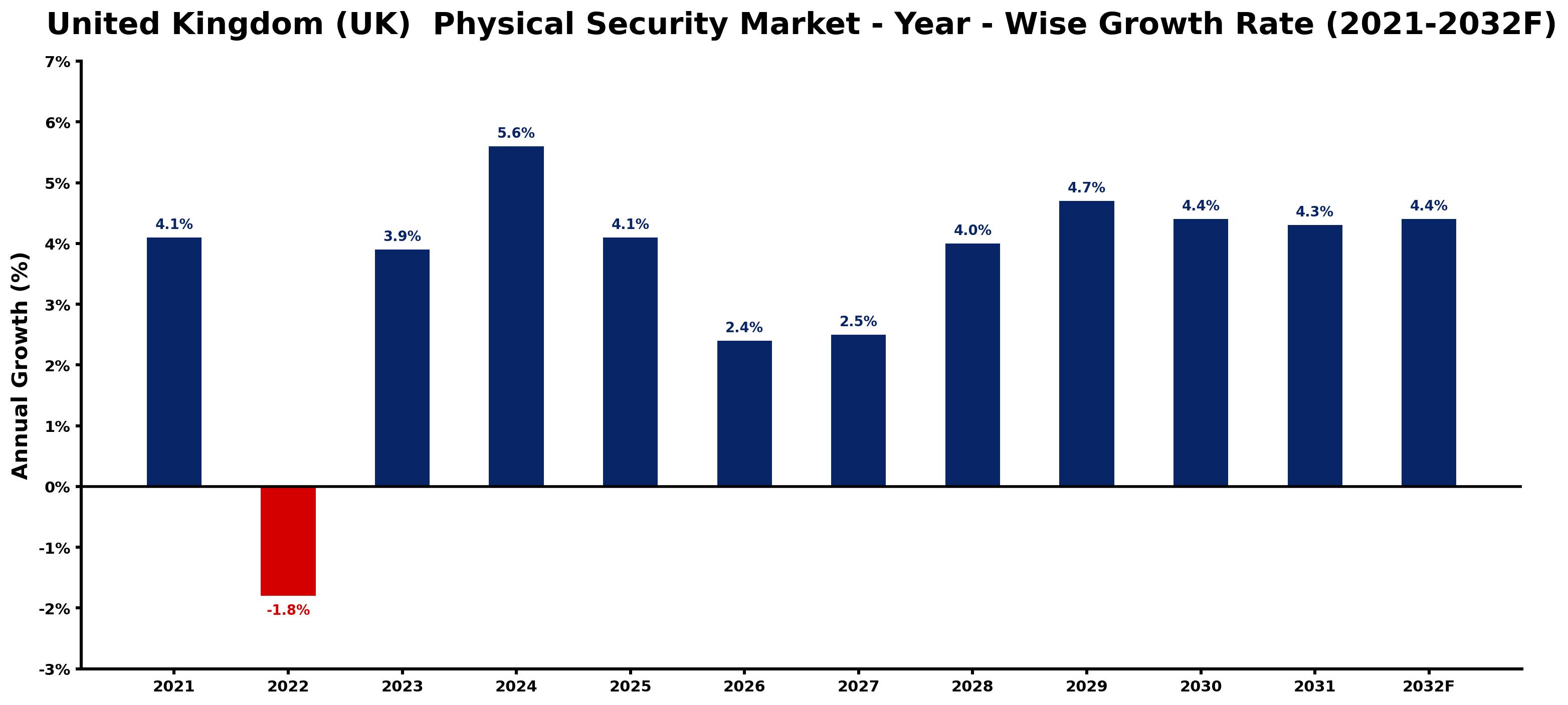
The table below presents the year‑wise growth rates along with the key drivers influencing the market
| Year | Growth Rate | Major Drivers |
| 2021 | 4.1% | Increased security measures post-Brexit for businesses. |
| 2022 | -1.8% | Increased scrutiny from the Information Commissioner's Office |
| 2023 | 3.9% | Rising concerns over cybersecurity threats to physical assets. |
| 2024 | 5.6% | Government funding boosts for public safety initiatives. |
| 2025 | 4.1% | Implementation of stricter safety protocols in crowded venues. |
| 2026 | 2.4% | Growth in insurance requirements for high-value properties. |
| 2027 | 2.5% | Increase in urban crime rates spurring security investments. |
| 2028 | 4.0% | Heightened terrorism threats prompting enhanced surveillance systems. |
| 2029 | 4.7% | Adoption of biometric access controls in commercial sectors. |
| 2030 | 4.4% | Public demand for enhanced safety in public transport. |
| 2031 | 4.3% | Legislative push for advanced security technologies in schools. |
| 2032 | 4.4% | Rising popularity of smart surveillance solutions among consumers. |
Note: Market size estimations and growth projections presented in this report are based on 6Wresearch's proprietary forecasting methodology, utilizing the latest available industry data, government publications, and primary research inputs.
United Kingdom (UK) Physical Security Market Key Takeaways
Below are some of the specific key takeaways from the market, including:
- Cloud-based solutions are increasingly favored for their flexibility and scalability.
- The integration of cybersecurity measures with physical security systems is on the rise.
- Government initiatives are pushing for enhanced security protocols across critical infrastructure.
- AI and data analytics are shaping the future of security system capabilities.
- Demand for comprehensive security solutions spans various sectors, including government, commercial, and residential.
Evaluation of Restraints in United Kingdom (UK) Physical Security Market
The United Kingdom's physical security market faces several constraints that limit its potential. One major issue stems from the increasing prevalence of cyber threats, which necessitates a sophisticated blend of physical and cyber defenses. This integration presents challenges for many organizations, particularly those that struggle with compliance in a landscape governed by strict regulations such as GDPR. Additionally, economic uncertainties and limited budgets can hinder the decision-making process regarding investment in security solutions, making it imperative for vendors to clearly demonstrate the ROI of their offerings.
United Kingdom (UK) Physical Security Market Trends
Currently, the market is experiencing a trend towards the implementation of integrated security solutions, particularly in video surveillance and access control systems. Companies are seeking out solutions that not only improve security but also streamline operations. The shift towards cloud-based technologies continues to gain momentum, driven by their capacity to enhance operational efficiency. on top of that, an increasing focus on the intersection of physical and cybersecurity is prompting organizations to invest in systems that can protect against a broader spectrum of threats.
United Kingdom (UK) Physical Security Market Opportunities
Amid the growing security concerns, multiple investment opportunities are emerging in the United Kingdom Physical Security Market. The rising demand for advanced systems, such as intruder alarms and biometric solutions, presents a lucrative avenue for companies willing to innovate. The government's commitment to improving public safety measures opens up possibilities for partnerships and contracts in both private and public sectors. Emerging technologies such as artificial intelligence also promise to enhance the effectiveness of security operations, providing further avenues for growth.
Government Initiatives in the United Kingdom (UK) Physical Security Market
The regulatory environment plays a crucial role in shaping the United Kingdom Physical Security Market. Recent government initiatives emphasize the importance of robust security solutions aimed at safeguarding critical infrastructure and public safety. As regulations evolve, businesses must remain compliant while adapting to new protocols that govern security measures.
- A national infrastructure security upgrade program launched in late 2024 aims to bolster the resilience of critical facilities.
- Ongoing collaboration between the UK government and industry stakeholders to enhance security frameworks, focusing on terrorism prevention and response.
- The introduction of a regulatory framework in early 2025 mandating increased cybersecurity measures for physical security providers.
- Upcoming public-private partnerships expected to expand access to advanced surveillance technology by 2028.
- Guidance from the National Counter Terrorism Security Office (NaCTSO) to support businesses in implementing effective security protocols.
Future Insights of the United Kingdom (UK) Physical Security Market
Looking ahead, the United Kingdom Physical Security Market is on a clear growth trajectory through 2032. The demand for advanced security solutions will likely increase as both private and public sectors continue to prioritize safety in an unpredictable environment. With the integration of smart technologies and data analytics becoming standard practice, organizations will invest more in intelligent security systems that can anticipate and mitigate potential threats.
United Kingdom (UK) Physical Security Market Latest Developments
In recent months, the United Kingdom Physical Security Market has witnessed notable advancements that reflect the industry's responsiveness to growing security demands. Firms are rapidly adapting to the changing environment by developing innovative solutions that enhance both physical and cyber defenses.
- A new suite of cloud-based security management tools launched in early 2025, designed to streamline operations for commercial users.
- An ongoing initiative aimed at upgrading video surveillance systems in public transport hubs, expected to be completed by Q3 2026.
- A strategic partnership formed in late 2024 between security solution providers to enhance integrated security offerings.
- Upcoming pilot programs for AI-powered facial recognition technology set to begin in early 2026, focusing on public safety applications.
- A major technology vendor announced plans in mid-2025 to expand its biometric security solutions across various sectors.
United Kingdom (UK) Physical Security Market - Key Attractiveness of the Report
- 10 Years of Market Numbers
- Historical Data Starting from 2022 to 2025
- Base Year: 2025
- Forecast Data until 2032
- Key Performance Indicators Impacting the Market
- Major Upcoming Developments and Projects
Key Highlights of the Report:
- United Kingdom (UK) Physical Security Market Outlook
- Market Size of United Kingdom (UK) Physical Security Market, 2025
- Forecast of United Kingdom (UK) Physical Security Market, 2032
- Historical Data and Forecast of United Kingdom (UK) Physical Security Revenues & Volume for the Period 2022-2032F
- United Kingdom (UK) Physical Security Market Trend Evolution
- United Kingdom (UK) Physical Security Market Drivers and Challenges
- United Kingdom (UK) Physical Security Price Trends
- United Kingdom (UK) Physical Security Porter's Five Forces
- United Kingdom (UK) Physical Security Industry Life Cycle
- Historical Data and Forecast of United Kingdom (UK) Physical Security Market Revenues & Volume By Component for the Period 2022-2032F
- Historical Data and Forecast of United Kingdom (UK) Physical Security Market Revenues & Volume By Systems (PACS, PSIM, PIAM, Video Surveillance, Fire and Life Safety) for the Period 2022-2032F
- Historical Data and Forecast of United Kingdom (UK) Physical Security Market Revenues & Volume By Services for the Period 2022-2032F
- Historical Data and Forecast of United Kingdom (UK) Physical Security Market Revenues & Volume By Vertical for the Period 2022-2032F
- Historical Data and Forecast of United Kingdom (UK) Physical Security Market Revenues & Volume By BFSI for the Period 2022-2032F
- Historical Data and Forecast of United Kingdom (UK) Physical Security Market Revenues & Volume By Government for the Period 2022-2032F
- Historical Data and Forecast of United Kingdom (UK) Physical Security Market Revenues & Volume By Retail for the Period 2022-2032F
- Historical Data and Forecast of United Kingdom (UK) Physical Security Market Revenues & Volume By Transportation for the Period 2022-2032F
- Historical Data and Forecast of United Kingdom (UK) Physical Security Market Revenues & Volume By Residential for the Period 2022-2032F
- Historical Data and Forecast of United Kingdom (UK) Physical Security Market Revenues & Volume By Telecom and IT for the Period 2022-2032F
- Historical Data and Forecast of United Kingdom (UK) Physical Security Market Revenues & Volume By Other Verticals (Healthcare, Manufacturing, Energy and Utilities, and Education). for the Period 2022-2032F
- Historical Data and Forecast of United Kingdom (UK) Physical Security Market Revenues & Volume By Organization Size for the Period 2022-2032F
- Historical Data and Forecast of United Kingdom (UK) Physical Security Market Revenues & Volume By SMEs for the Period 2022-2032F
- Historical Data and Forecast of United Kingdom (UK) Physical Security Market Revenues & Volume By Large Enterprises for the Period 2022-2032F
- United Kingdom (UK) Physical Security Import Export Trade Statistics
- Market Opportunity Assessment By Component
- Market Opportunity Assessment By Vertical
- Market Opportunity Assessment By Organization Size
- United Kingdom (UK) Physical Security Top Companies Market Share
- United Kingdom (UK) Physical Security Competitive Benchmarking By Technical and Operational Parameters
- United Kingdom (UK) Physical Security Company Profiles
- United Kingdom (UK) Physical Security Key Strategic Recommendations






































