United Kingdom (UK) Ploughing and Cultivating Machinery Market Size, Share & Growth Rate
The United Kingdom (UK) Ploughing and Cultivating Machinery Market was estimated at USD 279 Million in 2025 and is projected to reach USD 345 Million by 2032, growing at a CAGR of 3.1% from 2026 to 2032. This growth trajectory is driven primarily by the increasing demand for precision farming techniques, which enhance both crop yield and operational efficiency. Additionally, a rising emphasis on sustainable agricultural practices is further propelling the market, as farmers seek to modernize their equipment and methodologies.
United Kingdom (UK) Ploughing and Cultivating Machinery Market Year-wise Growth Rate and Key Drivers
This graph highlights how the United Kingdom (UK) Ploughing and Cultivating Machinery Market has steadily grown over the years, supported by major growth factors.
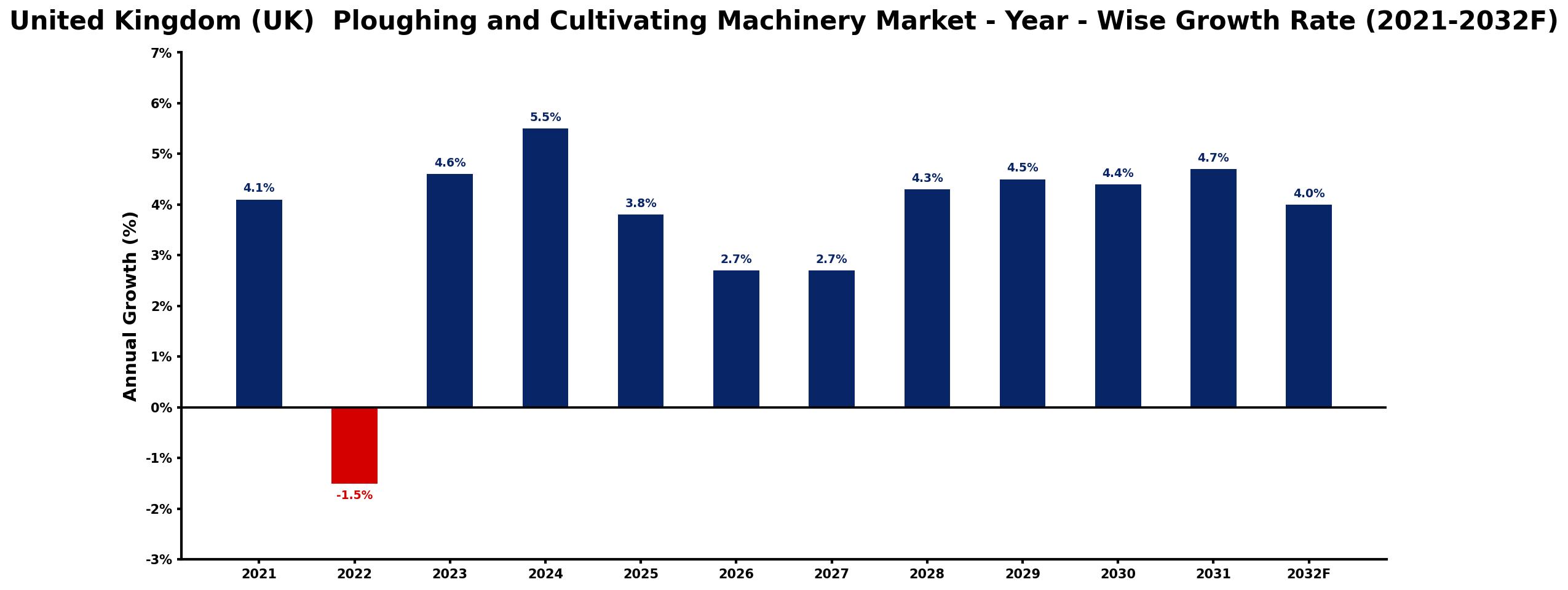
The table below presents the year‑wise growth rates along with the key drivers influencing the market
| Year | Growth Rate | Major Drivers |
| 2021 | 4.1% | Rising agricultural technology investments |
| 2022 | -1.5% | Lower consumer spending on equipment |
| 2023 | 4.6% | Increased demand for sustainable practices |
| 2024 | 5.5% | Expansion of precision farming techniques |
| 2025 | 3.8% | Growth in organic farming sector |
| 2026 | 2.7% | Higher adoption of automation solutions |
| 2027 | 2.7% | Increased government agricultural funding |
| 2028 | 4.3% | Surge in export opportunities abroad |
| 2029 | 4.5% | Rising interest in eco-friendly solutions |
| 2030 | 4.4% | Technological advancements driving efficiency |
| 2031 | 4.7% | growing regional consumption patterns |
| 2032 | 4.0% | strengthening international trade flows |
Note: Market size estimations and growth projections presented in this report are based on 6Wresearch's proprietary forecasting methodology, utilizing the latest available industry data, government publications, and primary research inputs.
United Kingdom (UK) Ploughing and Cultivating Machinery Market Synopsis
The UK Ploughing and Cultivating Machinery Market has experienced steady momentum in recent years, underscored by significant investments in advanced agricultural technologies. As farmers transition towards more innovative solutions, the market is poised for continued evolution, with a growing focus on eco-friendly machinery and precision farming tools.
Despite this positive trajectory, the market faces challenges such as fluctuating raw material costs and uncertainties related to trade and regulations, particularly following Brexit. Nevertheless, the overall outlook remains optimistic, with stakeholders adapting to these changes while enhancing productivity and sustainability.
United Kingdom (UK) Ploughing and Cultivating Machinery Market Key Takeaways
- The UK market is transitioning towards precision agriculture, driving demand for advanced machinery.
- Investment in environmentally friendly technologies is becoming a key priority for farmers.
- The market's growth is bolstered by government initiatives promoting modernization in agriculture.
- Trade uncertainties stemming from Brexit could impact pricing and market dynamics.
- Collaboration with local manufacturers presents a viable opportunity for investment growth.
Evaluation of Restraints in United Kingdom (UK) Ploughing and Cultivating Machinery Market
The UK Ploughing and Cultivating Machinery Market faces several restraints that could hinder its growth. One significant factor is the rising cost of raw materials, which directly affects production costs for manufacturers. Additionally, the economic implications of Brexit create uncertainty in trade agreements and regulatory environments, complicating market stability. The pressure to innovate sustainably further challenges manufacturers, who must balance development costs with competitive pricing.
United Kingdom (UK) Ploughing and Cultivating Machinery Market Trends
A notable trend within the UK market is the increasing adoption of automation and smart technologies. Farmers are investing in machinery that integrates sensors and data analytics to enhance decision-making and operational efficiency. Moreover, there is a growing preference for larger, more powerful machinery to accommodate modern farming practices and larger farm sizes, reflecting the shift towards economies of scale in agriculture.
United Kingdom (UK) Ploughing and Cultivating Machinery Market Opportunities
The market presents significant investment opportunities, particularly in the domains of precision farming and sustainable agricultural technologies. The ongoing demand for machinery that improves efficiency while lowering labor costs is a fertile ground for new entrants and innovative solutions. Strategic partnerships with local players, exploration of export markets, and continuous engagement with technological advancements are essential for capitalizing on these opportunities.
Government Initiatives in the United Kingdom (UK) Ploughing and Cultivating Machinery Market
The UK government has introduced various initiatives to support the Ploughing and Cultivating Machinery Market, focusing on sustainability and modernization. This includes offering grants and subsidies to farmers for investment in cutting-edge machinery, alongside promoting practices that enhance efficiency and reduce environmental impact. Regulatory frameworks are also in place to ensure safety and fair competition, further encouraging growth in the agricultural sector.
Future Insights of the United Kingdom (UK) Ploughing and Cultivating Machinery Market
Looking ahead to 2026-2032, the UK Ploughing and Cultivating Machinery Market is expected to thrive, driven by ongoing technological advancements and a commitment to sustainable practices. As farmers increasingly adopt precision agriculture techniques, demand for sophisticated machinery will continue to rise. However, stakeholders must remain agile in navigating regulatory changes and market fluctuations to sustain growth in this evolving landscape.
United Kingdom (UK) Ploughing and Cultivating Machinery Market Latest Developments (2025 - 2026)
Recent developments in the UK Ploughing and Cultivating Machinery Market indicate a growing emphasis on automation and data-driven farming solutions. Numerous manufacturers are focusing their efforts on enhancing the connectivity of their machinery, enabling seamless integration with farm management systems. There is also a marked shift towards developing machinery that meets stringent environmental standards, reflecting the agricultural sector's commitment to sustainability.
United Kingdom (UK) Ploughing and Cultivating Machinery Market - Key Attractiveness of the Report
- 10 Years of Market Numbers
- Historical Data Starting from 2022 to 2025
- Base Year: 2025
- Forecast Data until 2032
- Key Performance Indicators Impacting the Market
- Major Upcoming Developments and Projects
Key Highlights of the Report:
- United Kingdom (UK) Ploughing and Cultivating Machinery Market Outlook
- Market Size of United Kingdom (UK) Ploughing and Cultivating Machinery Market, 2025
- Forecast of United Kingdom (UK) Ploughing and Cultivating Machinery Market, 2032
- Historical Data and Forecast of United Kingdom (UK) Ploughing and Cultivating Machinery Revenues & Volume for the Period 2022-2032F
- United Kingdom (UK) Ploughing and Cultivating Machinery Market Trend Evolution
- United Kingdom (UK) Ploughing and Cultivating Machinery Market Drivers and Challenges
- United Kingdom (UK) Ploughing and Cultivating Machinery Price Trends
- United Kingdom (UK) Ploughing and Cultivating Machinery Porter's Five Forces
- United Kingdom (UK) Ploughing and Cultivating Machinery Industry Life Cycle
- Historical Data and Forecast of United Kingdom (UK) Ploughing and Cultivating Machinery Market Revenues & Volume By Type for the Period 2022-2032F
- Historical Data and Forecast of United Kingdom (UK) Ploughing and Cultivating Machinery Market Revenues & Volume By Ploughs for the Period 2022-2032F
- Historical Data and Forecast of United Kingdom (UK) Ploughing and Cultivating Machinery Market Revenues & Volume By Harrows for the Period 2022-2032F
- Historical Data and Forecast of United Kingdom (UK) Ploughing and Cultivating Machinery Market Revenues & Volume By Others for the Period 2022-2032F
- Historical Data and Forecast of United Kingdom (UK) Ploughing and Cultivating Machinery Market Revenues & Volume By Application for the Period 2022-2032F
- Historical Data and Forecast of United Kingdom (UK) Ploughing and Cultivating Machinery Market Revenues & Volume By Soil Loosening for the Period 2022-2032F
- Historical Data and Forecast of United Kingdom (UK) Ploughing and Cultivating Machinery Market Revenues & Volume By Clod Size Reduction for the Period 2022-2032F
- Historical Data and Forecast of United Kingdom (UK) Ploughing and Cultivating Machinery Market Revenues & Volume By Clod Sorting for the Period 2022-2032F
- Historical Data and Forecast of United Kingdom (UK) Ploughing and Cultivating Machinery Market Revenues & Volume By Others for the Period 2022-2032F
- United Kingdom (UK) Ploughing and Cultivating Machinery Import Export Trade Statistics
- Market Opportunity Assessment By Type
- Market Opportunity Assessment By Application
- United Kingdom (UK) Ploughing and Cultivating Machinery Top Companies Market Share
- United Kingdom (UK) Ploughing and Cultivating Machinery Competitive Benchmarking By Technical and Operational Parameters
- United Kingdom (UK) Ploughing and Cultivating Machinery Company Profiles
- United Kingdom (UK) Ploughing and Cultivating Machinery Key Strategic Recommendations






































