United Kingdom (UK) Railway Maintenance Machinery Market Size, Share & Growth Rate
The United Kingdom (UK) Railway Maintenance Machinery Market was estimated at USD 611 Million in 2025 and is projected to reach USD 879 Million by 2032, growing at a CAGR of 5.3% from 2026 to 2032. This growth trajectory is fueled by a combination of government initiatives aimed at upgrading rail infrastructure and a burgeoning demand for innovative maintenance solutions that enhance operational efficiency. As railway operators increasingly prioritize preventive maintenance, the market is poised for robust expansion.
United Kingdom (UK) Railway Maintenance Machinery Market Year-wise Growth Rate and Key Drivers
This graph highlights how the United Kingdom (UK) Railway Maintenance Machinery Market has steadily grown over the years, supported by major growth factors.
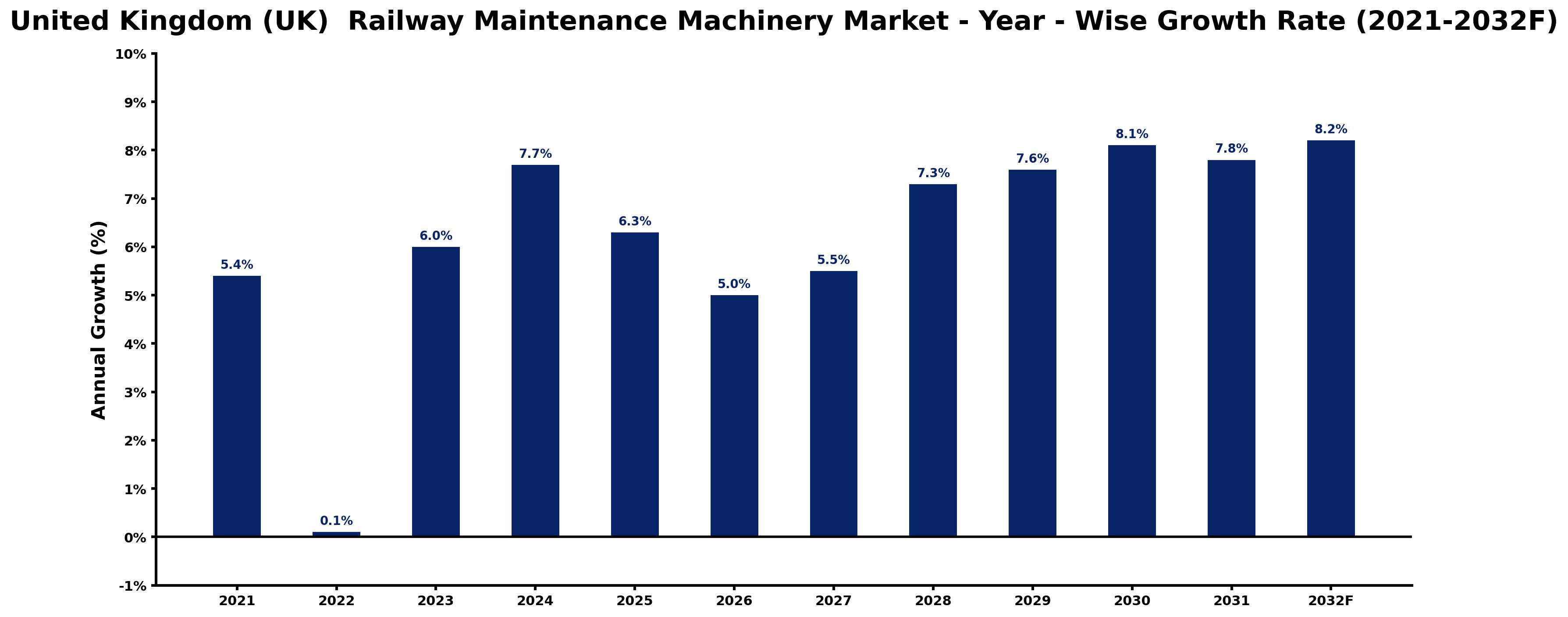
The table below presents the year‑wise growth rates along with the key drivers influencing the market
| Year | Growth Rate | Major Drivers |
| 2021 | 5.4% | Increasing smart city development projects |
| 2022 | 0.1% | Increasing industrial infrastructure investments |
| 2023 | 6.0% | Increasing adoption of advanced technologies |
| 2024 | 7.7% | Increasing industrial infrastructure investments |
| 2025 | 6.3% | Increasing smart city development projects |
| 2026 | 5.0% | Expansion of commercial construction activities |
| 2027 | 5.5% | Growing urbanization and commercial development |
| 2028 | 7.3% | Increasing industrial automation investments |
| 2029 | 7.6% | Increasing industrial automation investments |
| 2030 | 8.1% | Growing renewable energy integration projects |
| 2031 | 7.8% | Increasing industrial automation investments |
| 2032 | 8.2% | Rapid growth in telecom and data center sectors |
Note - Market size estimations and growth projections presented in this report are based on 6Wresearch’s advanced forecasting approach, validated with industry datasets as of June 2026.
United Kingdom (UK) Railway Maintenance Machinery Market Synopsis
The UK Railway Maintenance Machinery Market has experienced significant momentum in recent years, driven by technological advancements and a shift towards preventive maintenance strategies. However, as the market evolves, it is gearing up for a transformative phase characterized by the adoption of smart technologies and sustainability-driven practices.
Looking ahead, the need for advanced maintenance solutions that not only improve reliability but also adhere to environmental standards will define the industry's future. With increasing investments from both public and private sectors, the market is on the cusp of a new era of innovation and efficiency.
United Kingdom (UK) Railway Maintenance Machinery Market Key Takeaways
- The market is estimated to grow from USD 611 Million in 2025 to USD 879 Million by 2032.
- Technological innovations, including automation and digitalization, are reshaping the landscape of railway maintenance.
- Government policies are supportive, emphasizing infrastructure investment and compliance with safety standards.
- There is a heightened focus on sustainable practices within the maintenance machinery sector.
- Investment opportunities abound in advanced maintenance technologies and integrated solutions.
Evaluation of Restraints in United Kingdom (UK) Railway Maintenance Machinery Market
Despite its positive outlook, the UK Railway Maintenance Machinery Market faces several constraints. Key among them is the challenge of keeping pace with rapid technological advancements, necessitating continuous innovation to address the aging infrastructure. Additionally, budgetary limitations and regulatory compliance requirements often force railway operators to make difficult choices, balancing cost-effectiveness with necessary upgrades. Another pressing concern is the skill gap within the workforce; specialized expertise is crucial for the effective operation and maintenance of advanced machinery. These factors, combined with the complexities of procurement processes, may hinder growth unless addressed collaboratively.
United Kingdom (UK) Railway Maintenance Machinery Market Trends
The market is currently witnessing a significant shift towards advanced, technology-driven solutions. Digitalization and automation are becoming more prevalent, with predictive maintenance techniques allowing for timely interventions that reduce downtime. Additionally, there is a marked trend towards sustainability, with companies increasingly focusing on the development of eco-friendly machinery that minimizes environmental impact. Integrated maintenance solutions, capable of handling various tasks simultaneously, are also gaining traction as operators seek efficiency and cost savings in their operations.
United Kingdom (UK) Railway Maintenance Machinery Market Opportunities
Investors will find promising opportunities in the UK Railway Maintenance Machinery Market, particularly in sectors that emphasize technological advancements. Areas such as automated track inspection systems and remote monitoring solutions are ripe for development. As the UK government reinforces its commitment to modernizing rail infrastructure, there is an escalating need for advanced machinery that enhances safety and reliability. Companies that can offer cutting-edge solutions tailored to the industry's evolving requirements are well-positioned to benefit from this growth.
Government Initiatives in the United Kingdom (UK) Railway Maintenance Machinery Market
The UK government plays a crucial role in the development of the Railway Maintenance Machinery Market through various initiatives aimed at enhancing rail safety and efficiency. These include investments in modernizing railway systems and fostering innovation in technology. Public-private partnerships are encouraged to stimulate investment in maintenance machinery, while compliance with stringent maintenance standards is actively promoted. These policies reflect a strong commitment to advancing the railway sector and ensuring its long-term sustainability.
Future Insights of the United Kingdom (UK) Railway Maintenance Machinery Market
The future of the UK Railway Maintenance Machinery Market appears promising as ongoing investments in infrastructure modernization continue to drive demand. With technological advancements paving the way for smarter, more efficient maintenance practices, the focus on predictive maintenance and sustainability will intensify. As the rail industry adapts to evolving operational challenges, the market is set to embrace innovation, leading to enhanced safety and reduced environmental impact.
United Kingdom (UK) Railway Maintenance Machinery Market Latest Developments (May 2025 - June 2026)
Recent developments in the UK Railway Maintenance Machinery Market indicate a strong industry direction towards innovation and sustainability. Companies are increasingly investing in research and development to produce smarter, more efficient machinery. Additionally, public sector initiatives are fostering a collaborative environment for private investment, leading to the introduction of advanced technologies and integrated solutions that aim to address contemporary maintenance challenges. As the market landscape evolves, the focus on automation and eco-friendly practices remains a priority.
United Kingdom (UK) Railway Maintenance Machinery Market - Key Attractiveness of the Report
- 10 Years of Market Numbers
- Historical Data Starting from 2022 to 2025
- Base Year: 2025
- Forecast Data until 2032
- Key Performance Indicators Impacting the Market
- Major Upcoming Developments and Projects
Key Highlights of the Report:
- United Kingdom (UK) Railway Maintenance Machinery Market Outlook
- Market Size of United Kingdom (UK) Railway Maintenance Machinery Market, 2025
- Forecast of United Kingdom (UK) Railway Maintenance Machinery Market, 2032
- Historical Data and Forecast of United Kingdom (UK) Railway Maintenance Machinery Revenues & Volume for the Period 2022-2032F
- United Kingdom (UK) Railway Maintenance Machinery Market Trend Evolution
- United Kingdom (UK) Railway Maintenance Machinery Market Drivers and Challenges
- United Kingdom (UK) Railway Maintenance Machinery Price Trends
- United Kingdom (UK) Railway Maintenance Machinery Porter's Five Forces
- United Kingdom (UK) Railway Maintenance Machinery Industry Life Cycle
- Historical Data and Forecast of United Kingdom (UK) Railway Maintenance Machinery Market Revenues & Volume By Type for the Period 2022-2032F
- Historical Data and Forecast of United Kingdom (UK) Railway Maintenance Machinery Market Revenues & Volume By Tamping Machine for the Period 2022-2032F
- Historical Data and Forecast of United Kingdom (UK) Railway Maintenance Machinery Market Revenues & Volume By Stabilizing Machinery for the Period 2022-2032F
- Historical Data and Forecast of United Kingdom (UK) Railway Maintenance Machinery Market Revenues & Volume By Rail Handling Machinery for the Period 2022-2032F
- Historical Data and Forecast of United Kingdom (UK) Railway Maintenance Machinery Market Revenues & Volume By Ballast Cleaning Machine for the Period 2022-2032F
- Historical Data and Forecast of United Kingdom (UK) Railway Maintenance Machinery Market Revenues & Volume By Other for the Period 2022-2032F
- Historical Data and Forecast of United Kingdom (UK) Railway Maintenance Machinery Market Revenues & Volume By Applications for the Period 2022-2032F
- Historical Data and Forecast of United Kingdom (UK) Railway Maintenance Machinery Market Revenues & Volume By Ballast Track for the Period 2022-2032F
- Historical Data and Forecast of United Kingdom (UK) Railway Maintenance Machinery Market Revenues & Volume By Ballastless Track for the Period 2022-2032F
- United Kingdom (UK) Railway Maintenance Machinery Import Export Trade Statistics
- Market Opportunity Assessment By Type
- Market Opportunity Assessment By Applications
- United Kingdom (UK) Railway Maintenance Machinery Top Companies Market Share
- United Kingdom (UK) Railway Maintenance Machinery Competitive Benchmarking By Technical and Operational Parameters
- United Kingdom (UK) Railway Maintenance Machinery Company Profiles
- United Kingdom (UK) Railway Maintenance Machinery Key Strategic Recommendations






































