Qatar Railway Maintenance Machinery Market Size, Share & Growth Rate
The Qatar Railway Maintenance Machinery Market was estimated at USD 682 Million in 2025 and is projected to reach USD 1182 Million by 2032, growing at a CAGR of 8.2% from 2026 to 2032. This robust growth trajectory is primarily driven by Qatar's substantial investment in railway infrastructure expansion, which encompasses metro systems and long-distance connections. As the country aims to enhance its transportation framework, the need for sophisticated maintenance machinery to support the safe and efficient operation of the rail network becomes imperative.
Qatar Railway Maintenance Machinery Market Year-wise Growth Rate and Key Drivers
This graph highlights how the Qatar Railway Maintenance Machinery Market has steadily grown over the years, supported by major growth factors.
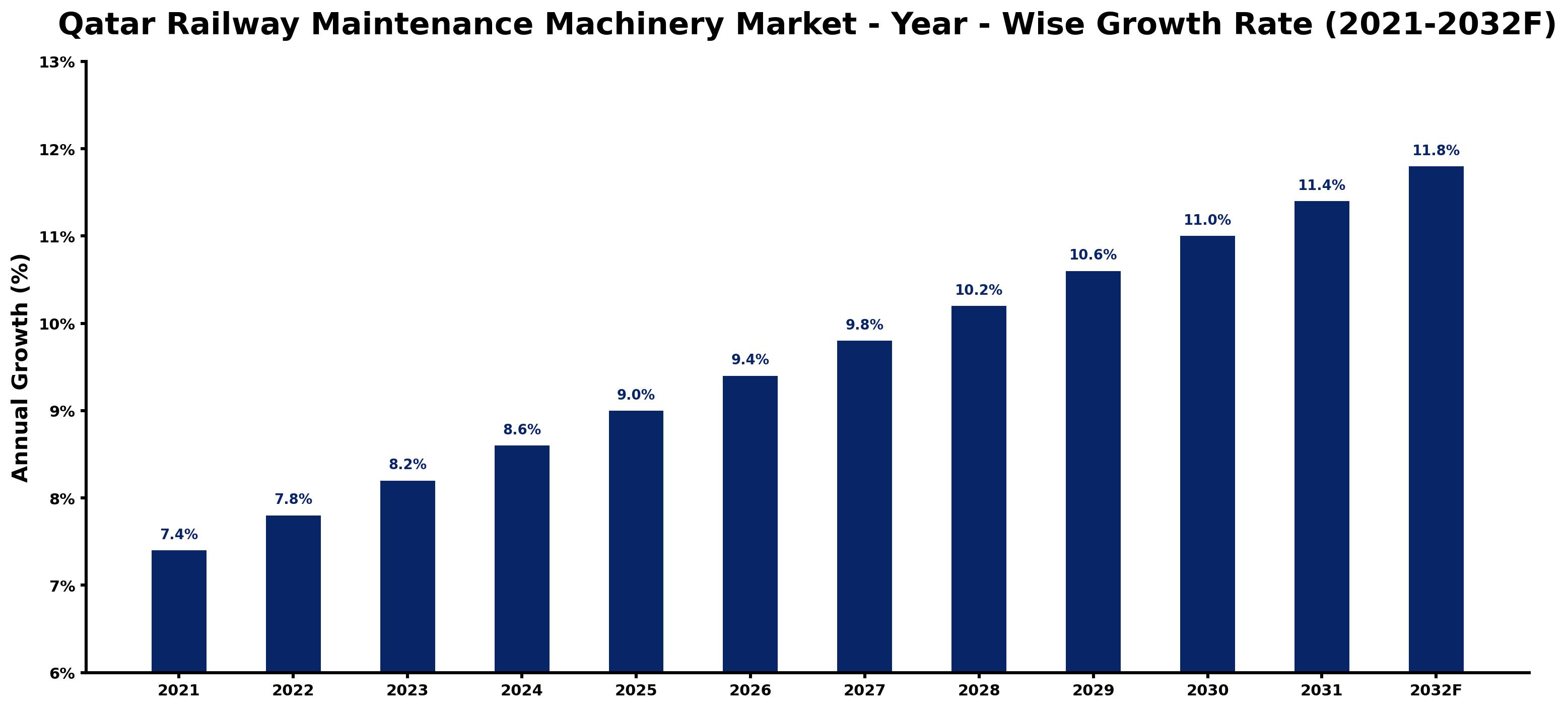
The table below presents the year‑wise growth rates along with the key drivers influencing the market
| Year | Growth Rate | Major Drivers |
| 2021 | 7.4% | Rapid growth in telecom and data center sectors |
| 2022 | 7.8% | Increasing adoption of advanced technologies |
| 2023 | 8.2% | Expansion of commercial construction activities |
| 2024 | 8.6% | Increasing adoption of advanced technologies |
| 2025 | 9.0% | Rapid growth in telecom and data center sectors |
| 2026 | 9.4% | Increasing industrial infrastructure investments |
| 2027 | 9.8% | Growing renewable energy integration projects |
| 2028 | 10.2% | Increasing industrial automation investments |
| 2029 | 10.6% | Rapid growth in telecom and data center sectors |
| 2030 | 11.0% | Government infrastructure modernization initiatives |
| 2031 | 11.4% | Growing renewable energy integration projects |
| 2032 | 11.8% | Growing renewable energy integration projects |
Note - Market size estimations and growth projections presented in this report are based on 6Wresearch's advanced forecasting approach, validated with industry datasets as of June 2026.
Qatar Railway Maintenance Machinery Market Synopsis
The demand for specialized railway maintenance machinery in Qatar is intensifying as the nation embarks on an ambitious agenda to develop its rail network. With the government's emphasis on enhancing connectivity through advanced rail systems, maintaining infrastructure integrity is critical to ensuring safety and operational efficiency.
Moreover, the adoption of cutting-edge technologies in maintenance practices is becoming commonplace, driven by a commitment to sustainable transportation. This trend is compelling machinery suppliers to innovate, ensuring that their products meet the stringent operational requirements imposed by Qatar's unique environmental conditions.
Qatar Railway Maintenance Machinery Market Key Takeaways
- Qatar's railway maintenance machinery market is positioned for substantial growth, fueled by significant infrastructure investments.
- There is a pressing demand for advanced equipment to address the specific maintenance needs of Qatar's railway systems.
- Government initiatives are aligning with the broader goal of sustainable transportation, fostering the adoption of modern maintenance technologies.
- The impact of the COVID-19 pandemic has underscored the importance of reliable rail networks, fueling renewed focus on maintenance machinery.
- Challenges regarding equipment adaptation to Qatar's environmental conditions remain a key focus for industry stakeholders.
Evaluation of Restraints in Qatar Railway Maintenance Machinery Market
Despite the market's promising growth, certain restraints continue to challenge its momentum. One of the primary concerns is the necessity for specialized machinery tailored to the unique demands of Qatar's railway infrastructure. The extreme environmental conditions, characterized by a hot desert climate and sandy terrain, require maintenance equipment that not only performs efficiently but also withstands these challenges. Furthermore, the operational need to conduct timely maintenance while minimizing downtime poses an additional layer of complexity, necessitating both innovative equipment solutions and efficient maintenance processes.
Qatar Railway Maintenance Machinery Market Trends
Current trends indicate a growing focus on automation and digitalization within the railway maintenance sector. The integration of smart technologies, such as predictive maintenance and remote monitoring systems, is transforming how maintenance is performed, enhancing efficiency and reliability. Additionally, as sustainability becomes a priority, there's a noticeable shift towards greener technologies and machinery, aligning with Qatar's vision for an eco-friendly transportation network.
Qatar Railway Maintenance Machinery Market Opportunities
The potential for growth and investment in the Qatar railway maintenance machinery market is significant. Opportunities exist for manufacturers and suppliers that can provide advanced, specialized equipment tailored to the local requirements. Moreover, the push for digital solutions presents a chance for innovative technologies, such as automation and IoT-enabled devices, to enter the market. As the country continues to expand its rail infrastructure, partnerships with local entities for technology transfer and maintenance services could prove mutually beneficial.
Government Initiatives in the Qatar Railway Maintenance Machinery Market
The Qatari government is actively promoting initiatives to enhance its railway infrastructure through public investment and strategic partnerships. This includes funding for the construction of new rail lines and maintenance facilities, as well as programs designed to elevate the overall standard of rail transport in the country. Policies aimed at fostering innovation and attracting foreign investment in maintenance technologies are also being prioritized, ensuring that the railway sector is well-equipped to meet future demands.
Future Insights of the Qatar Railway Maintenance Machinery Market
Looking ahead to the period from 2026 to 2032, the Qatar Railway Maintenance Machinery Market is expected to experience dynamic growth. The expansion of the railway network, coupled with a commitment to safety and operational efficiency, will drive ongoing investments in maintenance technologies. As the market matures, greater emphasis on innovative solutions and sustainable practices will redefine the landscape, ensuring that maintenance operations keep pace with the evolving demands of Qatar's ambitious transportation goals.
Qatar Railway Maintenance Machinery Market Latest Developments (May 2025 - June 2026)
Recent developments within the Qatar railway maintenance machinery landscape indicate a shift towards enhancing operational efficiencies through the adoption of advanced technologies. Key players are focusing on integrating digital tools to facilitate better maintenance practices, while collaborations between local and international firms are expected to enhance the quality and availability of specialized maintenance equipment. The recovery from the COVID-19 pandemic has also reignited interest in expanding railway infrastructure projects, further driving demand for sophisticated maintenance solutions.
Qatar Railway Maintenance Machinery Market - Key Attractiveness of the Report
- 10 Years of Market Numbers
- Historical Data Starting from 2022 to 2025
- Base Year: 2025
- Forecast Data until 2032
- Key Performance Indicators Impacting the Market
- Major Upcoming Developments and Projects
Key Highlights of the Report:
- Qatar Railway Maintenance Machinery Market Outlook
- Market Size of Qatar Railway Maintenance Machinery Market, 2025
- Forecast of Qatar Railway Maintenance Machinery Market, 2032
- Historical Data and Forecast of Qatar Railway Maintenance Machinery Revenues & Volume for the Period 2022-2032F
- Qatar Railway Maintenance Machinery Market Trend Evolution
- Qatar Railway Maintenance Machinery Market Drivers and Challenges
- Qatar Railway Maintenance Machinery Price Trends
- Qatar Railway Maintenance Machinery Porter's Five Forces
- Qatar Railway Maintenance Machinery Industry Life Cycle
- Historical Data and Forecast of Qatar Railway Maintenance Machinery Market Revenues & Volume By Type for the Period 2022-2032F
- Historical Data and Forecast of Qatar Railway Maintenance Machinery Market Revenues & Volume By Tamping Machine for the Period 2022-2032F
- Historical Data and Forecast of Qatar Railway Maintenance Machinery Market Revenues & Volume By Stabilizing Machinery for the Period 2022-2032F
- Historical Data and Forecast of Qatar Railway Maintenance Machinery Market Revenues & Volume By Rail Handling Machinery for the Period 2022-2032F
- Historical Data and Forecast of Qatar Railway Maintenance Machinery Market Revenues & Volume By Ballast Cleaning Machine for the Period 2022-2032F
- Historical Data and Forecast of Qatar Railway Maintenance Machinery Market Revenues & Volume By Other for the Period 2022-2032F
- Historical Data and Forecast of Qatar Railway Maintenance Machinery Market Revenues & Volume By Applications for the Period 2022-2032F
- Historical Data and Forecast of Qatar Railway Maintenance Machinery Market Revenues & Volume By Ballast Track for the Period 2022-2032F
- Historical Data and Forecast of Qatar Railway Maintenance Machinery Market Revenues & Volume By Ballastless Track for the Period 2022-2032F
- Qatar Railway Maintenance Machinery Import Export Trade Statistics
- Market Opportunity Assessment By Type
- Market Opportunity Assessment By Applications
- Qatar Railway Maintenance Machinery Top Companies Market Share
- Qatar Railway Maintenance Machinery Competitive Benchmarking By Technical and Operational Parameters
- Qatar Railway Maintenance Machinery Company Profiles
- Qatar Railway Maintenance Machinery Key Strategic Recommendations






































