Argentina Railway Maintenance Machinery Market Size, Share & Growth Rate
The Argentina Railway Maintenance Machinery Market was estimated at USD 806 Million in 2025 and is projected to reach USD 1420 Million by 2032, growing at a CAGR of 8.4% from 2026 to 2032. This positive trajectory is driven by increased government investments in rail infrastructure modernization, coupled with a growing demand for efficient and advanced maintenance technologies. The market's expansion is further fueled by a concerted effort to improve safety and operational efficiency across the railway network.
Argentina Railway Maintenance Machinery Market Year-wise Growth Rate and Key Drivers
This graph highlights how the Argentina Railway Maintenance Machinery Market has steadily grown over the years, supported by major growth factors.
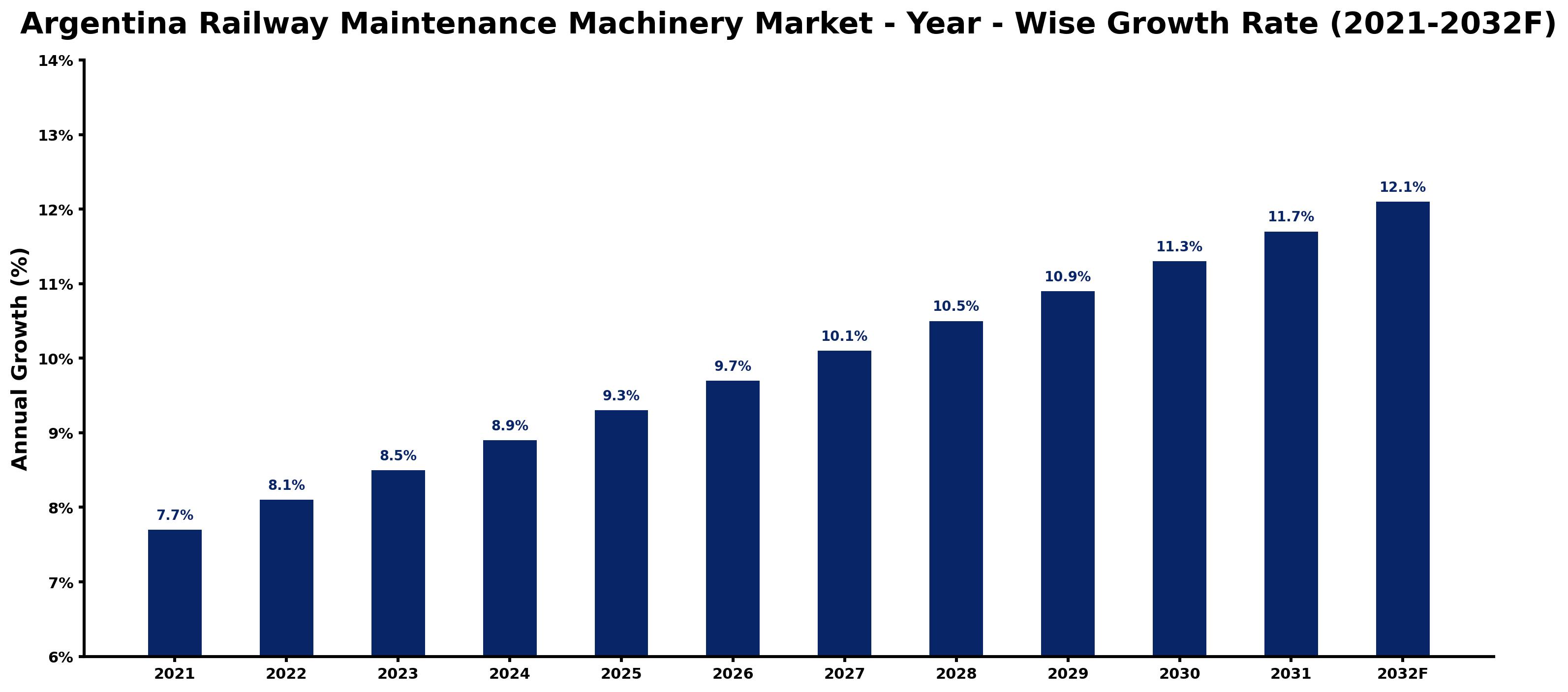
The table below presents the year‑wise growth rates along with the key drivers influencing the market
| Year | Growth Rate | Major Drivers |
| 2021 | 7.7% | Increasing industrial automation investments |
| 2022 | 8.1% | Rising electricity demand across industries |
| 2023 | 8.5% | Increasing industrial infrastructure investments |
| 2024 | 8.9% | Rapid growth in telecom and data center sectors |
| 2025 | 9.3% | Expansion of transportation and logistics networks |
| 2026 | 9.7% | Increasing industrial automation investments |
| 2027 | 10.1% | Growing renewable energy integration projects |
| 2028 | 10.5% | Expansion of manufacturing activities |
| 2029 | 10.9% | Increasing industrial infrastructure investments |
| 2030 | 11.3% | Government infrastructure modernization initiatives |
| 2031 | 11.7% | Expansion of transportation and logistics networks |
| 2032 | 12.1% | Increasing industrial infrastructure investments |
Note - Market size estimations and growth projections presented in this report are based on 6Wresearch’s advanced forecasting approach, validated with industry datasets as of June 2026.
Argentina Railway Maintenance Machinery Market Synopsis
Recently, the Argentina Railway Maintenance Machinery Market has shown significant momentum, primarily due to renewed focus on enhancing rail services and infrastructure. Looking ahead, this momentum is expected to accelerate as the government implements modernization projects aimed at reducing operational costs and improving service reliability.
As the industry transitions towards automated and technologically advanced solutions, the market is poised for transformation. Increased demand for machinery that ensures safety and durability, along with the adoption of sustainable practices, positions the sector for robust growth in the coming years.
Argentina Railway Maintenance Machinery Market Key Takeaways
- The market is set to grow from USD 806 Million in 2025 to USD 1420 Million by 2032, reflecting a strong CAGR of 8.4%.
- Government investments and modernization initiatives are pivotal in driving market growth.
- Technological advancements are reshaping the market landscape, emphasizing automation and predictive maintenance.
- Environmental sustainability is becoming a key focus, encouraging the development of greener solutions.
- Investment opportunities are emerging in various segments, including track maintenance and diagnostic equipment.
Evaluation of Restraints in Argentina Railway Maintenance Machinery Market
Despite its promising growth trajectory, the Argentina Railway Maintenance Machinery Market faces notable challenges. Outdated railway infrastructure hampers progress, while limited financial resources often restrict the modernization efforts essential for advancement. Additionally, there is a pressing shortage of skilled labor capable of operating and maintaining sophisticated machinery. The political and economic instability in the region further complicates long-term planning and investment, creating a landscape where immediate actions are critical to unlocking the market's full potential.
Argentina Railway Maintenance Machinery Market Trends
The market is currently witnessing a shift towards advanced technologies that aim to enhance maintenance operations. Automation in maintenance tasks is gaining traction, with predictive maintenance tools increasingly being utilized to anticipate equipment failures before they occur. The integration of IoT and big data analytics is allowing operators to optimize maintenance schedules and asset management, driving operational efficiencies.
Additionally, environmental sustainability is influencing equipment design and operational practices, with manufacturers focusing on reducing carbon footprints. Customized solutions tailored to the unique needs of railway operators are becoming commonplace, fostering efficiency and cost-effectiveness in maintenance activities.
Argentina Railway Maintenance Machinery Market Opportunities
Opportunities for growth in the Argentina Railway Maintenance Machinery Market are abundant, particularly in the realms of track maintenance machinery, inspection vehicles, and diagnostic tools. The Argentine government's strategies aimed at attracting foreign investment and promoting public-private partnerships signal a promising environment for investment. By innovating solutions that cater to the evolving needs of the industry, companies can capitalize on the expanding market and contribute significantly to the enhancement of Argentina's railway network.
Government Initiatives in the Argentina Railway Maintenance Machinery Market
The Argentine government has rolled out a series of initiatives designed to bolster the railway maintenance machinery market. These efforts include the modernization of existing rail networks, such as the Renovation and Modernization Plan for the Belgrano Cargas railway. Additionally, the government is prioritizing investment in key infrastructure projects, emphasizing the electrification of lines and the acquisition of advanced maintenance machinery. Such policy measures are fostering an environment conducive to growth and innovation in the railway sector.
Future Insights of the Argentina Railway Maintenance Machinery Market
Looking ahead to 2026-2032, the Argentina Railway Maintenance Machinery Market is expected to experience sustained growth driven by ongoing investments in infrastructure and technological advancements. As the emphasis on operational efficiency, safety, and sustainability intensifies, the demand for cutting-edge maintenance solutions is likely to rise. Furthermore, government initiatives focusing on enhancing connectivity and expanding rail networks will play a crucial role in shaping the market's future landscape.
Argentina Railway Maintenance Machinery Market Latest Developments (May 2025 - June 2026)
In recent months, the Argentina Railway Maintenance Machinery Market has seen strategic movements towards embracing advanced technologies. Developments in predictive maintenance tools and automation solutions have been particularly noteworthy, enhancing operational efficiencies. Additionally, there has been a marked increase in initiatives aimed at addressing the workforce skills gap, ensuring that personnel are adequately trained to handle the latest maintenance equipment.
Argentina Railway Maintenance Machinery Market - Key Attractiveness of the Report
- 10 Years of Market Numbers
- Historical Data Starting from 2022 to 2025
- Base Year: 2025
- Forecast Data until 2032
- Key Performance Indicators Impacting the Market
- Major Upcoming Developments and Projects
Key Highlights of the Report:
- Argentina Railway Maintenance Machinery Market Outlook
- Market Size of Argentina Railway Maintenance Machinery Market, 2025
- Forecast of Argentina Railway Maintenance Machinery Market, 2032
- Historical Data and Forecast of Argentina Railway Maintenance Machinery Revenues & Volume for the Period 2022-2032F
- Argentina Railway Maintenance Machinery Market Trend Evolution
- Argentina Railway Maintenance Machinery Market Drivers and Challenges
- Argentina Railway Maintenance Machinery Price Trends
- Argentina Railway Maintenance Machinery Porter's Five Forces
- Argentina Railway Maintenance Machinery Industry Life Cycle
- Historical Data and Forecast of Argentina Railway Maintenance Machinery Market Revenues & Volume By Type for the Period 2022-2032F
- Historical Data and Forecast of Argentina Railway Maintenance Machinery Market Revenues & Volume By Tamping Machine for the Period 2022-2032F
- Historical Data and Forecast of Argentina Railway Maintenance Machinery Market Revenues & Volume By Stabilizing Machinery for the Period 2022-2032F
- Historical Data and Forecast of Argentina Railway Maintenance Machinery Market Revenues & Volume By Rail Handling Machinery for the Period 2022-2032F
- Historical Data and Forecast of Argentina Railway Maintenance Machinery Market Revenues & Volume By Ballast Cleaning Machine for the Period 2022-2032F
- Historical Data and Forecast of Argentina Railway Maintenance Machinery Market Revenues & Volume By Other for the Period 2022-2032F
- Historical Data and Forecast of Argentina Railway Maintenance Machinery Market Revenues & Volume By Applications for the Period 2022-2032F
- Historical Data and Forecast of Argentina Railway Maintenance Machinery Market Revenues & Volume By Ballast Track for the Period 2022-2032F
- Historical Data and Forecast of Argentina Railway Maintenance Machinery Market Revenues & Volume By Ballastless Track for the Period 2022-2032F
- Argentina Railway Maintenance Machinery Import Export Trade Statistics
- Market Opportunity Assessment By Type
- Market Opportunity Assessment By Applications
- Argentina Railway Maintenance Machinery Top Companies Market Share
- Argentina Railway Maintenance Machinery Competitive Benchmarking By Technical and Operational Parameters
- Argentina Railway Maintenance Machinery Company Profiles
- Argentina Railway Maintenance Machinery Key Strategic Recommendations






































