United Kingdom (UK) Residential Boiler Market Size, Share & Growth Rate
The United Kingdom (UK) Residential Boiler Market was estimated at USD 403 Million in 2025 and is projected to reach USD 499 Million by 2032, growing at a CAGR of 3.1% from 2026 to 2032. This upward trajectory is significantly driven by stringent government policies aimed at reducing carbon footprints, increasing consumer awareness about energy efficiency, and a growing demand for modern heating solutions. These factors combine to create a competitive atmosphere conducive to innovation and investment.
United Kingdom (UK) Residential Boiler Market Year-wise Growth Rate and Key Drivers
This graph highlights how the United Kingdom (UK) Residential Boiler Market has steadily grown over the years, supported by major growth factors.
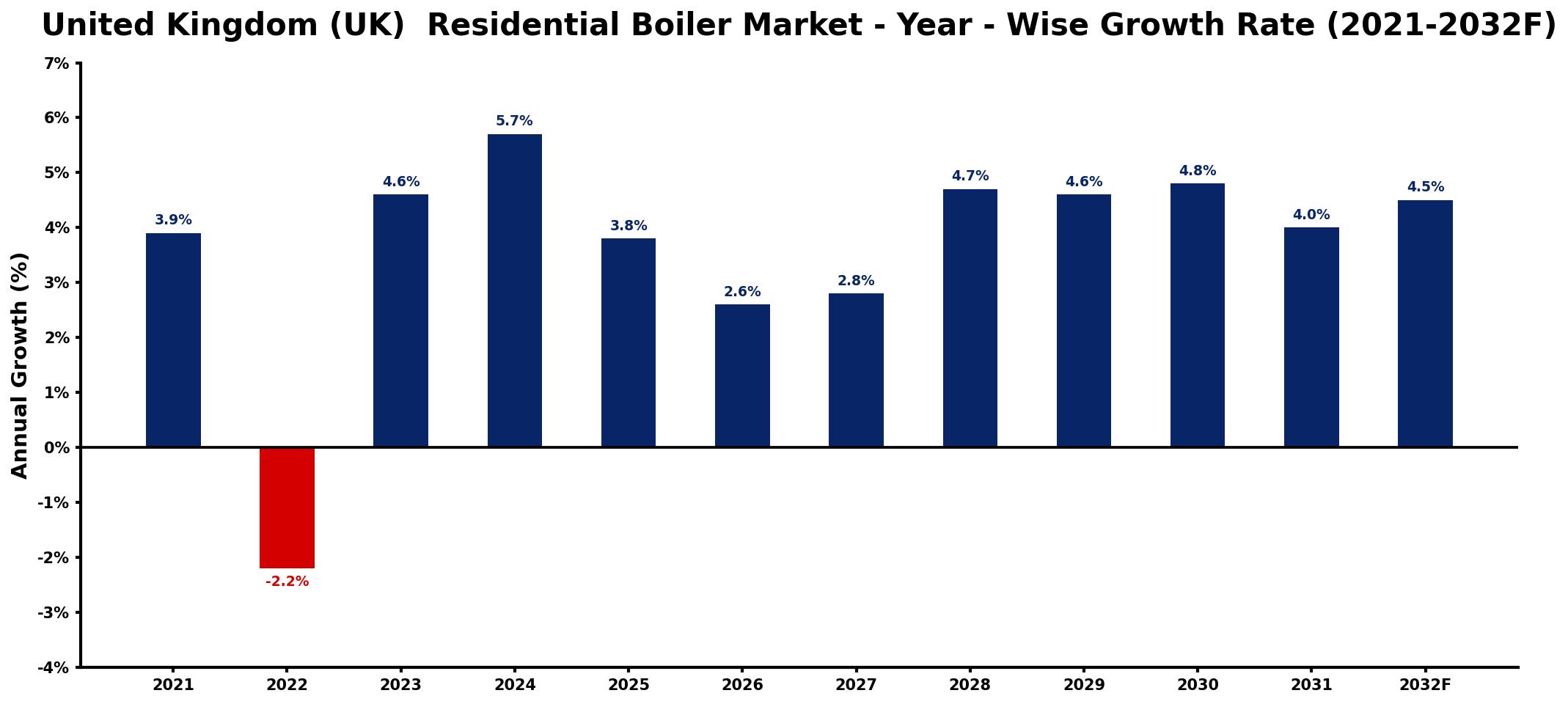
The table below presents the year‑wise growth rates along with the key drivers influencing the market
| Year | Growth Rate | Major Drivers |
| 2021 | 3.9% | Increased energy efficiency regulations |
| 2022 | -2.2% | Decrease in construction activities |
| 2023 | 4.6% | Rising consumer energy awareness |
| 2024 | 5.7% | Government incentives for upgrades |
| 2025 | 3.8% | Growth in renewable energy investments |
| 2026 | 2.6% | Expansion of smart home technology |
| 2027 | 2.8% | Higher demand for sustainable solutions |
| 2028 | 4.7% | Advancements in energy storage systems |
| 2029 | 4.6% | Increased focus on climate initiatives |
| 2030 | 4.8% | growing commercial sector adoption |
| 2031 | 4.0% | Rising interest in energy independence |
| 2032 | 4.5% | Enhanced focus on retrofit solutions |
Note: Market size estimations and growth projections presented in this report are based on 6Wresearch's proprietary forecasting methodology, utilizing the latest available industry data, government publications, and primary research inputs.
United Kingdom (UK) Residential Boiler Market Synopsis
The UK residential boiler market stands as a testament to evolving consumer preferences and regulatory imperatives. With an urgent focus on sustainability, the industry is witnessing a shift towards more efficient, eco-friendly heating solutions that align with national carbon reduction goals.
As older models are replaced with advanced, high-efficiency systems, manufacturers are embracing innovation. The integration of smart technologies, such as app-controlled functionalities, is becoming commonplace, thus enhancing user experience while optimizing energy consumption. This dynamic market is set for further growth, fueled by technological advancements and regulatory support.
United Kingdom (UK) Residential Boiler Market Key Takeaways
- The market is primarily driven by increasing energy efficiency standards and a shift towards greener solutions.
- Condensing and combi boilers are becoming more popular due to their efficiency and space-saving benefits.
- Smart heating technologies are reshaping consumer expectations, emphasizing convenience and energy management.
- Government initiatives play a crucial role in promoting low-carbon heating solutions and supporting market growth.
- Investment opportunities abound for innovative companies focused on eco-friendly heating solutions.
Evaluation of Restraints in United Kingdom (UK) Residential Boiler Market
Despite its growth trajectory, the UK Residential Boiler Market faces certain constraints that could impede progress. New regulations and standards are increasing the compliance burden on manufacturers, demanding significant investments in technology upgrades and adaptations. Furthermore, the rising costs of raw materials, coupled with intense competition from alternative heating technologies such as heat pumps, challenge traditional boiler manufacturers to evolve quickly. The impact of Brexit adds uncertainty to trade agreements, which could affect market dynamics further.
United Kingdom (UK) Residential Boiler Market Trends
The market is seeing an unmistakable trend towards energy-efficient systems, particularly condensing boilers, due to their lower carbon emissions and higher efficiency. Additionally, smart technology integration is on the rise, allowing consumers to manage their heating remotely, aligning with modern lifestyle demands. The interest in renewable heating solutions like heat pumps and biomass boilers is also gaining traction, reflecting a broader movement towards sustainable energy sources. Overall, consumer preferences are gravitating towards solutions that promise energy savings and environmental responsibility.
United Kingdom (UK) Residential Boiler Market Opportunities
As the UK transitions to greener energy solutions, several investment opportunities emerge within the residential boiler market. The government's commitment to low-carbon heating is paving the way for innovative boiler designs that incorporate renewable energy sources. Companies focusing on smart technology and user-friendly features are well-positioned to capture the evolving demands of consumers. Moreover, partnerships with established manufacturers can facilitate entry into the market while leveraging existing distribution networks to maximize reach. In essence, the future holds lucrative prospects for forward-thinking investors.
Government Initiatives in the United Kingdom (UK) Residential Boiler Market
The UK government has introduced several policies to promote energy efficiency and support sustainable heating solutions. Notable initiatives include the Boiler Plus regulations, which mandate that new gas boilers meet specific energy performance criteria. Additionally, the Clean Heat Grant scheme encourages households to transition to renewable heating systems, enabling financial support for heat pump installations. These proactive measures demonstrate the government's dedication to achieving net-zero emissions by 2050, fostering an environment where innovative, eco-friendly technologies can thrive.
Future Insights of the United Kingdom (UK) Residential Boiler Market
Looking ahead, the UK Residential Boiler Market is anticipated to flourish, driven by the pressing demand for energy-efficient heating solutions and supportive government policies. The anticipated growth in the replacement market, as homeowners opt for high-efficiency systems, will further bolster this trend. Advancements in smart technology will likely shape the market landscape, offering consumers enhanced control and efficiency. With a collective commitment to reducing carbon footprints, the future seems optimistic for innovative heating solutions in residential settings.
United Kingdom (UK) Residential Boiler Market Latest Developments (2025 - 2026)
Recent developments in the UK residential boiler market indicate a significant shift towards smart heating technologies and renewable solutions. Manufacturers are launching new products that integrate advanced features designed for energy management and user convenience. Simultaneously, there is a marked increase in public awareness campaigns aimed at educating homeowners about the benefits of upgrading to energy-efficient heating systems. The competitive landscape is increasingly characterized by innovations that cater to the sustainable preferences of consumers, reflecting the industry's evolution towards greener practices.
United Kingdom (UK) Residential Boiler Market - Key Attractiveness of the Report
- 10 Years of Market Numbers
- Historical Data Starting from 2022 to 2025
- Base Year: 2025
- Forecast Data until 2032
- Key Performance Indicators Impacting the Market
- Major Upcoming Developments and Projects
Key Highlights of the Report:
- United Kingdom (UK) Residential Boiler Market Outlook
- Market Size of United Kingdom (UK) Residential Boiler Market, 2025
- Forecast of United Kingdom (UK) Residential Boiler Market, 2032
- Historical Data and Forecast of United Kingdom (UK) Residential Boiler Revenues & Volume for the Period 2022-2032F
- United Kingdom (UK) Residential Boiler Market Trend Evolution
- United Kingdom (UK) Residential Boiler Market Drivers and Challenges
- United Kingdom (UK) Residential Boiler Price Trends
- United Kingdom (UK) Residential Boiler Porter's Five Forces
- United Kingdom (UK) Residential Boiler Industry Life Cycle
- Historical Data and Forecast of United Kingdom (UK) Residential Boiler Market Revenues & Volume By Type for the Period 2022-2032F
- Historical Data and Forecast of United Kingdom (UK) Residential Boiler Market Revenues & Volume By Water Tube Boiler for the Period 2022-2032F
- Historical Data and Forecast of United Kingdom (UK) Residential Boiler Market Revenues & Volume By Fire Tube Boiler for the Period 2022-2032F
- Historical Data and Forecast of United Kingdom (UK) Residential Boiler Market Revenues & Volume By Electric Boiler for the Period 2022-2032F
- Historical Data and Forecast of United Kingdom (UK) Residential Boiler Market Revenues & Volume By Fuel Type for the Period 2022-2032F
- Historical Data and Forecast of United Kingdom (UK) Residential Boiler Market Revenues & Volume By Coal Fired for the Period 2022-2032F
- Historical Data and Forecast of United Kingdom (UK) Residential Boiler Market Revenues & Volume By Oil Fired for the Period 2022-2032F
- Historical Data and Forecast of United Kingdom (UK) Residential Boiler Market Revenues & Volume By Gas Fired for the Period 2022-2032F
- Historical Data and Forecast of United Kingdom (UK) Residential Boiler Market Revenues & Volume By Others for the Period 2022-2032F
- Historical Data and Forecast of United Kingdom (UK) Residential Boiler Market Revenues & Volume By Technology for the Period 2022-2032F
- Historical Data and Forecast of United Kingdom (UK) Residential Boiler Market Revenues & Volume By Condensing for the Period 2022-2032F
- Historical Data and Forecast of United Kingdom (UK) Residential Boiler Market Revenues & Volume By Non-condensing for the Period 2022-2032F
- United Kingdom (UK) Residential Boiler Import Export Trade Statistics
- Market Opportunity Assessment By Type
- Market Opportunity Assessment By Fuel Type
- Market Opportunity Assessment By Technology
- United Kingdom (UK) Residential Boiler Top Companies Market Share
- United Kingdom (UK) Residential Boiler Competitive Benchmarking By Technical and Operational Parameters
- United Kingdom (UK) Residential Boiler Company Profiles
- United Kingdom (UK) Residential Boiler Key Strategic Recommendations






































