United Kingdom (UK) Simulation Software Market Size & Growth Rate (2026-2032)
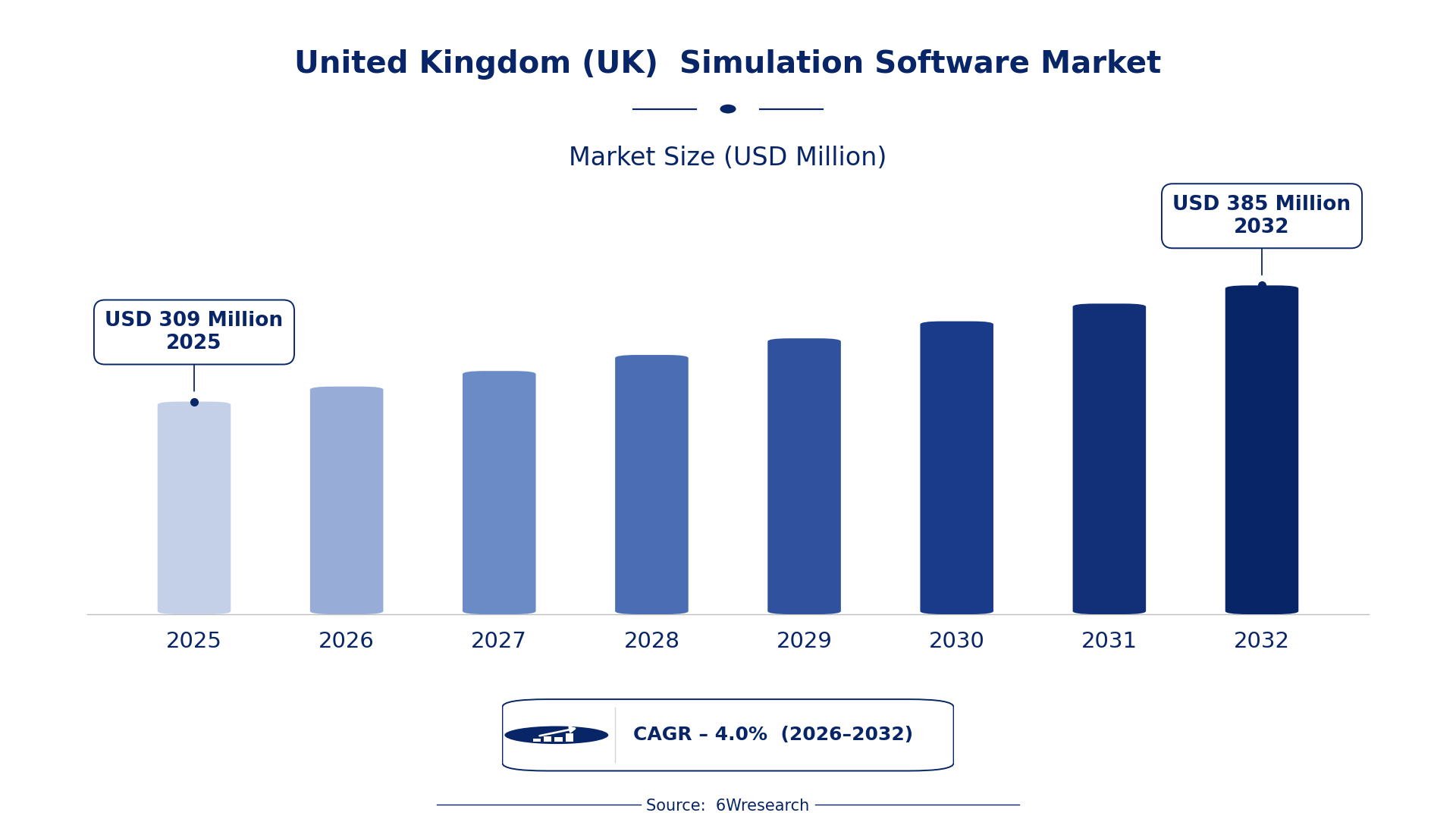
The United Kingdom (UK) Simulation Software Market was estimated at USD 309 Million in 2025 and is projected to reach USD 385 Million by 2032, growing at a CAGR of 4.0% from 2026 to 2032.
United Kingdom (UK) Simulation Software Market Synopsis
The United Kingdom’s simulation software market has gained momentum recently, fueled by the rapid adoption of advanced technologies across sectors. However, as the market evolves, it is now shifting towards a more specialized approach, with an increasing focus on industry-specific solutions that cater to unique operational needs.
Key industries such as automotive, healthcare, and aerospace are driving demand, reflecting a broader trend of digital transformation. As organizations continue to prioritize efficiency and innovation, the market is likely to see robust growth, with a strong emphasis on integrating cutting-edge technologies like AI and VR into simulation applications.
United Kingdom (UK) Simulation Software Market Year-wise Growth Rate and Key Drivers
This graph illustrates the annual growth rates of the United Kingdom (UK) Simulation Software Market from 2021 to 2032, highlighting a steady upward trajectory and projected expansion over the forecast period.
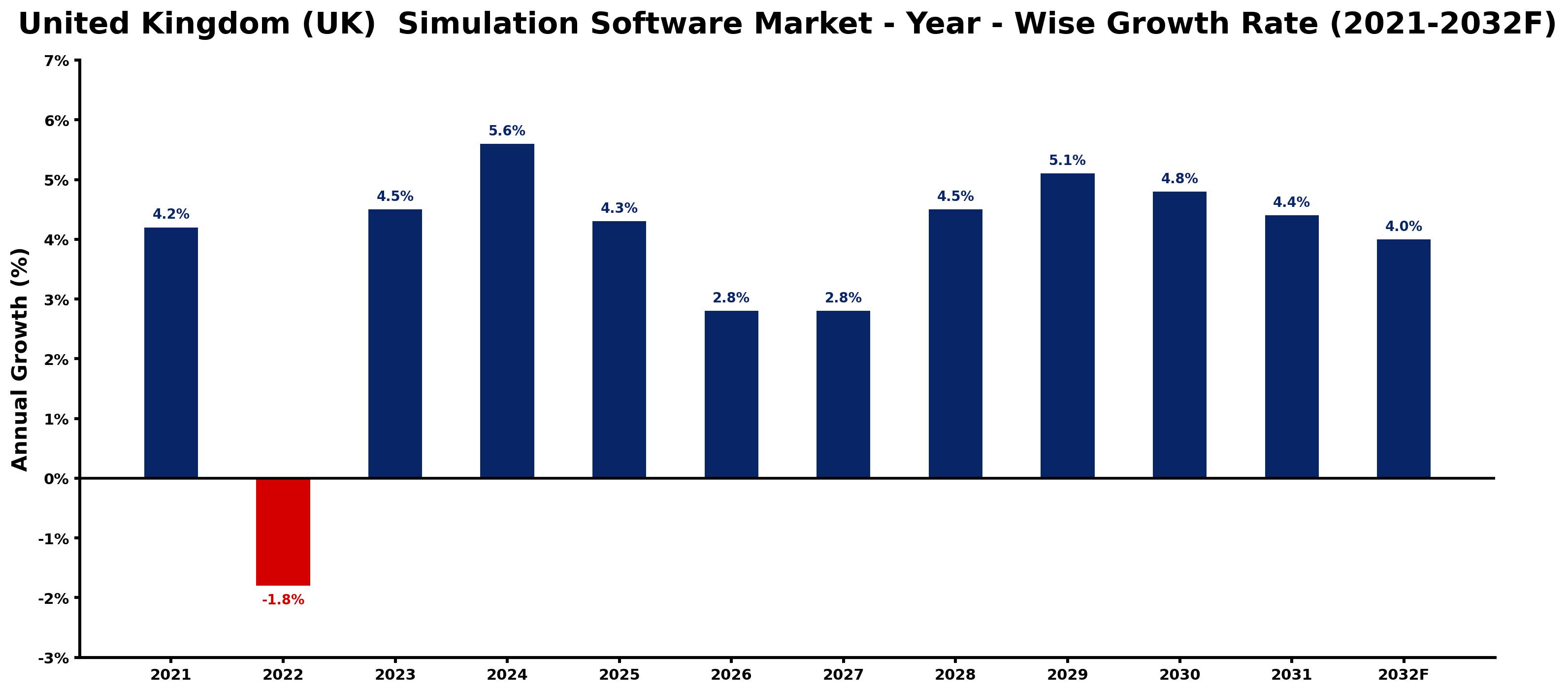
The table below presents the year‑wise growth rates along with the key drivers influencing the market
| Year | Growth Rate | Major Drivers |
| 2021 | 4.2% | Increased investments in virtual training by UK organizations. |
| 2022 | -1.8% | UK budget cuts reduced software development funding. |
| 2023 | 4.5% | Government funding for digital transformation in manufacturing sectors. |
| 2024 | 5.6% | Surge in demand for AI-driven simulation solutions. |
| 2025 | 4.3% | Growth in remote working boosting simulation software usage. |
| 2026 | 2.8% | Emerging UK startups focusing on innovative simulation technologies. |
| 2027 | 2.8% | Regulatory push for enhanced digital skills in education. |
| 2028 | 4.5% | Rise in UK defense projects requiring advanced simulations. |
| 2029 | 5.1% | Growing UK interest in sustainable engineering simulations. |
| 2030 | 4.8% | Increased adoption of simulation tools in automotive sector. |
| 2031 | 4.4% | UK universities enhancing simulation software in curricula. |
| 2032 | 4.0% | Demand for personalized healthcare simulations in UK hospitals. |
Note: Market size estimations and growth projections presented in this report are based on 6Wresearch's proprietary forecasting methodology, utilizing the latest available industry data, government publications, and primary research inputs.
United Kingdom (UK) Simulation Software Market Key Takeaways
Below are some of the specific key takeaways from the market, including:
- The market is expected to grow steadily, reaching USD 385 million by 2032.
- Cloud-based solutions are increasingly preferred for their flexibility and collaboration capabilities.
- Industries are demanding more customized simulation tools tailored to specific operational requirements.
- Integration of AI and VR technologies is enhancing the realism and effectiveness of simulations.
- Government initiatives are actively supporting digital transformation and innovation within the sector.
Evaluation of Restraints in United Kingdom (UK) Simulation Software Market
Despite the positive growth trajectory, the UK simulation software market faces several restraints. The competitive landscape is becoming increasingly saturated, with numerous global providers vying for market share. This leads to price pressures and necessitates continuous innovation to stay relevant.
Data security remains a significant concern, especially as organizations process sensitive information within their simulations. on top of that, the complexity of integrating new software with legacy systems can hinder adoption rates. Finally, a lack of understanding among some businesses regarding the benefits of simulation software presents a barrier to market penetration.
United Kingdom (UK) Simulation Software Market Trends
Several trends are shaping the UK simulation software market. The shift towards cloud-based solutions is paramount, allowing for enhanced scalability and collaborative functionalities. Industry-specific applications are on the rise, particularly in sectors such as healthcare and manufacturing, where tailored solutions drive operational efficiencies.
The integration of advanced technologies, including AI and virtual reality, is gaining traction, enabling organizations to create more immersive and realistic training environments. Sustainability is also becoming a focal point, with businesses seeking simulation tools that align with environmental initiatives and support energy-efficient practices.
United Kingdom (UK) Simulation Software Market Opportunities
Investment opportunities in the UK simulation software market are plentiful. The growing demand for advanced simulation solutions across automotive, aerospace, and healthcare sectors creates a fertile ground for innovation. Companies focusing on VR and AR technologies stand to benefit significantly, as these tools become integral to training and design processes.
The UK government's emphasis on promoting digital transformation through funding and initiatives further supports the market's growth potential, making it an attractive space for investors looking for long-term opportunities.
Government Initiatives in the United Kingdom (UK) Simulation Software Market
The UK government plays a crucial role in fostering the simulation software market through various initiatives. These efforts focus on enhancing technological capabilities and ensuring the workforce is equipped with the necessary skills for the future. Current policies aim to support innovation while maintaining data security and privacy standards, which are critical for market confidence.
- A funding programme initiated in early 2025 aims to support R&D in simulation technologies.
- Ongoing initiatives are focused on upskilling the workforce in digital skills relevant to simulation software.
- A recent regulatory framework was introduced in late 2025 to enhance data security measures within the industry.
- Upcoming plans include a public-private partnership expected to launch in 2026, promoting the integration of simulation tools in educational settings.
- Current government policies emphasize the importance of sustainability in technology development, encouraging green practices in simulation software.
Future Insights of the United Kingdom (UK) Simulation Software Market
Looking ahead to 2026-2032, the UK simulation software market is set for continued expansion. The increasing adoption of simulation tools across various sectors will drive demand, particularly as organizations seek to enhance operational efficiencies and reduce time to market.
Technological advancements, particularly in AI and VR, will further revolutionize simulation capabilities, making them more accessible and effective. As businesses prioritize innovation and sustainability, the market will likely see an influx of new entrants and solutions tailored to meet these evolving demands.
United Kingdom (UK) Simulation Software Market Latest Developments
Recent activity in the UK simulation software market has been characterized by innovation and strategic partnerships. Over the past year, companies have focused on enhancing their offerings, responding to the growing need for advanced simulation solutions tailored to specific industries.
- A major technology vendor launched a new simulation platform in early 2025, designed specifically for the healthcare sector.
- In mid-2025, a collaborative initiative was announced between educational institutions and simulation software developers to enhance training programs.
- A leading regional operator is currently expanding its simulation software capabilities, with a rollout expected by late 2026.
- A planned partnership between defense contractors and simulation providers is set to begin in Q3 2026, aiming to improve training methodologies.
- Ongoing research projects are exploring the integration of AI-driven analytics into simulation tools, with results anticipated by mid-2026.
United Kingdom (UK) Simulation Software Market - Key Attractiveness of the Report
- 10 Years of Market Numbers
- Historical Data Starting from 2022 to 2025
- Base Year: 2025
- Forecast Data until 2032
- Key Performance Indicators Impacting the Market
- Major Upcoming Developments and Projects
The UK government supports the simulation software market through funding for R&D, initiatives aimed at workforce upskilling, and regulatory frameworks that enhance data security and privacy.
Key Highlights of the Report:
- United Kingdom (UK) Simulation Software Market Outlook
- Market Size of United Kingdom (UK) Simulation Software Market, 2025
- Forecast of United Kingdom (UK) Simulation Software Market, 2032
- Historical Data and Forecast of United Kingdom (UK) Simulation Software Revenues & Volume for the Period 2022-2032F
- United Kingdom (UK) Simulation Software Market Trend Evolution
- United Kingdom (UK) Simulation Software Market Drivers and Challenges
- United Kingdom (UK) Simulation Software Price Trends
- United Kingdom (UK) Simulation Software Porter's Five Forces
- United Kingdom (UK) Simulation Software Industry Life Cycle
- Historical Data and Forecast of United Kingdom (UK) Simulation Software Market Revenues & Volume By Component for the Period 2022-2032F
- Historical Data and Forecast of United Kingdom (UK) Simulation Software Market Revenues & Volume By Software for the Period 2022-2032F
- Historical Data and Forecast of United Kingdom (UK) Simulation Software Market Revenues & Volume By Professional Services for the Period 2022-2032F
- Historical Data and Forecast of United Kingdom (UK) Simulation Software Market Revenues & Volume By Deployment for the Period 2022-2032F
- Historical Data and Forecast of United Kingdom (UK) Simulation Software Market Revenues & Volume By Cloud for the Period 2022-2032F
- Historical Data and Forecast of United Kingdom (UK) Simulation Software Market Revenues & Volume By On-premises for the Period 2022-2032F
- Historical Data and Forecast of United Kingdom (UK) Simulation Software Market Revenues & Volume By Application for the Period 2022-2032F
- Historical Data and Forecast of United Kingdom (UK) Simulation Software Market Revenues & Volume By Product Engineering for the Period 2022-2032F
- Historical Data and Forecast of United Kingdom (UK) Simulation Software Market Revenues & Volume By Research and Development for the Period 2022-2032F
- Historical Data and Forecast of United Kingdom (UK) Simulation Software Market Revenues & Volume By Gamification for the Period 2022-2032F
- Historical Data and Forecast of United Kingdom (UK) Simulation Software Market Revenues & Volume By Vertical Automobile for the Period 2022-2032F
- Historical Data and Forecast of United Kingdom (UK) Simulation Software Market Revenues & Volume By Automobile for the Period 2022-2032F
- Historical Data and Forecast of United Kingdom (UK) Simulation Software Market Revenues & Volume By Aerospace and Defense for the Period 2022-2032F
- Historical Data and Forecast of United Kingdom (UK) Simulation Software Market Revenues & Volume By Electrical and Electronics for the Period 2022-2032F
- Historical Data and Forecast of United Kingdom (UK) Simulation Software Market Revenues & Volume By Healthcare and Pharmaceuticals for the Period 2022-2032F
- Historical Data and Forecast of United Kingdom (UK) Simulation Software Market Revenues & Volume By Oil and Gas and Mining for the Period 2022-2032F
- Historical Data and Forecast of United Kingdom (UK) Simulation Software Market Revenues & Volume By Construction for the Period 2022-2032F
- Historical Data and Forecast of United Kingdom (UK) Simulation Software Market Revenues & Volume By Ship Buildings and Marine for the Period 2022-2032F
- Historical Data and Forecast of United Kingdom (UK) Simulation Software Market Revenues & Volume By Chemicals for the Period 2022-2032F
- United Kingdom (UK) Simulation Software Import Export Trade Statistics
- Market Opportunity Assessment By Component
- Market Opportunity Assessment By Deployment
- Market Opportunity Assessment By Application
- Market Opportunity Assessment By Vertical Automobile
- United Kingdom (UK) Simulation Software Top Companies Market Share
- United Kingdom (UK) Simulation Software Competitive Benchmarking By Technical and Operational Parameters
- United Kingdom (UK) Simulation Software Company Profiles
- United Kingdom (UK) Simulation Software Key Strategic Recommendations






































