United States (US) AcoUStic Guitar Market Top 5 Importing Countries and Market Competition (HHI) Analysis
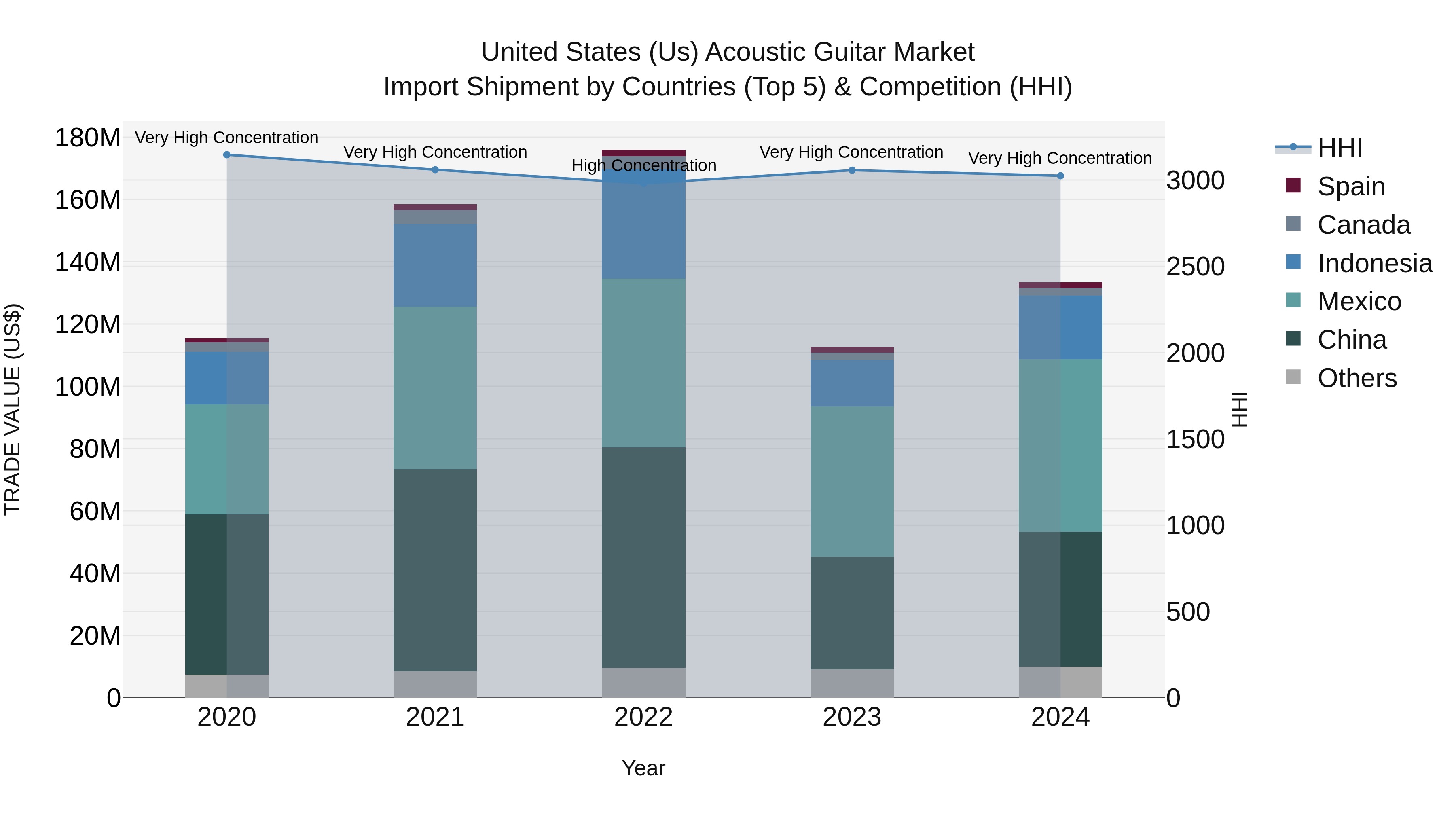
The United States continues to be a key destination for acoustic guitar imports, with top suppliers such as Mexico, China, and Indonesia dominating the market in 2024. The high Herfindahl-Hirschman Index (HHI) indicates a concentrated market structure, while the steady Compound Annual Growth Rate (CAGR) of 3.66% from 2020 to 2024 showcases sustained demand. The notable growth rate of 18.38% from 2023 to 2024 signals a surge in imports, highlighting the enduring popularity of acoustic guitars in the US market.
US Acoustic Guitar Market Highlights
| Report Name | US Acoustic Guitar Market |
| Forecast period | 2025-2031 |
| CAGR | 4.2% |
| Growing Sector | Music Sector (Media and Entertainment) |
Topics Covered in the US Acoustic Guitar Market Report
The US Acoustic Guitar market report thoroughly covers the market by product, by application and competitive Landscape. The report provides an unbiased and detailed analysis of the on-going market trends, opportunities/high growth areas, and market drivers which would help the stakeholders to devise and align their market strategies according to the current and future market dynamics.
US Acoustic Guitar Market Synopsis
As the United States acoustic guitar industry thrives, manufacturers continue to innovate with sustainable materials and advanced production techniques to meet the demands of both beginners and professional musicians. The popularity of acoustic guitars among diverse age groups has led to a varied range of products, from entry-level instruments to high-end, handcrafted models. Market trends also show a significant rise in online retailing, making it easier for consumers to find the perfect guitar to match their style and budget. Additionally, with digital music production becoming increasingly user-friendly, the acoustic guitar market is also observing a crossover trend where musicians seek instruments that can easily integrate into digital setups. USB-enabled acoustic guitars and models with advanced preamp systems are gaining traction as artists look for seamless recording solutions. Furthermore, sustainability is a growing concern among consumers, leading to a preference for guitars crafted from responsibly sourced materials. The rise of ethical consumerism is driving manufacturers to be more transparent about their wood sourcing and to invest in eco-friendly production practices.
According to 6Wresearch, US Acoustic Guitar market size is projected to grow at a CAGR of 4.2% during 2025-2031. The expansion of the United States acoustic guitar market is spurred by several key factors. Firstly, the resurgence of live musical performances and the increasing number of music festivals has amplified the demand for high-quality acoustic guitars. Secondly, social media platforms and online tutorials have made learning the guitar more accessible, thus broadening the customer base to include self-taught musicians. Another contributor to market growth is the influence of popular music artists who inspire fans to take up the instrument. Lastly, educational institutions continue to emphasize music as a core part of their curriculum, which creates a steady demand for student-level acoustic guitars. These drivers, combined with the rise of e-commerce sales channels, indicate a robust future for the acoustic guitar market.
Government Initiatives Introduced in the US Acoustic Guitar Market
Recent government initiatives have also played a pivotal role in bolstering the acoustic guitar market. Programs aimed at funding arts education in public schools have provided an uptick in institutional guitar purchases. Grants for community music programs have likewise increased accessibility to musical instruments for those in underprivileged areas, facilitating a culture of music appreciation and literacy. Consistently, these plans have heightened the US Acoustic Guitar Market Share. Additionally, trade policies that encourage domestic manufacturing of musical instruments have helped local artisans and guitar companies to flourish, promoting a more sustainable and locally-grounded industry. These governmental efforts not only encourage cultural enrichment but also drive economic activity within the musical instrument sector.
Key Players in the US Acoustic Guitar Market
Despite a market with numerous competitors, several key companies stand out due to their reputation for quality and innovation. Brands like Martin & Co., Taylor Guitars, and Gibson are synonymous with top-tier acoustic guitars, appealing to both professionals and enthusiasts. Yamaha continues to dominate the entry-level segment, offering affordability without compromising on sound quality. Fender, also a powerhouse in electric guitars, has made significant inroads into the acoustic scene with instruments that cater to a broad range of musical tastes and skill levels. In addition, the corporations’ grasp massive US Acoustic Guitar Market Revenues. Further, the craftsmanship of boutique firms like Larivee and Collings, while commanding higher prices, earns accolades for their exquisite custom designs and superior tonal qualities. Collectively, these companies not only shape market trends but also define the standards by which all acoustic guitars are judged.
Future Insights of the US Acoustic Guitar Market
Technological advancements are likely to play a greater role in the manufacturing and customization of acoustic guitars. Innovations such as 3D printing and new materials may introduce changes to the way guitars are built, potentially enhancing sound quality while reducing production costs. Moreover, consumer preferences are shifting towards more sustainable and ethically-sourced materials, which will likely influence the sourcing decisions of manufacturers. Lastly, the rise of online music platforms and teaching apps envisages a future where learning and sharing guitar music becomes even more accessible, broadening the market for acoustic guitars as people seek instruments that cater to digital-age musicianship. judged.
Market Analysis by Product type
According to Ravi Bhandari, Research Head, 6Wresearch, within the acoustic guitar market, there are several types of products tailored to the diverse needs of musicians. Nylon or gut stringed guitars, traditionally used in classical and flamenco music, are revered for their warm, mellow tones, and are a preferred choice for fingerstyle players. Steel-stringed guitars, on the other hand, are the backbone of folk, country, and rock music, known for their bright and crisp sound that cuts through the mix. Other variations include the resonator guitar, which uses a metal resonator cone for amplification and is chose for its distinct sound, as well as the twelve-string guitar, with its rich, ringing jangle made famous in folk-rock. Each type offers a unique timbre and playing experience, catering to the eclectic tastes and techniques of guitarists worldwide.
Market Analysis by Application
The Applications of acoustic guitars extend beyond performance to encompass a range of uses that amplify their cultural and educational significance. Moreover, acoustic guitars are the centerpiece for many live solo performers and bands, proving their versatility across genres from intimate acoustic sessions to large concert stages. Teaching: They serve as a fundamental tool in music education, aiding in teaching rhythm, melody, and harmony to students of all ages, with a tactile and approachable learning curve. Moreover, beyond live music and education, acoustic guitars are used in therapeutic practices, songwriting, and recording, facilitating emotional expression and creativity in various settings.
Key Attractiveness of the Report
- 10 Years Market Numbers.
- Historical Data Starting from 2021 to 2024.
- Base Year: 2024.
- Forecast Data until 2031.
- Key Performance Indicators Impacting the Market.
- Major Upcoming Developments and Projects.
Key Highlights of the Report:
- US Acoustic Guitar Market Overview
- US Acoustic Guitar Market Outlook
- US Acoustic Guitar Market Forecast
- Market Size of US Acoustic Guitar Market, 2024
- Forecast of US Acoustic Guitar Market, 2031
- Historical Data and Forecast of US Acoustic Guitar Revenues & Volume for the Period 2021 - 2031
- US Acoustic Guitar Market Trend Evolution
- US Acoustic Guitar Market Drivers and Challenges
- US Acoustic Guitar Price Trends
- US Acoustic Guitar Porter's Five Forces
- US Acoustic Guitar Industry Life Cycle
- Historical Data and Forecast of US Acoustic Guitar Market Revenues & Volume By Product for the Period 2021 - 2031
- Historical Data and Forecast of US Acoustic Guitar Market Revenues & Volume By Nylon/gut Stringed Guitars for the Period 2021 - 2031
- Historical Data and Forecast of US Acoustic Guitar Market Revenues & Volume By Steel Stringed Guitars for the Period 2021 - 2031
- Historical Data and Forecast of US Acoustic Guitar Market Revenues & Volume By Other for the Period 2021 - 2031
- Historical Data and Forecast of US Acoustic Guitar Market Revenues & Volume By Application for the Period 2021 - 2031
- Historical Data and Forecast of US Acoustic Guitar Market Revenues & Volume By Perform for the Period 2021 - 2031
- Historical Data and Forecast of US Acoustic Guitar Market Revenues & Volume, By Teaching for the Period 2021 - 2031
- Historical Data and Forecast of US Acoustic Guitar Market Revenues & Volume, By Other for the Period 2021 - 2031
- US Acoustic Guitar Import Export Trade Statistics
- Market Opportunity Assessment, By Product
- Market Opportunity Assessment, By Application
- US Acoustic Guitar Top Companies Market Share
- US Acoustic Guitar Competitive Benchmarking, By Technical and Operational Parameters
- US Acoustic Guitar Company Profiles
- US Acoustic Guitar Key Strategic Recommendations
Markets Covered
The US Acoustic Guitar market report provides a detailed analysis of the following market segments:
By Product
- Nylon/Gut Stringed Guitars
- Steel Stringed Guitars
- Other
By Application
- Perform
- Teaching
- Other






































