United States (US) Chlorine Dioxide Market Size, Share & Growth Rate
The United States (US) Chlorine Dioxide Market was estimated at USD 202 Million in 2025 and is projected to reach USD 236 Million by 2032, growing at a CAGR of 2.2% from 2026 to 2032. This growth trajectory is primarily driven by the surging demand for effective water treatment solutions across municipal and industrial sectors, alongside an increasing emphasis on sustainable practices. The pulp and paper industry's consistent need for efficient bleaching agents further fortifies the market's positive outlook.
United States (US) Chlorine Dioxide Market Year-wise Growth Rate and Key Drivers
This graph highlights how the United States (US) Chlorine Dioxide Market has steadily grown over the years, supported by major growth factors.
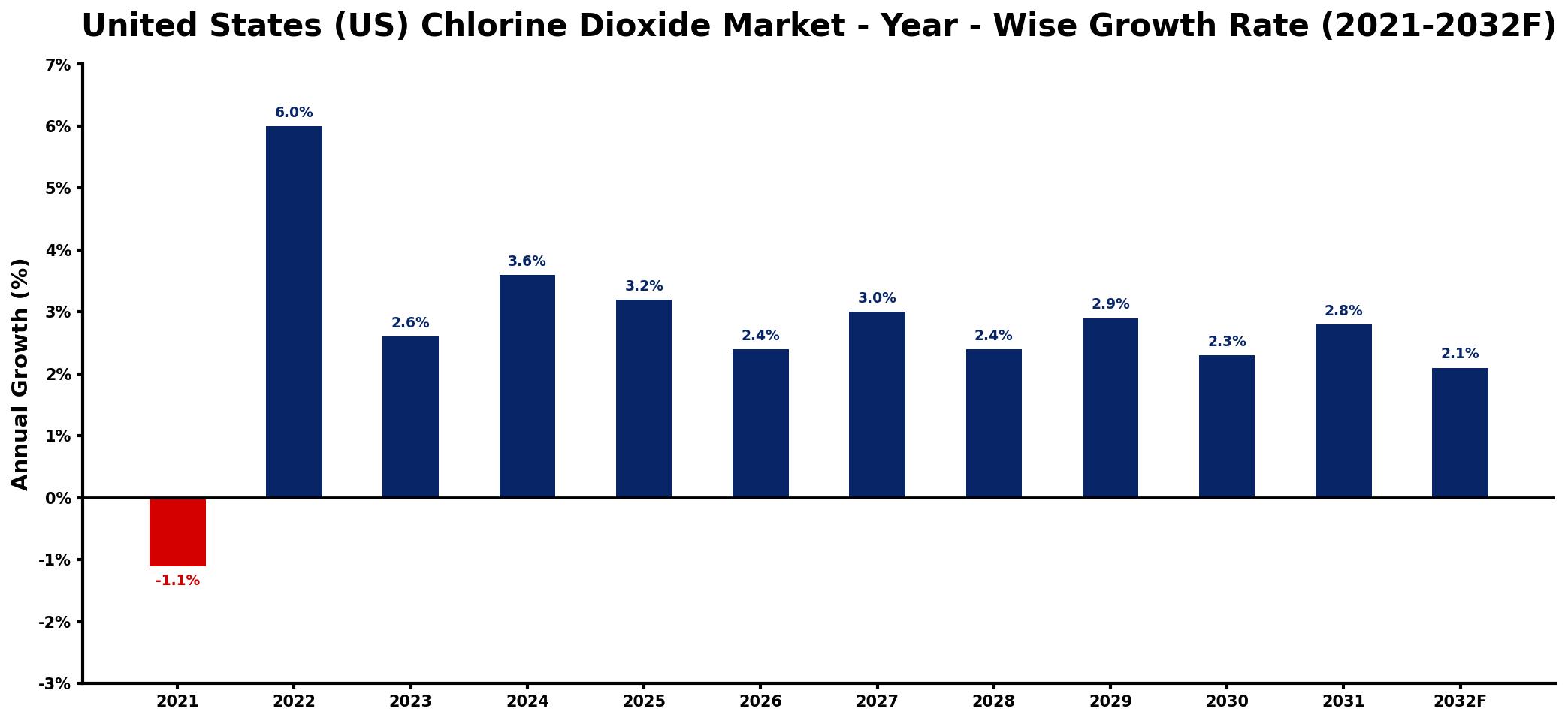
The table below presents the year‑wise growth rates along with the key drivers influencing the market
| Year | Growth Rate | Major Drivers |
| 2021 | -1.1% | decreased industrial water treatment demand |
| 2022 | 6.0% | increased focus on safety protocols |
| 2023 | 2.6% | growth in environmental regulations |
| 2024 | 3.6% | expansion of wastewater treatment facilities |
| 2025 | 3.2% | rising investment in sanitation technologies |
| 2026 | 2.4% | improved raw material availability |
| 2027 | 3.0% | increased adoption in healthcare facilities |
| 2028 | 2.4% | expanding residential water purification market |
| 2029 | 2.9% | growing awareness of waterborne pathogens |
| 2030 | 2.3% | increased demand for industrial disinfection |
| 2031 | 2.8% | growing regional consumption patterns |
| 2032 | 2.1% | growing emphasis on sustainability practices |
Note: Market size estimations and growth projections presented in this report are based on 6Wresearch's proprietary forecasting methodology, utilizing the latest available industry data, government publications, and primary research inputs.
United States (US) Chlorine Dioxide Market Synopsis
Currently, the most significant force shaping the United States (US) Chlorine Dioxide Market is the critical demand for enhanced water treatment solutions. As public and industrial entities intensify their focus on water quality, chlorine dioxide's role as a powerful disinfectant has come to the forefront, addressing both safety and regulatory requirements.
Moreover, the healthcare industry's reliance on chlorine dioxide for sterilization and disinfection applications underscores its versatility. As concerns about pathogens and environmental impacts mount, industries are increasingly turning to chlorine dioxide as a safer, effective alternative to traditional disinfectants, further boosting market growth.
United States (US) Chlorine Dioxide Market Key Takeaways
- Chlorine dioxide is vital in multiple industries, including water treatment and healthcare, due to its efficacy as a disinfectant.
- Regulatory frameworks are increasingly influencing chlorine dioxide usage, promoting safe handling and environmental compliance.
- Technological advancements are enhancing the efficiency and safety of chlorine dioxide applications.
- The shift towards sustainable solutions is accelerating the adoption of chlorine dioxide over traditional chlorine-based products.
- Investment opportunities are emerging in manufacturing and R&D, driven by rising demand across various sectors.
Evaluation of Restraints in United States (US) Chlorine Dioxide Market
Despite its favorable applications, the United States (US) Chlorine Dioxide Market faces significant restraints. Stringent environmental regulations pose challenges to manufacturers, as compliance can be costly and complex. The perception of chlorine dioxide as a potentially hazardous chemical also creates hesitance among certain consumer segments, affecting its market penetration. Furthermore, high production costs and raw material limitations can impede growth. To navigate these constraints effectively, stakeholders must prioritize innovation and foster strategic collaborations.
United States (US) Chlorine Dioxide Market Trends
The current trends in the United States (US) Chlorine Dioxide Market highlight an increasing shift towards eco-friendly solutions. Industries are prioritizing chlorine dioxide as an alternative to traditional chlorine due to its lower environmental footprint and enhanced safety profile. Furthermore, there is a noticeable surge in R&D investments aimed at developing novel applications and improving the overall effectiveness of chlorine dioxide products. These trends reflect a broader commitment across sectors to adopt safer, more sustainable practices.
United States (US) Chlorine Dioxide Market Opportunities
The United States (US) Chlorine Dioxide Market offers substantial investment opportunities, particularly in water treatment and healthcare. As demand for clean and safe water continues to rise, there are clear avenues for investment in disinfection technologies. The pulp and paper industry's ongoing reliance on chlorine dioxide for bleaching processes also presents a lucrative opportunity. Moreover, potential partnerships with manufacturers and investment in innovative applications could greatly enhance market growth, positioning stakeholders favorably in this expanding landscape.
Government Initiatives in the United States (US) Chlorine Dioxide Market
Government policies play a pivotal role in shaping the United States (US) Chlorine Dioxide Market. Regulatory bodies such as the EPA and OSHA enforce stringent guidelines to ensure public safety and environmental protection. These regulations dictate permissible levels of chlorine dioxide in water treatment and require safe handling practices in industrial settings. Additionally, public investment in water quality improvement initiatives highlights the governments commitment to enhancing public health, which further stimulates market demand.
Future Insights of the United States (US) Chlorine Dioxide Market
The United States (US) Chlorine Dioxide Market is expected to witness continued growth from 2026 to 2032, driven by the escalating demand for effective water treatment solutions and stringent regulations regarding water safety. The market will likely see an increase in adoption as industries recognize the advantages of chlorine dioxide over traditional alternatives. Innovations in production methods and applications are anticipated, paving the way for enhanced operational efficiencies and broader acceptance of chlorine dioxide across sectors.
United States (US) Chlorine Dioxide Market Latest Developments (2025 - 2026)
In the recent period, the United States (US) Chlorine Dioxide Market has seen a marked focus on innovation, with several companies investing in the development of more efficient chlorine dioxide production technologies. There is also a growing trend towards integrating chlorine dioxide in multi-functional applications, especially in healthcare settings. Furthermore, regulatory discussions are evolving, indicating potential adjustments in guidelines that could affect market dynamics in the near future.
United States (US) Chlorine Dioxide Market - Key Attractiveness of the Report
- 10 Years of Market Numbers
- Historical Data Starting from 2022 to 2025
- Base Year: 2025
- Forecast Data until 2032
- Key Performance Indicators Impacting the Market
- Major Upcoming Developments and Projects
Key Highlights of the Report:
- United States (US) Chlorine Dioxide Market Outlook
- Market Size of United States (US) Chlorine Dioxide Market, 2025
- Forecast of United States (US) Chlorine Dioxide Market, 2032
- Historical Data and Forecast of United States (US) Chlorine Dioxide Revenues & Volume for the Period 2022-2032F
- United States (US) Chlorine Dioxide Market Trend Evolution
- United States (US) Chlorine Dioxide Market Drivers and Challenges
- United States (US) Chlorine Dioxide Price Trends
- United States (US) Chlorine Dioxide Porter's Five Forces
- United States (US) Chlorine Dioxide Industry Life Cycle
- Historical Data and Forecast of United States (US) Chlorine Dioxide Market Revenues & Volume By Application for the Period 2022-2032F
- Historical Data and Forecast of United States (US) Chlorine Dioxide Market Revenues & Volume By Industrial Water Treatment for the Period 2022-2032F
- Historical Data and Forecast of United States (US) Chlorine Dioxide Market Revenues & Volume By Pulp & Paper Processing for the Period 2022-2032F
- Historical Data and Forecast of United States (US) Chlorine Dioxide Market Revenues & Volume By Oil & Gas for the Period 2022-2032F
- Historical Data and Forecast of United States (US) Chlorine Dioxide Market Revenues & Volume By Medical for the Period 2022-2032F
- Historical Data and Forecast of United States (US) Chlorine Dioxide Market Revenues & Volume By Food & Beverages for the Period 2022-2032F
- Historical Data and Forecast of United States (US) Chlorine Dioxide Market Revenues & Volume By Others for the Period 2022-2032F
- United States (US) Chlorine Dioxide Import Export Trade Statistics
- Market Opportunity Assessment By Application
- United States (US) Chlorine Dioxide Top Companies Market Share
- United States (US) Chlorine Dioxide Competitive Benchmarking By Technical and Operational Parameters
- United States (US) Chlorine Dioxide Company Profiles
- United States (US) Chlorine Dioxide Key Strategic Recommendations






































